
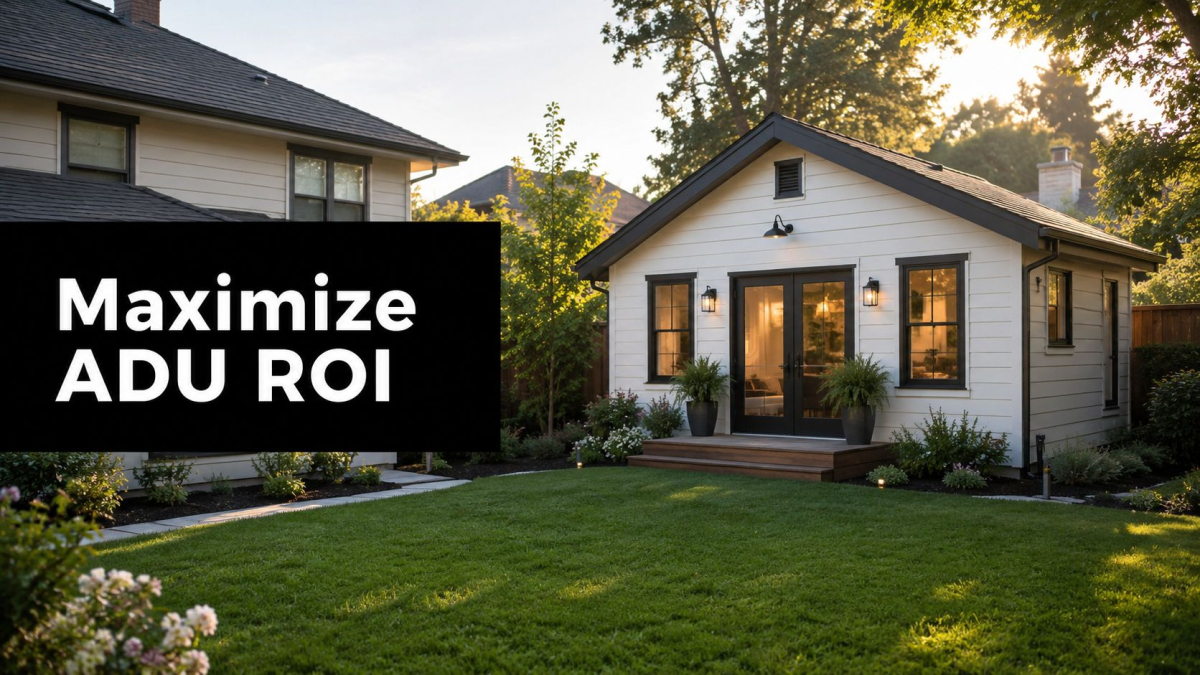
A lot of Fresno and Clovis homeowners are sitting on an asset they haven't fully priced correctly. They own a house with yard space, a detached garage, or enough lot depth to add a small second unit, but they still think about that space as storage, landscaping, or “maybe someday” square footage. In practice, that unused area can become an income stream, a financing lever, and a resale advantage if the numbers work.
That's the part most ADU articles skip. They jump from “build a unit” straight to “collect rent,” as if the middle doesn't matter. In Central California, the middle is everything. Rent has to be realistic. Permits have to be right. Tax treatment can help you or hurt you. And your return usually comes from steady performance, not the kind of coastal appreciation hype that gets repeated in generic California content.
A homeowner in Fresno often starts with the same questions. Is the rent high enough to justify the build? Will the property appraise better later? What happens if a lender reviews the income? What if family uses the unit part of the year? Those are the questions that decide whether ADU rental income becomes a smart move or an expensive distraction.
For anyone watching local inventory, affordability pressure, and neighborhood turnover, Fresno housing trends already show why flexible housing matters. An ADU can serve that demand, but only if you underwrite it conservatively and manage it like a business.
Your Home's Untapped Financial Potential
A backyard ADU isn't just a construction project. It's a way to turn part of your property into an operating asset.
In Fresno and Clovis, that matters because many owners aren't trying to become large investors. They're trying to make one good decision with the property they already have. Some want help covering a mortgage. Others want income before retirement. Some want a unit for family now and a rental later. The reason varies, but the financial question stays the same. Will this unit earn enough, long enough, to justify the cost and effort?
What owners usually get wrong
The biggest mistake is treating ADU rental income as one number pulled from an online listing. Real income depends on the unit's legal status, layout, privacy, parking situation, finish level, and the type of tenant the property can attract. A detached, permitted unit with a separate feel usually performs differently than a converted space that still feels attached to the main house.
A second mistake is focusing only on gross rent. Owners get excited about the monthly check and ignore turnover, repairs, leasing time, tax treatment, and management time. That's how a project that looks strong on paper starts underperforming in real life.
Practical rule: If your ADU plan only works with optimistic rent and no friction, the deal probably isn't tight enough yet.
What makes an ADU financially useful
When an ADU works, it usually does four things at once:
- Produces monthly income that can offset ownership costs.
- Improves flexibility because the unit can serve rental, family, or future resale goals.
- Creates a better finance story when the income is documented and supportable.
- Adds another layer of value beyond the main house alone.
That's why ADU rental income deserves to be analyzed like a small business line attached to your home. In Fresno, the winning approach isn't flashy. It's disciplined. Build legally, estimate rent like an appraiser would, and run the numbers on conservative assumptions before the first permit application goes in.
Understanding ADU Rental Income and Property Value
Hearing “ADU rental income” often leads to thinking only about the rent deposit. That's too narrow. A better way to think about it is this: you're adding a second earning component to the same parcel. Your lot stops being just a place where a house sits. It becomes a property with an additional revenue-producing use.

Rent is only one part of the value
That distinction matters because buyers, appraisers, and lenders don't only look at what the unit can rent for this month. They also look at whether the property has become more useful, more marketable, and more durable as an asset. A legal ADU can appeal to a buyer who wants rental help, multigenerational flexibility, or a separate work or living space.
California appraisal data makes that point clearly. The FHFA review of California properties with ADUs found that the median appraised value for single-family properties with ADUs rose from $550,000 in 2013 to $1,064,000 in 2023, while comparable properties without ADUs increased from $405,000 to $715,000 over the same period. That doesn't mean every ADU creates the same premium, but it does show that ADUs are being recognized in major mortgage-backed valuation data as more than a side feature.
Why lenders take ADUs seriously
Mainstream lending also treats ADU rent as real income, but underwrites it conservatively. Fannie Mae allows rental income from an existing ADU on a one-unit principal residence to be counted for qualifying, yet lenders typically use 75% of gross monthly market rent and cap qualifying ADU income at 30% of total qualifying income under that framework, as shown in the Fannie Mae rental income guidance. In plain terms, the market treats ADU rent as useful and documentable, but not risk-free.
That's a healthy mindset for owners too.
Think of an ADU as a small engine added to the property. If it's permitted, rented well, and supported by local market evidence, it can move the whole asset forward. If it's informal or poorly planned, it creates drag instead.
What this means in Fresno and Clovis
In Central California, that framework matters more than generic “ADUs add value” advice. The property has to function in the actual market. A clean detached unit in a strong Fresno or Clovis location may improve marketability because it solves a practical problem for future buyers. A cramped or unpermitted unit may do the opposite.
Owners who make money with ADUs usually understand this early. They don't ask only, “What can I charge?” They ask, “What kind of property am I creating, and will the market respect it later?”
How to Accurately Estimate Your ADU Rent
If you want a rent estimate that holds up, don't start with broad neighborhood averages. Start with comparables that look like your actual unit.

Use the same logic an appraiser would use
Freddie Mac's standard is a useful benchmark because it forces discipline. For lender-supported income, Freddie Mac requires an appraisal backed by at least three comparable rentals, with at least one comparable rental that includes a rented ADU, and the unit must be legally permitted. Income from an illegal ADU isn't eligible, according to the Freddie Mac ADU fact sheet.
That tells you exactly how to estimate rent the right way in Fresno or Clovis. Don't build your pro forma on generic apartment rents or on a detached guesthouse in a completely different neighborhood. Build it on the closest legal equivalents you can find.
What to compare locally
When I look at ADU rent potential in Central California, I want the comparison set to match the unit in practical ways, not just on paper.
Focus on:
- Location fit. Compare Fresno to Fresno, Clovis to Clovis, and keep school area, commute access, and neighborhood condition in mind.
- Unit type. Detached ADUs should be compared to detached backyard units when possible, not just duplex units or apartment listings.
- Functional size. Finished square footage matters, but so do room count and bath count.
- Privacy and access. Separate entrance, parking, yard use, and distance from the main home all influence rentability.
- Finish level. New kitchens, in-unit laundry, HVAC, and quality flooring change market positioning.
A quick estimate can start with a local tool like this fair market rent calculator, but that's only the first pass. It helps frame the neighborhood range. It shouldn't replace comp work.
A practical way to build your own rent range
Here's the process I'd use before finalizing any ADU income assumption:
- Pull several current listings for units in Fresno or Clovis that are as close as possible in layout and feel.
- Separate true ADU comps from non-ADU rentals. If a listing is really a small house or part of a duplex, note that difference.
- Adjust for unit quality. A newly built detached ADU can justify a different position than an older converted room over a garage.
- Discount your first draft. If the highest listing in your sample is the one making your deal work, your estimate is too aggressive.
- Test the leasing story. Ask whether the unit will attract a stable long-term tenant at that number, not just clicks online.
The strongest rent estimate is one you can defend to a lender, an appraiser, and a cautious buyer. If all three would challenge it, lower it.
What doesn't work
Owners get into trouble when they use one premium listing as proof of market rent. They also get into trouble when they compare their planned ADU to a fully independent small home with better parking, a larger yard, or a superior neighborhood.
A Fresno ADU usually performs best when priced to lease cleanly and keep a qualified tenant. Vacancy and turnover are what ruin projections. A slightly lower but reliable rent often beats an ambitious asking price that leaves the unit sitting.
Calculating Your Real ADU Return on Investment
Central California ADU math usually works best when you underwrite for stable cash flow first and treat appreciation as a secondary benefit. That's different from the way many coastal articles frame the decision.
According to the research facts provided for this topic, ADUs in coastal markets might see 8-10% annual appreciation, while Central California markets like Fresno tend to show a steadier 4-5% appreciation. The same research also notes that homes with ADUs in the Central Valley sell about 12% faster and at 7% higher prices than non-ADU comps. The practical takeaway isn't that Fresno is weaker. It's that the local case for an ADU is usually consistency, not speculation.
How I'd model an ADU in Fresno
Construction cost is the first variable, and it moves based on site work, utility runs, foundation conditions, finishes, and whether you build detached or convert existing space. If you're comparing methods and timelines, a current 2026 prefab ADU estimate can help you benchmark one branch of the cost discussion before you request local bids.
After that, the useful exercise is to build a simple owner-level model.
| Metric | Example Value |
|---|---|
| Sample ADU ROI Calculation (Fresno, CA) | Conservative local underwriting model |
| Project cost | Use your actual builder, permit, and utility bids |
| Gross rental income | Use a Fresno or Clovis comp-based estimate |
| Vacancy and turnover | Include a reserve rather than assuming perfect occupancy |
| Repairs and maintenance | Budget ongoing ownership costs |
| Insurance and taxes | Confirm with your insurer and tax professional |
| Management or leasing cost | Include if you won't self-manage |
| Net operating income | Gross income minus operating expenses |
| Cash flow after financing | NOI minus debt service if financed |
| Resale benefit | Consider separately from monthly cash flow |
Where owners misread the return
Three problems show up often.
- They use gross rent as if it were net income. It isn't. A unit that rents well still needs reserves.
- They count appreciation as guaranteed. In Fresno, the deal should stand on operating performance.
- They skip management time as a cost. Even if you self-manage, your time has value.
A cleaner decision framework is to ask:
- Would the ADU still make sense if rent comes in at the middle of the local range?
- Would the property still cash flow if you hit routine repairs and normal tenant turnover?
- Would you still want the unit if resale timing changed?
A Fresno ADU is usually strongest when the owner wants dependable monthly income, better property flexibility, and a clearer long-term hold strategy.
What a healthy local mindset looks like
The best ADU investors in this market don't chase the biggest theoretical return. They build for a unit that leases predictably, is easy to maintain, and broadens the buyer pool later. That's why some smaller, simpler designs outperform more expensive plans. Fewer things break. More tenants fit the rent target. The project is easier to explain to appraisers, lenders, and future buyers.
If your numbers only look good when everything goes exactly right, keep refining the plan.
Navigating Permits Legalities and Tax Rules
Permits and taxes are where a profitable ADU can subtly turn into a problem. This is not paperwork for paperwork's sake. Compliance is what protects the rent, the financing use, and the future sale.

Legal status affects income usability
An unpermitted unit may still seem rentable in the short run, but that's not the standard that matters. What matters is whether the unit is legal, documented, and usable in the ways that support value. If the unit isn't permitted correctly, you can run into trouble with leasing, insurance, appraisal treatment, and financing assumptions.
In real practice, “it's livable” and “it's lender-usable” are not the same thing.
The tax rule many owners miss
The tax side gets overlooked even more. Many owners know rental income is taxable and that expenses may be deductible. Fewer understand how personal use can change the whole picture.
Based on the IRS analysis provided in the verified data for this article, the IRS can reclassify an ADU as a vacation home if the owner uses it for more than 14 days annually, and that can severely limit the ability to deduct rental losses. The same verified analysis notes that the depreciation deduction on a $300,000 ADU could be over $10,000 annually, but that benefit can be lost if personal use is too high under the relevant IRS framework.
That issue shows up more often than people expect in Fresno. Owners say the unit is a rental, but then a family member uses it for stretches of time, or the owner keeps it for storage, guest stays, or occasional personal occupancy. What felt informal to the owner can become very formal when tax treatment is reviewed.
Tax warning: If you want rental tax treatment, treat the ADU like a rental asset consistently. Casual personal use can undo planning that looked fine on a spreadsheet.
Where compliance usually breaks down
These are the problem areas I see most often:
- Mixed personal and rental use without clear records.
- Assuming depreciation applies cleanly even when the unit isn't used primarily as a rental.
- Relying on verbal guidance instead of written permit and tax advice.
- Using a family arrangement that doesn't match the owner's tax reporting position.
A safer operating approach
Owners usually protect themselves best when they do the following early:
- Confirm the ADU is permitted and documented correctly.
- Decide whether the unit is for long-term rental, family use, or a staged transition between the two.
- Keep records that match that decision.
- Review depreciation and personal-use implications with a qualified tax professional before the first lease starts.
The tax side can work in your favor, but only if the use pattern supports it. If you blur the line between investment property and personal convenience, you risk losing deductions you were counting on.
That's why I tell owners to think of compliance as part of the return. It protects the income stream, the valuation story, and the tax position. Without that foundation, the rest of the ADU model gets shaky fast.
Professional Management to Maximize Your ADU Income
Once the unit is built and leased, the question changes. It's no longer “Can this ADU produce income?” It becomes “Who's going to protect that income month after month?”

A small rental still creates real operational work. Someone has to market the vacancy, respond to inquiries, show the property, screen applicants, draft the lease, collect rent, document the move-in condition, coordinate repairs, handle renewals, and deal with problems when timing is inconvenient. That workload doesn't disappear because the unit is behind your own house.
Two ways owners usually handle it
Some owners want fully passive income. Others are comfortable with day-to-day decisions but don't want to handle leasing and screening.
That's where management structure matters more than generic advice about “getting help.” If you're comparing models, this overview of what property management includes is a good baseline for separating leasing tasks from ongoing operations.
- Full-service monthly management fits owners who want rent collection, repair coordination, tenant communication, lease renewals, move-in and move-out coordination, and accounting handled consistently.
- Placement-only service fits owners who want help with marketing, applicant screening, lease preparation, and move-in coordination, but plan to manage the property after the tenant is placed.
Edinhart Realty and Property Management offers both of those service models in the Fresno region, which makes it relevant for ADU owners who aren't looking for the same level of involvement.
Why management affects profitability
Poor management doesn't only create stress. It can reduce income in quieter ways. Weak screening can lead to avoidable turnover. Slow maintenance response can push out good tenants. Incomplete lease paperwork can create disputes later. Overpricing a vacancy can leave the unit idle. Underpricing it can lock in weaker returns for a full lease term.
That's why an ADU often performs best when the owner chooses a management approach before the build is even finished. You want the leasing plan, rental standard, and tenant profile lined up before the certificate of occupancy turns into a vacancy clock.
A short video can help frame that landlord-to-manager shift:
What works better in practice
For most Fresno and Clovis ADUs, long-term success comes from boring discipline. Price the unit well. Screen carefully. Use clear lease documents. Handle repairs promptly. Keep records clean. Renew strong tenants when it makes sense.
A well-managed ADU feels passive to the owner because the systems are active in the background.
That's the primary management goal. Not zero work in theory. Predictable income with fewer preventable mistakes.
Is an ADU the Right Investment for You
An ADU makes sense when the property can support a legal, rentable unit and the owner wants dependable income more than a speculative win. In Fresno and Clovis, the best projects usually come from conservative rent assumptions, a realistic build budget, clear tax planning, and a management plan that fits the owner's time and risk tolerance.
If you're looking at your lot and wondering whether the numbers work, don't start with the dream version. Start with the disciplined version. That's the one that usually holds up.
If you own property in Fresno, Clovis, Friant, or nearby Central California communities and want a realistic opinion on ADU rental income, Edinhart Realty and Property Management can help you evaluate the rental side of the decision, the likely management workload, and how the unit may fit your broader property goals.


