

A Fresno landlord can start the morning answering a tenant's message about a leaking faucet, spend lunch chasing rent, and lose the afternoon coordinating a contractor who can't arrive until next week. An investor living outside California faces the same decisions without being nearby, while an owner adding more properties may discover that a manageable side investment has become an unpaid operations job.
The right arrangement depends on available time, risk tolerance, property count, location, and desired involvement. Full-service monthly management can take over rent collection, tenant communication, maintenance coordination, renewals, inspections, and accounting. Placement-only service can handle marketing, applicant screening, and lease preparation while the owner keeps daily control.
The fee shouldn't be compared with zero in isolation. Compare it with lost rent, make-ready work, emergency coordination, compliance mistakes, administrative time, and the opportunity cost of staying tied to one property. The following eight benefits focus on those operating decisions in Fresno, Clovis, Friant, and the wider Central California market.
1. Time Savings and Reduced Administrative Burden
Rental ownership creates recurring work even during a quiet week. Rent tracking, tenant questions, repair scheduling, move-in and move-out coordination, renewals, notices, and financial records all require follow-through. A full-service manager assigns these tasks to a defined process and point of contact, while the owner retains approval over spending and other key decisions.
For an out-of-state investor with a Fresno rental, local coordination has direct operating value. A tenant may need access for a repair, a contractor may need approval, and a vacant home may require a showing before the owner can reach California. Full-service management handles those details locally while the owner reviews statements and authorizes exceptions. Recepta.ai for property teams can also support the communication workload when prompt responses matter.
Practical rule: Outsource recurring interruptions, not only dramatic emergencies.
Technology reduces repetitive administration, but it does not replace judgment. Automated rent collection can limit manual payment tracking, and owner statements preserve visibility without requiring the owner to process every transaction. Edinhart's automation in property management resources describe how systems can handle routine tasks while human oversight addresses unusual situations.
The right model depends on the owner's available time and operating capacity. An owner with two homes may manage communication personally, but additional units create overlapping leases, maintenance requests, and payment records. Placement-only service can fill a vacancy through marketing, applications, and lease preparation, while the owner remains responsible for daily communication afterward. Full-service management is better suited to an owner who wants that continuing workload assigned to a local team.
Time saved has an economic value. It can support another acquisition, a separate business, or prevent evenings and weekends from becoming landlord shifts. Before signing, request monthly statements, written approval thresholds, and a precise description of what the management fee includes. Compare that fee with the value of your time, the cost of delayed decisions, and the risk of missed administrative work.

2. Professional Tenant Screening and Quality Tenant Acquisition
A fast lease isn't automatically a good lease. The applicant who responds first may not be the applicant best positioned to pay consistently, follow the agreement, and care for a Fresno or Clovis property.
Professional screening creates a repeatable process around rental history, income, credit information, background information, and application documentation. Consistency matters because owners should evaluate applicants against the same lawful criteria rather than changing standards under vacancy pressure. A manager can also coordinate questions, document decisions, and help reduce the risk of informal comments that create fair-housing concerns.
Owners who prefer to stay involved can use a placement-only model. The manager markets the home, processes applications, recommends qualified applicants, and prepares the lease, while the owner retains responsibility for rent collection, maintenance, and resident communication after placement. That model can work well for a nearby landlord with reliable contractors and enough time to respond.
A full-service arrangement makes more sense when the owner wants the screening process connected to ongoing operations. The same team can coordinate move-in documentation, explain lease requirements, track payment behavior, handle renewal discussions, and respond when a resident reports a problem. The benefit isn't just finding someone to sign. It's building a documented resident relationship from application through renewal.
Use a written screening standard and review the manager's process before hiring:
- Ask about verification: Confirm how income, employment, rental references, credit information, and application identity are reviewed.
- Review consistency: Make sure the company applies documented criteria to every applicant and understands fair-housing requirements.
- Clarify approval authority: Decide whether the owner receives a recommendation or makes the final selection.
- Inspect the lease process: Read the lease form and confirm how deposits, notices, utilities, and maintenance duties are stated.
Edinhart's tenant screening checklist can help owners understand which documents and decisions should be addressed before approving an applicant. Strict screening may lengthen the process when a weak application is rejected, but that delay is usually preferable to choosing a tenant solely because the property is empty.
3. Maximized Rental Income and Competitive Market Pricing
Pricing a Fresno rental is an operating decision, not a one-time guess. A rent that sits far above comparable homes can extend vacancy, while a rent set below the market can leave income on the table throughout the lease term.
A property manager can compare nearby listings, evaluate condition and amenities, monitor competing availability, and consider how the property fits the tenant pool in its neighborhood. A home near major employment, schools, transit, or services may compete differently from a similar-looking property in another part of Central California. The manager's job is to balance monthly rent with leasing speed and tenant quality.
That balance matters during renewal as well. A rent increase should reflect the home's condition, local competition, resident history, and the cost of replacing a good tenant. Raising rent without considering turnover can produce a higher asking price but a weaker annual result. Holding rent too low can create a smooth renewal while reducing the property's earning capacity.
Pricing should answer two questions at once: what will the market pay, and what rent produces the best annual operating result after vacancy and turnover?
Owners should expect a manager to explain the reasoning behind a recommended rate, not merely provide a number. Ask for comparable listings, a plan for adjusting the price if showings are weak, and a renewal timeline. The owner should also understand whether rent increases are included in the monthly service or charged separately.
Edinhart's rental pricing strategy is relevant for owners deciding whether to outsource pricing entirely or use professional guidance while retaining approval authority. Placement-only service can provide an initial market position for a new listing. Full-service management can continue reviewing pricing at renewal and during changing local conditions.
The financial test is straightforward. Compare the management fee with the rent that would otherwise be missed through underpricing, the cost of extended vacancy, and the value of better renewal decisions. Don't assume the highest advertised rent is the best result. The strongest price is the one supported by the home's presentation, condition, location, and likely tenant demand.
4. Professional Property Marketing and High-Quality Presentation
A Fresno rental can lose qualified applicants before anyone schedules a showing. Dark photos, vague descriptions, missing lease terms, or slow replies make a well-kept home appear harder to rent. Professional marketing presents the property accurately, answers common questions early, and reduces wasted inquiries.
The listing should show the home clearly, describe its condition without exaggeration, state key lease terms, explain showing instructions, and highlight features relevant to Central California renters. Overpromising may increase initial inquiries, but disappointed prospects can leave poor feedback and consume showing time without improving the final applicant pool.
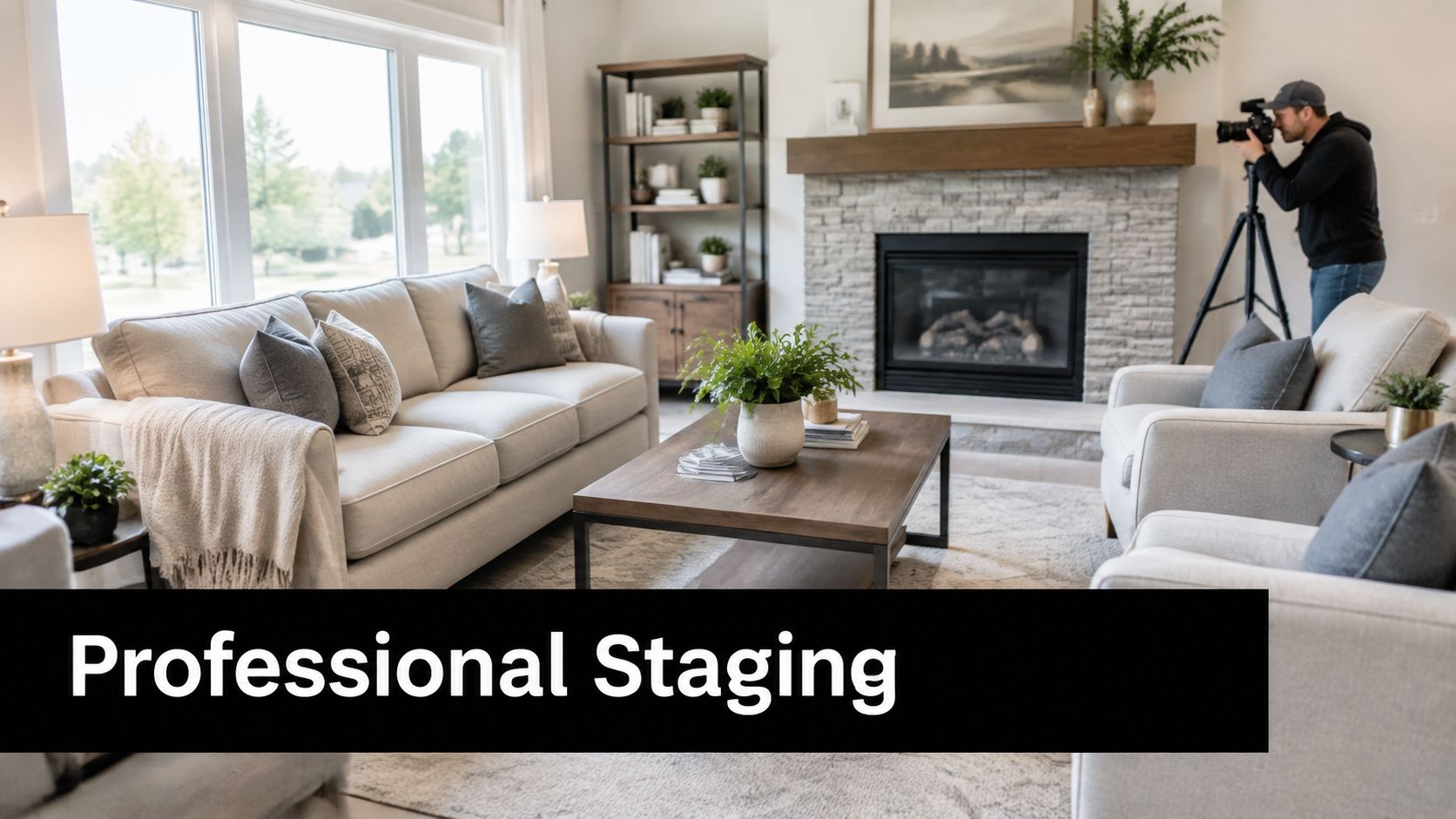
Owners can choose placement-only service for photography, listing distribution, online applications, screening, recommendations, and lease drafting while retaining responsibility after move-in. That model may suit an experienced local landlord with reliable vendors who wants help during the vacancy and leasing period. The trade-off is that the owner still handles resident communication, maintenance, and future turnover.
Full-service management connects preparation with leasing and move-in. A company can coordinate cleaning and touch-ups, publish the listing, arrange showings, answer questions, process applications, and transfer the approved resident into the home. Fewer handoffs can reduce delays, especially for an owner managing a property from outside Fresno.
A marketing review should cover:
- Photography standards: Ask who takes the photographs, when images are refreshed, and whether the owner receives copies. For owners comparing editing options, VideoTour.ai compares photo editors.
- Distribution channels: Confirm where the listing appears, how quickly inquiries receive replies, and whether advertising costs are separate.
- Showing process: Learn who conducts showings, how access is arranged, and how attendance is recorded.
- Property readiness: Establish who coordinates cleaning, touch-ups, landscaping, and safety checks before publication.
Virtual tours can help remote investors and relocating residents evaluate a home before traveling. A short walkthrough may answer routine questions, but it cannot replace in-person access when condition, layout, or neighborhood fit affects the decision.
To assess the fee, compare it with vacancy days, repeated showing time, poor applicant fit, and the owner's cost of producing the marketing personally. Professional presentation earns its cost when it helps the right applicant understand the home and complete the leasing process without avoidable delays.
5. Maintenance Coordination and Property Preservation
Maintenance is where distance and inexperience become expensive. A tenant's report of a small plumbing issue may require diagnosis, access coordination, a qualified vendor, owner approval, and documentation. If nobody owns that sequence, the tenant waits and the underlying problem may grow.
A property manager gives maintenance requests a defined path. The team can determine whether an issue is routine or urgent, communicate with the resident, dispatch a vendor, review the completed work, and record invoices and photographs. That record supports future budgeting, warranty conversations, insurance documentation, and decisions about whether to repair or replace.
Preventive care deserves the same attention as emergency response. HVAC servicing, filter changes, roof checks, plumbing inspections, and seasonal property reviews can identify problems before they affect habitability or cause broader damage. For a Fresno property exposed to intense summer heat, reliable heating and cooling service is part of resident comfort and asset preservation, not an optional extra.
A maintenance policy should define response standards, owner approval limits, vendor selection, and after-hours escalation before the first emergency occurs.
Local vendor relationships can help a Central California manager coordinate work more efficiently than an owner starting from scratch. That doesn't mean every recommendation should be accepted without review. Owners should ask how vendors are selected, whether bids are obtained for larger work, how markups are disclosed, and how the company handles conflicts of interest.
Full-service management is strongest when the owner doesn't want to coordinate repairs or be available for emergencies. Placement-only service leaves those responsibilities with the owner, so it works only when the owner has dependable contractors and a clear after-hours plan.
Request maintenance histories with monthly statements and review recurring costs. A pattern of repeated repairs may indicate an aging system, a tenant-use issue, or a need for a capital improvement. Good coordination addresses today's request while helping the owner make a better long-term property decision.

6. Legal Compliance and Risk Management
California rental ownership carries legal responsibilities that don't disappear when an owner is busy, remote, or managing only one home. Lease terms, notices, security deposits, habitability, fair-housing practices, accessibility, and eviction procedures all require careful handling.
A professional manager can provide standardized forms, written communication, recordkeeping, and a consistent process for enforcement. That structure helps prevent an owner from improvising a notice, making an inconsistent accommodation, or mishandling a deposit. It also creates a clearer file if a dispute later requires review.
The manager should not be treated as a substitute for legal counsel. Ask how the company tracks regulatory changes, when it refers matters to an attorney, and who approves a legal action. A responsible process distinguishes routine property operations from issues that require professional legal advice.
For a Fresno or Clovis owner, compliance should be evaluated at the service-design stage:
- Lease documentation: Confirm which California forms and addenda the company uses and how updates are managed.
- Notice procedures: Ask who prepares, delivers, and records notices, including notices related to rent, access, or lease violations.
- Deposit handling: Review the company's process for accounting, deductions, timelines, and supporting documentation.
- Fair-housing controls: Confirm that advertising, screening, accommodations, and communication follow consistent standards.
- Records and insurance: Establish what documents are retained and verify that the owner's insurance matches the property's use.
Full-service management can reduce the owner's exposure to procedural mistakes because the manager handles ongoing communication and enforcement. Placement-only service can still improve the initial lease process, but the owner remains responsible for compliance after the resident moves in.
The value is difficult to measure in a calm month. It becomes clearer when a dispute, emergency, or nonpayment issue requires accurate records and timely action. Don't select a manager based only on a promise to “handle legal matters.” Request a written explanation of responsibilities, exclusions, escalation procedures, and attorney involvement.
7. Access to Real Estate Services and Property Improvement Guidance
Property management decisions often reveal larger investment questions. A recurring repair may point to an outdated system. A home that struggles to lease may need better presentation, a different layout, or a more careful assessment of its target resident. A planned sale may require improvements that differ from those justified by rental income.
A company with real estate, staging, photography, and design capabilities can connect daily operating information with those larger choices. The manager sees resident feedback, maintenance patterns, showing reactions, and renewal behavior. That operating perspective can help an owner decide whether to repair, upgrade, refinance, sell, or hold, although major financial and legal decisions still deserve independent professional review.
The practical question isn't whether every renovation increases value. It's whether the proposed work improves the property's position enough to justify its cost, disruption, and maintenance obligations. Durable flooring may make sense in a high-traffic rental. A costly finish may look attractive but fail to produce a rent increase that supports the investment.
For a Central California owner, improvements should match local demand and the home's likely resident profile. A family-oriented property may benefit from functional storage, durable surfaces, and reliable appliances. A smaller home may gain more from cleanliness, lighting, and efficient use of space than from a luxury remodel.
Ask for an improvement recommendation that separates required work, resident-facing upgrades, and optional cosmetic changes.
A full-service manager can help identify these opportunities during inspections, turnovers, renewals, and pricing reviews. Placement-only service may provide guidance at the leasing stage, but the owner will generally coordinate the work and make the operating decisions afterward.
Edinhart's combined real estate and property services include buying and selling assistance, valuation guidance, staging, photography, and strategic pricing. That integrated perspective can be useful when an owner is deciding whether to prepare a home for rent, improve it before sale, or reposition it for a different market segment.
8. Scalability and Portfolio Growth Support
One rental can be personal. A portfolio requires systems.
As an owner adds homes in Fresno, Clovis, Friant, or nearby communities, each property brings its own lease dates, resident questions, inspections, vendors, repairs, and financial records. The challenge isn't only the number of units. It's the overlap between tasks, especially when vacancies, renewals, and maintenance issues arrive at the same time.
Professional management gives the owner a repeatable operating layer. Standardized leasing, rent collection, communication, maintenance coordination, and reporting make it easier to compare properties and spot underperformance. The owner can remain involved in acquisition and strategy without personally becoming the dispatcher for every service request.
Full-service management is usually the more practical choice for an owner pursuing growth. Placement-only service may reduce leasing work, but daily management remains with the owner. That can work for a small, concentrated portfolio, yet it may become a bottleneck when properties are geographically dispersed or the owner is acquiring continuously.
Use portfolio reporting to ask better questions:
- Property performance: Which homes have recurring vacancy, maintenance, or collection problems?
- Resident operations: Where are communication or renewal processes inconsistent?
- Capital priorities: Which improvements protect the asset or improve marketability?
- Acquisition fit: Does a new property match the systems, neighborhoods, and resident profiles the team already handles well?
- Management economics: Do volume terms, reporting, and operational support improve as the portfolio expands?
Growth also requires reserves and approval rules. A manager can coordinate operations, but the owner still needs liquidity for repairs, vacancies, insurance, taxes, and acquisitions. Agree on spending limits, reporting frequency, and response expectations before purchasing additional properties.
The best scalability benefit isn't handling more doors. It's giving the owner reliable information and consistent execution, so portfolio growth doesn't depend on adding an equal amount of personal workload.
8-Point Comparison: Property Management Benefits
| Item | 🔄 Implementation Complexity | ⚡ Resource Requirements | 📊 Expected Outcomes | 💡 Ideal Use Cases | ⭐ Key Advantages |
|---|---|---|---|---|---|
| Time Savings and Reduced Administrative Burden | Low, established outsourced workflows 🔄 | Ongoing management fees; minimal owner time ⚡ | Reclaim ~200+ hrs/yr; consistent tenant handling, less stress 📊 | Busy professionals, out-of-state investors, multi-property owners 💡 | Scale portfolio without proportional time increase; 24/7 tenant handling ⭐ |
| Professional Tenant Screening and Quality Tenant Acquisition | Medium, multi-step screening process (checks, interviews) 🔄 | Background check tools, credit services, marketing spend ⚡ | Fewer evictions; higher on-time payments; reduced turnover 📊 | Landlords prioritizing tenant quality; income-focused investors 💡 | Improved tenant reliability; lower eviction/repair costs ⭐ |
| Maximized Rental Income and Competitive Market Pricing | Medium, data-driven pricing & market analysis 🔄 | Market data, pricing tools, analytics support ⚡ | Increase rent 5–15%; optimized occupancy and revenue 📊 | Owners seeking higher revenue; investors optimizing returns 💡 | Higher annual returns through optimized rates and timing ⭐ |
| Professional Property Marketing and High-Quality Presentation | Medium–High, photography, staging, multi-channel campaigns 🔄 | Photography, staging, ad spend, virtual tours ⚡ | Faster lease-ups; 25–50% reduced vacancy; more inquiries 📊 | Owners needing quick placement; sellers maximizing sale price 💡 | Premium presentation attracts qualified tenants; faster sales/rents ⭐ |
| Maintenance Coordination and Property Preservation | Medium, vendor networks and preventive scheduling 🔄 | Contractor relationships, maintenance budget, coordination ⚡ | Lower long-term repair costs; extended asset life; tenant satisfaction 📊 | Long-term investors; owners focused on preserving value 💡 | Preventive care reduces emergencies and preserves property value ⭐ |
| Legal Compliance and Risk Management | Medium–High, ongoing updates and proper procedures 🔄 | Legal expertise, compliant forms, record-keeping systems ⚡ | Reduced legal exposure; compliant evictions; fewer fines/claims 📊 | Owners in regulated markets (e.g., CA); multi-property portfolios 💡 | Liability protection; consistent compliance; documented procedures ⭐ |
| Access to Real Estate Services and Property Improvement Guidance | Medium, integrated advisory and project coordination 🔄 | Valuation/design experts, contractor bids, capital for improvements ⚡ | Higher property value; targeted ROI from renovations 📊 | Owners planning renovations; investors seeking integrated services 💡 | Data-driven improvement guidance; coordinated buying/selling with management ⭐ |
| Scalability and Portfolio Growth Support | Medium, standardized systems and centralized processes 🔄 | Centralized accounting, portfolio analytics, operational infrastructure ⚡ | Efficient growth to 10+ properties; lower per-property workload 📊 | Investors expanding holdings; groups aiming for passive scale-up 💡 | Multi-property discounts, repeatable systems, portfolio optimization ⭐ |
Choosing the Right Management Model for Your Properties
The best option depends on which responsibilities you want to retain. Full-service monthly management suits busy professionals, out-of-state investors, owners seeking hands-off operations, and growing portfolios. It also fits owners who can make strategic decisions but don't want to answer maintenance calls, chase payments, coordinate showings, or manage lease renewals.
Edinhart's full-service package includes rent collection, repair coordination, tenant communication, move-in and move-out coordination, lease renewals, and detailed accounting statements. For a remote owner with a Fresno rental, that package creates a local operating presence. For an owner adding properties, it provides consistent processes and reporting across the portfolio.
Placement-only service fits a different owner. Choose it when you can manage daily communication, maintenance, inspections, payment follow-up, and resident issues, but want professional help with property marketing, photography, applicant screening, qualified-applicant recommendations, and lease drafting. This model can reduce the most demanding part of a vacancy without transferring the entire operating relationship.
Fees deserve a complete comparison. Full-service management commonly runs 8% to 12% of monthly rent, according to 2026 property management fee benchmarks, and some firms add vacancy, setup, renewal, or maintenance charges. The same source says first-year costs can reach 18% to 20% of gross rent when extras are included. Review every charge, especially during a vacancy, because a fee structure can change the result.
Vacancy is a major part of that calculation. An All Property Management survey based on responses from 298 property management companies across 201 U.S. cities reported an average annual vacancy rate of 5.5% for professionally managed properties compared with 8.8% nationally. Another summary of the survey reported about 4.5% versus a national rate near 9%, so treat the historical figures as evidence of a potential operating advantage, not a promise for every Fresno property.
Run the decision through this checklist:
- Recovered time: What is your time worth, and how often do rental tasks interrupt work or family responsibilities?
- Avoided vacancy: How quickly can you market, show, screen, and place a tenant without professional support?
- Tenant selection: Do you have a consistent, documented screening process?
- Maintenance coordination: Can you respond locally, obtain qualified vendors, and document completed work?
- Compliance support: Can you manage California notices, deposits, records, and fair-housing requirements accurately?
- Portfolio economics: Will multi-property terms, standardized reporting, and shared systems improve operations as you grow?
- Service boundaries: Which tasks are included, and which create separate charges?
A useful KPI framework gives owners something concrete to monitor. Rental operator guidance commonly treats collection above 98% as a target and vacancy below 8% as healthy, while sustained vacancy above 10% can signal pricing, marketing, or property-quality problems, according to rental property KPI guidance. Compare your current results with the manager's reporting process, not just the advertised fee.
Tenant experience also belongs in the review. GRESB's 2026 tenant satisfaction assessment defines measurement through survey coverage and response rate, giving managers a way to track resident feedback rather than relying on informal impressions. Ask whether the company monitors maintenance, communication, and renewal friction through a structured process.
Edinhart Realty and Property Management offers both models for owners in Fresno and Central California. Compare the services, fees, approval procedures, reporting, and responsibilities at Edinhart before deciding whether you need full operational coverage or targeted leasing support.
Edinhart Realty and Property Management offers Full-Service Monthly Management for rent collection, repair coordination, tenant communication, move-in and move-out coordination, lease renewals, and accounting statements, along with Placement-Only Service for professional marketing, applicant screening, and lease drafting. Visit Edinhart Realty and Property Management to compare the model that best fits your property, time, and return goals in Fresno and Central California.


