

A landlord in Fresno can make a reasonable screening decision and still create a legal problem before the applicant ever receives the keys. The trouble usually starts with an inconsistent application form, an unclear fee receipt, a report pulled without the right authorization, or a denial communicated by text with no usable explanation. By the time the owner realizes what went wrong, the file may contain too little documentation to reconstruct the decision.
That's why tenant screening laws need to be treated as an operating procedure, not a quick background-check task. The federal rules establish the baseline, while California adds requirements around fees, reusable reports, source of income, criminal history, written criteria, application order, and refunds. A compliant process tells your staff what to publish, collect, review, record, and send at each stage.
Why Tenant Screening Has Become a Legal Process
A Central California landlord operating a duplex in Fresno recently pulled a background report, charged an applicant a screening fee, and sent a one-line message saying the application was denied. On the surface, it looked like an ordinary rental decision. A few weeks later, a demand letter arrived invoking the Fair Credit Reporting Act, followed by a state complaint alleging that the application fee had not been returned.
The problem wasn't necessarily the landlord's decision alone. The problem was the process around it. The owner had to answer basic questions: Was the report obtained for a permissible purpose? Did the applicant receive the required disclosure? What information caused the denial? Was the fee handled properly? Did the landlord send an adverse action notice identifying the reporting company and explaining the applicant's dispute rights?
The file matters as much as the decision
The Fair Credit Reporting Act, enacted in 1970, regulates the preparation and use of consumer reports, including tenant-screening reports, making it one of the foundational federal laws in this area (Consumer Financial Protection Bureau tenant background check market report). The same filing history points to a large and active market. A 2023 regulatory filing noted about 650 companies providing tenant screening reports, while a separate 2025 filing cited 8,369 FCRA filings, up 37.4% from 2024, with first-quarter 2026 filings running roughly 40% ahead of the prior year (same CFPB reference).
Those figures don't mean every landlord will face a claim. They do show why informal screening habits are risky. More vendors, more reports, and more regulatory attention create more opportunities for mismatched identities, incomplete records, and missing notices.
Practical rule: If another person reviewed your application file months later, the file should show the same criteria, the same evidence, and the same reason for the outcome.
Tenant screening laws now shape the application packet, fee receipt, consent language, decision order, denial letter, and retention system. The federal floor comes first, then California's operational rules add another layer rather than replacing federal obligations.
The Federal Floor Under Every Screening Decision
A compliant screening file starts before anyone orders a report. The FCRA governs consumer reports and the notices tied to them, while the Fair Housing Act governs whether the criteria and decision discriminate, including rules that appear neutral on their face.
Start before ordering the report
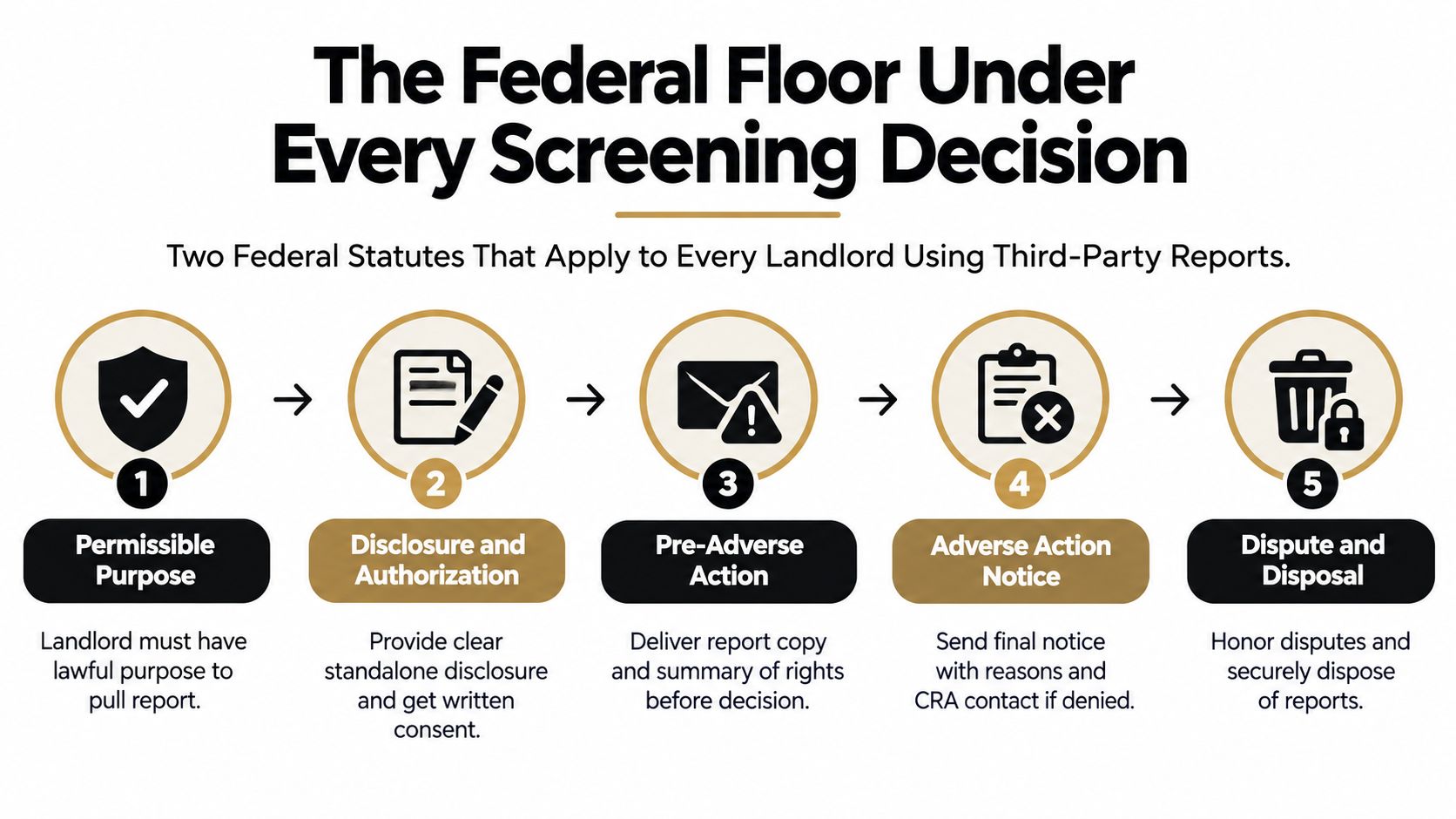
A landlord needs a documented permissible purpose to obtain a consumer report. The application should contain a clear, standalone disclosure and written authorization, rather than burying consent in unrelated lease language. The landlord also certifies to the consumer reporting agency that the report will be used for a permissible purpose and handled appropriately.
Confirm that the provider is a legitimate consumer reporting agency, then verify that the report belongs to the applicant. A name match alone does not resolve the risk of similar identifying information, mixed files, or incomplete records. Consumer-report disputes are tied to applicants' ability to correct credit information, so landlords can consult this credit repair legal rights guide for background on those dispute rights and their connection to screening decisions.
Use one written application and consent package for every applicant. These background check requirements provide a practical checklist for the records that should exist before a report is requested.
Treat a possible denial as a notice sequence
If report information may lead to a denial, a higher deposit, a co-signer requirement, or another unfavorable lease term, begin the pre-adverse-action process. Give the applicant the report and the applicable summary of rights. Allow a reasonable opportunity to identify errors, and review any dispute before making the final decision.
After final adverse action, the notice must identify the screening company, state that the company did not make the housing decision, describe the applicant's right to obtain a free report if requested within 60 days, and explain the right to dispute inaccurate information (CFPB guidance on rental application denials). State law and local ordinances may require additional language or procedures.
The Fair Housing Act prohibits discrimination based on protected characteristics, including race, color, national origin, religion, sex, familial status, and disability. A facially neutral rule can still create disparate-impact concerns if it excludes protected groups without a strong connection to legitimate housing risk. Keep the criteria consistent, document the reason for each outcome, and do not treat federal disclosures, authorizations, or notices as optional.
California Rules That Shape Day-to-Day Screening
A compliant screening decision starts before anyone orders a report. In California, the landlord must control the application workflow, disclose the screening terms, handle fees correctly, and apply the same written criteria to each applicant.
Fees, receipts, and reusable reports
Civil Code section 1950.6 sets a base application screening fee of $30 per applicant and provides for annual CPI adjustments beginning January 1, 1998. Because the permitted amount changes, verify the current cap through the statute or official state guidance before collecting money. Do not leave an outdated figure embedded in a paper form or online application.
The fee must correspond to screening services the landlord uses. Provide an itemized receipt and retain records showing when the application arrived, whether the unit was available, which services were ordered, and what the applicant paid. A vague “processing fee” description makes compliance reviews and refunds harder.
California also permits applicants to submit a reusable tenant screening report to participating landlords. If the landlord accepts that report, the landlord cannot charge a separate screening fee or report-access fee. The report is generally treated as valid for 30 days under the applicable guidance. State in the application packet whether reusable reports are accepted, what conditions apply, and what written notice the applicant will receive.
A practical rule follows: collect fees only after confirming the unit is available and the screening process is ready to run. If the landlord cannot use the fee for the stated screening purpose, preserve the records needed to support the required refund.
Source of income and sensitive information
California source-of-income protections cover lawful income sources, including housing subsidies. The 2019 expansion to federal, state, and local housing subsidies makes voucher-based discrimination unlawful. A landlord may still apply lawful, consistently written financial and tenancy criteria, but may not reject an applicant because rent is supported by a voucher or other housing assistance.
| Rule | What It Requires | Operational Impact |
|---|---|---|
| Screening fee cap | Charge no more than the current permitted amount and provide an itemized receipt | Verify the amount before collecting and preserve the receipt |
| Reusable screening report | Accept the report under applicable conditions without adding a separate report-access fee | State the policy in writing and record whether it was accepted |
| Source of income | Do not discriminate against lawful subsidies or other protected income sources | Apply the same financial criteria without treating assistance as a negative |
| Criminal-history limits | Do not seek or use prohibited criminal-history information in an adverse decision | Configure forms and vendor searches to prevent over-collection |
California's criminal-history restrictions took effect on January 1, 2020, limiting information housing providers may seek or use in an adverse decision. The rule affects more than the vendor's report. Application questions, screening settings, and staff conversations must align with it. A written policy does not protect the business if a leasing agent asks prohibited questions by phone (California tenant screening law overview).
Keep the workflow auditable. Record the criteria version used, the application order, the fee receipt, and any decision-specific explanation. That documentation helps show that eligibility rules and disclosures were handled consistently.
Criminal History and Eviction Records in Screening
More data doesn't automatically produce better risk management. A criminal record may be incomplete, misidentified, stale, or unrelated to the applicant's present ability to comply with a lease. An eviction filing may have been dismissed or resolved without a judgment. Treating every record as a permanent proxy for future tenancy creates both accuracy and fair-housing problems.
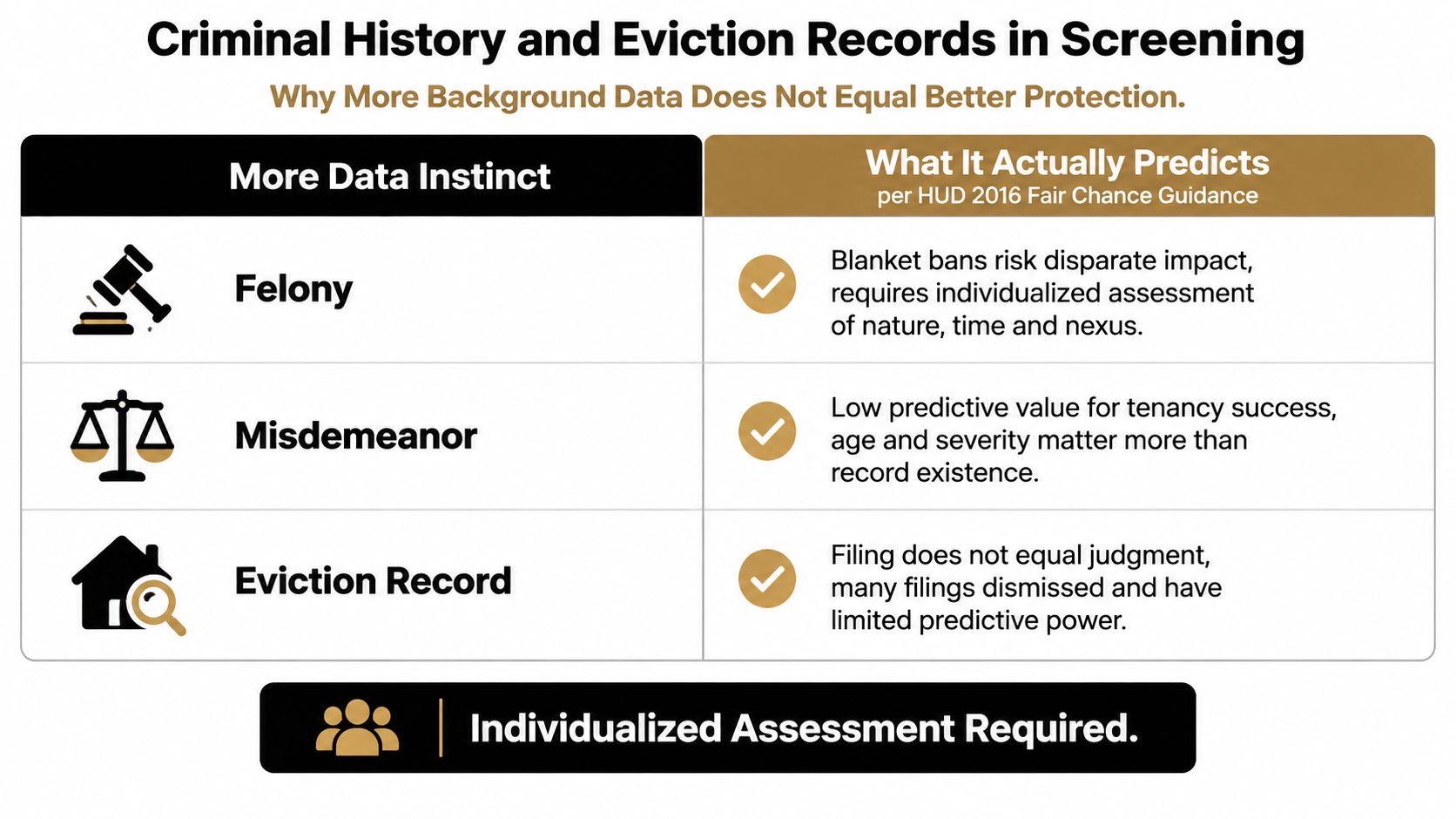
Federal housing guidance supports individualized assessment rather than categorical exclusion. Housing providers may consider criminal records, but blanket bans and overly broad rules can create disparate-impact liability when the policy isn't closely tied to housing risk. The more defensible review considers the recency, severity, and relevance of the conduct, while avoiding reliance on arrest records as proof of wrongdoing (Fair Housing for People With a Criminal Record digital toolkit).
Evaluate the record, not the label
A felony or misdemeanor label tells you less than the underlying facts, age of the conduct, and connection to the property risk you are trying to manage. A rule that rejects every applicant with any conviction may be easy to administer, but ease isn't the same as lawful justification.
California restrictions make over-collection especially dangerous. Civil Code section 12955.8 limits the lookback for most convictions to seven years and excludes arrest records that didn't lead to conviction, as described in the provided screening guidance. Sex-offender registry information also requires care. A registry check can support a denial only on a narrow lawful basis, not as a shortcut to reject anyone whose name appears in a database.
Eviction information needs the same discipline. California Civil Code section 12955.2 treats eviction filings as protected housing data for two years post-resolution, so a filing isn't interchangeable with a judgment and shouldn't be treated as automatic proof that an applicant is unsuitable.
A vendor that returns more records can increase your liability if your staff can't verify identity, relevance, accuracy, and lawful use.
Before adding another search product, ask what decision it improves. If the answer is only “we'll have more data,” the purchase may add cost without improving compliance. Consumer advocates increasingly press landlords to focus on current ability to pay and tenancy suitability rather than automatic denial based on any eviction, criminal record, or screening score (National Consumer Law Center tenant reform priorities).
Written Screening Criteria and the Order-of-Applications Rule
A landlord can create a screening problem before reviewing a single credit report. If the criteria are unclear, the application order is informal, or the fee process depends on memory, staff may treat similar applicants differently. California's 2025 rules require written screening criteria at application time and establish an order-based process when landlords accept screening fees. The first applicant who meets the stated criteria receives priority, subject to the transaction's lawful details and required notices (California Apartment Association summary of 2025 rental housing laws).
Put the standards in plain language
Write for an ordinary applicant, not for a dispute file. Avoid saying management will decide in its “sole discretion.” State the income standard, credit or payment-history requirements, rental-history expectations, occupancy rules, documentation requirements, subsidy treatment, and any individualized criminal-history review policy. Each standard should explain what qualifies, what needs clarification, and what results in a denial.
A practical packet can use this checklist:
- Identity and authorization: The applicant provides consistent identifying information and signs the standalone report authorization.
- Income and assistance: The applicant documents lawful income, including housing assistance, under the same affordability method applied to other applicants.
- Rental history: Staff reviews verified rental history and distinguishes a resolved filing from a judgment.
- Credit and payment history: Staff applies the published standard consistently and provides required notices if report information affects the decision.
- Criminal history: Staff conducts an individualized assessment tied to recency, severity, and relevance.
- Order received: Staff records the date and time a complete application arrives, without treating receipt as acceptance.
- Decision record: Staff records approval, conditional approval, or denial against the published criterion.
Control the queue
Define “received” in the policy. It should mean the file contains the materials required for completeness, not that a staff member has promised the unit. Once the first complete applicant meets the criteria, continuing to seek a more attractive applicant creates consistency and steering concerns.
The 2025 process also requires fee refunds within seven days of selecting a tenant or 30 days of receiving the application, whichever comes first. That timing appears in the amended Civil Code section 1950.6. Configure the property-management system to create the refund task automatically. If the unit is withdrawn or the applicant is ineligible, record why, when the decision occurred, and how the fee was handled.
For the financial-review portion of the packet, this guide to checking credit for a tenant can help organize the credit-review steps without replacing legal review.
Adverse Action Notices and Applicant Disputes
A denial is only one possible adverse action. If a consumer report influenced the decision to deny the application, raise the deposit, require a co-signer, or change another lease term, the landlord must preserve a clear documentation chain before and after the decision. In daily operations, the notice process should be a recorded workflow, not an email drafted from memory.
Use two communications
The pre-adverse-action notice gives the applicant an opportunity to review the report and identify inaccurate information before the landlord finalizes the outcome. Send the report and the applicable summary of rights, then allow the response period established in the landlord's written procedure. Keep the notice template, date sent, delivery method, and any applicant response in the file.
The final adverse action notice should identify the consumer reporting agency, state that the agency did not make the decision, explain the applicant's dispute rights, and tell the applicant about the right to request a free report within 60 days, as required under the FCRA. The notice should also state the factors that affected the decision and match the published screening criteria. If the applicant raises a credible accuracy issue, pause the file and follow the provider's reinvestigation procedure before treating the report as settled.
| Notice Element | FCRA Requirement | California Addition |
|---|---|---|
| Report influence | State that the report contributed to the decision | Include any applicable state disclosure or local notice |
| Screening company | Name the consumer reporting agency | Use the current provider's accurate contact information |
| Applicant rights | Explain the right to dispute and request a free report within 60 days | Preserve any California-specific rights and fee documentation |
| Decision reason | Communicate the factors that affected the outcome | Match the reason to the published criteria |
| Timing | Send pre-adverse and final notices through a documented process | Follow applicable state and local timing rules |
A dispute file should contain the application, authorization, report version, review notes, pre-adverse notice, applicant response, vendor correspondence, final notice, and delivery record. Staff should record whether the decision changed after reinvestigation and why.
Sloppy notices create exposure because the landlord cannot show what information affected the decision or when the applicant received an opportunity to respond. A complete record helps address consumer-reporting disputes and fair-housing complaints without reconstructing the file months later.
Building a Compliant Screening Workflow
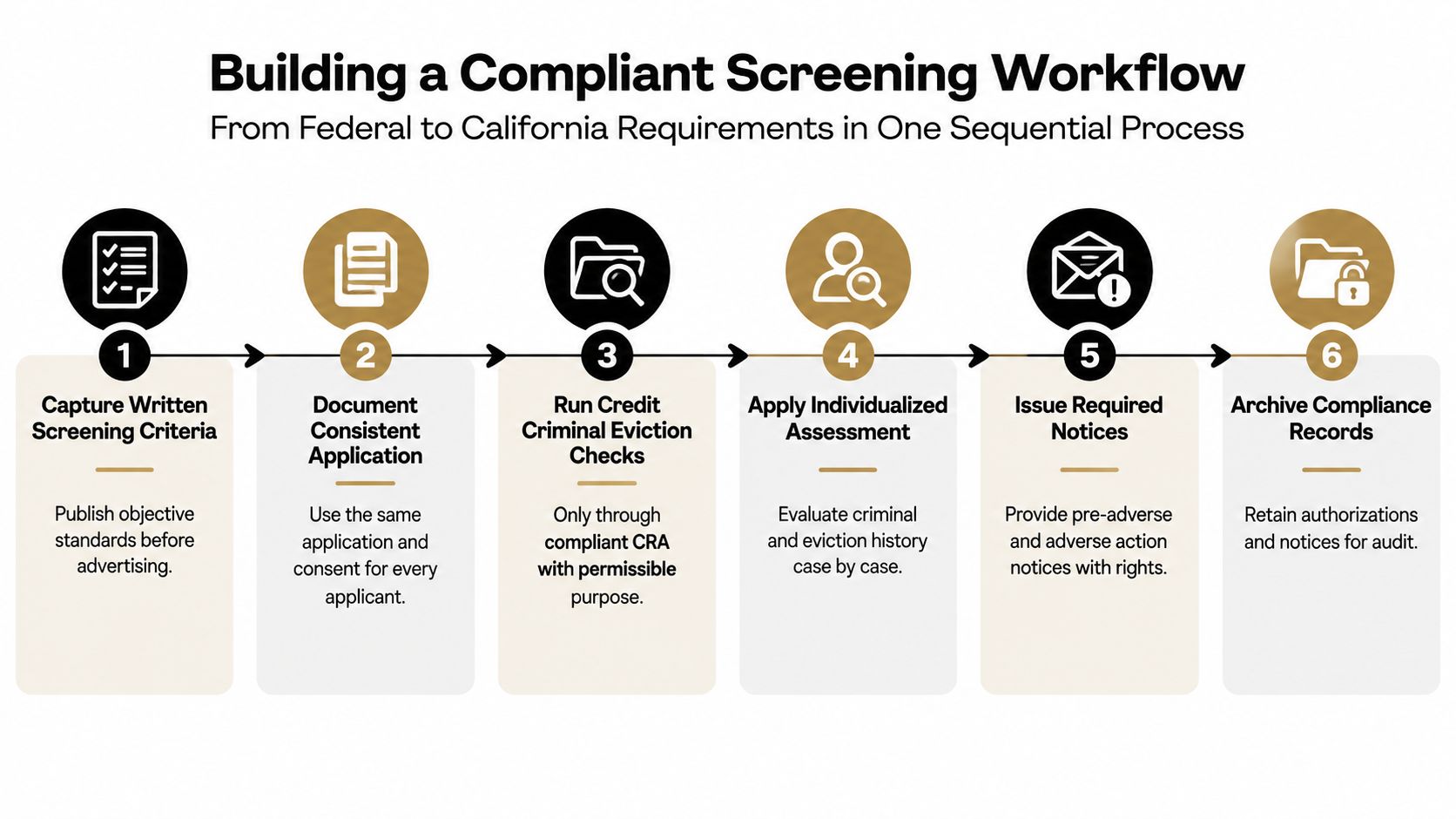
The safest workflow turns each legal requirement into a visible task, an owner, a document, and a deadline. That structure prevents a leasing agent from improvising after the first application arrives.
Assign a control to every stage
Publish the criteria before marketing. Save the dated advertisement, criteria sheet, application, fee policy, and reusable-report policy in one property folder. Don't change the standard after seeing who applied.
Use one application path. Every applicant should receive the same form, consent language, instructions, and method of submission. If a person sends only part of an application, record the missing items and don't move the file ahead of a complete application.
Confirm permissible purpose before ordering. The authorized staff member should verify consent, identity information, and the selected FCRA-compliant provider. Record the report date and provider rather than downloading reports into personal email accounts.
Apply the criteria consistently. Separate objective financial review from individualized criminal-history analysis. A supervisor should review exceptions, conditional approvals, and any record that may be incomplete or mismatched.
Send the correct notice. If the report may produce an unfavorable outcome, trigger the pre-adverse process. After the final decision, send the adverse action notice and preserve delivery evidence. A property management system can automate reminders, but staff still need to confirm that the reason matches the actual decision.
Refund and archive. Track fee deadlines, reusable reports, withdrawn units, and selected applicants. Securely retain authorizations, reports, notices, dispute correspondence, and decision notes under the business's retention policy.
Watch the Central California failure points
The common breakdowns are mundane. Someone accepts a partial application, a manager charges a fee before deciding whether a reusable report will be accepted, or an owner changes the income standard after a preferred applicant appears. Another employee may approve the applicant verbally but fail to record the conditional requirement, leaving the file inconsistent with the notice.
A checklist such as this tenant screening checklist can give staff a repeatable sequence. For unrelated ownership and identity research, landlords may encounter tools marketed as bulk owner tracing software, but skip-tracing tools aren't substitutes for permissible-purpose screening or applicant authorization.
Management control: The person who accepts the application shouldn't be the only person who decides whether an exception is justified.
Putting It All Together in Central California
For landlords in Fresno, Madera, Tulare, and Kings counties, a defensible screening operation starts before the property is advertised. Publish written criteria, use one application and consent package, explain the fee and reusable-report policy, and train every employee who answers applicant questions.
Then make the queue auditable. Record when each complete application arrives, process applicants in the required order, and stop accepting fees or applications when the unit's status changes under the applicable rules. Refund fees on the required schedule, and don't create a different standard for an applicant using a housing voucher or another lawful subsidy.
The decision file should make sense without a private conversation. It should show the report authorization, the criteria used, any individualized assessment, the reason for approval or denial, the notices delivered, and the handling of any dispute. That record protects applicants from arbitrary screening and gives owners a practical defense against fair-housing complaints, consumer-reporting claims, chargebacks, and unnecessary vacancy delays.
Local rules can add work. Fresno landlords should verify source-of-income requirements and any city-specific obligations, while owners with multiple properties should consider a qualified screening provider and California landlord-tenant counsel. A vendor can process reports, but the owner remains responsible for choosing lawful criteria and supervising the workflow.
Start by auditing your current application packet this week. Replace vague criteria with plain-language standards, add a complete fee and reusable-report procedure, create notice templates, and assign one person to monitor application order and refund deadlines. Those changes are far more reliable than ordering another background report.
Edinhart Realty and Property Management helps Central California owners with professional marketing, applicant screening, lease preparation, tenant communication, and either full-service management or placement-only support. Visit Edinhart Realty and Property Management to discuss a screening workflow that fits your property and keeps the documentation organized from application through move-in.


