

Maria manages four single-family rentals near Fig Garden. In mid-February, she notices that one lease ends on March 31, but she can't tell whether California requires a 30-day or 60-day notice, or whether she should send a renewal offer instead of a termination notice. Across town near River Park, Devon has received a proposed rent increase and wants to know how long he has to decide whether to sign, negotiate, or move.
Both are asking about the lease renewal notice period, but neither needs a generic answer copied from a 30-to-90-day checklist. The correct timing depends on the lease type, jurisdiction, occupancy length, and whether the landlord is changing rent or ending the tenancy. California also separates fixed-term expiration from month-to-month termination, a distinction that changes the workflow before anyone sends a letter.
The Calendar Problem Every Landlord and Tenant Faces
Maria's March 31 expiration date looks simple until she opens the lease. It may renew for another fixed term, convert to month-to-month, or require one party to give notice before the tenancy changes. The lease may also contain its own renewal language, while California law may impose separate rules if she intends to terminate a periodic tenancy, raise rent, or rely on a just-cause requirement.
Devon faces a different decision. A rent increase letter isn't automatically the same thing as a renewal offer, and receiving the proposed terms doesn't always tell him how long he has to accept them. He needs to read the lease, identify whether his tenancy is fixed-term or periodic, check the effective date of the increase, and determine whether the landlord has supplied a separate response deadline.
A single number fails because the legal clock can start from different events. A fixed-term lease has a stated expiration date. A month-to-month tenancy continues after each rental period unless properly terminated. A rent increase follows its own notice track, and regulated housing can impose a tenant acceptance deadline as well as a landlord delivery deadline.
Practical rule: Start with the tenancy, not the calendar. Identify the lease type and location before counting backward from the expiration date.
For landlords, the cost of guessing can include an unintended holdover, a delayed vacancy, or an ineffective rent change. For tenants, silence can leave the existing tenancy in place, trigger a move-out deadline, or cause the tenant to lose an opportunity to accept regulated renewal terms. The useful question isn't “Is notice 30, 60, or 90 days?” It's “Which clock applies to this tenancy, and who must act first?”
What a Lease Renewal Notice Period Actually Means
A lease renewal notice period is the time allowed for a landlord or tenant to communicate what should happen when the current rental arrangement reaches its end. That communication might offer a new lease, accept continuation under stated terms, propose changes, or state that the tenancy will end. The notice period isn't itself a promise that renewal will occur.
A notice to vacate has a narrower purpose. It tells the other party that the tenancy should end, rather than offering continuation. A renewal proposal does the opposite. It sets out the terms under which the landlord is willing to continue the relationship and gives the tenant a chance to respond.
Fixed-term leases use an expiration date
A fixed-term agreement, such as a six-month or one-year lease, identifies a beginning and an end. The parties should review the document before that end date because the agreement may include an automatic-renewal clause, a month-to-month conversion provision, or a deadline for accepting a renewal offer.
The clock is usually measured backward from the lease-end date, not forward from the day someone remembers to send a message. If the lease ends on March 31, a manager should calculate every applicable deadline from March 31, then allow time for preparing, serving, negotiating, and documenting the notice.
Many leases convert to month-to-month when neither party signs a new fixed term. That conversion creates a continuing tenancy with a different termination process. It doesn't necessarily mean the tenant has accepted a new fixed-term lease, and it doesn't necessarily give the landlord the right to end occupancy immediately after the original term.
Periodic tenancies keep running
A month-to-month tenancy doesn't wait for a new annual expiration date. It continues from rental period to rental period until one side properly ends it or the parties sign different terms. Week-to-week arrangements operate on the same basic principle, although their notice rules can differ.
That distinction matters in Fresno. A landlord discussing a new annual lease with a month-to-month tenant may be negotiating a renewal, but a landlord ending the periodic tenancy is serving a termination notice. The wording, timing, delivery, and legal basis must match the action being taken.
How Notice Windows Vary Across Major Markets
The lease renewal notice period changes sharply across jurisdictions. Texas, New York, Virginia, and Quebec illustrate why landlords with properties in different markets can't rely on a single operating rule.
Texas requires a landlord to provide either a notice to vacate or an offer of lease renewal no later than the 60th day before the current lease term expires. The same 60-day timing applies when a month-to-month lease is being terminated under the cited Texas rule. The statutory framework therefore connects the renewal offer and the decision not to continue, rather than treating them as unrelated calendar events. See the Texas property code provision on renewal and termination timing.
New York adds more layers. For rent-stabilized apartments, landlords must send renewal offers between 90 and 150 days before expiration, and tenants have 60 days to accept. New York City also uses occupancy-based notice periods for market-rate nonrenewals, ranging from 30 days for occupancy under one year, 60 days for one to two years, and 90 days for two years or more, as described in the city's tenant protection notice requirements.
Virginia provides a different model. One-year-or-longer agreements automatically renew for the same term unless either party gives written notice at least 60 days before expiration, according to the Virginia residential rental statute. Quebec uses date-specific periods tied to lease length and type. For leases lasting 12 months or more, landlords generally notify tenants 3 to 6 months before the end, while shorter leases and room leases use shorter windows under the cited framework.
| Jurisdiction | Month-to-month notice | Year-or-longer notice | Renewal trigger |
|---|---|---|---|
| Texas | The cited rule uses a 60-day timing for month-to-month termination | Notice to vacate or renewal offer no later than 60 days before term end | Lease expiration or periodic-tenancy termination |
| New York City | Market-rate notice scales by occupancy duration | Rent-stabilized renewal offer arrives 90 to 150 days before expiration | Regulation, occupancy duration, and tenant acceptance |
| Virginia | The cited statute focuses on written notice before automatic renewal | 60 days before expiration | Automatic renewal unless timely written notice is given |
| Quebec | Notice follows the applicable rental period and lease type | 3 to 6 months for leases lasting 12 months or more | Civil-law renewal dates and lease duration |
The comparison also shows why delivery rules and tenant response duties matter as much as the number of days. A landlord may need to initiate the offer, while a tenant may have a separate acceptance deadline. Early planning creates room for negotiation. Late delivery can restrict the choices available to both sides.
California and Fresno Area Rules in Practice
California requires managers to separate fixed-term expiration from month-to-month termination. Under California Civil Code Section 1946.2, ending a month-to-month tenancy generally requires 30 days' written notice when the tenant has occupied the unit for less than one year, and 60 days' written notice when occupancy is one year or more. Those figures concern termination of a periodic tenancy, not a universal deadline for sending every renewal offer.
A Fresno manager should map each file through separate questions:
- What is the tenancy? Is it still within a fixed term, or has it become month-to-month?
- What action is planned? Renewal, nonrenewal, termination, or a rent change?
- How long has the tenant occupied the unit? That can affect the month-to-month termination window.
- Does a local or statutory protection apply? Check just-cause rules, protected classes, subsidies, and local requirements before serving a termination notice.
- How will service be documented? Keep the notice, date, method, and proof of delivery together.
For a fixed-term lease, expiration alone doesn't automatically create the same notice obligation as ending a month-to-month tenancy. The lease may prescribe a renewal process, and a just-cause rule may affect whether the landlord can decline to continue. For a periodic tenancy, the manager should calculate the termination notice from the planned end date and avoid treating an informal text message as a substitute for a legally appropriate notice. Managers who need a broader California framework can review California landlord-tenant law guidance.
Rent changes follow a separate clock. California practice commonly requires 30 days' notice for an increase under 10 percent and 90 days' notice for an increase of 10 percent or more within a 12-month period, subject to the applicable law and exemptions. A renewal offer and a rent-increase notice may travel together, but they shouldn't be treated as the same document or deadline.
| Trigger | Threshold | Notice required | Authority |
|---|---|---|---|
| Month-to-month termination | Occupancy under one year | 30 days | California Civil Code Section 1946.2 |
| Month-to-month termination | Occupancy one year or more | 60 days | California Civil Code Section 1946.2 |
| Rent increase | Under 10 percent within the applicable 12-month period | 30 days | California rent-increase notice rules |
| Rent increase | 10 percent or more within the applicable 12-month period | 90 days | California rent-increase notice rules |
Service errors can undermine an otherwise timely notice. For a practical review of mistakes with acknowledgment of receipt, managers should focus on identifying the recipient, choosing a permitted delivery method, preserving evidence, and avoiding assumptions about email or signature acknowledgments.
Landlord and Tenant Duties Side by Side
A renewal works only when both parties manage their own deadline. The landlord usually controls the initial offer, but the tenant controls whether to accept, counter, or leave. Neither side should assume that the other party's silence resolves the tenancy.
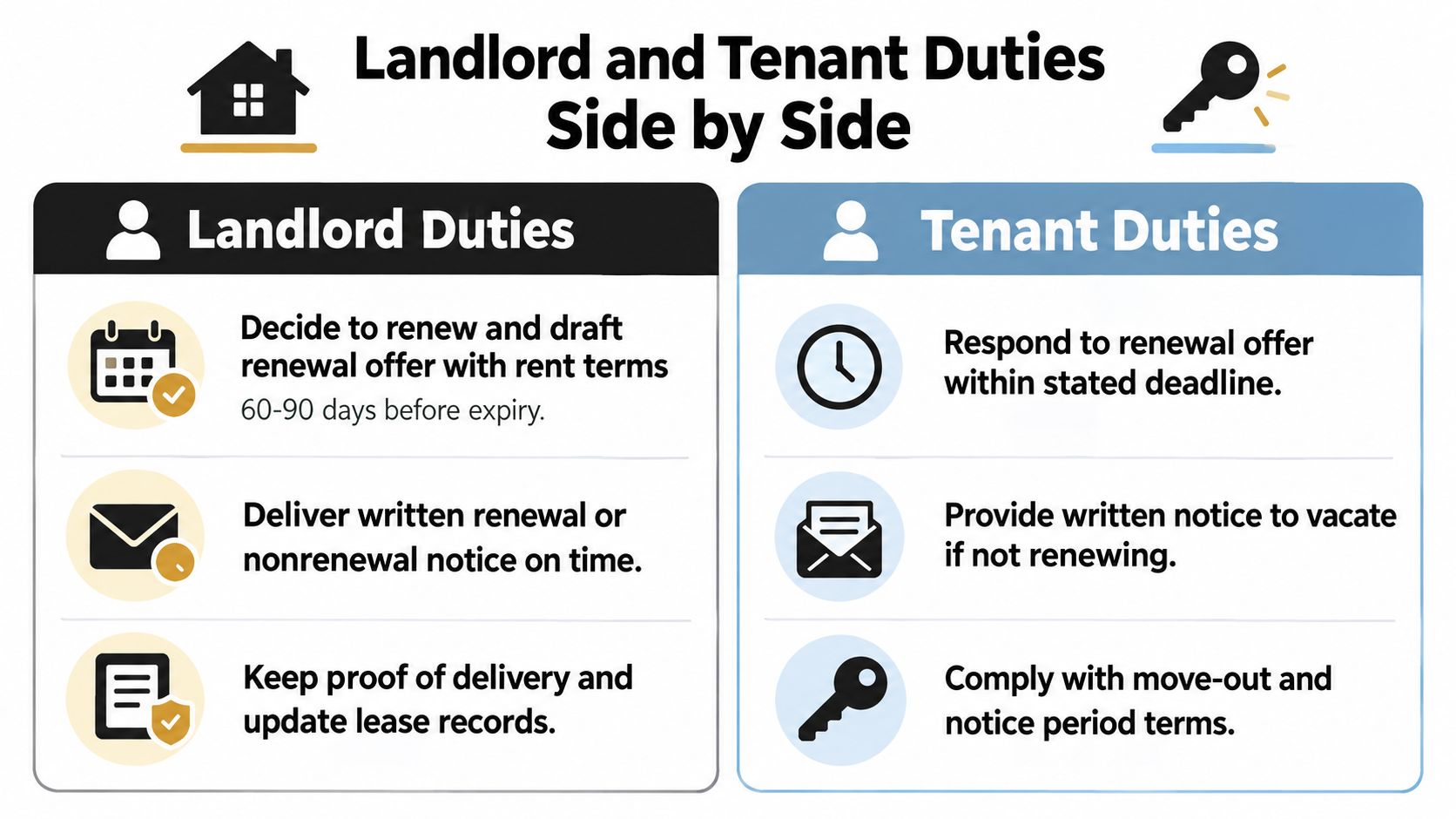
Landlord responsibilities
The landlord or manager should decide whether to renew, prepare the proposed term and rent, serve any required notice, and retain proof of delivery. If the tenant proposes different terms, respond in writing rather than leaving the negotiation in an ambiguous verbal state.
A manager should also update the rent ledger and lease records after the tenant signs. If the landlord doesn't intend to continue a month-to-month tenancy, the termination notice must meet the applicable occupancy-based deadline and any additional legal requirements.
Tenant responsibilities
The tenant should read the entire renewal package, not just the new rent line. Confirm the proposed term, utility obligations, deposit language, response deadline, move-out requirements, and whether the lease says the tenancy converts automatically if no one signs.
If leaving, the tenant should give any required written notice, pay through the proper end date, return keys, provide a forwarding address, and preserve a copy of the notice. If staying without signing a new fixed term, the tenant should understand what existing lease language controls the resulting tenancy.
Silence is rarely neutral. It can preserve a month-to-month arrangement, leave a proposal unanswered, or create a dispute over whether the parties agreed to new terms.
Landlords risk an unintended holdover, a missed rent-change deadline, or an avoidable possession dispute. Tenants can face a required move-out, changed rent terms, or litigation if they remain after a lawful tenancy-ending notice. For broader context on handling disagreements, a guide to tenant disputes can help identify where documentation and communication usually break down.
Sample Renewal and Nonrenewal Notice Templates
These samples are starting points for a Fresno-area property manager. They aren't legal forms, and they shouldn't replace review of the lease, current California law, local requirements, subsidy rules, or a just-cause analysis. Use the appropriate statutory notice when the landlord is terminating a periodic tenancy, and obtain attorney review for regulated or subsidized housing.
Renewal offer notice
Date: [Date]
To: [Tenant name or names]
Property: [Full rental address]Your current fixed-term lease ends on [Expiration date]. The landlord offers a renewal for the period from [New start date] through [New end date]. The proposed rent is [New rent amount] per month. [State whether the security deposit changes and identify the legal or lease basis for any change.]
Please sign and return the attached renewal by [Response deadline]. If you don't accept by that date, the tenancy will be handled according to the current lease and applicable law. Contact [Manager name and contact information] in writing with questions or proposed changes.
If applicable: [Insert required AB 1482 or other just-cause language, exemption statement, or local disclosure.]
The response deadline should give the tenant a clear, realistic opportunity to review the terms. Don't write that silence automatically means acceptance unless the lease and applicable law support that result.
Nonrenewal and notice to vacate
Date: [Date]
To: [Tenant name or names]
Property: [Full rental address]This notice states that the tenancy will end on [Move-out date]. The date is intended to provide the notice required for this tenancy under California Civil Code Section 1946.2 and any other applicable rule. [Insert the required just-cause reason and supporting language, if applicable.]
Remove all personal property, clean the unit as required by the lease, return every key and access device to [Delivery location], and provide a forwarding address to [Manager contact]. Contact management promptly if you believe the date or reason is incorrect.
Delivery record: Served by [personal service, permitted mail method, or another method allowed by the lease and law] on [Date]. Copies retained by [Name].
For detailed operational guidance, managers can also review how to issue a notice to a tenant.
What Happens When the Renewal Window Is Missed
A missed deadline rarely creates just one problem. It can change the tenancy's status, delay a planned vacancy, or make a rent change ineffective.
Consider a Fresno landlord who lets a fixed-term lease reach its end without sending a nonrenewal notice or a properly prepared renewal offer. If the lease provides for month-to-month continuation, the tenant may remain under that arrangement rather than leaving on the expiration date. The owner loses control over the planned turnover, marketing starts later, and the property may remain under terms the owner no longer wants.
A tenant can also miss an important response deadline. In New York rent-stabilized housing, the landlord must send a renewal offer between 90 and 150 days before expiration, and the tenant has 60 days to accept under the cited rules. A tenant who waits too long may lose the renewal opportunity, and the landlord may refuse renewal and pursue eviction after the lease ends. That regulated-market consequence shows why tenants must calendar their own response date, not merely wait for another reminder.
A third scenario involves a manager who sends a rent-increase notice after the required window. The manager may need to delay the effective date or withdraw the defective increase rather than collect it as if the notice were valid. If the manager collects an amount that wasn't lawfully effective, the dispute can expand into repayment demands, a challenge to the ledger, or a broader claim about notice handling.
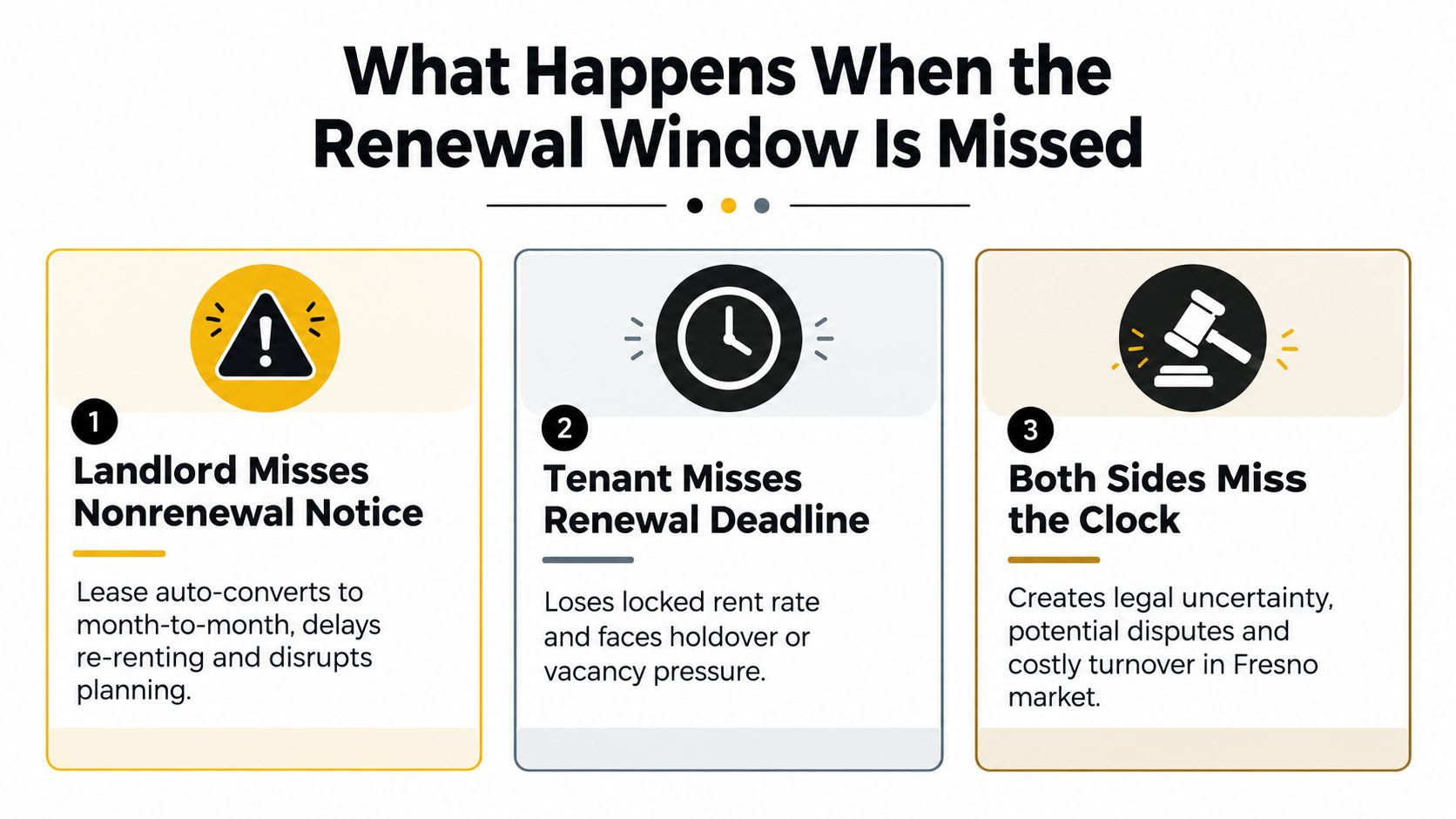
The practical consequences
- Lost planning control: A landlord may have to keep managing a tenancy that was expected to end.
- Weakened enforcement position: A defective notice can create wrongful-eviction exposure or delay possession.
- Unclear financial records: A late rent increase can produce an incorrect ledger and a demand for correction.
- Tenant displacement risk: A tenant who misses a regulated acceptance deadline may lose a renewal option.
The safest response is not to backdate a notice or rely on a casual text message. Stop, identify the tenancy type and governing rule, correct the timeline, and document the next communication. A California manager handling a planned move-out can use this notice to vacate California guidance as an operational reference, then obtain legal advice when the facts are disputed.
A Practical Timeline for Property Managers
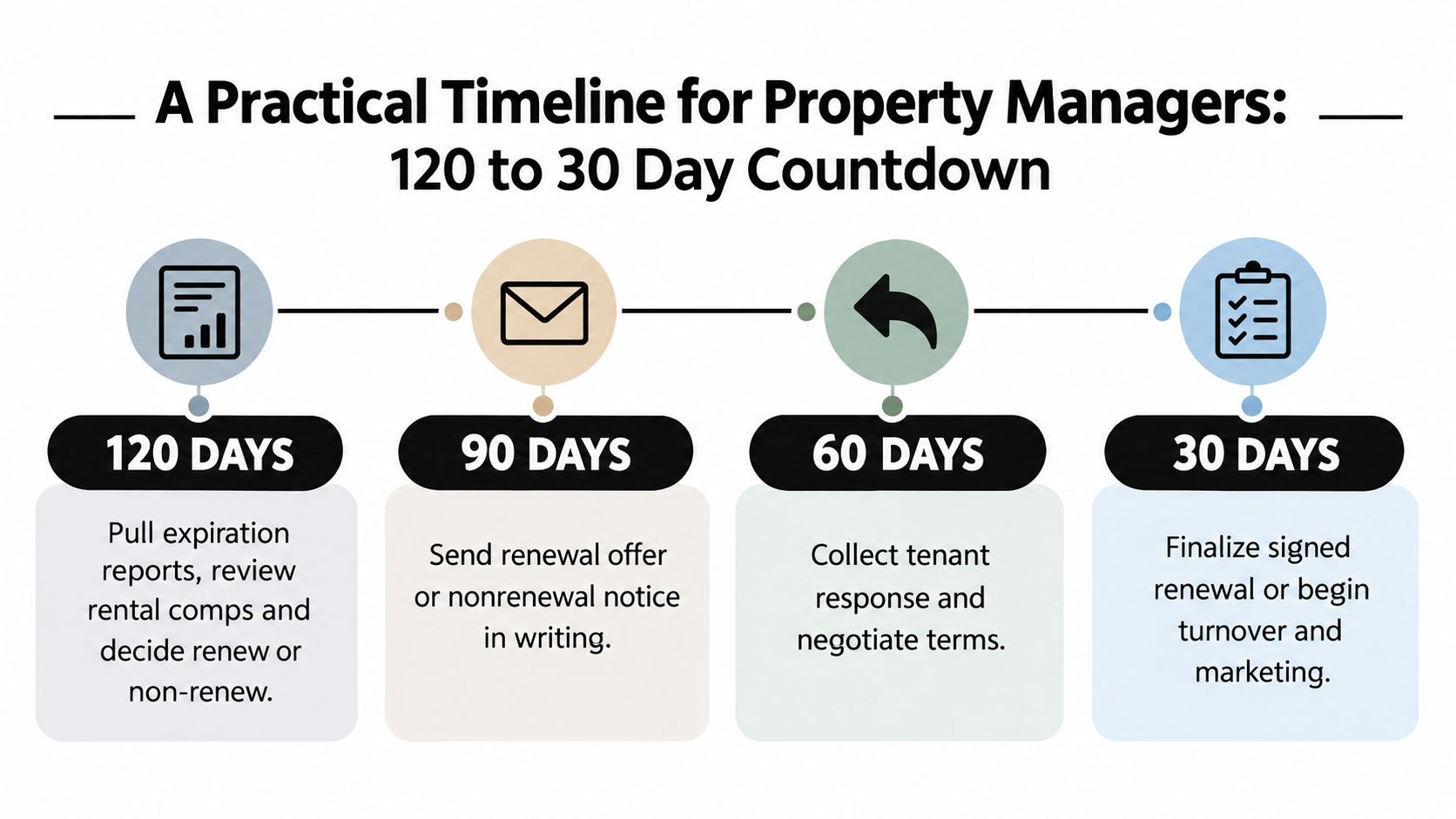
A Fresno property manager can run every lease through a countdown, but the countdown must be adjusted for the actual tenancy. The dates below are management checkpoints, not a replacement for the lease or applicable law.
120 days before expiration
Pull the expiration report and open the current lease. Review the tenant's occupancy history, payment record, pending maintenance, renewal clause, conversion language, and any applicable just-cause, subsidy, or local protection. Compare the home's condition and expected rental value with current market information, then choose a working path: renewal, renewal with a permitted rent change, or nonrenewal.
The early review matters because a rent increase can have a separate notice clock from the renewal offer. If the manager waits until the final month to decide, there may not be enough time to serve the correct document and allow the tenant to respond.
90 days before expiration
Draft the renewal package or prepare the termination notice if the tenancy and legal requirements call for one. Confirm names, address, lease dates, proposed rent, deposit treatment, utilities, insurance requirements, and any required disclosures.
For a tenant with a disability, an older tenant, or a military connection, don't assume the ordinary calendar answers every question. Verify whether the facts create an extension, accommodation issue, or additional procedural protection before serving a notice.
60 days before expiration
Deliver the applicable written notice and record the method, date, recipient, and supporting proof. If the renewal includes a rent change, check that the separate California rent-increase timing has also been satisfied. Send the tenant a clear response date and keep negotiation records in the property file.
A digital property-management system can help with expiration reports, automated reminders, rent ledgers, and document storage. Some managers also use platforms such as Rentabble's system for direct bookings for related rental operations, while keeping legal notice workflows tied to the governing lease and service rules.
30 days before expiration
Follow up with tenants who haven't responded, but don't treat a follow-up as a substitute for the original notice. Obtain signatures, confirm the effective date, schedule the handover inspection if the tenant is leaving, and prepare marketing only when the legal path and possession date are clear.
During the final week, verify keys, remotes, parking devices, forwarding information, cleaning expectations, and the security-deposit accounting process. Keep the signed renewal or completed move-out file with the notice record. The strongest workflow is boring by design: every deadline is calendared, every delivery is provable, and every exception is escalated before the notice goes out.
Edinhart Realty and Property Management helps Fresno-area owners coordinate tenant communication, lease renewals, move-in and move-out procedures, rent collection, and property records through full-service or placement-only management options. Visit Edinhart Realty and Property Management to discuss a renewal process that fits your California rental portfolio.


