

You've probably had the same thought a lot of Fresno owners have right now. A spare home, an inherited property, or a house that would make a strong Airbnb listing looks like an obvious income opportunity. Then you start searching the rules and hit a wall of city codes, county language, tax questions, permit requirements, and HOA documents that read like they were written to stop you from ever listing the place.
That confusion is normal. Short-term rental regulations aren't one simple yes-or-no issue anymore. In practice, they're a stack of overlapping rules, and the hidden layer is often the one that causes the biggest problem. In Fresno and across Central California, owners usually focus on city ordinances first. Many miss the county rules for unincorporated areas, and even more miss the private restrictions in their HOA or recorded CC&Rs.
That's where deals go sideways. A property can look perfect on Airbnb and still be a bad short-term rental candidate if the neighborhood rules, parking restrictions, guest limits, or permit requirements don't line up with how the property will operate.
Thinking of Airbnbing Your Fresno Home Start Here
A lot of owners start with the fun part. They browse comparable listings, estimate nightly rates, think about furnishing the place, and wonder how quickly they can get it live on Airbnb or Vrbo. That instinct makes sense. Presentation matters, and if you need ideas to elevate your Airbnb rental's appeal, design choices like bedding, layout, and guest-ready finishes absolutely affect bookings.

But a Fresno-area short-term rental only works if the property is legally workable before you spend money on furniture, photography, and setup. That means checking the house like an operator, not just like a marketer.
Start with the property, not the platform
Before you create a listing, answer these questions:
- Where is it located: Is the home inside Fresno city limits, in Clovis, or in unincorporated Fresno County?
- What community controls apply: Is there an HOA, condominium association, planned unit development, or recorded CC&R set?
- How would guests use it: Will parking spill onto the street, will trash day become an issue, and will neighbors tolerate weekend turnover?
- Who will respond locally: If a guest locks themselves out or a neighbor complains late at night, who handles it?
A good-looking listing can still be a bad business if the operation behind it is shaky.
Practical rule: If you haven't checked title documents, HOA rules, zoning, licensing, and tax registration, you're not ready to furnish the property yet.
The hidden Fresno problem
In this market, owners often assume the city is the whole story. It usually isn't. Fresno County and private community rules can block a short-term rental even when the house itself seems like a strong fit. HOA restrictions are especially easy to miss because they may not use the phrase “short-term rental.” They may regulate leasing minimums, guest parking, nuisance activity, business use, or owner occupancy instead.
That's why the safest approach is simple. Treat short-term rental compliance as a due diligence project first, and a hospitality project second. Owners who do that avoid the most expensive mistake in this space, building an STR business on a property that was never eligible.
Understanding the Four Layers of Rental Regulation
Think of short-term rental compliance like stacked layers around the property. You don't clear one rule and move on. You clear all of them, and the tightest layer usually controls the actual outcome.
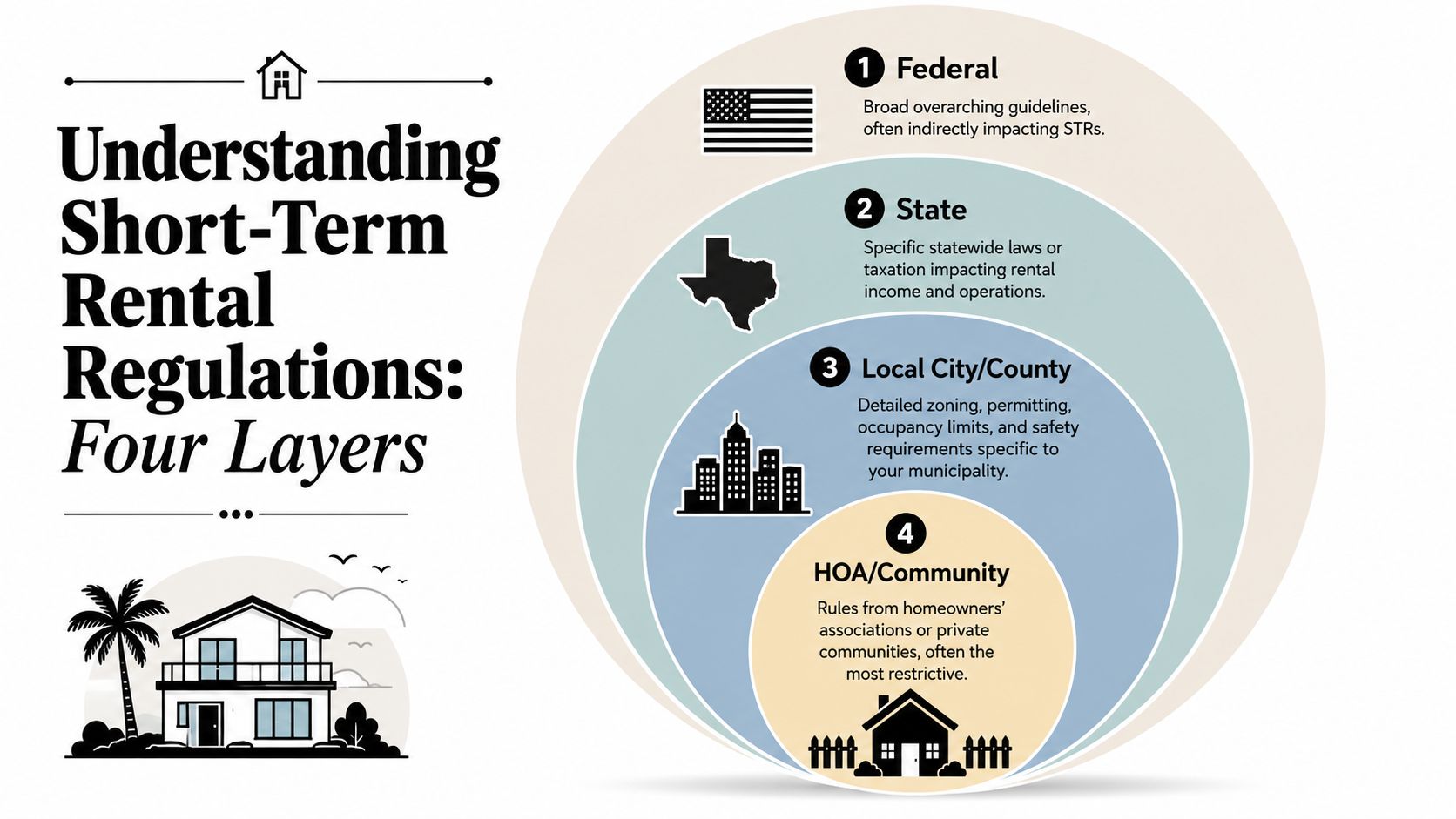
State rules set the broad frame
California usually supplies the broad legal and tax framework, while local governments handle the operating details. Owners who are also trying to understand the wider rental environment often benefit from reviewing how statewide housing rules affect their decisions, including topics like California rent control basics, even though STRs are a separate category from traditional long-term tenancies.
At the state level, the main practical issue for an STR owner is that rental activity doesn't exist in a vacuum. Taxes, business activity, insurance implications, and property use all sit in a broader regulatory environment.
City and county rules control the day-to-day operation
Most short-term rental regulations encompass complex policy areas. A practical policy guide from Granicus on regulating short-term rentals notes a major shift from simple zoning limits to layered permitting systems, including formal permits, neighborhood quotas, 24/7 local-contact obligations, recordkeeping for at least 3 years, “3 strikes” revocation models, and automatic expiration provisions.
That matters because local compliance is no longer just “get approved once.” It's ongoing administration.
For a Fresno-area owner, city or county rules may govern:
- Permits and registrations: Whether you need approval before listing
- Zoning compatibility: Whether your property's location allows this use
- Occupancy and parking: How many guests, cars, and visitors the home can realistically support
- Contact and complaint response: Whether someone local must be reachable around the clock
HOA rules are often the real gatekeeper
This is the layer many owners underestimate. An HOA doesn't need to mirror city law. It can be stricter. In practice, that means a property can satisfy public rules and still violate private community restrictions.
Common HOA obstacles include:
- Minimum lease terms that effectively block nightly or weekly bookings
- Parking limits that don't work for guest turnover
- Business use restrictions aimed at preserving residential character
- Amenity rules covering pools, clubhouses, gates, and guest access
The most expensive compliance error is assuming public approval overrides private restrictions. It doesn't.
Why this layered view matters
Once you understand the stack, decisions get easier. A home in unincorporated county territory with no HOA may be workable. A similar home inside a tightly governed subdivision may be a nonstarter. That's why owners should review the property by jurisdiction first and revenue potential second.
Decoding Fresno and Clovis STR Ordinances
In the Fresno market, the first practical question is simple. Where is the property located? A mailing address doesn't answer that. You need to know whether the home falls inside Fresno city limits, Clovis city limits, or unincorporated Fresno County. That one detail changes who you call, which ordinances apply, and where tax and licensing obligations may land.
What to verify before you list
For both Fresno and Clovis, don't rely on a platform setup page or a generic host article. Verify these items directly with the local jurisdiction:
- Whether a business license is required
- Whether there is a separate short-term rental permit or registration
- Whether the property's zoning district allows the use
- Whether there are owner-occupancy or local-contact expectations
- How transient occupancy tax is handled
- What your renewal calendar looks like
The biggest local mistake is assuming that because you can create an Airbnb listing, you're cleared to operate. You aren't.
Platform verification has changed the risk
A broader regulatory trend matters here even if the exact local mechanics differ. The National League of Cities notes a shift toward platform-verifiable licensing, where permit or registration numbers must appear in listings, and cities often pair that with fines ranging from $200 per day to $2,000 per violation in some ordinances, escalating with enforcement risk and delisting pressure, as outlined in the National League of Cities STR regulations report.
For owners in Fresno and Clovis, the practical takeaway is straightforward. If your local jurisdiction requires a license or registration number, your listing data has to match your permit status. Sloppy paperwork is no longer just a filing issue. It can become a listing issue.
Fresno vs. Clovis STR Rules at a Glance 2026
| Requirement | Fresno | Clovis |
|---|---|---|
| Business license | Verify directly with city | Verify directly with city |
| STR permit or registration | Verify current local requirements before listing | Verify current local requirements before listing |
| Zoning review | Check parcel-specific zoning and use rules | Check parcel-specific zoning and use rules |
| TOT obligations | Confirm registration, collection, and remittance process | Confirm registration, collection, and remittance process |
| Listing compliance | Match listing details to any permit or registration terms | Match listing details to any permit or registration terms |
| HOA overlay | Still applies if property is in a governed community | Still applies if property is in a governed community |
Don't compare your property to another host's listing and assume the rules are the same. Their address, zoning, permit status, or HOA terms may be completely different.
The Central California wrinkle
Clovis and Fresno owners often look only at city hall. That's too narrow. If the property sits outside incorporated boundaries, county rules may control instead. If it's in a planned development, the HOA may matter more than either city. Hyperlocal compliance starts with the parcel, not the brand name of the nearest city.
Managing Your Tax and Licensing Obligations
Running a short-term rental means you're managing two separate compliance tracks at the same time. One is local lodging tax and licensing. The other is state and federal income reporting. Owners get into trouble when they mix those together and assume one filing covers the other.
Local tax and permit work
If your property is approved for short-term use, you'll likely need to register with the correct local authority for occupancy-related taxes and any business or operating license that applies. The exact office depends on whether the home is in Fresno, Clovis, or unincorporated county territory.
Your operating file should include:
- Registration confirmations: Any business license, permit, or STR registration approval
- Tax setup records: The account information tied to local lodging tax collection
- Guest receipts and booking summaries: Keep platform exports and direct-booking records
- Renewal dates: Track each deadline in one calendar, not in scattered emails
A lot of owners assume the platform handles everything. Sometimes a platform may collect certain taxes in some places, but that never removes your responsibility to confirm what's being collected, what still needs to be reported, and whether local registration is required.
A broader policy trend shows why that assumption is risky. Recent New York legislation illustrates how STR regulation is shifting toward revenue administration, requiring platforms to collect and remit certain taxes and allowing county registry systems to support tax collection, as discussed in this New York State Association of Counties overview. Even though Fresno owners are dealing with California and local rules, the operational lesson is the same. Tax compliance is becoming more system-driven and easier for governments to monitor.
Income taxes are separate
Short-term rental revenue is still rental income. That means you need organized books for income and expenses, separate from your local occupancy tax process. If you want a cleaner system before filing season, this guide on preparing for tax season as a rental owner is a useful starting point.
Keep records that show:
- Income by stay: Platform payouts, cleaning charges, and any direct guest payments
- Property expenses: Cleaning, repairs, supplies, maintenance, insurance, and service vendors
- Use records: Dates the property was rented and dates it was used personally
- Support documents: Invoices, statements, receipts, and permit-related correspondence
What works and what doesn't
What works is one dedicated folder system, one bookkeeping workflow, and one monthly review. What doesn't work is letting Airbnb statements pile up until tax season and trying to rebuild the year from memory.
If the property is in an HOA community, keep those records too. If there's ever a dispute over permitted use, notices, or guest conduct, clean documentation matters.
Understanding Enforcement and Avoiding Costly Penalties
Most owners imagine enforcement starts with a city inspector knocking on the door. In reality, it usually starts smaller. A neighbor reports extra cars. Trash cans stay out. Guests hold a late-night gathering. The listing says one thing, while the permit file says another. That's how a manageable issue turns into an enforcement file.
How violations are usually discovered
Enforcement often begins through ordinary friction:
- Neighbor complaints: Noise, parking, trash, and constant turnover
- Listing review: Missing permit details or inaccurate descriptions
- Permit mismatch: Occupancy, contact information, or use conditions that don't align with operations
- Pattern problems: Repeated disturbances that suggest the home is being run outside approved terms
Modern ordinances are built to make nuisance issues measurable. A common benchmark is two adults per bedroom, and some jurisdictions also cap daytime visitors, as shown in this Londonderry Township short-term rental requirements document. That matters because complaints about noise, parking, and crowding are easier to prove when the occupancy envelope is already defined.
Why operators get in trouble
The problem usually isn't one dramatic violation. It's loose operations.
A host says the home sleeps more people than the parking can support. A cleaner leaves bags by the curb on the wrong day. A co-host can't respond quickly when a guest dispute escalates. An owner allows “a few extra visitors” without realizing that visitor counts may matter just as much as overnight occupancy.
If your guest rules, cleaning turnover, parking plan, and quiet-hour enforcement don't match the property's permitted use, your risk is operational, not theoretical.
The right mindset
Treat compliance like business insurance. It protects revenue by reducing complaints, enforcement exposure, and the chance that a permit problem shuts down the listing. Owners who run cleaner operations usually don't just avoid penalties. They also avoid the neighborhood friction that triggers scrutiny in the first place.
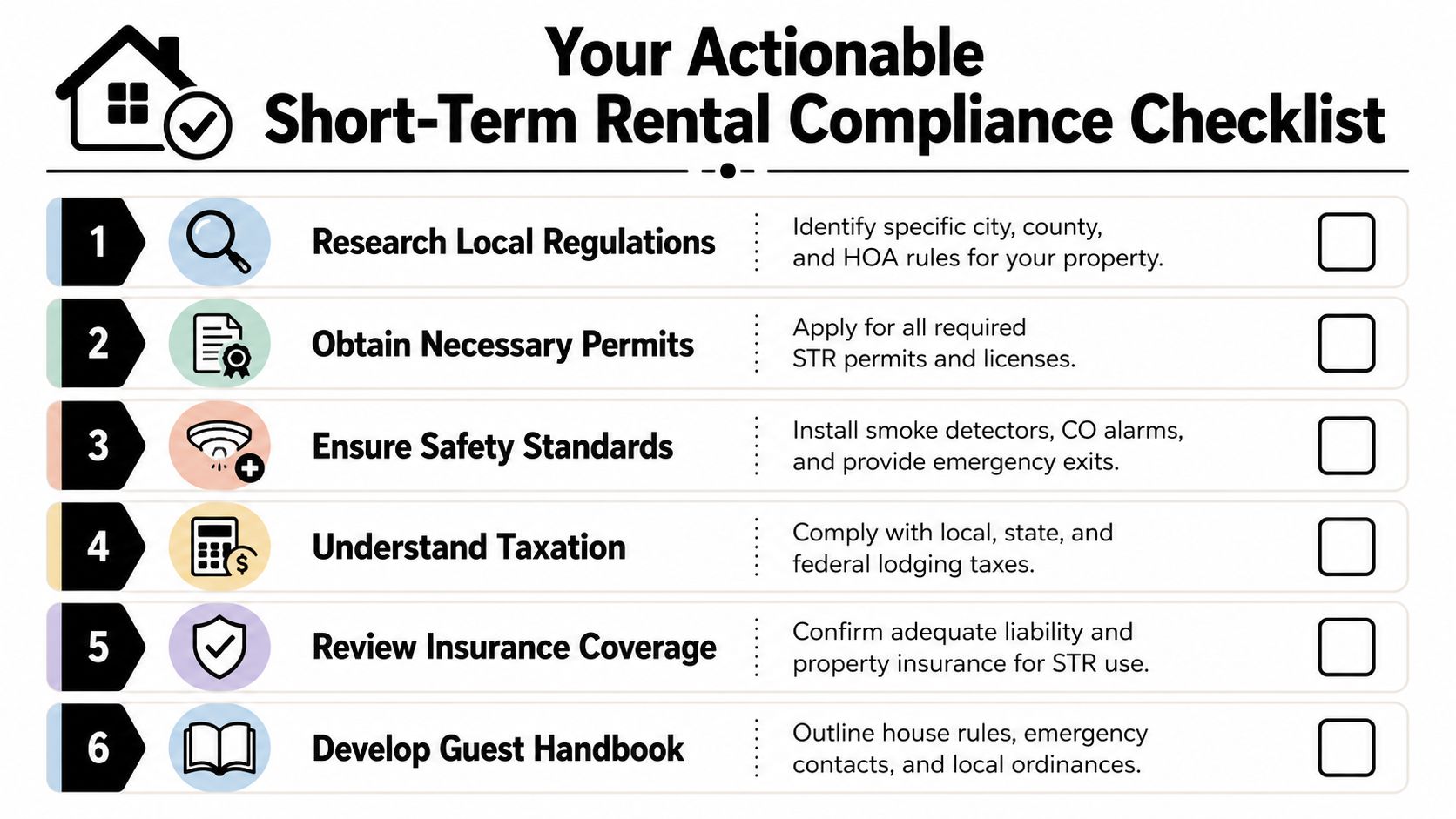
Your Actionable Short-Term Rental Compliance Checklist
A workable STR setup is built before the first guest arrives. Use this as a print-and-check list for a Fresno, Clovis, or broader Central California property.
Due diligence before spending money
Confirm the exact jurisdiction
Verify whether the property is in Fresno, Clovis, or unincorporated Fresno County. Don't guess from the mailing address.Pull the HOA and CC&R documents
Read the leasing section, parking rules, nuisance provisions, and guest-use language. If the documents are old or unclear, get written clarification.Check zoning and use eligibility
Contact the right local planning or licensing office and ask whether the parcel can be used as a short-term rental.Review title and community restrictions
Some limits aren't obvious from a quick HOA summary. Recorded restrictions and community rules can control the answer.
Setup tasks before listing goes live
- Apply for required licenses: Business licenses, STR permits, or registrations should be in place before launch.
- Create a compliance file: Save approvals, tax records, HOA correspondence, insurance documents, and guest-rule templates in one folder.
- Match the listing to the permit terms: Bedrooms, guest count, parking, and contact information should align with what the property is permitted to do.
- Set realistic house rules: Quiet hours, parking instructions, trash procedures, and visitor limits need to be specific.
Operating controls that prevent problems
Some steps matter more after launch than before it.
- Install and test safety basics: Smoke detectors, carbon monoxide alarms where appropriate, exterior lighting, and clear entry instructions should be checked routinely.
- Use a local response plan: If a guest calls late or a neighbor reports a problem, someone needs to act quickly.
- Track renewals and tax deadlines: Put every date on one master calendar.
- Document every issue: Complaint received, call returned, guest warned, cleaner notified. Keep a record.
Good hosts don't just market the property well. They run it in a way that holds up when a city staff member, neighbor, or HOA board asks questions.
Insurance and practical fit
Before you buy furniture, confirm your insurance carrier knows the intended use. Many owners assume standard homeowner coverage is enough. That assumption is risky. You also need to ask a blunt question that many tend to avoid: is this property built for guest turnover? If parking is tight, neighbors are close, and the HOA is aggressive, the house may be a stronger long-term rental than a short-term one.
How a Property Manager Simplifies STR Compliance
Short-term rental rules look manageable when you read them one by one. They stop looking simple when you have to apply them to a real property, answer guests, manage cleaners, watch tax deadlines, handle complaints, and keep the listing aligned with permit terms at the same time.

Where owners usually lose control
Part-time hosts are the most exposed. Existing guidance often misses that gray area, but it matters. Some jurisdictions use residency thresholds, owner-occupancy rules, or guest-cap triggers that are easy to overlook. Chesco Planning's summary notes examples such as cities requiring a host to live onsite for at least 270 days annually in some cases, and it highlights how local thresholds can create the biggest risk for casual or occasional hosts in this short-term rental guidance overview.
That's why a property manager's value isn't just convenience. It's process control.
A good operator helps with:
- Eligibility review: Checking whether the property is even a viable STR candidate
- Paperwork coordination: Keeping permits, business registrations, and tax setup organized
- Listing discipline: Making sure the public listing doesn't promise what the property can't legally support
- Local response: Handling guest issues and neighbor complaints quickly
- Vendor management: Coordinating cleaners, maintenance staff, and turnover schedules
Remote hosting sounds easy until compliance enters the picture
Owners who live outside Fresno often underestimate the local-contact problem. Remote hosting can work, but only if operations are tight. For a practical look at that side of the business, Altitude Cleaning Crew's remote Airbnb guide is worth reading because it shows how much depends on local systems, not just smart locks and messaging apps.
The same logic applies to regulation. If your cleaner sees overcrowding, if a guest parks wrong, or if a board member emails a violation notice, someone local has to respond in a way that protects the asset.
Why management changes the risk equation
For many owners, the better question isn't “Can I self-manage?” It's “Do I want to be personally responsible for every permit detail, guest issue, tax deadline, and complaint response tied to this property?”
A professional manager can reduce that friction by centralizing the work. If you're comparing options for ongoing oversight in this market, a local Fresno property management team can help evaluate whether a property is better suited for short-term use, long-term leasing, or a different strategy entirely.
A short video can help if you're weighing that management decision in practical terms.
For many Fresno owners, that's the key advantage. Not just getting listed, but staying compliant without turning every weekend booking into another administrative problem.
If you want help evaluating whether your Fresno, Clovis, Friant, or Central California property is a good candidate for short-term or long-term rental use, Edinhart Realty and Property Management can help you assess the rules, the property fit, and the management workload before you commit time and money in the wrong direction.


