

A typical property management fee covers a package of recurring operational services rather than a single task, usually averaging 8.49% of collected rent. Advertised rates can range from 3.75% to 14%, but the percentage alone doesn't tell you whether leasing, inspections, repairs, renewals, or eviction support are included.
You may be looking at a Fresno rental quote right now and seeing a reassuringly low monthly percentage. The assumption is understandable: one fee should cover rent collection, tenant questions, maintenance calls, inspections, and the next vacancy. Then the first repair coordination charge or tenant-placement invoice arrives, and the advertised rate no longer resembles the actual cost of management.
The practical question isn't just, “What percentage do you charge?” It's what work does that percentage buy, what triggers an additional charge, and what remains your responsibility? Edinhart's Full-Service and Placement-Only models provide a useful way to compare those answers without treating every landlord as though they needs the same level of support.
Understanding What You Actually Pay For
A landlord sees an 8% monthly management fee and may assume the number covers everything from the day a tenant moves in until the day the keys come back. In practice, a recurring management fee usually pays for an operating system, not one isolated task.
That system connects tenant screening, lease administration, rent collection, delinquency follow-up, tenant communication, maintenance coordination, inspections, vendor oversight, and owner reporting. The manager's value lies in keeping those activities connected, documented, and moving when the owner is unavailable.
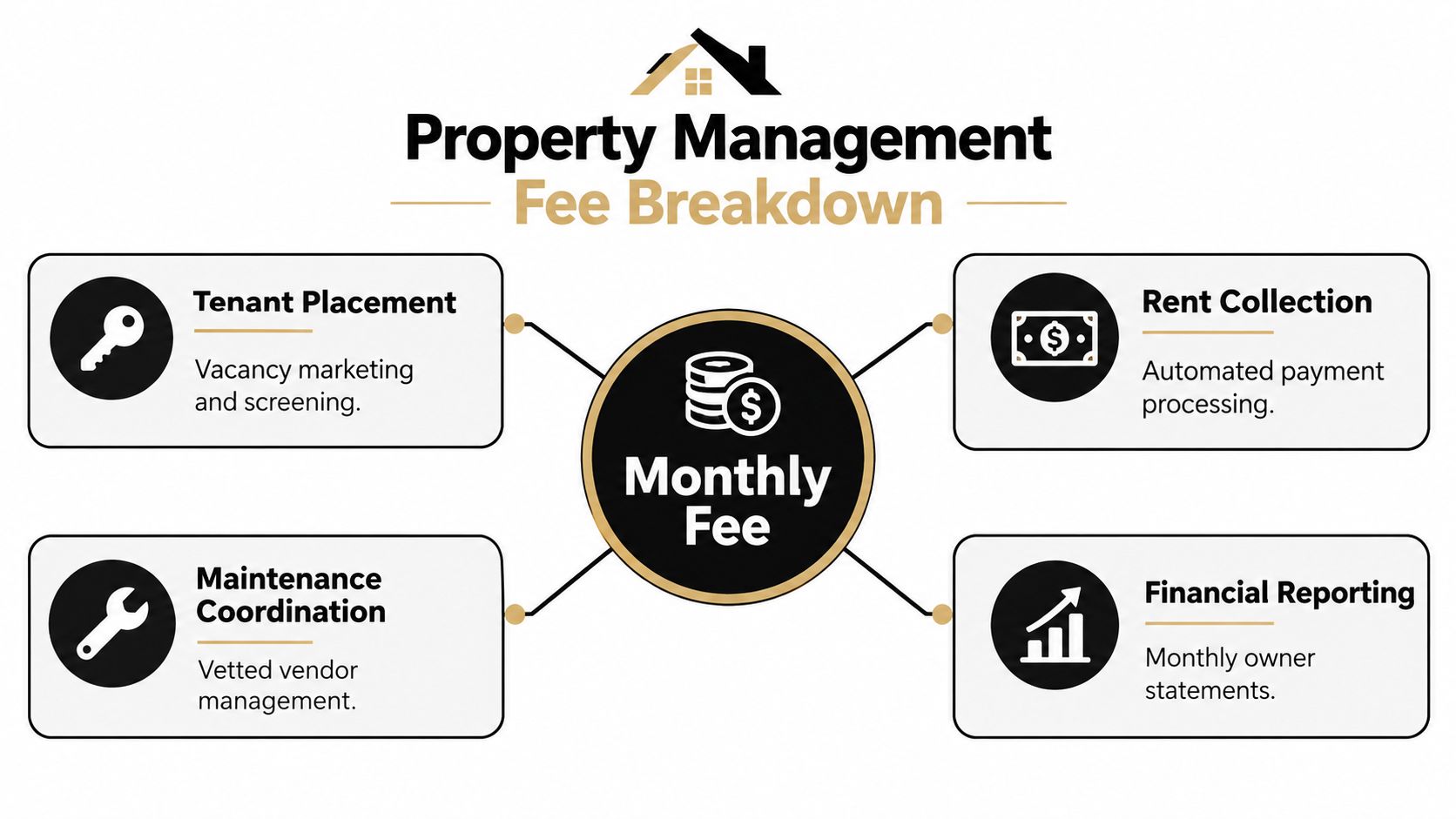
The fee transfers work and risk
A tenant reports a leaking water heater. The manager has to receive the request, establish whether it's urgent, contact an appropriate vendor, coordinate access, communicate with the tenant, obtain approval when required, review the invoice, and preserve the record. Rent collection follows a similar chain, from payment processing to delinquency administration and owner distribution.
That workload transfer is why a fee shouldn't be viewed only as a deduction from rent. It can also reduce the owner's direct involvement in lease compliance, habitability response, vendor supervision, and financial administration. HUD's management responsibilities similarly identify rent collection, maintenance, lease enforcement, tenant relations, inspections, and financial administration as distinct functions, making its property-management responsibilities benchmark useful when reviewing scope.
Practical rule: A percentage is meaningful only when you can connect it to a written list of recurring tasks.
The distinction between rent collected and rent due also matters. If the fee is calculated on collected rent, a vacancy or unpaid balance may change the amount charged. If it is calculated on scheduled rent, the owner may owe a management fee even when cash hasn't arrived. Before comparing providers, confirm which base applies and whether the fee continues during vacancy.
For a deeper explanation of how these revenue arrangements work, review how property management companies make money. The point isn't to avoid management fees. It's to understand whether the arrangement gives you a coherent service system or a low entry price followed by separate charges for essential work.
Core Components of Monthly Management Fees
A low monthly percentage can look attractive until the owner discovers that rent follow-up, maintenance coordination, and reporting carry separate charges. Compare the operating work included in the agreement, not only the rate. A full-service contract usually covers the functions that keep a tenancy stable after move-in, but the exact scope depends on the company and contract.
Rent administration and tenant communication
Rent collection includes more than receiving an electronic payment. The manager may maintain payment records, follow up on delinquency, deliver notices, administer the tenant ledger, and distribute funds to the owner. The manager also becomes the tenant's regular contact for access questions, lease terms, repairs, and routine concerns.
Slow communication can create avoidable costs. A tenant who cannot get a response may delay reporting a problem, misunderstand a lease obligation, or let a manageable issue become more disruptive. Confirm whether the monthly fee covers routine messages, delinquency contact, notice delivery, and after-hours calls.
Maintenance coordination and vendor control
Maintenance coordination may include triaging requests, selecting or contacting vendors, scheduling access, documenting work, reviewing invoices, and updating the owner. A percentage that excludes those tasks can leave you paying separately for the work that consumes the most management time.
Ask whether coordination is included or whether the company adds a markup to vendor invoices. Reported maintenance markups range from 0% to 20%. On a $1,000 repair, a 10% markup adds $100 before applicable taxes or owner-approved work, so check the policy against your annual budget. Industry fee information on property management costs provides further context for comparing these charges.
The same review applies to outsourced operating services. For commercial or mixed-use assets, compare Dallas office cleaning costs to help determine whether a vendor quote is a pass-through expense, a coordination charge, or part of the operating budget.
Accounting and owner reporting
A useful monthly package should show more than a payment confirmation. Look for owner statements, rent and expense records, vendor invoices, reserve activity, and year-end reporting suited to the property and tax preparation process.
Before signing, ask:
- Routine inspections: Are move-in, move-out, or periodic inspections included?
- Emergency response: Who handles urgent maintenance outside normal business hours?
- Approval authority: What repair amount can the manager approve without contacting you?
- Documentation: Will you receive photographs, invoices, inspection reports, and communication records?
- Compliance: Who maintains lease, notice, trust-fund, and tenant-file documentation?
A low percentage may represent leasing or rent collection only. The written scope determines whether you are buying full operational management or paying piecemeal for its main functions.
Full-Service Versus Placement-Only Models
The right model depends on who will handle the property after the lease is signed. A local landlord with reliable vendors and time for tenant communication may want control. An out-of-state owner, busy professional, or investor with several rentals may need a manager to remain responsible throughout the tenancy.
Edinhart's two-model framework makes that boundary easier to identify.
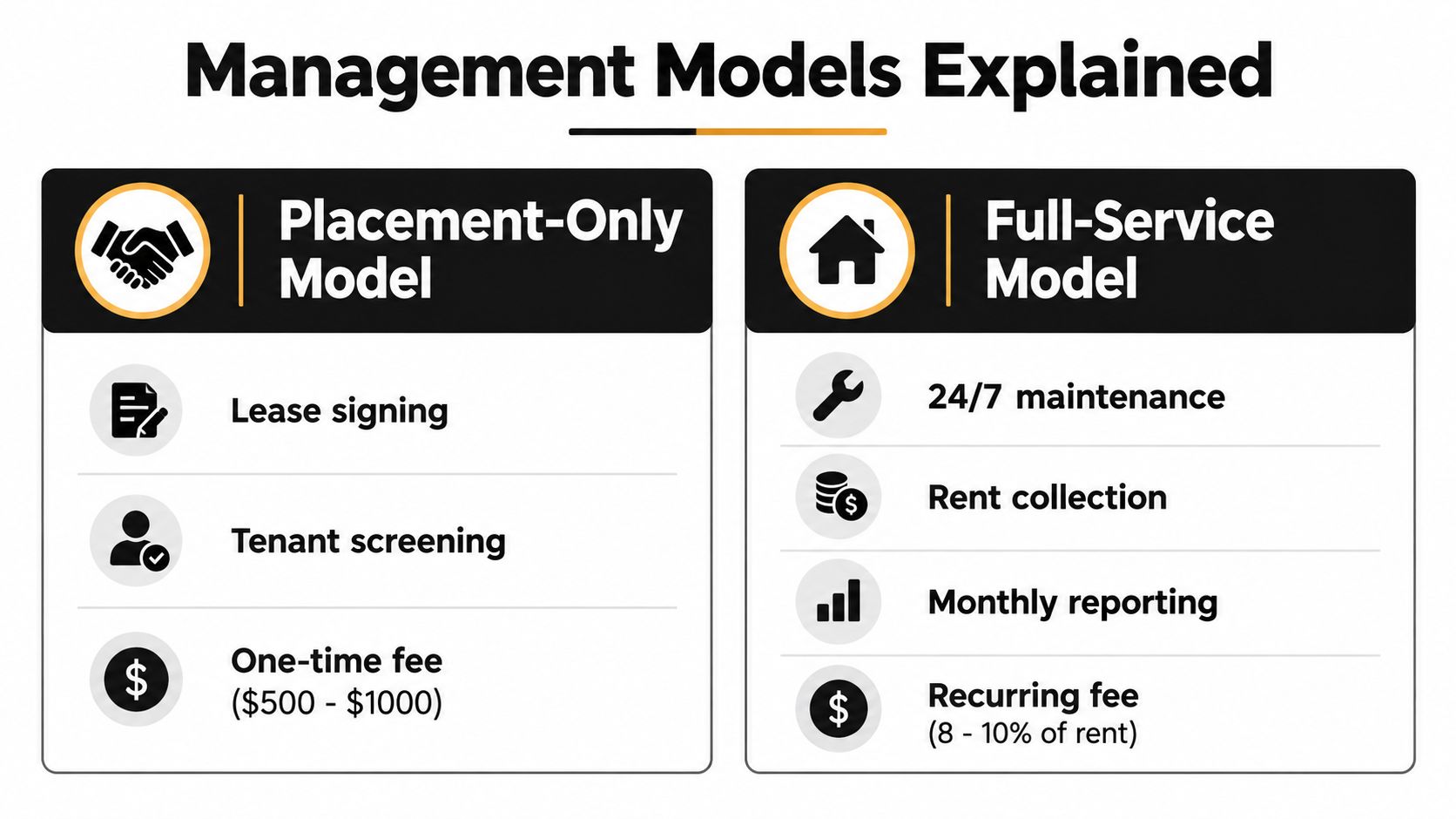
Placement-Only fits an involved owner
A Placement-Only service is designed for the owner who wants professional help with the highest-risk front end of a tenancy but plans to operate the rental afterward. The provider may market the vacancy, arrange showings, screen applicants, prepare the lease, and coordinate the move-in handoff.
After placement, the owner generally takes responsibility for rent collection, tenant requests, repairs, inspections, renewals, notices, and any later dispute. That can work well when you live nearby, already have trusted vendors, understand local requirements, and can respond quickly.
It won't work well if you're choosing the model only because the initial price looks lower. The owner is buying a defined transaction, not ongoing peace of mind. A placement agreement should state exactly when responsibility transfers and what happens if the selected tenant fails to perform.
Full-Service fits an owner who wants continuity
A Full-Service package carries the operating relationship beyond move-in. Typical functions include rent collection, tenant communications, maintenance coordination, move-in and move-out documentation, lease renewals, rent increases, notices, inspections, and monthly accounting statements, subject to the agreement.
That continuity matters during the unglamorous parts of ownership. Someone has to follow up on a late payment, respond to an urgent repair, document property condition, coordinate vendors, and explain the month's financial activity. If you're unavailable for those tasks, a recurring full-service fee buys delegated capacity.
The comparison is clearer in this form:
| Question | Placement-Only | Full-Service |
|---|---|---|
| Who finds and screens the tenant? | Management provider | Management provider |
| Who handles daily tenant issues? | Owner | Management provider |
| Who coordinates repairs after move-in? | Owner | Management provider, subject to the agreement |
| Who manages renewals and notices? | Owner | Management provider |
| How is the fee commonly structured? | A separate placement charge | A recurring percentage of rent, with possible additional charges |
Owners considering a fixed arrangement can also review flat-fee property management and compare the defined scope against a percentage-based package. The important decision is not whether one model sounds cheaper. It's whether the responsibilities match your actual time, location, and operating capability.
Additional and Episodic Costs to Expect
A low monthly percentage can look attractive until the property turns over, needs an inspection, or develops an urgent repair. Monthly management covers recurring work, while several high-impact tasks are priced when they occur. Put those triggers in your budget before signing.
Tenant placement
Tenant placement commonly costs 50% to 100% of one month's rent, according to reported industry fee data. The charge may cover vacancy marketing, showings, applicant screening, lease preparation, and move-in coordination.
Ask whether professional marketing, screening criteria, lease drafting, and condition documentation are included. Confirm when payment is due, such as at signing, move-in, or rent collection. A placement-only arrangement can keep the monthly fee low, but the owner still pays this larger episodic charge whenever a tenant changes.
Renewals and inspections
Renewals may carry a separate fee because the manager reviews market conditions, communicates terms, prepares documents, and collects signatures. Reported flat renewal charges range from $100 to $300, with one survey reporting an average of $211.92, as described in the property-management cost analysis.
Inspection pricing also varies. Some agreements include move-in, move-out, or periodic inspections, while others bill each visit separately. “Inspections available” does not identify the payer, frequency, report format, or follow-up included. Ask for those details in writing.
Repairs, emergencies, and legal work
Maintenance can produce two bills: the vendor's invoice and a management markup or coordination charge. The agreement should state whether the manager selects preferred vendors, accepts owner-nominated contractors, and requires approval above a stated threshold. Review expected rental property maintenance costs when setting your reserve.
Emergency repairs deserve a separate check because response time affects tenant safety and property damage. An urgent cooling failure may require a local provider found through a search for emergency ac repair near me. The vendor handles the physical repair; the manager may coordinate access, tenant communication, authorization, and documentation. Those services can appear as separate cost lines.
Eviction handling, court costs, legal work, major repairs, capital projects, insurance claims, and special inspections may sit outside the base package. Compare these exclusions before choosing between full-service management and placement-only support.
Use a fee matrix to identify:
- Base fee: What recurring work is included?
- Trigger: Which event creates another charge?
- Pass-through cost: Which vendor, legal, or government expenses does the owner pay?
- Markup: Does the manager add a percentage or coordination fee?
- Approval rule: Who authorizes work, and at what threshold?
Evaluating Value and Total Cost of Ownership
A low monthly percentage can become the most expensive option when it excludes turnover coordination, inspections, maintenance administration, or delinquency follow-up. Compare the work behind the rate, not the rate alone. A higher recurring fee may cost less overall when it covers tasks you would otherwise handle yourself or purchase separately.
Use an annual comparison to expose the difference. Suppose a property collects $2,000 per month and the recurring management rate is 8%. The monthly fee is $160, or $1,920 in recurring annual fees. A new tenant placement priced at 75% of one month's rent adds $1,500, before renewal, repair, inspection, or legal charges.
This example does not forecast your property's expenses. It shows why an advertised percentage represents only one part of the ownership calculation. Edinhart's Full-Service and Placement-Only models provide a useful comparison: the first bundles ongoing operational responsibility, while the second can leave the owner paying separately for management after the tenant is placed.
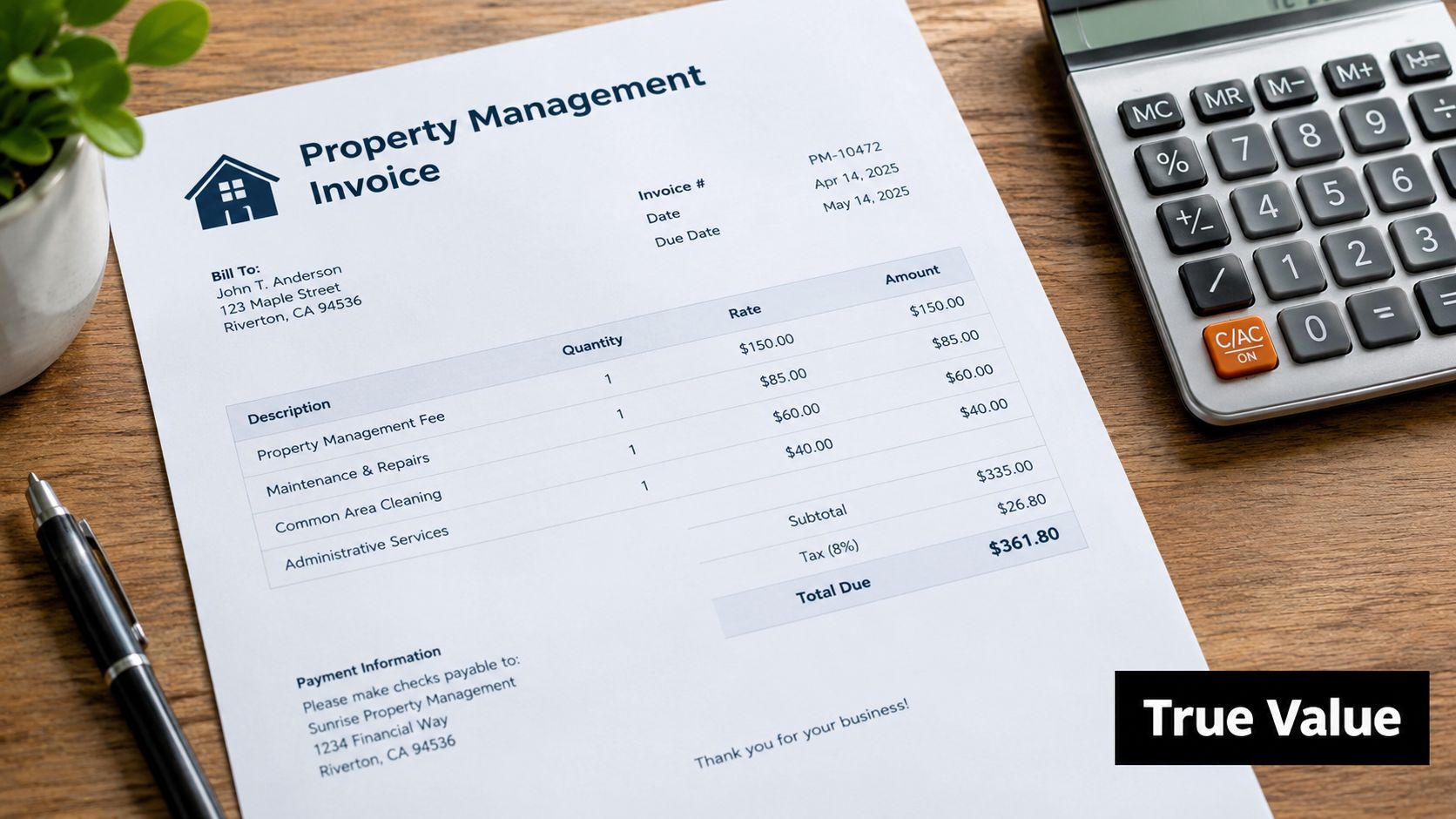
Compare scope before price
Ask what happens while the property is occupied, vacant, damaged, delinquent, or between tenants. Then assess whether the manager's service model supports your target net income.
| Cost question | Why it changes the decision |
|---|---|
| Is the percentage based on collected rent or rent due? | Nonpayment and vacancy may change the fee. |
| Is tenant placement separate? | Turnover can create a significant one-time charge. |
| Is maintenance coordination included? | Repair invoices may carry a markup or coordination fee. |
| Are renewals charged separately? | A stable tenancy can still create transaction fees. |
| Are inspections included? | Condition oversight may become an added cost. |
| Are legal and eviction services included? | A difficult tenancy can produce charges beyond monthly management. |
Budget for operating costs beyond management. One landlord-cost analysis estimates total operating expenses at roughly 35% to 50% of gross rent before debt service, with maintenance and repairs commonly at 5% to 10% and capital reserves at another 5% to 10%, according to Money365's rental property analysis. These figures are planning estimates, not a forecast for your Fresno property.
The value test is practical: does the manager reduce your workload, preserve response quality, maintain documentation, and limit avoidable vacancy or compliance problems? If so, the fee may make financial sense even when another provider quotes a lower percentage. If those functions are excluded, you retain the operational burden while paying for a narrower service.
How to Choose the Right Management Partner
Start with a written fee matrix, not a sales conversation. Request the percentage base, every placement and renewal charge, maintenance policies, inspection terms, repair approval threshold, vacancy rules, eviction provisions, and owner-reporting schedule in one document.
The percentage should identify whether it applies to rent collected or rent due. The service list should say whether the monthly package includes tenant communication, delinquency follow-up, after-hours response, routine inspections, vendor coordination, move-in and move-out documentation, renewals, notices, and accounting.
Ask questions that expose the real scope
Use the proposal as a working document and ask for direct answers:
- Monthly operations: What does the recurring fee cover from payment processing through owner statements?
- Repairs: Is coordination included, and does the company add a markup to vendor invoices?
- Approvals: What dollar threshold allows the manager to authorize work without calling the owner?
- Vacancy: Does the management fee continue when the property is vacant?
- Leasing: What does the placement fee include, and when is it earned?
- Renewals: Is a separate charge applied when an existing tenant signs again?
- Inspections: Which condition reports and periodic visits are included?
- Legal matters: What costs arise for notices, eviction coordination, court work, or legal advice?
- Funds: How are rent, owner distributions, tenant deposits, reserves, and fees recorded?
California owners should also ask how the manager keeps trust-fund records and updates tenant-facing forms. The California Department of Real Estate describes chronological records for trust-fund receipts and disbursements, and its resource guide on California rental laws explains requirements affecting application screening and security deposits.
Match the model to your operating life
Choose Placement-Only if you can reliably answer tenant questions, coordinate repairs, track rent, manage renewals, document property condition, and respond to notices after the lease begins. Choose Full-Service if those tasks conflict with your work, travel, location, portfolio size, or willingness to be on call.
Due diligence also matters for associations and shared communities. If an HOA is involved, a review process similar to HOA management due diligence can help you examine contracts, records, responsibilities, and communication standards rather than relying on a headline price.
Edinhart Realty and Property Management offers both a Full-Service Monthly Management package and a Placement-Only Service for owners who want professional leasing and screening while retaining daily control. Compare the written scope, not just the percentage, and make sure the agreement reflects the work you expect someone else to perform.
Edinhart Realty and Property Management can help Fresno, Clovis, Friant, and Central California owners compare full-service management with placement-only leasing, including rent collection, repair coordination, tenant communication, lease renewals, screening, and financial reporting. Review the available options and request a property-specific conversation through Edinhart Realty and Property Management.


