

You collect a tenant's check, place it in a drawer, update a spreadsheet, and wait for the bank deposit to appear. Then a tenant asks whether rent was received, an owner wants a current statement, and you discover that one payment was recorded on the wrong date. A rent collection portal replaces that scattered process with one shared payment and recordkeeping system, but the software only works well when its fees, payment rules, and access options are designed carefully.
Online rent payments have moved from an occasional convenience to a mainstream channel. Data covering approximately $21.88 billion in rent payments from January 2014 through October 2025 found that online payments rose from 4% of all rent payments in 2014 to 51% in 2025, a more than tenfold increase, according to Baselane's analysis of online rent payment trends. That shift makes a portal worth understanding, not because digital payment is automatically better, but because the details determine whether it improves accounting without creating new barriers for renters.
What a Rent Collection Portal Actually Does
A rent collection portal is the digital place where a tenant views a balance, chooses an approved payment method, submits rent, and receives a record of the transaction. On the landlord's side, it records the payment against the correct tenant and property, creates a time-stamped history, and can send receipts or reminders without requiring you to update a spreadsheet by hand.
The portal sits between three parties:
- The tenant, who initiates or schedules the payment.
- The payment processor, which moves the money through ACH or a card network.
- The landlord or manager, who reviews the ledger, reconciles deposits, and communicates with the tenant.
That structure matters because a tenant's confirmation screen isn't always proof that funds have cleared. A good system distinguishes between a payment being scheduled, initiated, settled, or returned. That distinction prevents a common mistake: treating “I submitted rent” and “rent is available in the operating account” as the same event.
From scattered tasks to one record
For a single-family rental, the change may look modest. Instead of receiving a check, writing a receipt, depositing funds, and updating a ledger, you review one transaction record. Across multiple properties, the difference becomes more significant because the system can organize payments by tenant, lease, unit, and owner statement.
A portal can also support recurring payments, scheduled one-time payments, automated receipts, and payment reminders. It doesn't remove the need to review exceptions, such as returned payments or disputed charges. It moves routine work into a structured workflow so your attention goes to the exceptions rather than every payment.
If several roommates contribute to one household's rent, a landlord can also point them toward practical apps to divide rent fairly, while keeping the property's official ledger tied to the lease and approved payment process. For broader guidance on setting up a consistent process, see this guide to collecting rent from tenants.
The Four Building Blocks Inside a Modern Portal
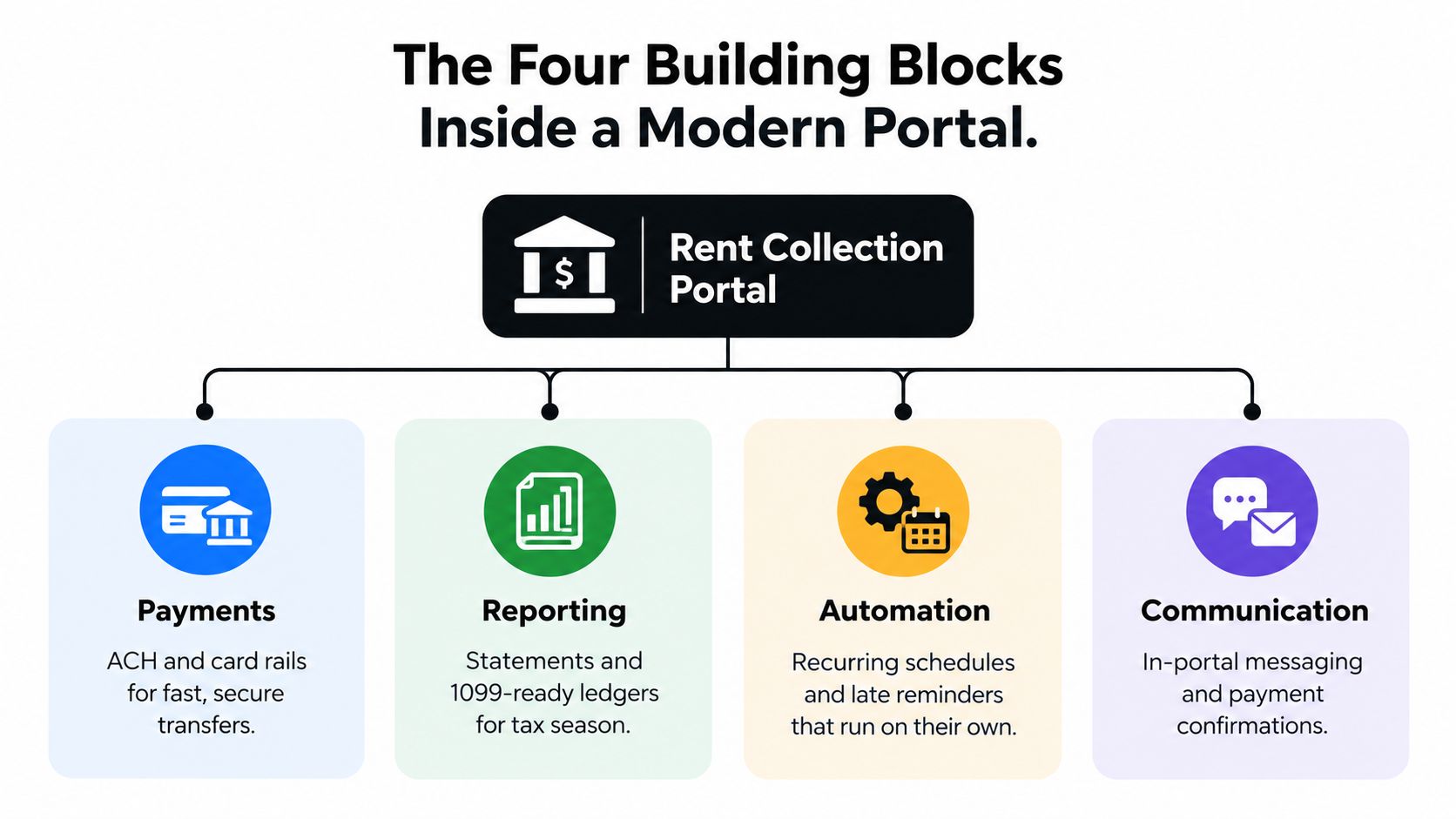
A portal is more than a payment button. It combines payments, reporting, automation, and communication, and each part replaces a task landlords often handle manually.
Payments
The payment layer connects the tenant to available rails, usually ACH bank transfer and card payment. It captures authorization, identifies the payer, and passes transaction status back to the property record. If an ACH payment is returned, the ledger should change from a received or pending state to unpaid or returned instead of leaving a misleading “paid” entry in place.
Reporting
Reporting turns transactions into usable property records. You should be able to review rent received by unit, outstanding balances, returned payments, and owner distributions without rebuilding the information in a separate spreadsheet. For a managed portfolio, the reporting layer should also support clear monthly statements and an export that your accountant can understand.
Automation
Automation handles predictable events. A tenant can authorize recurring rent, receive a reminder before the due date, and get an electronic receipt after the system records the payment. Automation reduces repetitive follow-up, but it shouldn't be configured as blind autopilot. Late-fee rules, failed-payment responses, and legally required notices still need careful review.
Communication
Communication gives the transaction a visible trail. A receipt shows what was submitted and when. A message can document a payment question, a returned transaction, or an agreed correction. That record is useful to both sides because it replaces “I thought you received it” with dates, notices, and transaction details.
Practical rule: Choose a portal that treats payment history as an accounting record, not just a collection of confirmation emails.
Payment Methods, Fees, and the Default That Matters
The first payment method a tenant sees shapes both adoption and your cost basis. ACH bank transfer is usually a low flat fee per transaction, while card payments commonly carry percentage-based fees, which makes them harder to ignore as rent amounts rise, especially if the owner absorbs the charge. The choice is not only about convenience. It is also about who pays for the rail, and how visible that cost is before the tenant clicks submit.
ACH also has a timing gap that first-time landlords can miss. A tenant may authorize or initiate a transfer before the money settles, so the portal should avoid marking rent as fully collected just because the payment screen showed success. Settlement can take 1 to 3 business days, and Same Day ACH is available in many cases, which is why the ledger has to track initiated, pending, and received as different states.
Card payments are useful for renters who want the option, but that flexibility comes with a trade-off. If you make cards the default, you may increase processing costs and create avoidable fee disputes. A cleaner setup is usually to make ACH the standard recurring method, keep cards available as an alternative, and show the fee policy before the tenant sends payment. For a side-by-side look at common rent collection methods, compare how each rail affects both cost and tenant behavior.
| Decision | ACH bank transfer | Debit or credit card |
|---|---|---|
| Cost structure | Generally a flat transaction cost | Commonly a percentage of the payment |
| Best operational use | Recurring rent and higher-value payments | Optional flexibility for tenants |
| Timing concern | Initiation and settlement may differ | Approval does not prevent declines or reversals |
| Policy question | Who pays the processing cost? | Is the fee passed to the tenant or absorbed? |
A 2024 analysis found that ACH or direct bank transfers accounted for 64.8% of digital rent transactions, while debit and credit cards represented 22.4%, according to Baselane's rent collection statistics. That split helps explain why the default setting matters. Before choosing a platform, compare the rails and fee rules against your own payment policy, not just the layout of the checkout screen.
The Underserved Question of Renter Access
A portal isn't automatically inclusive. A renter may have a job with changing hours, seasonal income, irregular commissions, or a bank balance that can't safely support an automatic withdrawal on the same date every month. Mandatory autopay can create overdraft risk or take away the tenant's ability to decide when to submit a manual payment.
A 2025 survey of 2,002 U.S. renters found that 39% still paid rent through traditional methods such as cash or check. Among those renters, 59% said online payment was unavailable to them, according to AppFolio's 2025 renter preferences report. Those figures don't mean every landlord should reject online payments. They show why a portal needs an access policy instead of a single compulsory workflow.
A more flexible payment policy
A balanced policy can allow:
- Manual ACH payments, so tenants can initiate rent each month without enrolling in autopay.
- Scheduled payments, for renters who know their pay date but don't want an open-ended recurring debit.
- Checks or documented cash workflows, where appropriate and legally permitted.
- Clear grace-period rules, including when a payment is considered late and when a fee may apply.
- Payment plans or hardship procedures, where the owner's policies and applicable law allow them.
The tenant should know which methods are accepted, which fees apply, how receipts are issued, and what happens after a payment fails. A portal then becomes more than a convenience app. It becomes a shared rent-accounting system that records different payment paths without forcing every household into the same financial arrangement.
Fees, Failed Payments, and Whether Portals Prevent Late Rent
A renter submits payment on payday, but the bank rejects it two days later. The portal may show a receipt, while the owner's ledger still needs a correction. That gap explains why online collection can improve records without guaranteeing on-time rent.
Offline payment methods have been associated with later rent. The important point is correlation, not proof that a portal caused punctual payment. Renters who choose digital tools may also differ in banking access, income stability, or financial habits. A portal can shorten the path from payment to ledger entry, but it cannot create funds that are not available.
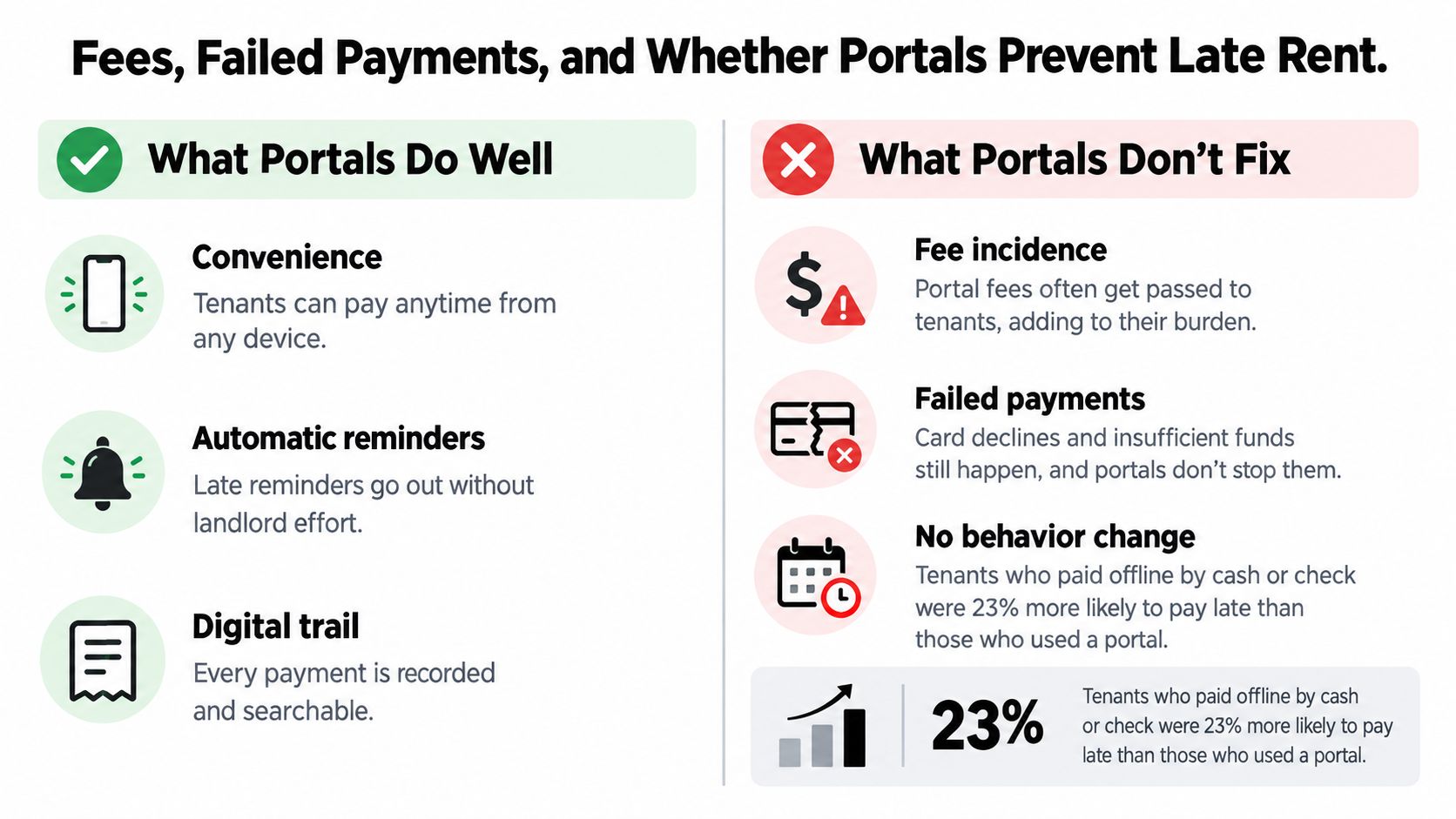
Fee design may matter more than the portal itself. The 2025 National Renter Survey reported that 35.0% of renters were charged convenience or service fees for paying rent through a particular method. It also reported that digital rent payments reached 51%, while offline tenants had the highest late-payment rate, peaking at 25%. These figures describe an association, not a cause-and-effect relationship. See the National Low Income Housing Coalition's survey findings.
Write the failure process before you activate the system
A tenant-facing policy should answer these questions in plain language:
- Who pays fees? State whether the owner absorbs ACH costs, the tenant pays card charges, or another arrangement applies.
- When does a late fee trigger? Identify the relevant date and any grace period, subject to applicable law and the lease.
- What happens after a rejection? Explain when the tenant is notified and whether another payment can be submitted.
- Can the tenant change methods? A failed card or ACH attempt should not leave the resident unsure whether another method is allowed.
- How are partial payments handled? Record the amount, date, remaining balance, and any written agreement.
- How are exceptions documented? Put hardship arrangements and corrections in the ledger and communication history.
Records matter during disputes. Guidance on dispute prevention for ecommerce can help landlords think through receipts, transaction records, and clear evidence. The property-management process should reverse a returned receipt, preserve the original transaction identifier, notify the tenant and manager, and apply only legally permitted charges disclosed in advance.
Security Architecture That Keeps Bank Data Out of Your Inbox
A landlord shouldn't ask tenants to email routing numbers or store account details in a spreadsheet. The safer design keeps sensitive credentials inside the payment processor's controlled environment, where the portal can use authorization records without exposing raw bank data to every employee who manages the property.
The basic controls should work together:
- TLS-protected connections protect data while it moves between systems.
- Tenant-direct entry lets the renter submit bank details inside the secured payment flow.
- Stored debit authorization records permission for recurring withdrawals.
- Role-based access limits what leasing, maintenance, accounting, and owner-reporting staff can view.
- Audit logs record access, changes, submissions, reversals, and administrative actions.
- MFA for administrators adds a second verification requirement beyond a password.
FFIEC guidance identifies TLS as a way to create authenticated, private channels between systems. NIST recommends MFA because a stolen password alone shouldn't grant access, and it identifies phishing-resistant authenticators as especially appropriate for privileged users handling personal or financial records, as summarized in the FFIEC authentication guidance.
Review access on a regular schedule
For a multi-property operation, review whether:
- Failed-login alerts are working.
- Former employees have lost access.
- Administrative accounts use MFA.
- Transport remains encrypted.
- Backups can be restored.
- Owner-statement exports remain complete and accurate.
Ask vendors specific questions instead of accepting “bank-level encryption” as a complete answer. Guidance such as these AgentStack security recommendations can help you frame broader questions about permissions, data handling, and administrative exposure.
How to Choose a Portal That Fits Your Portfolio
The cheapest portal may not produce the cleanest audit trail. Evaluate it as an accounting system that happens to take payments, and test the workflow with a real example before onboarding tenants.
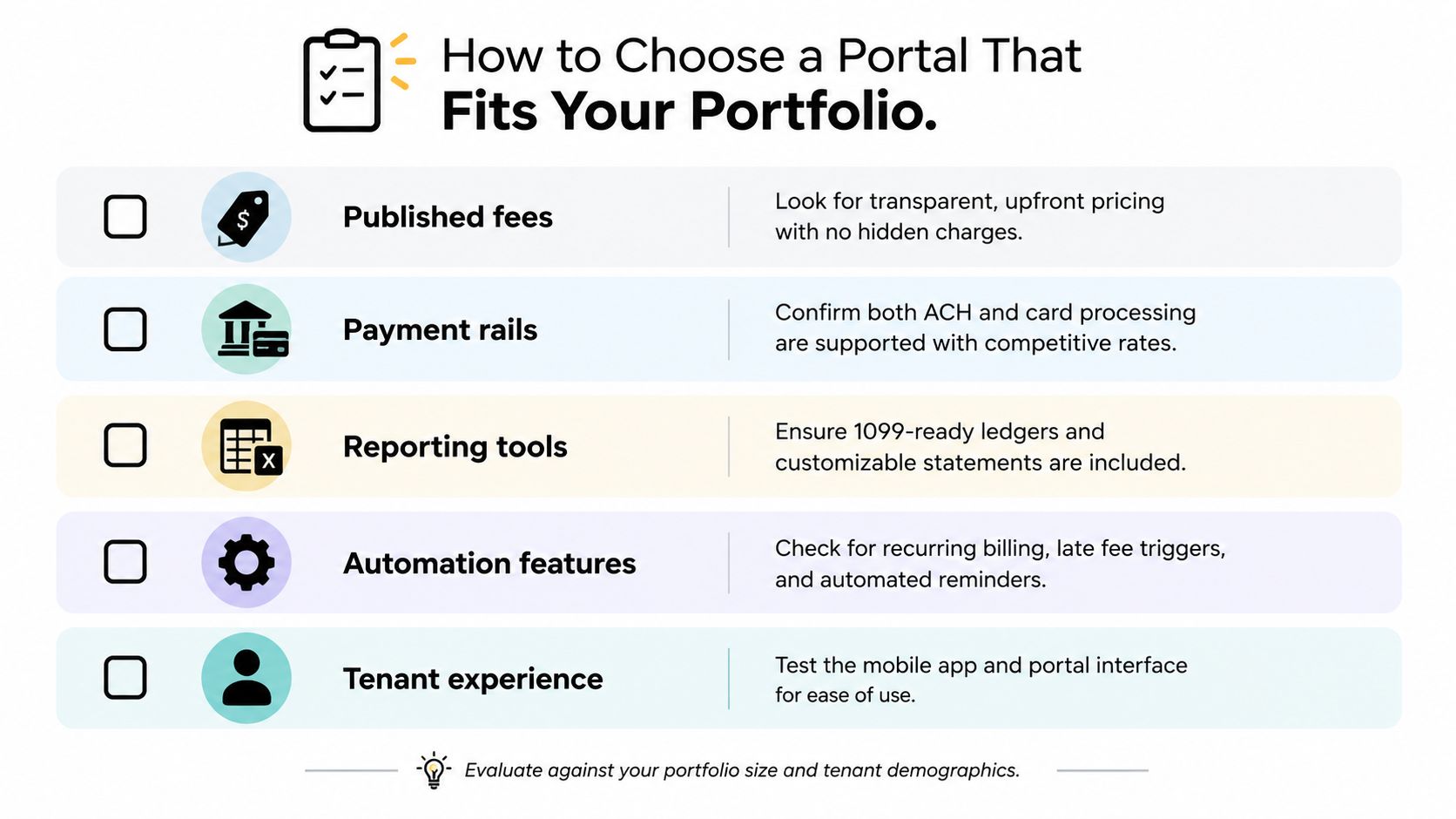
Bring these questions to a product demonstration:
- Published fees: Can you see every tenant and owner charge before activation?
- Payment states: Does the system distinguish scheduled, initiated, settled, and returned?
- Reporting depth: Can it produce understandable owner statements and detailed transaction exports?
- Role separation: Can accounting view payment records without giving maintenance access to financial information?
- Tenant access: Can renters use manual ACH, scheduled payments, and approved alternatives without mandatory autopay?
- Failure handling: Does a returned payment reverse the receipt, preserve its identifier, and trigger the right notices?
- Integration: Can the portal connect cleanly with your existing accounting workflow?
A single rental may need only basic payment records and receipts. A larger portfolio needs property-level reporting, owner distributions, permissions, and reliable exception handling. Compare the tenant experience on a phone as well as the manager dashboard on a computer, because a technically capable system can still fail if renters can't understand how to use it.
Putting It Together and What to Publish Before Onboarding
Before inviting tenants into a portal, publish a short payment-access policy. Name the accepted payment methods, identify who pays processing fees, explain when a payment is considered received, and describe what happens after a failed or returned transaction.
Also state whether autopay is optional, whether manual ACH is available, which alternatives are accepted, and how grace periods or hardship arrangements are handled. Give owners and staff the same written rules, then configure the portal to match them.
The right standard is not maximum automation. It is transparent collection with a dependable accounting trail, without making rent more expensive or excluding renters who can't maintain a stable bank balance. A portal should help you see what was scheduled, what settled, what returned, and what still needs human attention.
Edinhart Realty and Property Management supports full-service management with rent collection, automated payment options, tenant communication, repair coordination, and detailed accounting statements, while its placement-only service supports owners who prefer to manage ongoing operations themselves. Visit Edinhart Realty and Property Management to discuss a rent collection process that fits your properties, team, and tenants.


