

A Fresno landlord usually notices a lease renewal too late. The tenant has already started comparing listings, a repair is still open, and the owner is deciding between a rushed rent increase and an expensive vacancy. By then, the useful negotiating window has mostly disappeared.
Lease renewal terms should be managed as a 120-day business decision, not a signature request. You need time to inspect the property, review the tenant's record, compare current rents, select the right term, calculate any increase, and deliver legally effective notice. The right renewal may mean a higher rent, a longer commitment, a smaller increase, or keeping a reliable tenant in place.
Why Lease Renewals Deserve More Attention Than They Get
A Fresno owner once waited until the final month to ask a tenant about renewal. The tenant had paid reliably, cared for the home, and might have stayed. But the owner had no finalized offer, no documented rent analysis, and no answer to a basic maintenance complaint. The tenant moved out, the property sat vacant during turnover, and the owner absorbed the cost of preparing and re-leasing the unit.
That outcome wasn't caused by one bad decision. It came from treating renewal as paperwork instead of revenue management. A vacancy can remove rent while the owner pays for cleaning, repairs, advertising, showings, screening, and leasing work. Retaining a sound tenant often protects income more effectively than chasing the highest possible renewal figure.
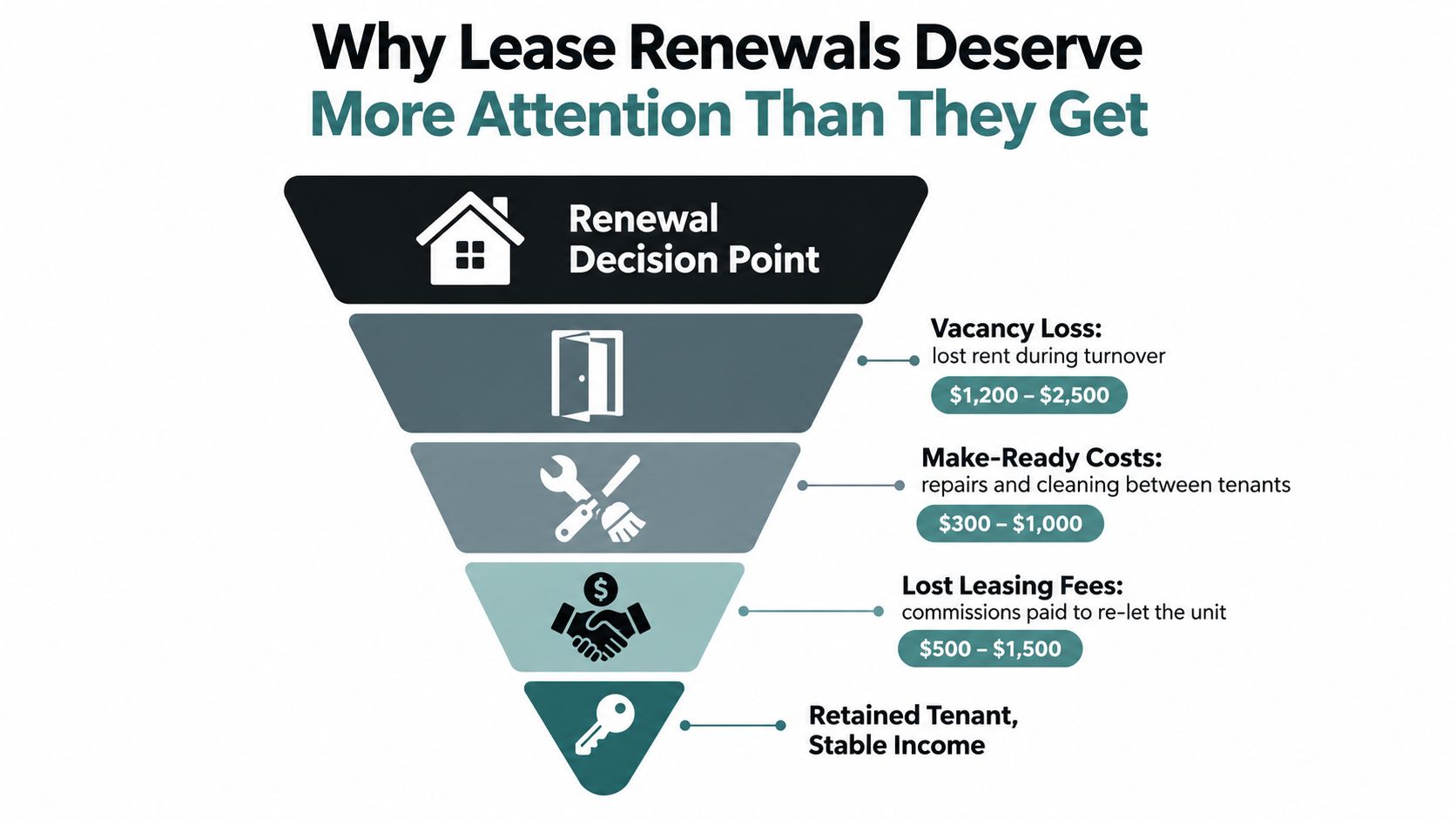
Treat renewal as a funnel
Start with every lease expiring in the next 120 days. Then narrow the group by payment history, maintenance conduct, property condition, market position, and tenant intent. The final decision should answer two separate questions:
- Rent decision: Should you hold the rent, raise it modestly, or push toward the top of the comparable range?
- Term decision: Should you sign another fixed term or allow a month-to-month continuation?
A strong renewal process gives you options before the tenant does. You can repair a concern, adjust the offer, prepare for a vacancy, or approve a different lease length without making a pressured decision.
Practical rule: The best renewal offer isn't the one with the largest nominal increase. It's the one that produces the strongest net result after vacancy, turnover, repairs, leasing costs, and tenant quality.
The evidence supports early action. Industry data reports renewal rates of roughly 70–82% when decisions are obtained on time, compared with 32–47% when decisions are late or unresolved (multifamily retention research). Those figures are benchmarks, not promises, but they point to a practical conclusion: unresolved renewals should be treated as an operational risk.
At 120 days, you can negotiate. At 30 days, you may only be reacting. Run every expiration through the same funnel, then make exceptions based on tenant quality, property plans, and California compliance.
A 120-Day Renewal Calendar That Works in California
A renewal calendar needs an owner, a document, and a next action at every checkpoint. Put the dates in your property management software or a shared spreadsheet. Don't rely on a calendar reminder that says only “renewal due.”
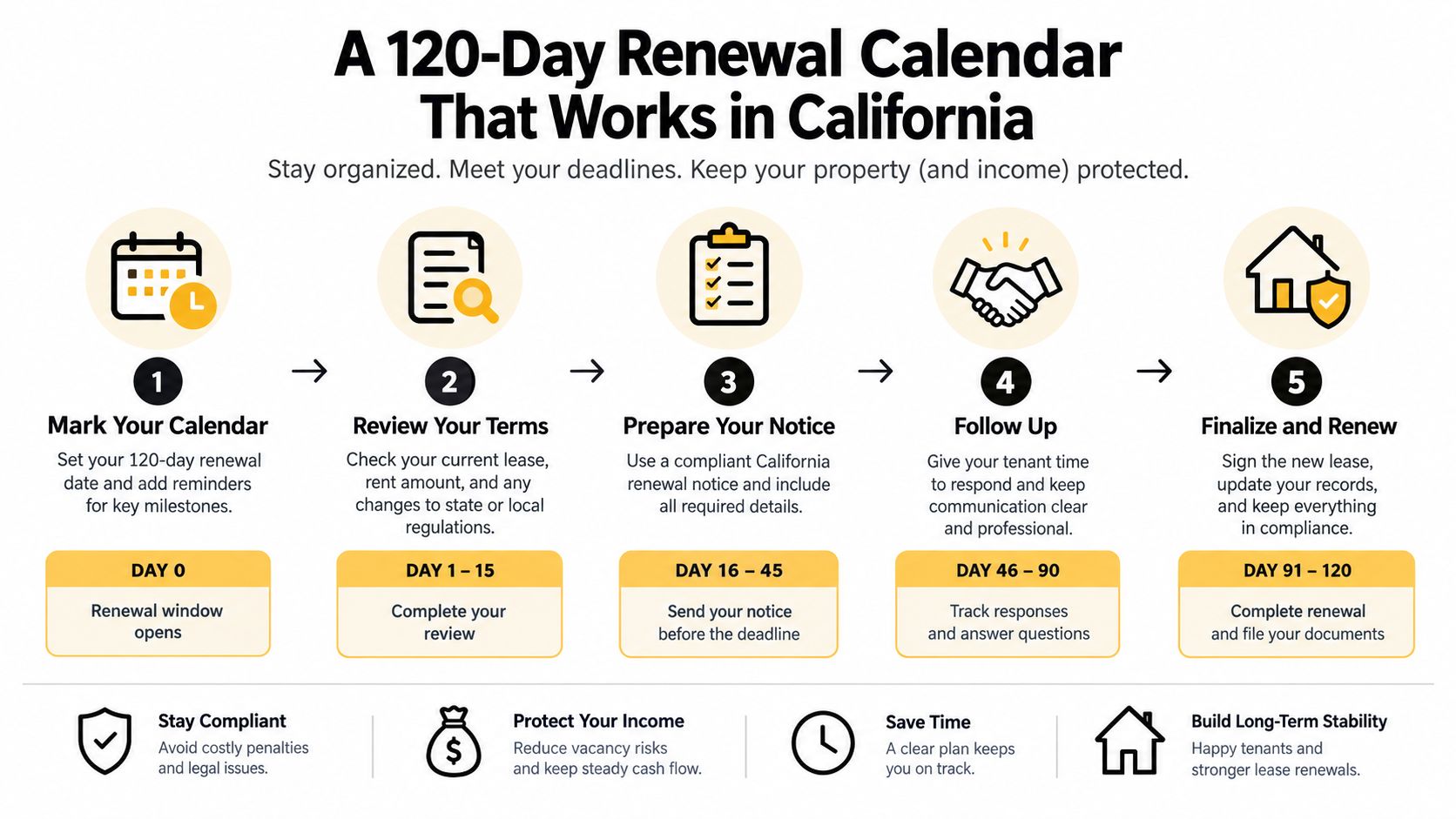
Day 120 starts the review
The property manager should pull the lease, payment ledger, maintenance history, violation records, and prior notices. Confirm the legal owner, tenant names, current rent, lease expiration date, deposit records, and whether the property may fall under an exemption or local rule.
At this stage, don't quote a new rent. First classify the tenant as stable, uncertain, or at risk. Resolve serious maintenance issues before presenting lease renewal terms. A tenant who reports a problem and receives no response is already giving you a reason for nonrenewal.
Day 90 tests the property and the market
Complete a documented condition review, subject to proper entry notice and tenant coordination. Record deferred maintenance, appliance concerns, safety items, and improvements that affect the proposed rent.
Pull comparable Fresno or Central California listings that resemble the property in location, size, condition, parking, amenities, and included utilities. Save the listings rather than relying on a verbal estimate. Your renewal file should show how you reached the proposed amount.
Day 75 presents the offer
Send a written renewal offer with the proposed rent, new term, effective date, response deadline, and any changed provisions. If you're offering choices, make each option easy to compare. A reliable tenant may prefer a longer fixed term, while another may value flexibility.
Use a clear California lease renewal notice process as an administrative reference, but confirm the actual notice requirements for the proposed change before sending anything legally significant.
Day 60 and Day 30 close the file
At day 60, follow up, answer objections, and verify that any rent-change notice was served through a legally compliant method. At day 30, obtain the signed agreement or prepare the property for a possible turnover. Never treat silence as acceptance.
California renewal performance depends on timing and proof. Keep the offer, calculation, notice, service record, tenant response, and executed agreement together. This creates an audit trail if the tenant later disputes the amount or effective date.
Use this short training video as a staff reminder for the workflow:
Choosing Between a New Term and Month-to-Month
A fixed-term renewal and a month-to-month continuation serve different business purposes. Don't let the existing lease roll over just because nobody made a decision.
Bureau of Labor Statistics data from January through June 2022 found that 59.6% of leases lasted 12 months, 31.8% were month-to-month, and 8.6% used another duration (BLS housing lease data). The same data shows why tenant tenure matters. Among residents who had occupied a unit for five or more years, only 49.7% held a 12-month lease, which means long-term residents were much more likely to remain on periodic terms.
Sign a fixed term when stability has value
Offer another fixed term when the tenant pays on time, maintains the home, communicates well, and fits the property plan. A written term gives both parties a defined end date and makes income easier to forecast. It also gives you a chance to update provisions instead of allowing outdated language to carry forward.
A fixed term is usually the stronger choice when:
- The tenant is profitable: Low turnover risk and dependable payment justify stability.
- The property has a predictable plan: You aren't expecting a near-term sale, major renovation, or owner move-in.
- The tenant wants certainty: A clear end date and rent amount can support retention.
Use month-to-month deliberately
Month-to-month can make sense if you may sell, renovate, occupy the property, or change the management strategy. It preserves flexibility, but flexibility has a cost. Income becomes less predictable, and the tenant may leave with less lead time than a fixed-term resident.
Document the periodic arrangement in writing. State the rent, payment date, continuing provisions, notice expectations, and any changed terms. Don't describe it casually as “just staying for now.”
The decision tree is straightforward. Stable tenant plus stable property plan means fixed term. Likely sale or renovation means consider month-to-month. Unclear facts mean investigate before choosing. Indefinite rollover without a written review is not a strategy. It leaves the owner with an outdated file and the tenant with unclear expectations.
California Rent Increase Timing and Notice Rules
A lease renewal isn't automatically a rent-increase notice. In a fixed-term agreement, the rent generally can't change before expiration unless the lease allows it. At renewal, you must separate the negotiated new term from the statutory notice required for the rent adjustment.
California Civil Code section 827 requires at least 30 days' written notice for an increase totaling 10% or less within a 12-month period, and at least 90 days' notice for an increase exceeding 10%. Personal delivery or compliant mail service is required. A telephone call, text message, or email alone isn't enough (California Civil Code section 827).
Calculate the increase correctly
Use the highest rent charged during the preceding 12 months as the relevant base for the calculation. For example, an increase from $1,400 to $1,500 is a $100 increase, or about 7.1%, which falls within the 30-day notice category. An increase from $1,400 to $1,600 is a $200 increase, or about 14.3%, which requires 90 days' notice.
Those examples explain timing only. The permitted amount may be lower because covered California properties generally fall under a statewide cap equal to the lower of 5% plus the regional cost-of-living adjustment or 10%, subject to exemptions and local rules. The applicable cap changes by county and effective period, so don't use a stale percentage from an old renewal file.
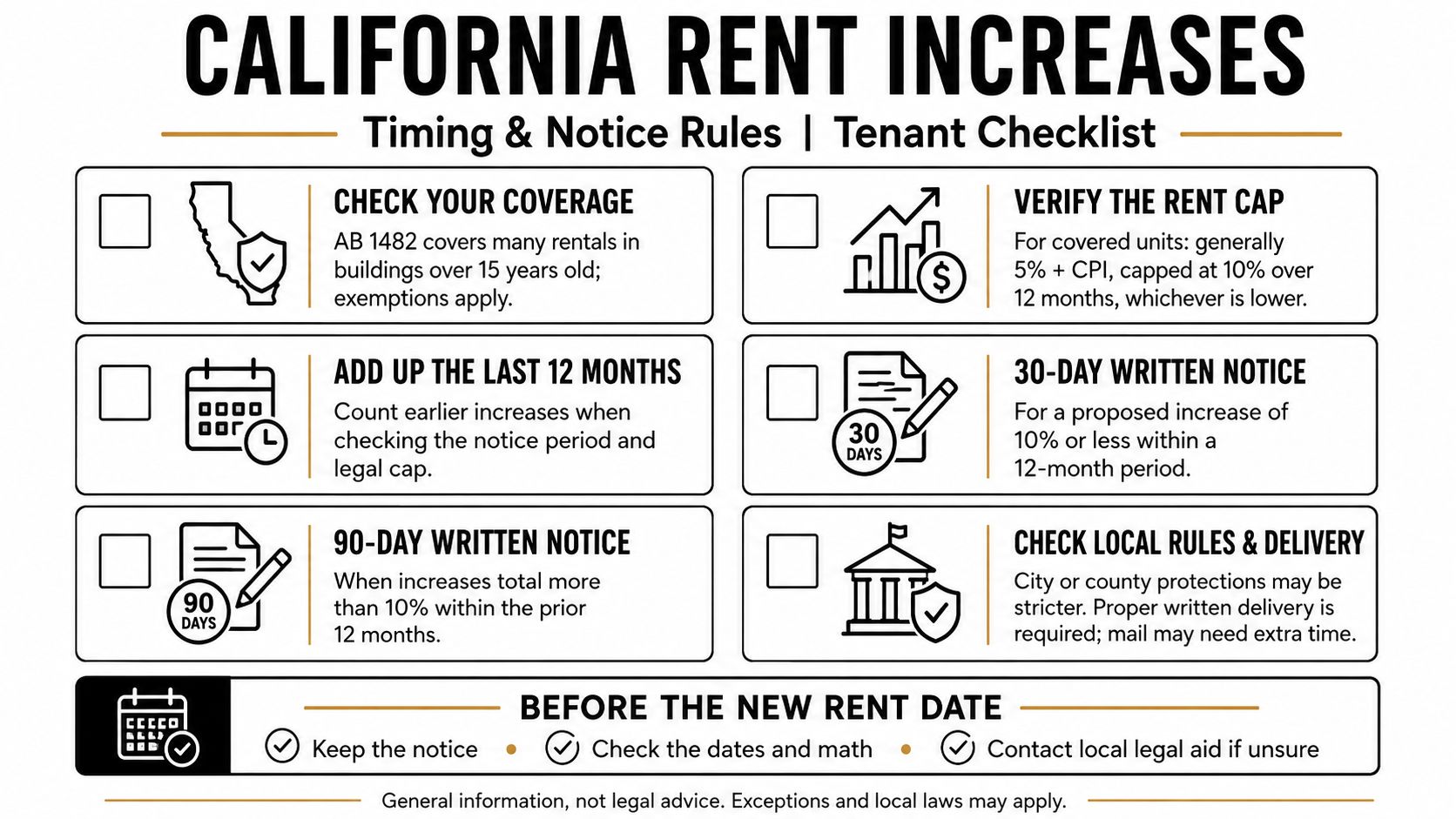
Put the required details in writing
A defensible renewal offer should identify:
- Current and proposed rent: State both amounts and the effective date.
- Lease dates: Name the existing expiration date and proposed new term.
- Response deadline: Give the tenant a clear date for accepting or declining.
- Notice method: Preserve proof of personal delivery or compliant mailing.
- Changed provisions: Identify revised utilities, pets, maintenance duties, or addenda.
For covered tenancies, California Civil Code section 1946.2 generally requires just cause to terminate after 12 months of continuous lawful occupancy, with the cause stated in the written termination notice (California Civil Code section 1946.2). Check coverage and exemptions before framing a nonrenewal decision.
A practical offer sentence can read: “Your current lease ends on 2026. We offer a new [term] beginning 2026 at $[rent] per month. Please respond by 2026. Any rent adjustment is served separately through the legally required notice method and effective date.” Have counsel review unusual facts, exemptions, or disputed notices.
The Keep the Tenant or Raise the Rent Decision
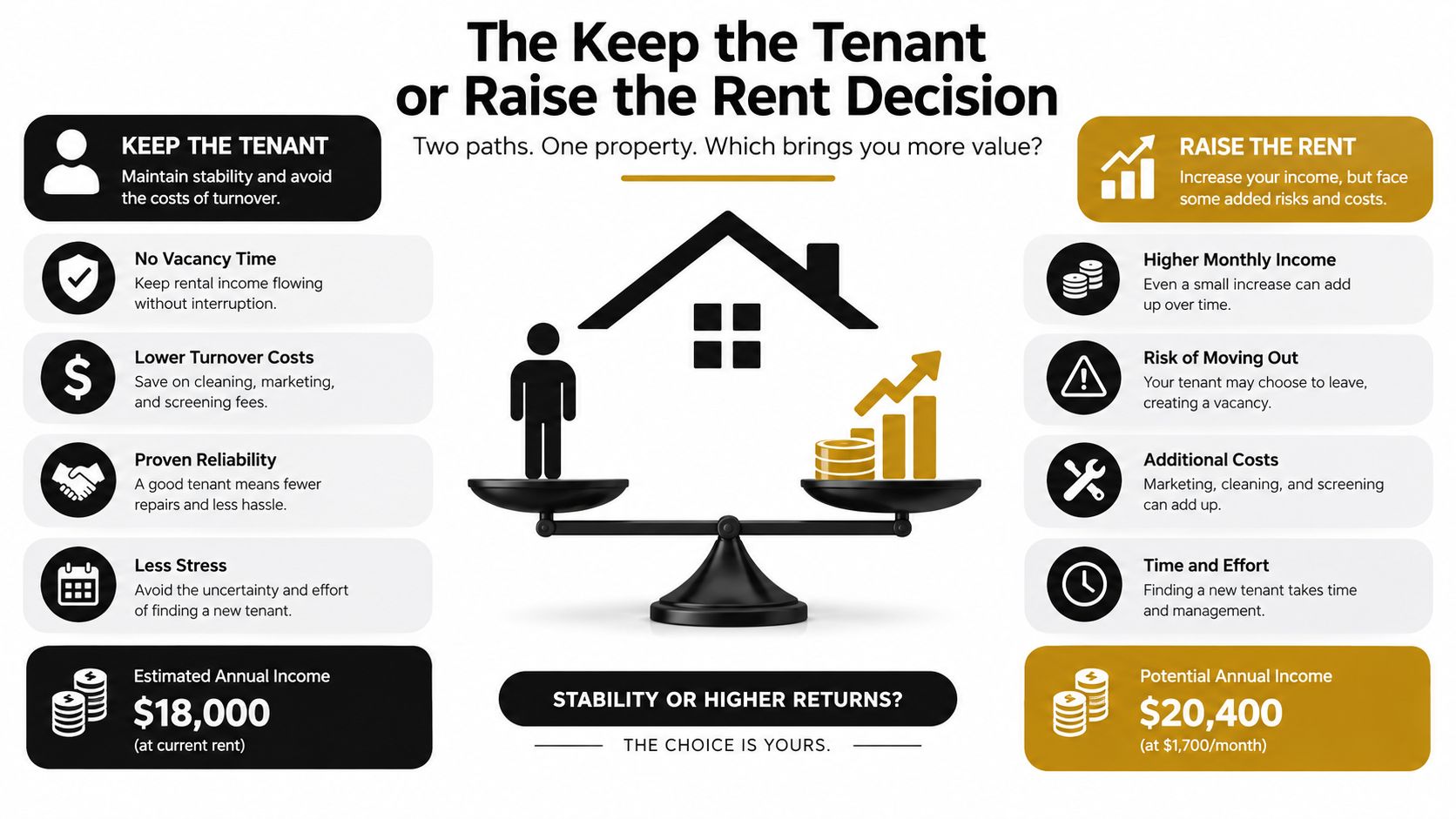
The right question isn't “How much can I raise the rent?” It's “What rent produces the best result after the tenant's probability of staying and the cost of turnover?”
Current market direction matters. Realtor.com data cited in recent coverage placed median asking rent across the 50 largest U.S. metros at $1,686 in May 2026, down 1.5% year over year, while Apartment List reported the same annual decline (market indicators and renewal strategy analysis). A Fresno owner shouldn't assume that a legally permitted increase is also a market-supported increase.
Build the decision from your own numbers
Create a simple turnover worksheet. Enter the rent difference from the proposed increase, likely vacancy loss, cleaning, repairs, landscaping, utilities, advertising, leasing fees, concessions, and staff time. Then compare that cost with the expected income from retaining the current tenant.
Don't invent a turnover estimate for the worksheet. Use your own invoices and prior vacancy records. The point is to calculate a break-even amount that reflects your property, not a national average.
| Renewal approach | Use it when | What to protect |
|---|---|---|
| Hold rent | The tenant is reliable, low-maintenance, and clearly below market only modestly | Occupancy and goodwill |
| Raise to market with a modest discount | The tenant is strong and the property needs a measured adjustment | Retention and rent alignment |
| Raise to market without a concession | The property is well-positioned and the tenant has few alternatives | Clean documentation and service |
| Push above market | The tenant is already likely to leave or the property has exceptional value | A vacancy plan and legal review |
A useful pricing decision also considers payment history, maintenance behavior, lease compliance, property condition, and the cost of finding a replacement. A tenant who pays on time and prevents avoidable damage may be more valuable than a higher asking rent from an unknown applicant.
Owner test: If the increase makes the tenant leave, can the additional rent recover the vacancy and turnover cost before the next lease cycle? If the answer is no, lower the increase or improve the offer.
The most defensible offer is often a choice. Present a market-aligned fixed term, a longer term with a different rent structure, or a month-to-month option at a clearly stated amount. Keep the decision matrix in the renewal file so the owner can explain why the chosen terms made financial sense.
Clauses Worth Updating at Every Renewal
A renewal is your chance to correct unclear language before it creates a dispute. Don't copy the old agreement forward without checking whether the property, tenant household, services, or legal disclosures have changed.
Start with the occupancy and pet terms. Confirm every adult occupant, approved animal, assistance-animal documentation, pet deposit treatment, and any pet-related responsibility. A practical sentence might read: “Only the occupants listed in this agreement may reside at the premises, and any change requires prior written approval as permitted by law.”
Review maintenance and utilities next. State who handles routine filters, yard care, pest reporting, appliance service, and utility accounts. Avoid vague promises such as “tenant handles maintenance.” Identify the duty and the reporting method.
Update operational provisions
Check these clauses individually:
- Security deposit: Confirm the amount, permitted use, and move-out accounting process.
- Entry and notice: Make sure the provision matches current California requirements and explains how access requests are communicated.
- Utilities: Identify the account holder, allocation method, billing timing, and any shared-service arrangement.
- Insurance and risk: State any required renter insurance language without shifting duties that the law doesn't allow you to shift.
- Addenda: Recheck parking, solar, ADU, smoking, mold, lead-based paint, local requirements, and any property-specific disclosures.
California's just-cause rules also affect how you think about termination language. Section 1946.2 generally requires a covered tenancy's just cause to appear in a written termination notice after 12 months of continuous lawful occupancy. Don't insert a broad “owner may terminate at any time” clause and assume it overrides statutory protections.
For a broader clause-by-clause review, the Lerner & Weiss lease guide offers a useful reminder to examine obligations, renewal mechanics, and risk allocation rather than focusing only on rent. For residential owners, Edinhart's lease agreement provisions guide can help organize the items that belong in the written agreement.
Tell the tenant what changed. A short renewal summary listing the new rent, term, deposit treatment, utilities, pet rules, and revised addenda prevents the tenant from discovering important terms only after signing.
Putting It Together With a Renewal Checklist
Print this checklist and keep it inside the lease file:
- Start early: Open the review 120 days before expiration.
- Review the record: Check payment history, maintenance requests, notices, occupants, pets, and violations.
- Inspect the property: Document condition and unresolved work before making the offer.
- Price from evidence: Save comparable listings and calculate the proposed change against the correct rent base.
- Choose the term: Decide between a fixed renewal and month-to-month based on tenant quality and property plans.
- Serve notice correctly: Record the notice content, delivery method, delivery date, and proof of service.
- Set a deadline: Require a written response and prepare for renewal or turnover.
- Execute the agreement: Confirm signatures, dates, rent, addenda, disclosures, and promised work.
- Track the result: Measure signed renewals against leases expiring during the same period, then segment by property, notice timing, rent-change band, and communication channel.
Three habits separate disciplined owners from reactive ones. Start 120 days early. Document every notice and decision. Track net income rather than headline rent. A renewal that produces slightly less rent but avoids a costly vacancy may be the stronger investment decision.
Technology can reduce missed follow-ups, but it doesn't replace judgment. A support workflow such as SupportGPT's guide to support agents illustrates how structured communication can help teams handle recurring questions and keep conversations organized. For the signed paperwork itself, use a consistent lease renewal form and retain the completed file with the supporting calculations.
The right lease renewal terms should work for both sides. The tenant needs a rent they can sustainably pay, and the owner needs income that covers financing, taxes, insurance, maintenance, vacancy risk, and management effort. Push when the property and tenant facts support it. Give ground when retaining a strong resident protects the better net return.
Edinhart Realty and Property Management helps Fresno-area owners manage tenant communication, lease drafting, renewal timing, repair coordination, and documented property operations. Visit Edinhart Realty and Property Management to discuss a renewal process that fits your rental, whether you need full-service management or placement support.


