

Two applications hit your inbox at the same time. One applicant has strong income, polished pay stubs, and a clean credit profile, but their rental history is thin and the addresses don't line up cleanly. The other looks stable on paper too, except they recently moved to California from another country and don't have a standard U.S. lease trail. Both could be excellent tenants. Either could also become an expensive mistake.
That's where rental history verification stops being paperwork and starts becoming risk control. A credit report can tell you whether someone has handled debt. It usually can't tell you whether they paid rent on time every month, respected lease terms, maintained a property, or created ongoing problems for neighbors and management. Those are landlord issues, not just lending issues.
In California, this process also sits inside a legal framework that landlords can't afford to treat casually. Screening has to be structured, documented, consistent, and consent-based. Sloppy verification creates two problems at once. It weakens your decision-making, and it increases legal exposure.
A professional approach does more than spot red flags. It helps you distinguish between a fabricated story and a legitimate nontraditional applicant. That matters in a market where many qualified renters don't fit the old model of “long lease history, same employment pattern, same city for years.”
Introduction
Most landlords don't lose money because they skipped one dramatic warning sign. They lose money because they approved an applicant with a story that sounded fine, but wasn't fully verified.
Rental history verification is the part of screening that tests whether the applicant has performed well as a tenant. It answers practical questions that matter after move-in: Did they pay rent on time? Did their tenancy dates match what they claimed? Did they leave the unit in reasonable condition? Would the prior landlord rent to them again?
In day-to-day property management, those answers often matter more than a polished application packet. Applicants know how to present themselves well. A rigorous screening process checks whether the record underneath the presentation is consistent.
California landlords need that rigor. Between Fair Housing obligations, privacy concerns, consent requirements, and local screening restrictions that can vary by jurisdiction, rental history verification has to be both careful and repeatable. The strongest systems don't rely on intuition. They rely on documentation, verified sources, and the same standards for every applicant.
Practical rule: If your process only works when an applicant is easy to verify, your process isn't strong enough.
The good news is that rental history verification doesn't have to be slow or chaotic. When it's built correctly, it becomes a dependable screening layer that protects the property, supports fair decisions, and keeps the leasing process moving.
What Is Rental History Verification and Why It Matters
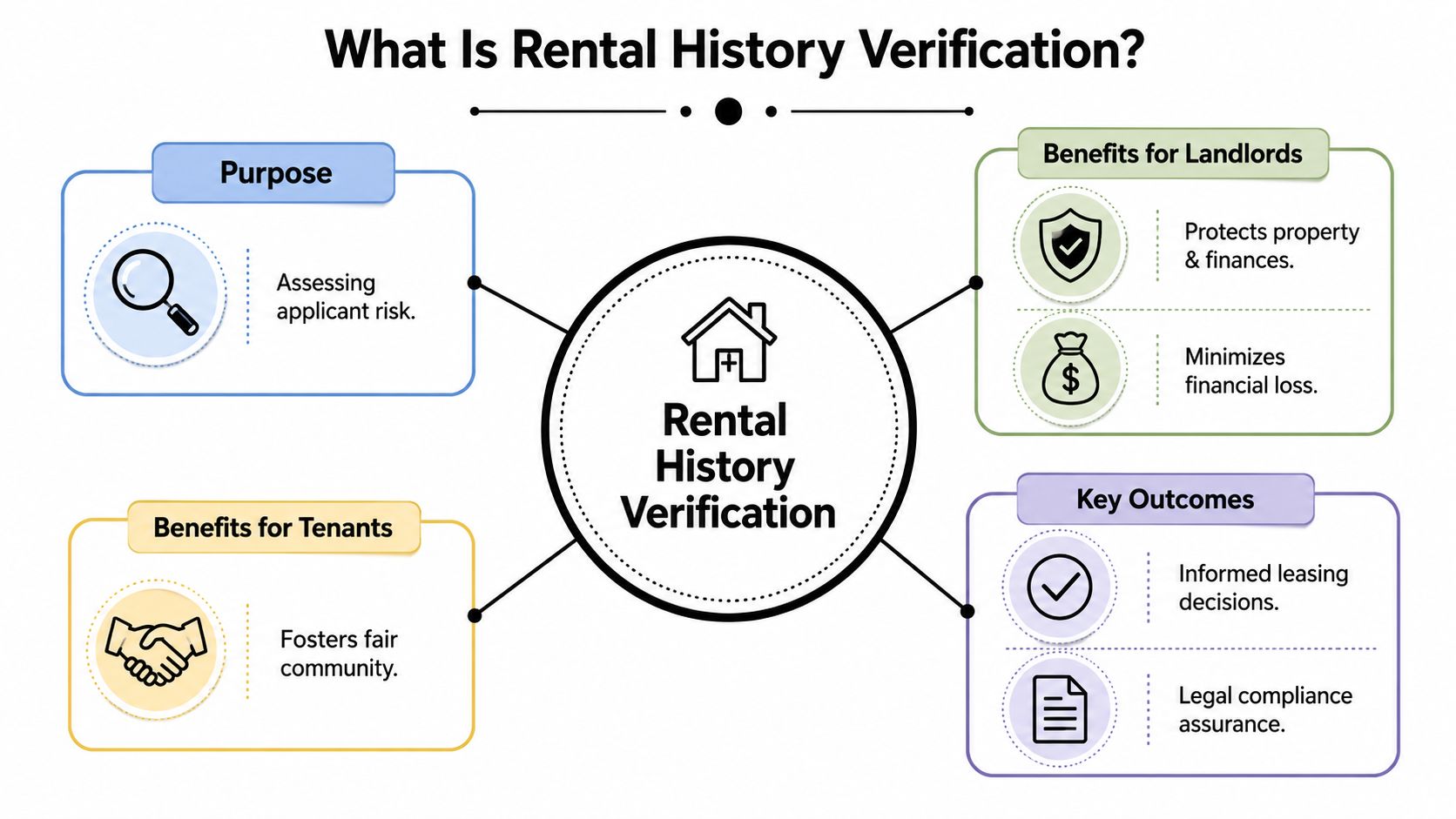
Rental history verification is a reference check for housing. The application tells you what the tenant says happened. Verification tests whether the facts hold up.
A lot of landlords blur this with a credit check. That's a mistake. Credit history shows how someone has handled financial obligations that lenders report. Rental history shows how someone behaved in the exact relationship you're about to enter: tenant, landlord, property, lease, and community rules.
What this process is designed to uncover
A solid verification process looks past surface-level qualifications and asks whether the applicant's prior tenancy was stable and truthful.
Key signals include:
- Address accuracy. Do the listed residences match the applicant's timeline?
- Lease continuity. Are there unexplained gaps, overlaps, or impossible date sequences?
- Payment behavior. Was rent generally paid as agreed, or was there a recurring pattern of delinquency?
- Lease compliance. Did the applicant follow rules on occupancy, pets, noise, and unauthorized residents?
- Move-out quality. Was the unit left in acceptable condition beyond ordinary wear?
Those details matter because tenancy risk is operational. Landlords don't just need someone who can qualify on paper. They need someone who can perform under a lease.
Why old-school verification often falls short
Calling previous landlords is still useful, but by itself it's incomplete. A 2018 NMHC survey found that about 75% of managers reported routinely contacting previous landlords, yet only about 45% said they received responses from prior landlords in the majority of cases, according to Azibo's summary of rental history reporting practices. That response gap is one reason experienced managers don't rely on one phone call and call it done.
Some landlords don't answer. Some records are old. Some ownership changed. Some references are unreliable.
Good screening doesn't assume every reference is real, available, or complete.
Why the process protects both sides
For landlords, rental history verification reduces guesswork. For tenants, it creates a more objective process than snap judgments based on income alone, accent, age, or presentation. That matters in California, where consistent criteria and documented decisions are part of staying compliant.
A tenant with an average credit profile but a strong tenancy record may be lower risk than a higher-income applicant with vague prior housing. Verification helps you make that distinction with evidence instead of instinct.
What Landlords and Screening Services Actually Check
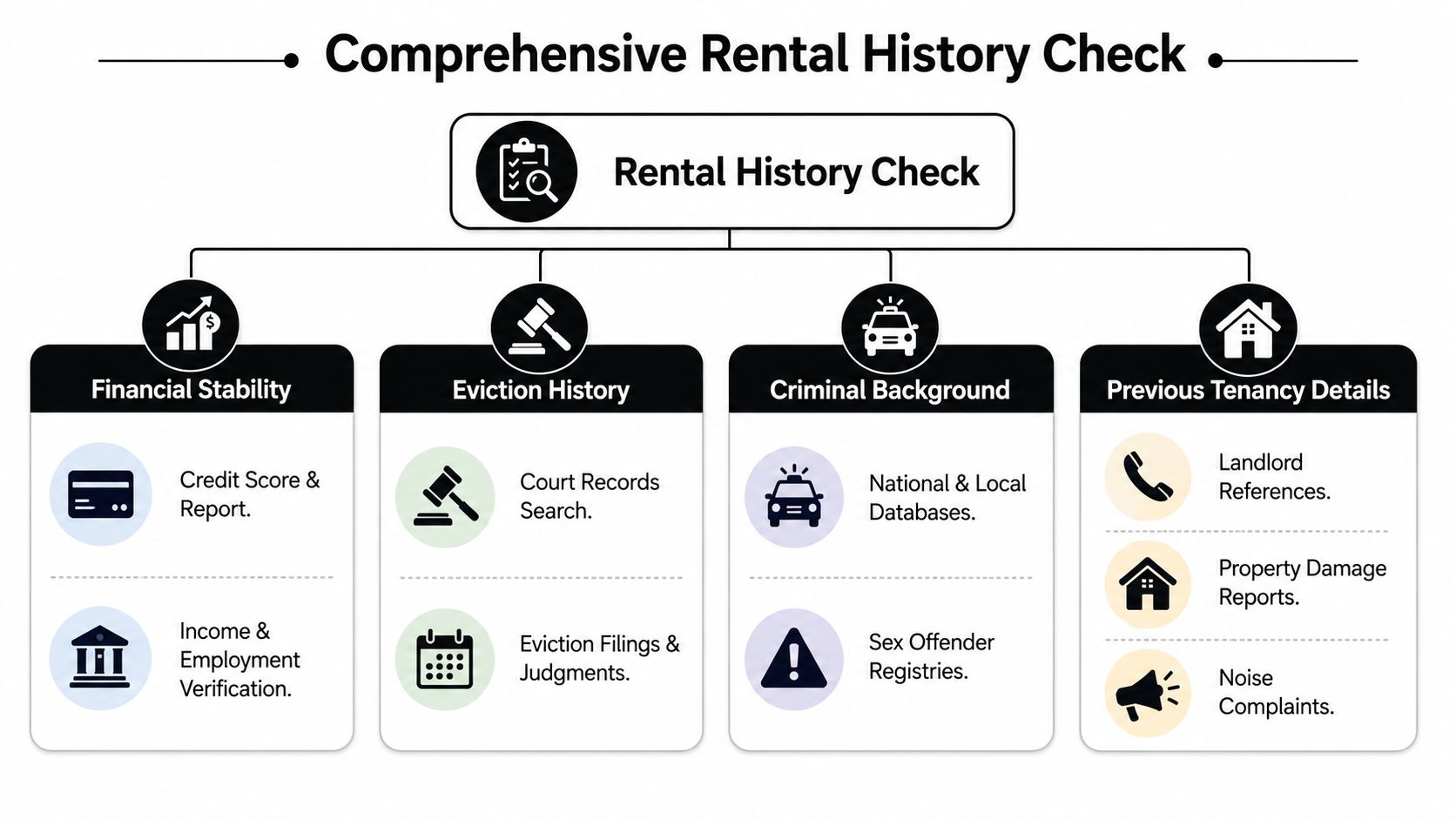
A screening file becomes more reliable when the facts line up from more than one source. Professional verification means comparing what the applicant reported against identity records, address history, rental payment data, court records, and a prior housing provider who can credibly confirm the tenancy.
The core items that matter
The best reviews focus on a small set of high-signal details. Long questionnaires often produce noise. Clear lease facts and consistent timelines produce usable screening decisions.
A strong review typically checks:
- Identity and address history. The applicant's legal name, prior residences, and occupancy dates should match the application, identification, and screening records.
- Lease dates. Date mismatches are one of the fastest ways to catch invented rental history, omitted moves, or overlapping addresses that need explanation.
- Rent amount and payment pattern. Reported rent should make sense for the unit and market. Late payments, partial payments, and unexplained gaps matter more than a vague statement that rent was “usually paid.”
- Prior landlord willingness to re-rent. This tends to produce more useful information than broad character questions.
- Lease violations and property care. Repeated noise complaints, unauthorized occupants, unauthorized animals, smoking violations, and avoidable damage often predict future management issues.
In California, I also pay attention to context. A clean record with one ownership transition or one poorly documented tenancy is different from a file with shifting stories, unverifiable contacts, and dates that do not reconcile.
Where the data comes from
Direct contact with a prior landlord still has value, but it should not stand alone. Managers often compare landlord feedback with address databases, public records, and rental tradeline reporting where available. Experian describes RentBureau as the largest rental payment database and states that it contains rental payment history data on more than 25 million U.S. consumers in its RentBureau tenant screening product materials. Used properly, that kind of reporting helps confirm whether an applicant's stated housing history matches independent records.
For owners who want a broader understanding of applicant vetting methods beyond rent performance alone, resources on discreet background checks can help clarify how identity, history, and documentation review fit together. It is not a substitute for compliant tenant screening, but it does show why independent confirmation matters.
Some landlords also run a separate credit review so they can compare payment capacity with tenancy performance. If you want a practical comparison of those two screening layers, this guide on how to check credit for a tenant explains where credit analysis ends and rental history review begins.
Why shortcuts create risk
Weak verification usually breaks down in predictable ways. The landlord either misses a material fact or relies on information that cannot be defended later.
That is why informal habits cause problems. Social media searches are inconsistent. Text-message references are easy to fake. A phone number supplied by the applicant may reach a friend, not a real housing provider. The better practice is to confirm who owned or managed the property during the claimed tenancy, then compare that answer against the dates and rent figures in the file.
A useful verification process is skeptical without being arbitrary. It checks facts, applies the same method to each applicant, and leaves a clear record of why the file was approved, denied, or sent for further review.
Navigating Legal Compliance and Consent in California
California landlords need to treat screening like a controlled process, not an improvisation. The legal side starts before the first phone call to a prior landlord.

A compliant workflow requires written authorization before contacting prior landlords, and the most valuable fields to verify are lease dates, rent amount, payment history, and whether the prior landlord would rent to the applicant again, as outlined by LeaseRunner's rental verification guidance. That written authorization isn't a courtesy. It's the beginning of a defensible file.
How a compliant California workflow looks in practice
In a disciplined process, the application comes in first. The authorization language is clear. The criteria are already set before anyone looks at the individual applicant. Then the file moves through the same sequence used for every other applicant.
That matters in California because screening decisions can trigger scrutiny from more than one direction. Federal law, state privacy expectations, and local housing rules all intersect here. A landlord who asks casual extra questions of one applicant, waives steps for another, or uses inconsistent standards creates unnecessary exposure.
For owners trying to understand the broader framework behind these decisions, this overview of California landlord tenant law is a useful companion to the screening process itself.
What experienced managers do differently
A seasoned manager doesn't just collect information. They document why each step was taken, where the information came from, and whether the same standard was applied to every applicant.
That means:
- Using the same written criteria for all applicants
- Obtaining consent before screening or landlord outreach
- Limiting questions to tenancy-related issues
- Keeping records of calls, reports, and decision points
- Avoiding off-list criteria that drift into subjective judgment
One common California mistake is confusing “more information” with “better information.” Extra questions that aren't relevant to tenancy can create problems. Focused questions tied to lease performance are safer and more useful.
This short video gives a helpful visual overview of the legal mindset landlords should bring to screening and housing compliance.
The practical standard
When I review screening systems, the best ones share one trait. They're boring in the right way. Same forms. Same sequence. Same documentation. Same standards.
The more consistent your process is before a dispute, the more credible it is if a dispute ever happens.
California landlords don't need a complicated process. They need one that is written down, legally aware, and repeatable every time.
A Professional's Guide to the Verification Process
At 4:30 p.m. on a Friday, an applicant looks ready to approve. Income appears solid. Credit is acceptable. Then the rental history starts to wobble. One address does not match the application, the listed landlord number routes to a friend, and a gap in occupancy has no clear explanation. That is where a disciplined verification process earns its keep.
In practice, good rental history verification is an ordered review. Start with the file. Then confirm the tenancy facts. Then resolve what does not line up. The goal is not speed by itself. The goal is a documented decision that can hold up if the tenancy goes badly or the screening decision is later questioned.
A defensible sequence that works
I use a five-step sequence because it reduces avoidable mistakes and keeps judgment tied to records rather than impressions.
Confirm the application is complete
Check for missing dates, partial addresses, inconsistent move-in and move-out timelines, and unexplained housing gaps. If the file is incomplete, pause there and request clarification. Outside calls made too early create bad notes and wasted effort.
Compare the application against screening records
Screening tools can help identify prior addresses, filing records, and other discrepancies that deserve follow-up. Software is useful for triage. It does not answer the core question, which is whether the applicant performed as a tenant at the property they claim.
Verify the housing provider before discussing the tenancy
The contact listed on an application should not be accepted at face value. Cross-check ownership, tax records, business listings, lease documents, or management information first. After that, ask narrow questions tied to lease performance: tenancy dates, payment pattern, notices, property care, and whether the resident would be accepted again.
Work through mismatches with evidence
Not every inconsistency means the applicant is hiding something. Roommate situations, family-owned properties, informal rentals, and clerical errors show up often. The key is whether the explanation is specific and whether documents support it.
Write down the decision trail
Keep call logs, report dates, contact names, supporting documents, and the reason each issue was resolved or escalated. A short, clear file note is often more useful than a long narrative if a decision is ever challenged.
A written process helps here. A tenant screening checklist for consistent application review can keep the sequence stable across properties and staff.
How to handle applicants with limited history
On this point, many California landlords make poor decisions. No formal lease history does not automatically point to higher risk, especially for first-time renters, recent graduates, people leaving shared family housing, or applicants who have lived in informal arrangements that produced little paperwork.
A fair review looks for substitute proof of housing reliability. That can include recurring housing-related payments, roommate agreements, letters that confirm residence, school or employer housing records, or bank statements showing regular transfers tied to occupancy. The standard should stay the same for everyone. The documents can vary if the applicant's situation reasonably calls for it.
Affordability still matters, but it should be reviewed as a separate question. If you also need a practical framework for the income side, this Guide to tenant affordability checks is a useful companion to rental history review.
What tends to fail
The weakest verification files usually have the same problems:
- One landlord reference is treated as enough
- Ownership or management identity is never cross-checked
- No response from a prior landlord is treated as a positive
- A persuasive applicant gets a lower standard of proof
- Exceptions are made without a written reason
Those shortcuts create preventable risk. Problems that are ignored during screening usually return later as late payment disputes, unauthorized occupants, property condition issues, or harder eviction decisions. A professional process does not remove all risk, but it does make the risk visible before the lease is signed.
Actionable Tips for Fair and Effective Tenant Screening
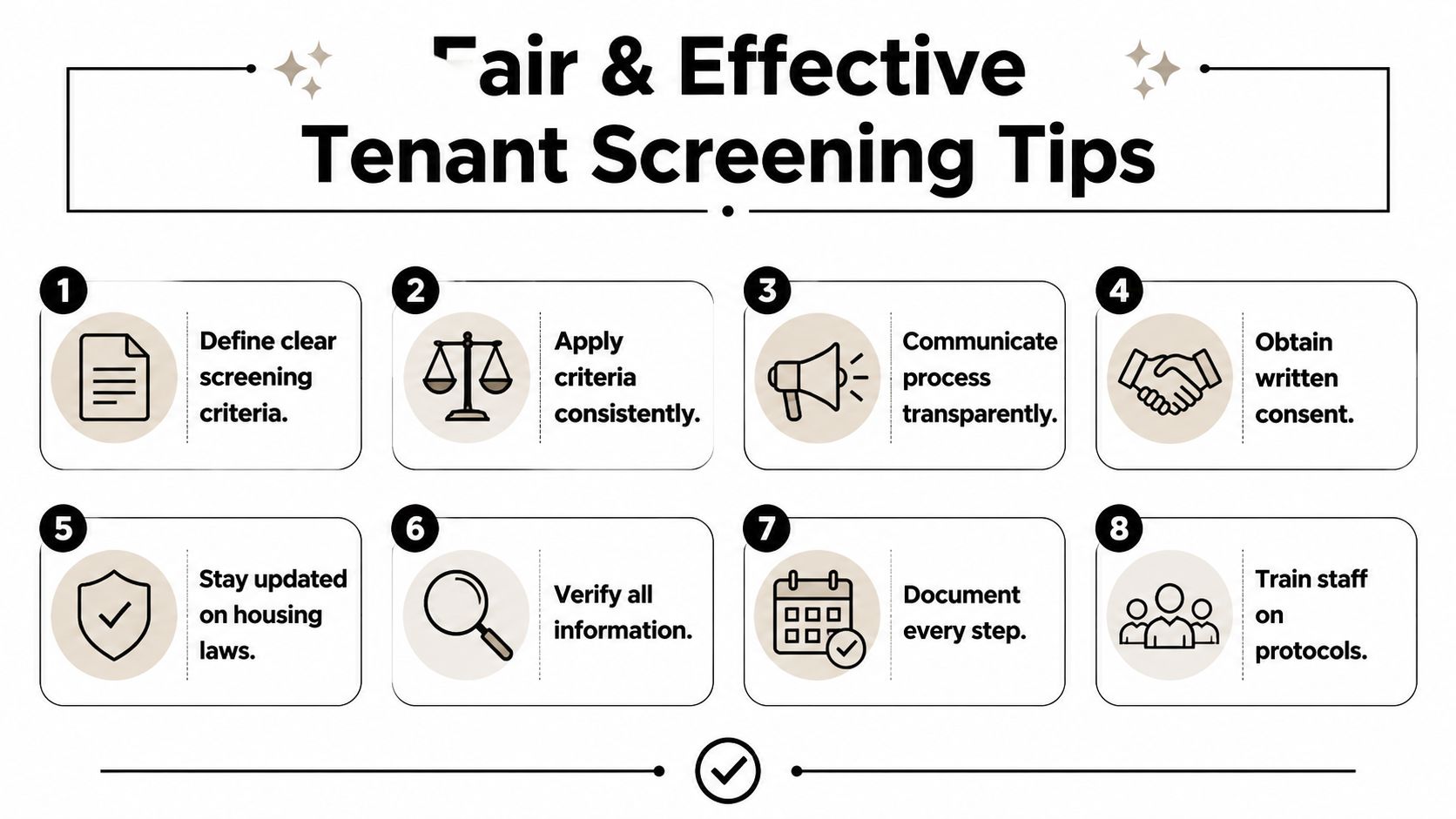
The most reliable screening systems are fair because they are structured. They don't depend on memory, mood, or who happened to answer the phone that day.
Build a written standard before applications arrive
A written screening policy protects both decision quality and compliance. If you decide what matters after you see the applicant, you're already drifting into inconsistency.
At minimum, define:
- Your verification criteria. Which tenancy factors matter most for approval?
- Your documentation rules. What counts as acceptable proof if records are incomplete?
- Your escalation points. What triggers further review rather than instant denial?
- Your recordkeeping method. How will notes, reports, and contact logs be stored?
A practical screening checklist helps owners keep that process stable. This tenant screening checklist is useful as a starting point for standardizing the steps.
Create a fair path for applicants with no formal rental history
This issue deserves its own framework because many landlords mishandle it. A lack of traditional lease records can describe a risky applicant, but it can also describe a first-time renter, a recent immigrant, an adult leaving family housing, or someone who lived in an informal arrangement.
A more compliant and inclusive review can consider bank statements showing consistent housing payments, sublease agreements, or references from employers, as discussed in this overview of incomplete tenant screening reports. The point is not to lower standards. The point is to use alternative proof when standard proof doesn't exist.
Here's a simple evaluation model:
| Applicant type | Better question | Better evidence |
|---|---|---|
| First-time renter | Have they shown payment discipline in another housing arrangement? | Bank records, roommate or sublease documentation |
| Recent immigrant | Can their housing story be documented another way? | Prior housing agreements, employer reference, identity consistency |
| Informal family housing | Is there evidence of reliable contribution and stable occupancy? | Payment traces, written statements, address continuity |
Keep the process transparent
Applicants don't need every internal note, but they should understand what documentation you require and what happens next. Transparency reduces conflict and often improves the quality of the file you receive.
Screening standard: Fairness isn't about approving everyone. It's about applying the same process to everyone.
Practical habits that improve outcomes
- Use consistent questions when speaking with prior landlords.
- Verify every unusual detail instead of assuming it's either fraud or harmless.
- Avoid internet scavenger hunts that pull in irrelevant or unreliable information.
- Document exceptions carefully if your policy allows case-by-case review.
- Train anyone involved in leasing so the process doesn't change depending on who answers the office line.
Done properly, rental history verification creates a cleaner rental ecosystem. Landlords make decisions on evidence. Tenants know what is expected. Properties stay more stable.
Advice for Tenants and The Path to a Successful Tenancy
Tenants can make rental history verification easier by preparing before they apply. The strongest applications don't just look good. They are easy to confirm.
A renter should gather prior landlord or property manager contact information, accurate address dates, identification, and any documents that support nontraditional housing history. If a tenant knows there's a complication, it's better to explain it early and provide backup than to let the manager discover a discrepancy later.
If you have limited rental history
Don't assume that “no formal lease” means “don't apply.” It's often possible to present a stronger file with alternative documentation. A first-time renter might show recurring housing payments. A recent arrival to California might provide prior housing records and employer verification. A tenant leaving a roommate arrangement might provide the sublease or a written occupancy record.
Tenants should also review their own screening-related information before applying when possible. If there's inaccurate information in a report used for housing decisions, they have rights to dispute errors through the appropriate reporting channel. That matters because bad data can affect otherwise qualified applicants.
The habits that help after approval
The path to an easier next application starts during the current tenancy. Pay on time. Follow the lease. Communicate in writing when issues come up. Give proper notice. Leave the property in solid condition. Those habits create the kind of landlord reference that helps later.
It also helps to think beyond approval and focus on tenancy stability. For California renters, this simple guide to renters insurance is a practical resource for understanding one of the basic protections that can reduce friction when losses or accidents happen during a lease.
A good screening process shouldn't feel like a trap. It should feel like a filter for honesty, readiness, and fit. That benefits the owner, the manager, and the tenant who plans to perform well once the lease begins.
If you want a structured, California-aware screening process that includes rental history review, lease preparation, and ongoing management support, Edinhart Realty and Property Management offers property management and placement services for owners in Fresno, Clovis, Friant, and the greater Central California region.


