

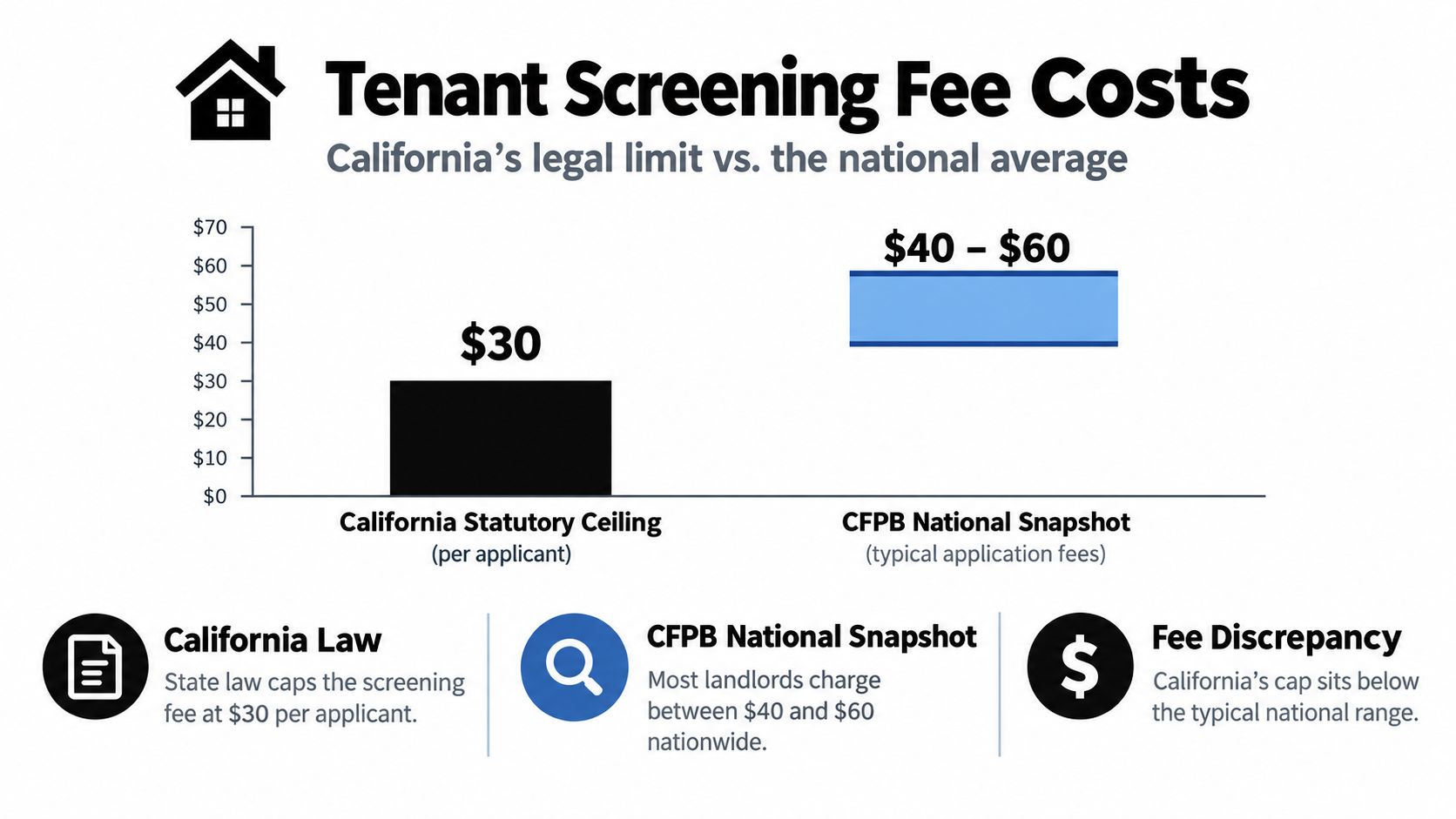
In California, Civil Code §1950.6 limits a tenant screening fee to the landlord's actual out-of-pocket screening costs plus the reasonable value of processing time, with a statutory ceiling of $30 per applicant. That makes the fee a reimbursement for a documented service, not a profit center.
The popular advice is to pick a number, add it to the rental application, and collect from everyone who applies. That approach is risky in Fresno and throughout California. A screening fee affects an applicant's cash flow, the owner's refund obligations, the timing of the leasing decision, and the paper trail that may matter if a tenant challenges the process.
California's rule is more demanding than a simple price cap. The landlord must connect the charge to actual information-gathering and review, provide required disclosures, document expenses and labor, and handle applicants who aren't selected according to a defined process. The fee also can't be collected when the owner knows or should know that no unit is available, unless the applicant agrees otherwise in writing.
The practical question isn't just, “How much can I charge?” It's who pays, what work does that payment cover, when must money be returned, and how do I apply the same screening standard to everyone?
The Screening Fee Question Most Owners Get Wrong
A tenant screening fee is really a cash-flow and consumer-protection issue. Owners tend to focus on the amount collected from each applicant, while renters experience the cost across every property they apply for. A fee that looks modest on one application can become a meaningful expense when an applicant submits several applications before securing a home.
The Consumer Financial Protection Bureau reported that prospective tenants typically paid application fees ranging from $40 to $59.76, and its consumer snapshot found that 9% of applicants reported paying more than $100. Those figures describe the broader market, not California's statutory limit, but they explain why applicants pay close attention to fee disclosures and reusable reports. The CFPB's tenant background check market report provides the relevant national context.
California's structure forces owners to think differently. The charge must reflect the cost of gathering and reviewing applicant information, including vendor expenses and reasonable staff time. A flat amount can be lawful only when it stays within both limits, actual documented cost and the applicable statutory ceiling.
Practical rule: Treat every screening payment as restricted operating money until the file is processed and the related expenses are documented.
For a Fresno-area owner, four decisions matter:
- Define the service: Know whether the fee covers credit information, tenant-screening services, references, or other lawful information-gathering.
- Control the timing: Confirm that a rental is available before requesting payment.
- Handle competing applicants: Decide whether to use a first-qualified-applicant process or refund fees to applicants who aren't selected.
- Separate screening from judgment: Apply written criteria consistently instead of allowing a payment, personal impression, or informal conversation to influence the result.
The safest workflow is usually less complicated than the improvised one. Publish the criteria, disclose the fee before collecting it, screen in a consistent order, keep an applicant-specific ledger, and issue the required receipt. Charging every applicant a standardized amount without validating the cost creates more exposure than it removes.
What a Tenant Screening Fee Actually Covers
California Civil Code §1950.6 defines a tenant screening fee as a charge for obtaining and reviewing information about an applicant, including consumer credit reports, tenant-screening services, reference checks, and documented processing time. The statute is focused on the work performed, not on a vague application charge. Read the California Civil Code provision defining tenant screening fees
A typical Fresno application may involve several distinct checks. Each one answers a different question, and each can create a different vendor or labor cost.
| Component | What It Checks | Typical Provider |
|---|---|---|
| Credit report | Payment history, credit obligations, and reported collection activity | Consumer reporting agency or screening platform |
| Background review | Reported criminal-record information subject to applicable law and policy | Tenant-screening service |
| Eviction history | Available housing-court and rental-case information | Screening provider or records service |
| Income and employment verification | Whether the applicant's stated financial information can be verified | Employer, payroll service, or verification platform |
| Rental references | Prior rental history and landlord-provided information | Property manager or previous housing provider |
Four cost categories owners should track
Credit information is often generated through a screening platform. The vendor charge should appear in the owner's records, not disappear inside a generic software subscription with no allocation method.
Background and eviction searches may involve separate data sources. A provider's report can combine services, but the manager still needs to understand what was ordered and what the fee covered.
Income and employment verification requires more than accepting an uploaded document at face value. The review may involve contacting an employer, checking a third-party verification service, or evaluating other lawful documentation under the published policy.
Staff time is part of the legal cost calculation when it reflects reasonable time spent obtaining and reviewing applicant information. Record who performed the work, what was reviewed, and how much time was spent. A receipt should connect that labor to the applicant's file.
Applicants with collections or other credit complications may also need clear explanations of what screening criteria mean and how the owner evaluates the complete file. A resource such as apartment approval with collections can help renters understand the interaction between credit history and rental screening, although it doesn't replace the owner's written criteria.
For owners, the operational answer is simple: build the file before building the charge. A practical tenant screening checklist can help staff identify the required documents, record review steps, and produce a defensible receipt.
Typical Cost Ranges in California and Nationwide
California's statutory ceiling is $30 per applicant, subject to the law's adjustment provisions. That ceiling is not an automatic price. If the documented screening cost is lower, the lawful charge must be lower too. Vendor invoices and reasonable processing time determine the amount an owner can support.
National pricing is a poor template for California owners. Screening companies may charge per report, combine credit and eviction searches in a package, or add separate fees for income and employment verification. A bundled price can look efficient while including services an applicant's file does not need. Compare the actual order, the invoice, and the work performed before setting a fee.
The practical rule is simple: build the charge from the applicant's file, not from a competitor's advertised rate. Owners moving a fee schedule from another state must recalculate it under California's cost-recovery rules. An ordinary national price can still exceed the documented cost for a particular applicant.
Keep a ledger that identifies:
- Vendor charges: Record the amount billed for each report or verification service.
- Review time: Name the staff member, task, and reasonable time spent.
- Applicant identity: Connect every expense to the correct application.
- Unused balance: Return any amount not supported by legitimate screening work.
Portable or reusable screening reports can reduce repeated payments for applicants. California has identified them, along with laws in Maryland and Washington, as an option in tenant screening. An owner who accepts one needs a written policy covering acceptable reports, required recency, and the review process.
Choose vendors by report contents, documentation, and workflow, not by the largest package. A guide to best tenant screening services can help compare providers. The final tenant screening fee must still match California's rules and the records for that application.
Who Pays and When the Fee Must Be Refunded
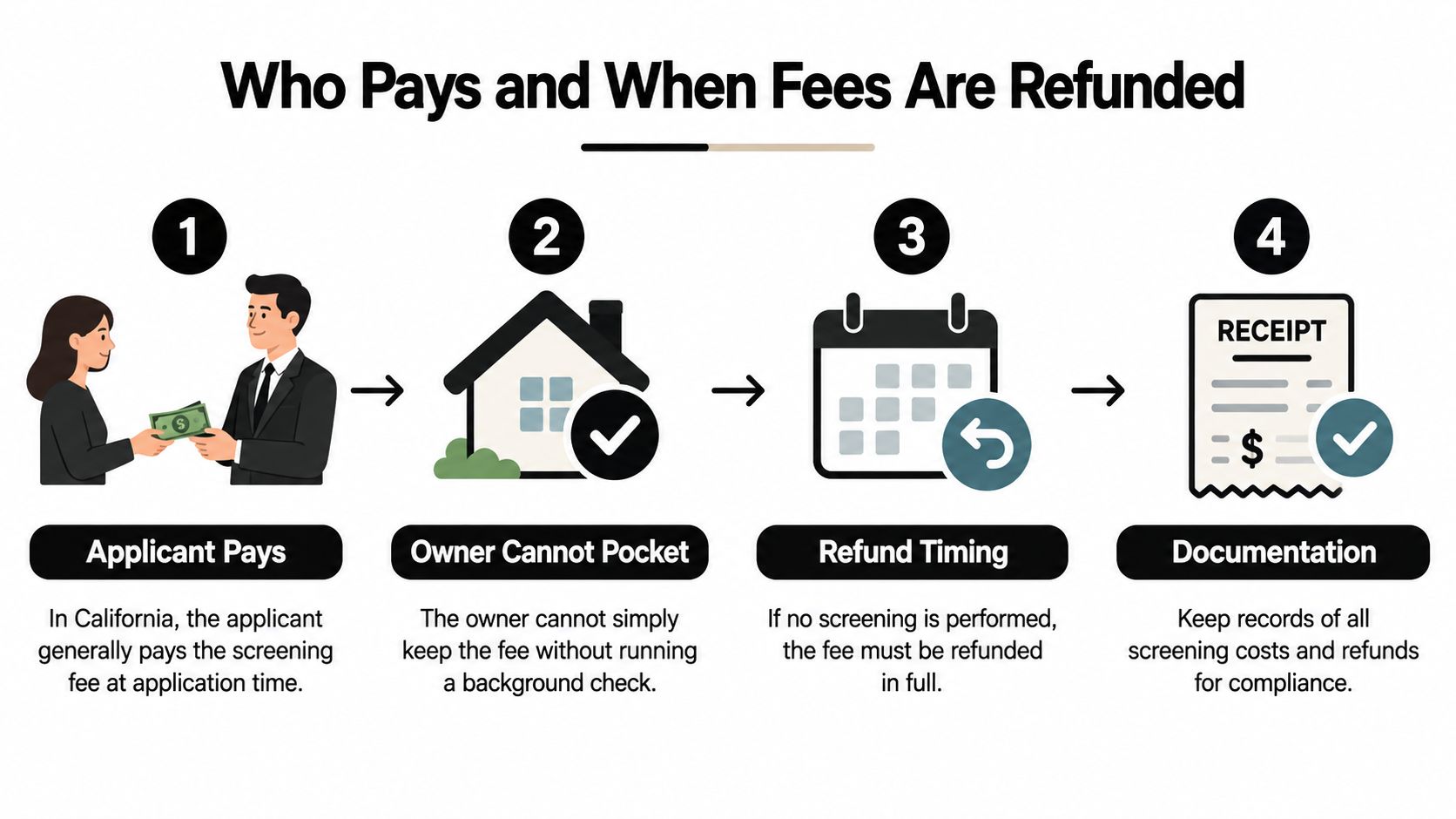
In most California transactions, the applicant tenders the tenant screening fee at the start of the application process. That doesn't mean the owner can treat the payment as unrestricted income. The money is tied to information-gathering and review, and the owner must follow the required handling process.
Start with availability. If the owner knows or should know that no rental unit is available, a screening fee generally can't be charged unless the applicant agrees otherwise in writing. Collecting payments merely to build a backup pool is a poor practice because it disconnects the charge from an available housing opportunity.
The next decision involves competing applicants. California law requires the landlord either to refund screening fees to applicants who aren't selected or to use a first-qualified-applicant process. The owner must choose the process in advance and apply it consistently. The California Civil Code text addresses refunds, first-qualified applicants, reports, and receipts
A practical decision path
- Confirm the unit is available. Don't request payment for a home that has already been rented or withdrawn.
- Give the written disclosure. Explain the fee, the screening criteria, the information requested, and the process for handling applicants.
- Process the file. Record vendor expenses and the reasonable time spent obtaining and reviewing information.
- Deliver the required documentation. Provide the applicant's consumer credit report within seven days of receiving the screening fee, as required by California law.
- Select or refund. Use the disclosed first-qualified process, or refund fees to applicants who aren't selected.
- Close the ledger. Issue an itemized receipt showing the relevant expenses and labor, then return any unsupported balance.
Incomplete applications need their own rule. A manager should state whether screening begins only after the application is complete, what happens when the applicant fails to provide requested information, and how payments are handled if no review occurs. Don't improvise that decision differently for different applicants.
Reusable reports can change who pays for duplicate screening. California law provides that when a landlord accepts a reusable tenant screening report supplied by an applicant, the landlord may not charge the specified access or application screening fee. The owner should decide whether to accept such reports before applications arrive, not after seeing an applicant's profile.
The important distinction is this: the applicant may provide the money, but the owner carries the duty to use it lawfully, return it when required, and retain the records.
Ethical Screening and Avoiding Discrimination
A written screening policy is the strongest operational defense against inconsistent decisions. HUD guidance recommends that rental screening policies be written, public, and readily available to prospective applicants, with measurable decision variables applied consistently to materially similar applicants. Read HUD's guidance on screening applicants for rental housing

A policy should answer practical questions before the first application arrives:
- Income verification: What documents or verification methods will you accept?
- Rental history: What evidence shows satisfactory prior tenancy?
- Credit review: Which credit factors matter, and how will you consider lawful alternative documentation?
- Occupancy: What occupancy standard applies to the property?
- Records and timing: How will staff document decisions and process applications received close together?
The policy should be specific enough that two trained employees can reach the same result from the same file. “Good credit” and “strong applicant” are not standards. They invite personal judgment, inconsistent treatment, and weak explanations.
Criminal-history screening requires particular care. A broad rule that treats every record identically may create unnecessary fair housing risk, especially when the policy ignores the nature, severity, and relevance of the conduct. Voucher holders and applicants using lawful alternative income documentation also shouldn't face different standards unless the distinction is grounded in a legitimate, consistently applied requirement.
The fee pays for information. It must never buy an easier path to approval.
Keep the payment decision separate from the housing decision. The applicant pays for information-gathering, while approval depends on the evidence and the pre-disclosed criteria. Don't loosen a standard for one applicant because the owner likes the person, and don't add a new requirement after reviewing a file that raises concerns.
For a deeper operational review, use fair housing compliance guidance alongside current legal advice and local requirements.
The visual below reinforces the distinction between collecting information and applying a housing standard. It should be used as a training aid, not as a substitute for a written policy.
Best Practices for Compliance in Fresno and Beyond
Compliance should be predictable. Use one documented process for a Fresno rental, a Clovis home, and a larger Central California portfolio, then adjust it when local rules require more.
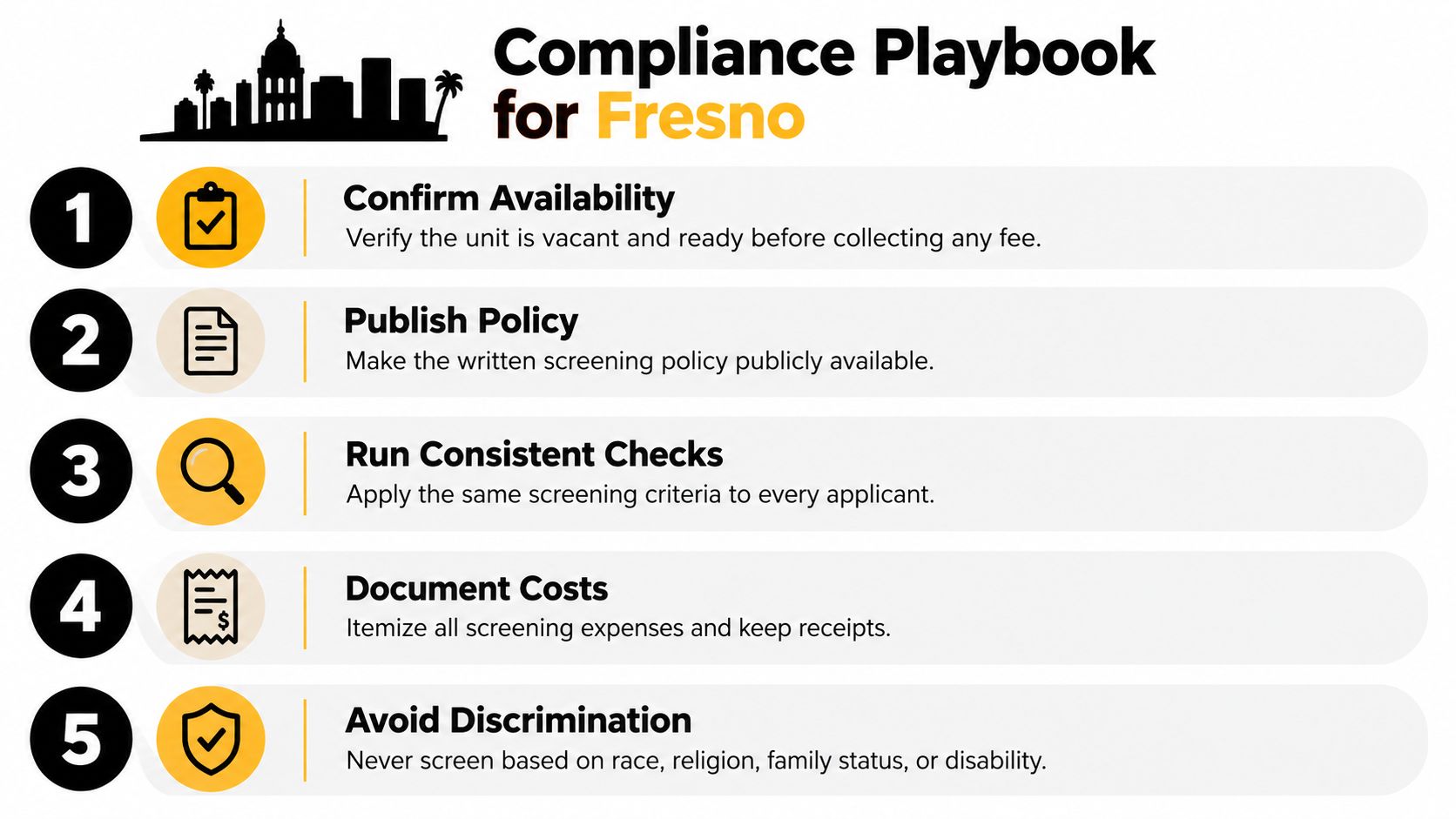
Use this operating sequence
Confirm availability first. Verify that the unit remains available before requesting payment. If another applicant has already secured it, stop collecting screening fees.
Publish the screening policy. Give applicants the written criteria and fee disclosure before payment. Keep the policy accessible, including the standards used to decide whether a charge is refundable.
Track each file separately. Record the vendor charge, report ordered, staff member, review activity, and time spent. Allocate shared software costs through a reasonable, documented method rather than assigning the full subscription to each applicant.
Issue the receipt. Itemize the out-of-pocket expenses and labor connected with that applicant. “Application fee paid” does not explain how the money was used.
Resolve the balance. Refund amounts that were not legitimately used. If the owner follows a first-qualified-applicant process, document the order received, qualification review, and selection decision.
Mark incomplete files clearly. The record should show whether screening was delayed, stopped, or completed, and explain the reason. That detail prevents a partial review from becoming an unexplained charge.
Municipal rules may impose requirements beyond the statewide framework. Berkeley's rent board publishes a 2026 maximum of $68.96 and additional local procedures, showing why owners must check city and county requirements separately. Review Berkeley's published rental-property rules
Do not copy Berkeley's figure into a Fresno policy. Use it as a reminder to confirm the rules that apply to the property before collecting a fee. California Association of Realtors forms and current legal updates can support documentation, but accurate records remain the owner's responsibility.
Owners facing a disputed charge or a complicated landlord-tenant matter may want advice from a local attorney for rental disputes. Use counsel for legal questions, and maintain the daily records counsel may need.
A Realistic Scenario for a Fresno Rental
Consider a representative Fresno owner listing a two-bedroom home. The owner publishes a written policy, confirms the home is available, accepts applications in the order received, and collects $30 from each applicant, subject to the California rules governing actual costs and processing time.
Eight applicants submit files. The owner reviews each application, records the vendor charges and staff work, selects the first applicant who meets the published criteria, and handles the other seven according to the disclosed process. If the owner has not adopted a valid first-qualified-applicant process, the non-selected applicants require refunds rather than silent retention of their payments.
The cash-flow lesson is easy to miss. The owner may receive money from several applicants before one lease is signed, but that money isn't ordinary revenue. It creates documentation work, report-delivery obligations, receipt duties, and possible refunds. The owner should maintain an application ledger showing payment, review status, costs, decision, report delivery, receipt, and refund activity.
An applicant who supplies an acceptable reusable screening report may avoid duplicate screening charges when the landlord agrees to accept it. That option can make the process less expensive for renters who are applying to several properties and can reduce repetitive vendor activity for managers.
The same disciplined file management applies after the lease ends. Owners who need help preparing a property for the next listing can consult end of tenancy cleaning experts, but cleaning records should remain separate from screening-fee records. Different services require different documentation.
Key Takeaways and Your Next Step
Three habits prevent most tenant screening fee problems:
- Publish one written policy and apply it identically to materially similar applicants.
- Keep a per-application cost ledger for vendor expenses, report activity, and reasonable staff time.
- Run a defined refund workflow for non-selected applicants, unused balances, and applications that never reach screening.
Before collecting the next payment, confirm the unit is available, provide the disclosure, check applicable local rules, and use current California Association of Realtors forms where appropriate. If your process depends on memory or informal judgment, it isn't ready for repeated applications.
Edinhart Realty and Property Management serves Fresno-area owners through placement-only and full-service management workflows that include marketing, applicant screening, lease preparation, tenant communication, and ongoing property administration. Visit Edinhart Realty and Property Management to discuss a documented screening process that fits your property and management needs.
If you manage a Fresno rental, ask Edinhart Realty and Property Management to review your tenant screening policy, fee ledger, refund procedure, and applicant documentation. Their placement-only and full-service options can help you handle screening as a consistent compliance workflow instead of an improvised transaction.


