

So, what really makes a rental property a good investment?
A great rental property is more than just a house with a "For Rent" sign. It's a well-oiled business asset built on three core pillars: it generates consistent positive cash flow, has strong potential to appreciate in value, and is in high demand with quality tenants.
Think of it as an investment that pays you every month, grows your wealth over the long haul, and is easy to keep occupied.
Defining a Profitable Rental Property
Figuring out what makes a rental property a winner goes way beyond just four walls and a roof. It's about spotting an asset that will perform predictably and, most importantly, profitably. The savviest investors don't get lucky; they use a clear framework to size up opportunities.
They focus on what really matters: financial viability, location, and long-term sustainability.
This means looking at a property from three different angles—its ability to make you money right now, its potential to be worth more in the future, and its appeal to the kind of tenants you actually want. Each pillar supports the others, creating a stable, rewarding investment.
The Three Pillars of Success
A truly successful rental property has a solid balance of these critical elements:
Financial Viability: This is the engine of your investment. It all comes down to the numbers, making sure the property brings in more money than it costs each month. We look at key metrics like cash flow, cash-on-cash return, and capitalization rate (cap rate). You can learn more about how to calculate cap rate in our detailed guide.
Strategic Location: A property’s location dictates almost everything—tenant demand, how much you can charge for rent, and its appreciation potential. The best spots have strong job markets, good schools, and are close to things people want and need.
Property Condition and Appeal: The physical shape and layout of the property have to meet the needs of your target tenants. A durable, well-maintained property keeps your expenses down and attracts responsible residents who stick around.
A profitable rental isn’t just a transaction; it's a strategic acquisition designed to meet specific financial goals. By focusing on cash flow, appreciation, and tenant demand, you build a resilient investment portfolio.
To make this crystal clear, I've broken down these core concepts in the table below. Think of it as a blueprint for what to look for when you're evaluating any potential rental.
Core Pillars of a Profitable Rental Property
| Pillar | Key Characteristics | Why It Matters |
|---|---|---|
| Financial Viability | Positive monthly cash flow, a healthy cap rate (ideally 5-10%), and a strong cash-on-cash return. | This ensures the property pays for itself and generates a profit from day one, rather than being a constant drain on your finances. |
| Strategic Location | Low crime rates, close to jobs and schools, and easy access to amenities like parks and shopping. | This drives consistent tenant demand, supports higher rental rates, and fuels long-term property value appreciation. |
| Condition & Appeal | Good structural integrity, a modern and functional layout, and low-maintenance features. | This reduces your long-term repair costs, attracts higher-quality tenants, and minimizes the time your property sits empty. |
By keeping these three pillars in mind, you shift from simply buying property to making a smart, strategic investment that works for you.
Crunching the Numbers: How to Spot a Winner
Looks can be deceiving. A property might have great curb appeal in a perfect neighborhood, but if the numbers don't work, it's a money pit, not an investment. When it comes down to it, successful real estate investing is a numbers game. Profitability isn’t something you hope for; it’s something you calculate.
To really know if you’ve got a winner, you have to get comfortable with a few key financial metrics. These formulas are your best friends, steering you toward deals that build real wealth and helping you dodge the ones that just drain your bank account.
This chart breaks down the engine of a successful rental—it all starts with cash flow.
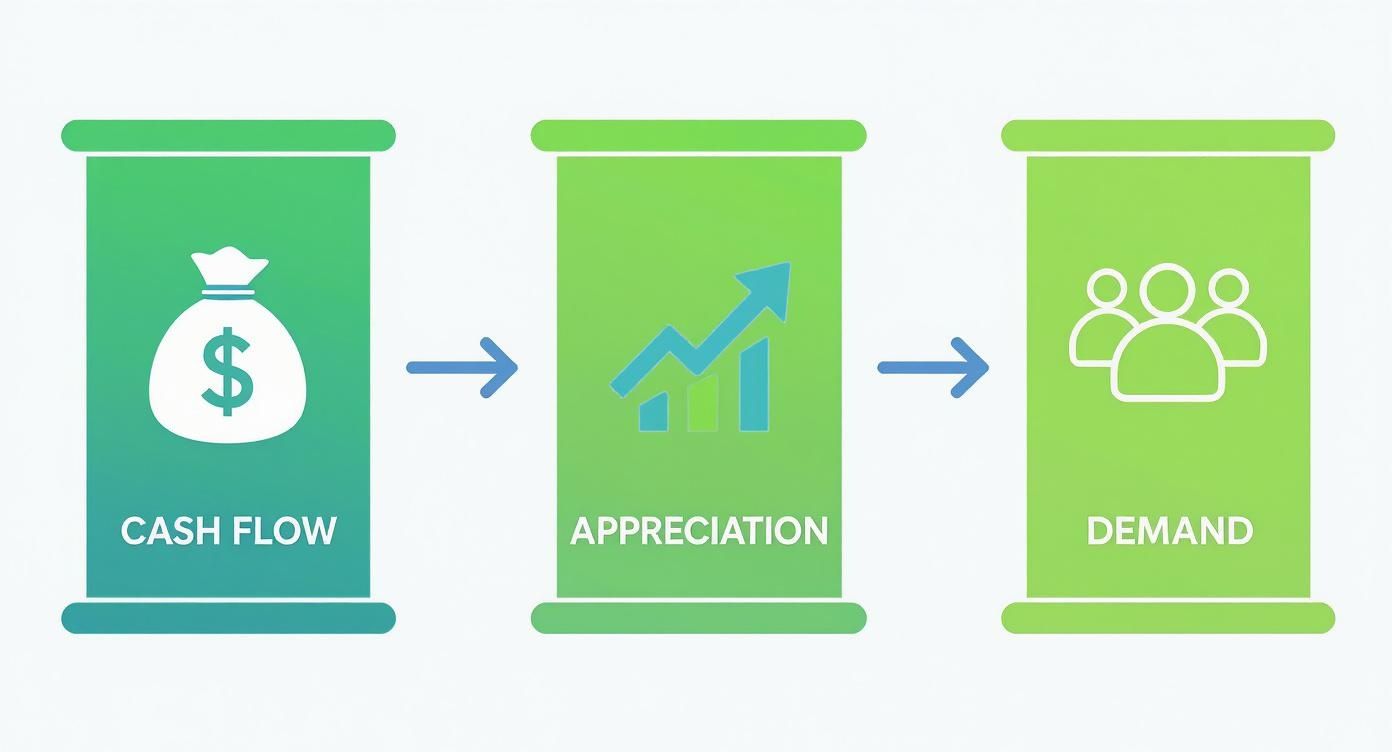
You can see how positive cash flow is the fuel. It keeps the investment running, which eventually leads to appreciation and keeps good tenants wanting to stay.
Decoding Cap Rate
Think of the Capitalization Rate (Cap Rate) as the miles-per-gallon rating for a rental property. It’s a quick and easy way to judge how efficiently a property makes money relative to its price, completely ignoring any mortgage you might have on it. This lets you compare an apple in Clovis to an orange in Fresno on a level playing field.
The formula is pretty simple:
Cap Rate = Net Operating Income (NOI) / Current Market Value
Let’s say a property in Fresno brings in $18,000 a year after basic expenses (that’s your NOI) and it’s worth $300,000. Your Cap Rate is 6% ($18,000 / $300,000). A bigger number is usually better, and a lot of savvy investors around here in the Central Valley won't look twice at a property under 5%.
Cash-on-Cash: What’s Your Real Return?
While Cap Rate is a great universal benchmark, Cash-on-Cash Return is all about you. It tells you exactly what kind of return you’re getting on the actual money you pulled out of your pocket—your down payment, your closing costs, all of it. This is the metric that shows you how hard your cash is truly working for you.
Here's the math on that:
Cash-on-Cash Return = Annual Pre-Tax Cash Flow / Total Cash Invested
Using that same Fresno property, maybe you put down $60,000 in total to buy it. After paying all the bills, including the mortgage, you have $3,600 left over at the end of the year. Your Cash-on-Cash Return is 6% ($3,600 / $60,000). It's a powerful number because it factors in your loan, giving you a clear picture of your investment's performance.
To really get this down, you’ll want to do a full rental property cash flow analysis on any potential deal.
The Hidden Costs That Can Sink You
Your calculations are only as good as the numbers you plug into them. It's absolutely critical that you know how to accurately calculate cash flow on rental property to make sure you're not missing anything.
It's easy to remember the mortgage and property taxes, but it’s the other expenses that often catch new investors by surprise. Always budget for these:
- Vacancy: Let's be real—no property is occupied 100% of the time. Setting aside a buffer for the empty months between tenants is just smart business. A conservative goal is 5% of your total annual rent.
- Repairs & Maintenance: Faucets leak. Disposals jam. Things break. Plan on it by budgeting 5-10% of your rental income for the routine fixes that keep your property in good shape and your tenants happy.
- Capital Expenditures (CapEx): These are the big ones—the new roof, the HVAC system that dies in July, the water heater that finally gives out. They don't happen often, but they're expensive. Sock away another 5-10% of your rent into a separate savings fund so a major repair doesn't become a financial crisis.
Choosing a Location Primed for Growth
That old saying "location, location, location" isn't just a real estate cliché—it's the absolute foundation of a profitable rental property. You could have a fantastic building, but if it's in a neighborhood going downhill, you're going to struggle. On the flip side, even an average house in a thriving, up-and-coming area can turn into a serious cash cow.
The key is learning to spot a location that’s primed for growth. This means looking past today's map and seeing what the area could become tomorrow. Think of yourself as a detective, searching for clues that a neighborhood is on an upward swing. Is the city putting money into new parks or public transit? Are you seeing new coffee shops and small businesses popping up? These are the tell-tale signs of a community on the rise.
The Non-Negotiables of a Great Rental Location
Some things just aren't optional when you're picking a spot. They are the core features that attract and keep great tenants. A good location isn't just about a trendy zip code; it’s about offering a safe, stable, and convenient place for people to live. A solid first step in your research is understanding the average rental rates by zip code.
When you're sizing up a potential neighborhood, make sure these pillars are firmly in place:
- Stable Job Markets: Look for areas close to major employers like hospitals, universities, or big company headquarters. A mix of different industries is even better, as it protects your investment if one sector takes a hit.
- Quality Schools: Even tenants without kids pay attention to school districts. It’s a huge signal of a strong, family-friendly community, and that directly props up property values.
- Low Crime Rates: Safety is a top concern for everyone. Use online crime maps and check local police department stats to get a real feel for how safe a neighborhood is before you even think about buying.
- Access to Amenities: Convenience is king. Properties that are a short walk or drive from grocery stores, parks, restaurants, and public transportation will always be in high demand.
Spotting Future Growth and Appreciation
Once you've covered the basics, the truly savvy investors know how to spot areas that are set for long-term appreciation. This is where you start digging into city development plans and watching demographic shifts. Is the population growing? Are younger professionals moving into the area? Trends like these almost always come before a big jump in rental demand and property values.
Globally, markets with growing populations and economic opportunities deliver the best rental yields. While the Asia-Pacific region is currently leading the pack, the pattern holds true everywhere: cities on the rise offer investors the best potential. This just proves, once again, that getting the location right is the most critical factor for success.
The goal is to invest where the puck is going, not where it has been. By identifying a neighborhood's growth signals, you secure not just steady rent today but also significant wealth-building appreciation for tomorrow.
Alright, you've crunched the numbers and found a neighborhood that looks promising. Now comes the fun part—getting your hands dirty and really digging into the property itself. This is where you need to put on your investor hat and look past the fresh coat of paint and nicely staged furniture.
What you're really looking for is the story the house is telling you. A sagging floor isn't just a quirk; it's a potential foundation nightmare. Those horizontal cracks in the stucco? That could be a five-figure problem. On the other hand, an ugly brass light fixture from 1982 is a cheap, easy fix. The real skill is learning to tell the difference between a cosmetic issue and a catastrophic one.
Don't forget the big-ticket items. I'm talking about the roof, the HVAC unit, the plumbing, and the electrical panel. You absolutely have to know the age and condition of these systems. Finding out you need to replace a 30-year-old furnace right after closing can completely wipe out your cash flow for the entire year. Trust me, it's a gut punch you want to avoid.
Matching the Property to the Tenant
Here’s something a lot of new investors miss: you can't just buy a house and hope the right tenants show up. The property's layout and features will attract a very specific type of renter. Your job is to make sure you're buying the right property for the right demographic in your area. When you get that match right, vacancies drop and your income stays consistent.
Let's get specific for a minute here in the Central Valley:
- Families: Looking for a three-bedroom, two-bath home with a fenced yard? You’re in family territory, especially if it’s zoned for the Clovis Unified School District. They're looking for safety, space, and great schools.
- Young Professionals: A sleek two-bedroom condo near Fresno's Tower District or Downtown is perfect for this crowd. They want to be able to walk to restaurants, bars, and entertainment. Convenience is king.
- Students: If you're near Fresno State, a house with multiple bedrooms, durable flooring (think spills and foot traffic), and plenty of parking is a goldmine. Students are happy to share a place if it means being close to campus.
A property without a clear target tenant is like a ship without a rudder. Knowing who you're renting to allows you to focus on the amenities they value most, ensuring your property stands out in a crowded market.
You also have to keep up with what renters actually want today. It changes. For instance, a huge number of people—over 40% of renters—are specifically looking for pet-friendly places. Another 40% say affordability is their absolute top priority. We're also seeing demand for energy-efficient features jump by 20%. It pays to stay on top of these rental market trends to keep your property competitive.
Prioritizing Durability for Long-Term Profit
Finally, you have to think like a long-term owner, not a flipper. The finishes you choose have a direct impact on your maintenance budget and, ultimately, your profit. That fancy granite countertop might look great on TV, but there are more durable and cost-effective options that make a lot more sense for a rental.
Your mantra should be "durable and easy to clean." Opt for materials that can take a beating. I'm talking about luxury vinyl plank (LVP) flooring instead of carpet that stains and holds odors. Use semi-gloss paint that you can actually scrub. Choose simple, sturdy fixtures that aren't going to break every time someone looks at them. Even the landscaping matters—low-maintenance plants and rockscapes save you money on yard care.
Remember, every dollar you don't have to spend on a needless repair is another dollar straight into your pocket.
How Smart Management Maximizes Your Returns
Finding a property with great numbers is really just the starting line. The true test of a rental's profitability comes down to how it’s managed day-to-day. Smart property management is the engine that turns a solid asset into a fantastic, hands-off investment. It transforms potential headaches into predictable income.
This goes way beyond just cashing rent checks. It's a strategic operation designed to protect your asset, keep vacancies to a minimum, and lock in high-quality tenants. Neglecting this crucial step is one of the fastest ways to watch a promising investment fall short of its potential.
Effective property management directly boosts your bottom line in a few critical ways. From strategic marketing that brings in a flood of applicants to rigorous screening that weeds out problem tenants, every single action is aimed at one thing: maximizing your income while minimizing your risk.
Slashing Vacancy with Expert Marketing
An empty property isn’t just sitting there—it’s actively costing you money. A professional manager's first job is making sure your property is never vacant for long.
This all starts with top-notch, professional photography that makes your property pop online. Great photos attract more views and, ultimately, more applications. They also roll out broad marketing campaigns across tons of platforms, guaranteeing your listing gets in front of the largest possible pool of qualified renters.
The goal here is simple: create a little competition for your property. This gives you the power to pick the best possible tenant and dramatically cuts down on that expensive downtime between leases.
A good property manager doesn't just fill vacancies; they create a pipeline of demand for your property. Their marketing efforts ensure you spend less time worrying about lost rent and more time enjoying your investment returns.
Securing Quality Tenants and Protecting Your Asset
Let’s be honest: the single most important factor in a successful rental experience is who you put in it. A tough, thorough screening process is completely non-negotiable.
This is where a professional manager really earns their keep, handling every detail of this critical phase:
- Credit and Background Checks: They dig into an applicant’s financial history, looking for stability and any red flags.
- Income Verification: This ensures the applicant makes enough to comfortably afford the rent. The industry standard is an income of at least three times the monthly rent.
- Rental History: They’ll actually call previous landlords to confirm a track record of on-time payments and responsible tenancy.
This meticulous process drastically reduces your risk of dealing with late payments, property damage, and the nightmare of an eviction.
Beyond just finding the right person, proactive maintenance is key to keeping your property’s value high. A manager coordinates repairs efficiently, tackles small issues before they blow up into expensive problems, and runs regular inspections to keep the place in top shape. It's all about systematic processes, like using a meticulous rental property cleaning checklist to make sure tenant turnovers are smooth and painless.
Finally, trying to navigate the tangled web of landlord-tenant laws is a huge challenge for independent owners. A professional manager makes sure your entire operation is fully compliant with Fair Housing laws and all local regulations, shielding you from legal trouble and giving you some invaluable peace of mind.
Alright, let's move from the 'what' to the 'how.' We've talked about the big ideas, but success in real estate investing always comes down to the details. This is where you put everything we've discussed into a practical, repeatable process.
Think of it like a pilot’s pre-flight checklist. You don’t just jump in the cockpit and hope for the best. You methodically check every single system to make sure you’re set up for a safe and successful journey. This is your pre-flight inspection for buying a rental property.
Financial Due Diligence
First, let's make sure the numbers actually work. Gut feelings are great, but they don't pay the mortgage.
- Run the 1% Rule: A great starting point. Does the monthly rent you expect to get cover at least 1% of what you're paying for the place? If not, you need to look very closely at why.
- Calculate Your Cap Rate: Is the property’s Net Operating Income (NOI) a healthy percentage of its purchase price? You're generally looking for something in the 5-10% range in a market like ours.
- What’s Your Cash-on-Cash Return?: This is the big one. After all the bills are paid, how much cash does the property spin off each year compared to the actual cash you pulled out of your pocket to buy it?
- Don't Forget the Hidden Costs: This is where new investors get tripped up. Did you realistically budget for vacancy (around 5% is a safe bet), ongoing maintenance (5-10% of rent), and those big-ticket items like a new roof or AC unit down the road (another 5-10%)?
Location and Property Analysis
Once the numbers pass the initial smell test, it's time to dig into the physical asset and its surroundings. A great deal on paper can turn into a nightmare if the property or location is a dud.
- Scout the Neighborhood: Is it a place people actually want to live? Look for low crime stats, good proximity to jobs, and the kind of amenities (parks, decent coffee, grocery stores) that make life easier.
- Does it Fit the Tenant?: A five-bedroom home in a neighborhood full of young professionals might be a tough rental. Make sure the property’s layout—bedrooms, bathrooms, yard space—matches who is actually renting in that specific area.
- Inspect the "Big Bones": How old is the roof? When was the HVAC last serviced? Get a good look at the plumbing and electrical systems. These are the budget-killers, and you need to know what you’re getting into.
- Check for Durability: We’re not looking for high-end designer finishes here. We want stuff that lasts. Are the floors, paint, and fixtures simple, durable, and ready to handle the wear and tear that comes with tenants?
Here is the rewritten section, designed to sound like an experienced human expert:
Your Top Rental Property Questions, Answered
Jumping into real estate investing brings up a lot of questions. It’s only natural. Let's tackle some of the most common ones we hear from new investors, breaking down the key concepts that separate a good investment from a headache.
Is a Condo or a Single-Family Home a Better Rental?
That's the classic debate, and honestly, there's no single right answer—it all comes down to what you're trying to achieve. With a single-family home, you're the captain of your own ship. You have total control. No Homeowners Association (HOA) can tell you what you can or can't do with your property or hit you with a surprise special assessment for a new roof. For many investors, that freedom is everything.
On the other hand, condos have their own appeal, mostly centered around easier maintenance. The HOA is on the hook for the big-ticket exterior items like landscaping and roofing, which can mean fewer unexpected repair bills for you. The trade-off, of course, is that you have less control and a monthly HOA fee that chips away at your profits. You absolutely have to run the numbers to see if it makes sense.
Should I Put My Rental Property in an LLC?
This is one of the smartest things you can do to protect yourself. Think of a Limited Liability Company (LLC) as a legal shield. It builds a wall between your personal life—your family home, your savings, your car—and your investment property. If something goes wrong at the rental and a lawsuit is filed, they can only go after what's inside the LLC, not your personal assets.
An LLC essentially acts as a "firewall," protecting your personal finances from business liabilities. This separation is one of the smartest ways to mitigate risk as a real estate investor.
Sure, there are some costs and a bit of paperwork to set up and maintain an LLC. But that small investment is nothing compared to the peace of mind you get knowing your personal financial security is locked down.
How Much Cash Flow Should a Good Rental Property Generate?
Everyone wants to know the magic number for cash flow, but it really shifts depending on the market and the price of the home. A great starting point, a quick back-of-the-napkin test, is the 1% Rule. It’s simple: the monthly rent should be at least 1% of what you paid for the property. So, if you buy a house for $250,000, you should be aiming for a monthly rent of at least $2,500.
Now, that's just a screening tool. The real test of profitability is your net cash flow—the money left in your pocket after paying the mortgage, property taxes, insurance, and setting aside funds for future vacancies and repairs. A property that puts positive cash in your bank account every single month, no matter what? That's the goal.
Navigating the world of property investment is a lot easier when you have an experienced guide. At Edinhart Realty and Property Management, we provide the professional insight you need to find, buy, and manage profitable rental properties right here in the Central California market. Learn how we can help maximize your returns today.


