

Tenant screening is a structured evaluation of an applicant's ability and likelihood to meet lease obligations, combining identity, income, credit, rental, eviction, and criminal-history information. A screening report may also include employment verification, bankruptcies, civil judgments, registry information, and watchlist data.
You're a Fresno landlord with applications on the kitchen table, or an applicant who's just been asked to submit sensitive financial and personal information. The landlord wants confidence that rent will be paid and the property will be treated responsibly. The applicant wants a fair opportunity, privacy, and a chance to correct anything inaccurate.
That shared tension explains why screening isn't just a credit check. It's a decision system, and a poorly designed system can harm both sides. Reliable, relevant information helps an owner assess risk. Incomplete, duplicated, outdated, or misunderstood records can reject a qualified renter and create compliance problems.
What Tenant Screening Really Means for Landlords and Applicants
A landlord usually begins screening after receiving an application for a vacant home or apartment. The applicant supplies identifying information, income details, employment history, rental references, and authorization for reports. A property manager then compares the file with written rental criteria before deciding whether the applicant is likely to meet the lease obligations.
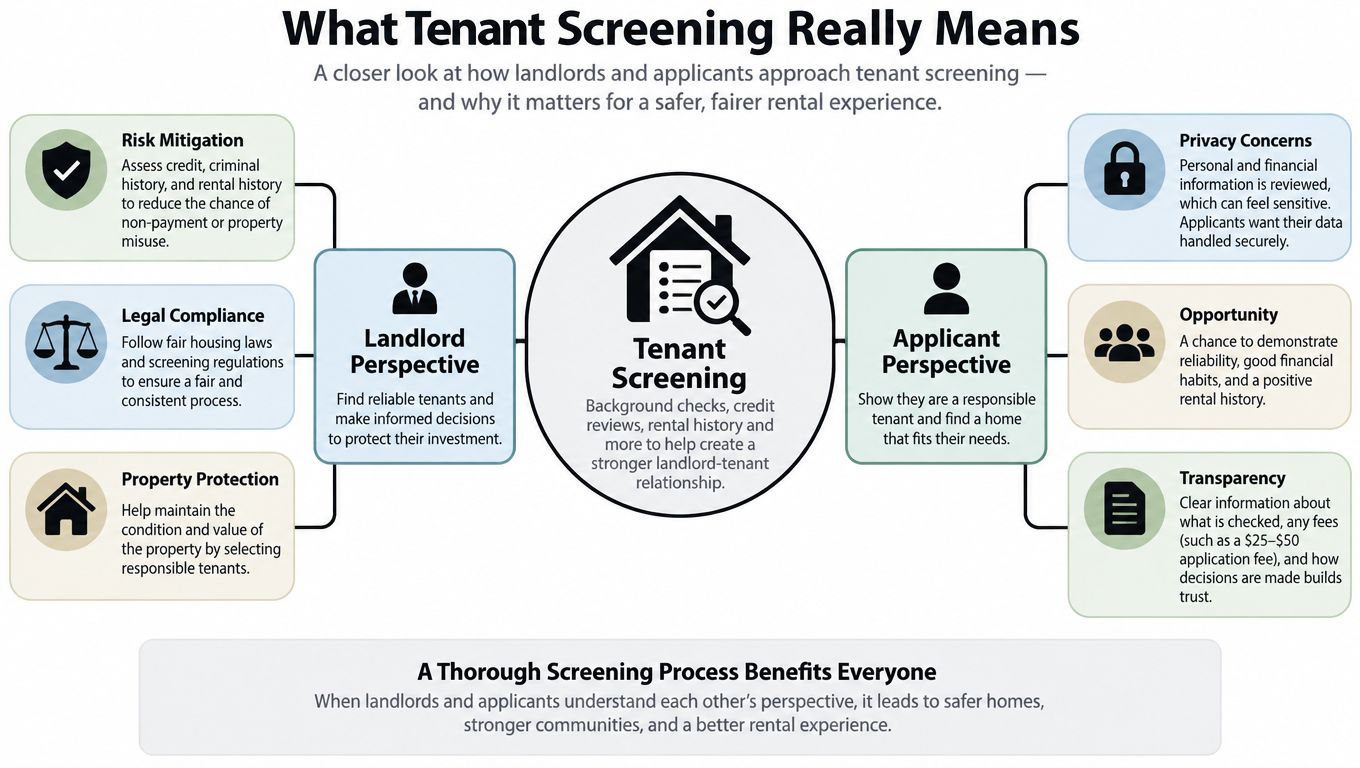
The purpose differs by perspective:
- For the landlord: Screening supports risk assessment, property protection, and consistent leasing decisions.
- For the applicant: Screening affects access to housing and can influence the outcome even when a record is incomplete or wrong.
- For both parties: A documented process creates a clearer basis for approval, denial, or further review.
The Consumer Financial Protection Bureau received approximately 26,700 tenant-screening complaints from January 2019 through September 2022, with complaint volumes increasing year over year. That history makes accuracy and dispute handling part of responsible screening, not administrative extras. The CFPB's tenant background-check snapshot also explains that screening reports can combine many types of financial, identity, behavioral, and housing-history information.
A shared risk conversation
A responsible landlord isn't asking whether an applicant has a flawless history. The useful question is whether verified information relates to likely tenancy outcomes, such as paying rent, following the lease, and caring for the property.
An applicant, meanwhile, shouldn't have to guess what a report means. An eviction filing isn't automatically the same as a judgment or completed eviction, and a criminal-record entry may not tell the full story. The process should leave room to examine context and correct material errors.
Practical rule: Good screening is consistent enough to defend and flexible enough to recognize verified context.
A 2011 TransUnion survey cited in later housing research found that 87% of surveyed landlords used tenant-screening services, although researchers caution that no official national statistics establish the true prevalence across all landlords. The figure illustrates how common third-party reporting has become, but it doesn't turn a vendor's score into a final answer.
The Core Components Every Screening Report Reviews
A screening file combines several lenses. Each one answers a different question, and each one can mislead when the information is incomplete or treated as conclusive.
Identity verification helps match the report to the correct person. Name variations, address history, or data-entry mistakes can create mixed files, so an identity match deserves attention before other information is weighed.
Income and employment verification tests whether the applicant has a reliable source of funds for rent. Pay records, employment details, benefit documentation, or other lawful income sources may help, but a single document doesn't always show the full financial picture.
Credit reports and scores describe credit behavior and repayment history. They don't directly prove how someone will care for a home, and a score can obscure the circumstances behind a disputed account, temporary hardship, or identity error.
Rental-payment history and landlord references are closer to the tenancy itself. They may reveal payment patterns, notice practices, property care, or unresolved balances, but references can be incomplete or difficult to verify.
Eviction records require careful interpretation. A filing, a judgment, and a completed eviction are different events. A report that duplicates one matter under several labels can make a single incident look like a pattern.
Criminal-record searches may identify information that a landlord believes relates to safety or lease compliance. HUD advises providers to use relevant information and avoid blanket exclusions. Arrest information, old records, or records belonging to another person can produce unfair results when a reviewer skips verification.
Reports may also include bankruptcies, civil judgments, sex-offender-registry information, and national-terrorist-watchlist data. Proprietary tenant scores can combine several categories into one recommendation, which is convenient but often makes the underlying reasoning harder for an applicant to understand.
| Component | What it predicts | Common error or limitation |
|---|---|---|
| Identity verification | Whether the file belongs to the applicant | Names and records can be mixed or mismatched |
| Income and employment | Ability to support rent payments | Documents may be incomplete or fail to show lawful alternative income |
| Credit report and score | Payment and debt-management patterns | A score doesn't explain context or guarantee lease compliance |
| Rental history | Prior payment, communication, and property-care behavior | References may be unavailable, incomplete, or biased |
| Eviction history | Prior housing-court activity | Filings, judgments, and completed evictions can be confused |
| Criminal history | Potentially relevant conduct, when legally permitted | Records can be inaccurate, outdated, or unrelated to tenancy |
| Tenant score | Combined risk recommendation | The scoring method may be difficult to audit or explain |
For a deeper look at the credit portion of the process, see how to check credit for a tenant. When identity information is uncertain, specialist resources such as UK people tracing show why accurate person-to-record matching matters, even though tenant screening itself follows housing and consumer-reporting rules.
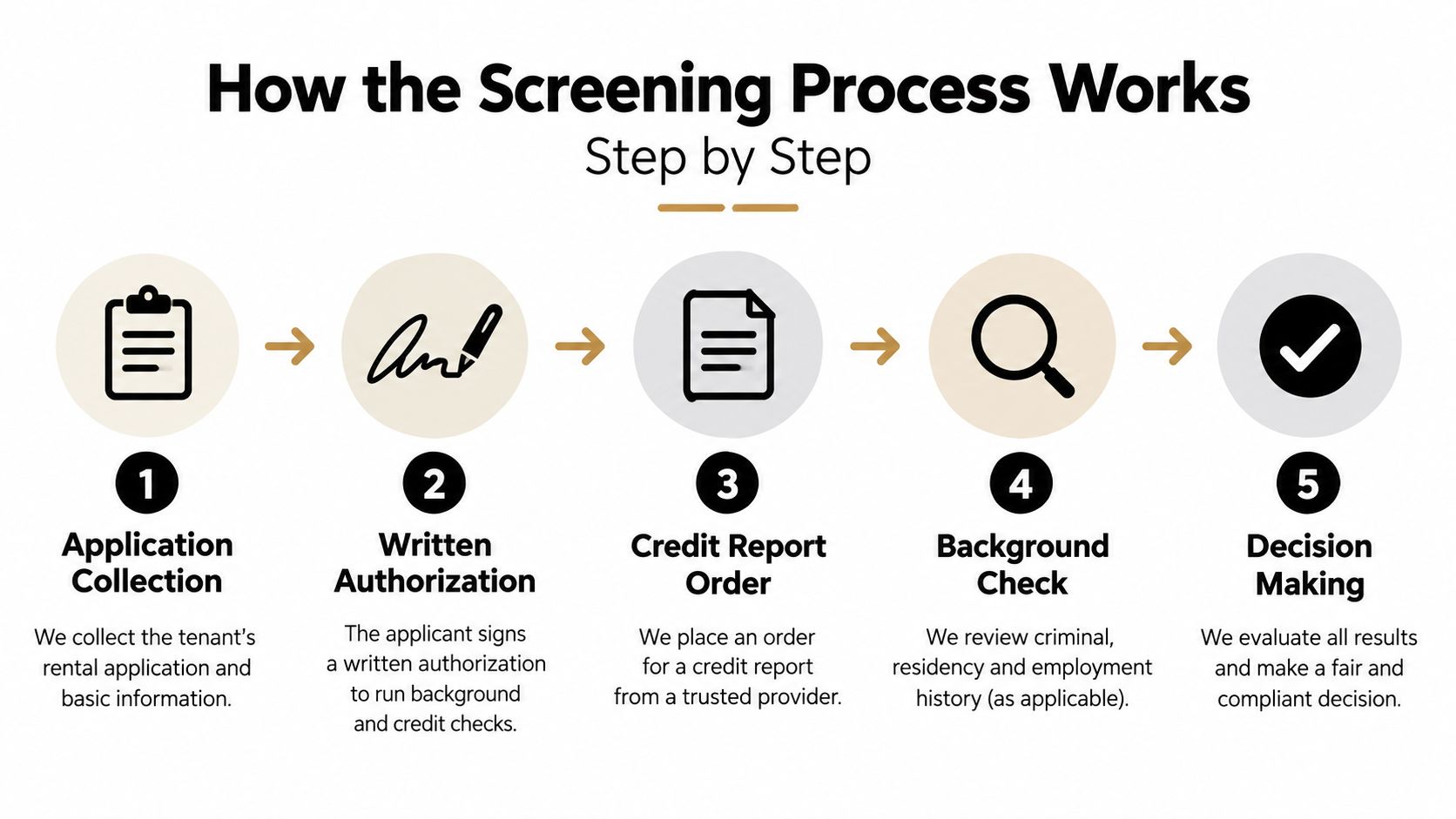
How the Screening Process Works Step by Step
Screening works best as a documented sequence rather than an informal impression.
1. Collect a complete application
The landlord gathers the same core information from every applicant, including identity details, income sources, employment information, rental history, and required authorizations. Missing information should trigger a neutral request for clarification, not an automatic assumption about the applicant.
2. Obtain written authorization
Before ordering a consumer report, the housing provider needs a permissible housing-related purpose and must certify that the report will be used only for that purpose under the Fair Credit Reporting Act. The authorization or permissible-purpose record belongs in the file.
3. Order and review the report
The landlord or property manager obtains the report through a reporting company and checks whether the identity information appears to match. A report is evidence for review, not a substitute for judgment. The reviewer should distinguish a verified record from an ambiguous database entry.
4. Verify the important facts
Income, employment, rental history, and disputed records may require follow-up. The reviewer can compare application information with supporting documents and references, while giving the applicant a reasonable opportunity to explain material inconsistencies.
5. Make and communicate the decision
The decision should follow the written criteria. If report information contributes to denial, a higher deposit or rent, or a co-signer requirement, the applicant must receive an adverse-action notice identifying the reporting company and explaining the right to dispute inaccurate information under the FCRA.
Keep the application, authorization, report relied upon, decision rationale, and notice delivered. Those records help show that the landlord used a consistent process rather than making a decision from an undocumented impression.
A background check can involve sensitive records in many settings. For general context on how organizations structure a criminal background check for volunteers, review the linked resource, then apply the separate housing-specific rules that govern rental decisions.
Why Stricter Screening Can Actually Be Riskier
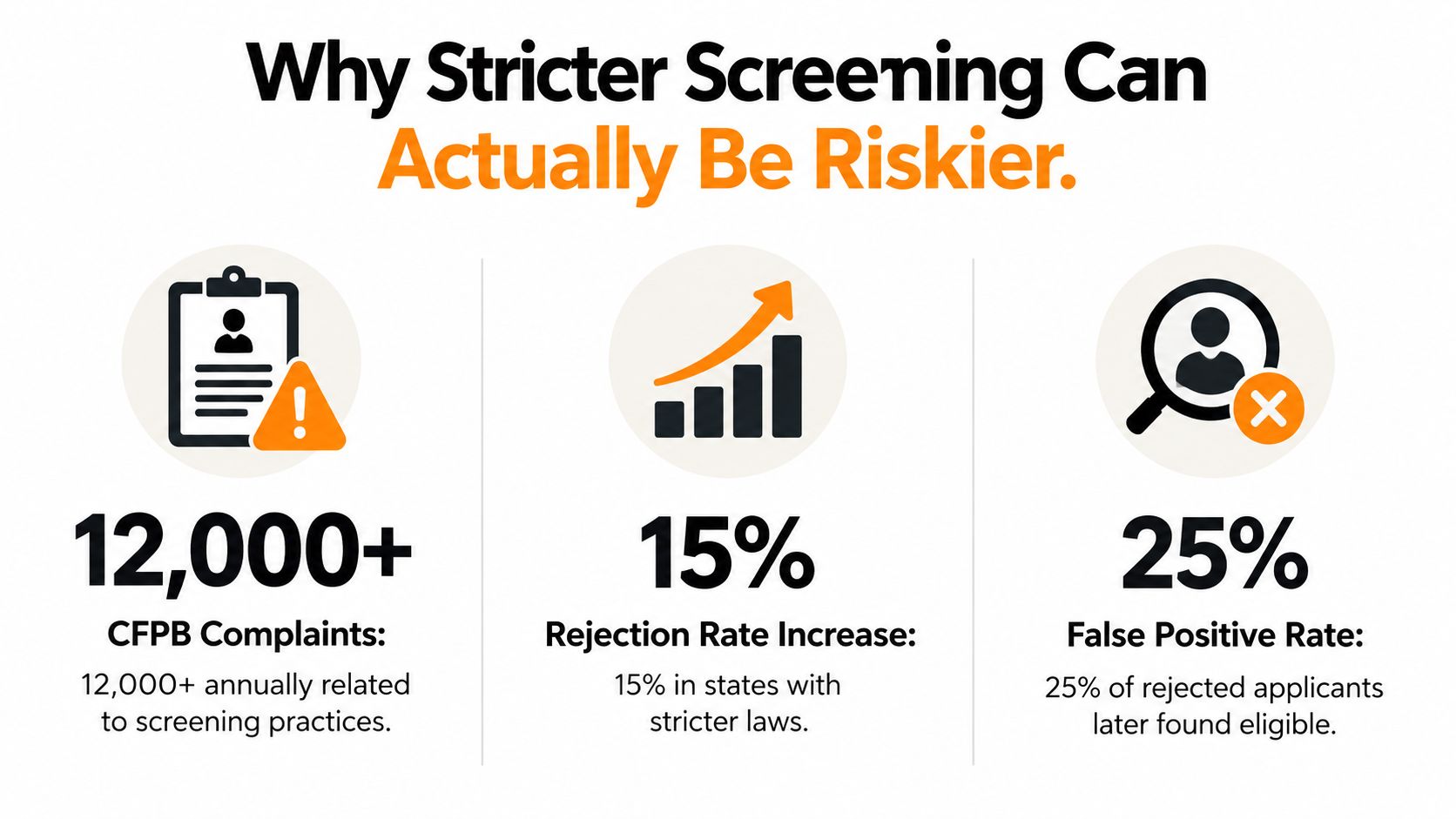
More data doesn't automatically produce a safer tenancy. A landlord who rejects every applicant with any negative entry may be acting on records that are duplicated, outdated, incomplete, or unrelated to the applicant's actual ability to follow a lease.
The CFPB has described complaints involving applicants denied housing because reports contained incorrect information. Examples include an eviction filing shown without its final disposition, the same eviction appearing more than once under different procedural labels, and negative information remaining after the generally applicable seven-year reporting limit. The CFPB's guidance for reviewing a rental background check explains why applicants should inspect reports rather than accept a database result as unquestionable.
Relevance matters more than volume
HUD's April 2024 guidance says screening should focus on information relevant to an applicant's actual likelihood of complying with tenancy obligations. An event connected to temporary job loss, for example, may not predict future conduct in the same way as a verified pattern of unpaid rent.
That principle changes how a landlord should use automated scores. A score can help organize information, but an opaque threshold may hide the reason for a recommendation. Human review should check the underlying record, its accuracy, its age, and its connection to tenancy.
Errors create risk on both sides
A cautious applicant should request clarification when a report contains a wrong identity, duplicated case, missing disposition, or information that should no longer appear. A landlord should pause before relying on that entry and document the correction or review.
The safer policy isn't always the stricter policy. It's the policy that uses accurate, relevant information and gives people a meaningful way to correct mistakes.
HUD's screening guidance identifies criminal, credit, and eviction history as areas requiring nondiscriminatory policies and procedures. It also warns against relying on events unlikely to recur or unrelated to tenancy. HUD's guidance on screening rental-housing applicants provides the practical foundation for narrower, outcome-linked criteria.
Federal and California Rules Every Landlord Must Follow
A Fresno landlord must treat screening as both a housing decision and a consumer-reporting activity. The Fair Housing Act prohibits intentional discrimination and rental practices that create an unjustified discriminatory effect. Those obligations apply to housing providers and third-party screening companies.
The operational answer is a written policy. It should identify the information considered, explain how the information relates to tenancy, apply the same process to every applicant, and define how the landlord handles alternative income, co-signers, disputed records, and mitigating circumstances.

The FCRA controls consumer reports
In the United States, a tenant report is generally a consumer report when it contains information about creditworthiness, character, reputation, or personal characteristics. The landlord needs a permissible housing purpose, must certify the purpose, and should use reasonable procedures supporting accuracy.
An adverse action can include denial, a higher deposit or rent, or a co-signer requirement. If a report contributed to that outcome, the applicant must receive the reporting company's identity and an explanation of the right to dispute inaccurate information. The landlord should preserve the report relied upon, decision rationale, and notice.
The Federal Trade Commission's landlord guidance on consumer reports explains these obligations in practical terms.
California requires careful local application
California landlords should use current state and local requirements when drafting criteria, forms, fee practices, and notices. A policy that seems neutral can still create problems if it excludes people based on irrelevant information, handles applicants inconsistently, or ignores the context of a record.
For a California-focused overview, review tenant screening in California. Landlords should also obtain qualified legal advice for a policy tied to a particular property, city, applicant category, or new legal development.
A compliant file is more than a completed application. It shows what the landlord required, what information was verified, what decision criterion applied, and how the applicant was notified. That paperwork protects the applicant's opportunity to challenge errors and helps the landlord demonstrate consistent treatment.
Costs, Timelines, and Who Pays at Each Stage
Applicants often ask why screening costs money. Landlords and property managers may pay third-party reporting companies, verify documents, contact references, and maintain records. Those costs may be reflected in a rental-application fee, subject to applicable law and proper disclosure.
One study estimated typical rental-application fees at $40 to $59, while 9% of applicants reported paying more than $100. The CFPB tenant-screening snapshot shows why applicants should understand the fee before authorizing a report and should know what service the fee covers.
Who pays varies by the arrangement. An owner may absorb a management company's screening expense, an applicant may pay a disclosed application fee, or the cost may be handled under the manager's service agreement. A deposit or rent isn't a substitute for a lawful adverse-action process.
The calendar also varies. A straightforward file may move quickly once the application and authorization are complete, while income verification, reference checks, identity questions, or a disputed record can require additional communication. Neither side should treat a delay as proof of approval or rejection.
Applicants can prepare by gathering readable income documentation, accurate rental references, and an explanation of any known record issue. Landlords can reduce avoidable delay by using one application process, one set of criteria, and a clear request for missing information. For a more detailed timing discussion, see how long tenant screening takes.
How Edinhart Realty and Property Management Screens Locally
In Fresno, Clovis, Friant, and the broader Central California region, a local screening process should reflect the realities of diverse applicants while protecting the owner's property. Consistency matters more than a landlord's personal instinct. Each applicant should be evaluated against the same written criteria, with relevant records verified before a decision is made.
Edinhart Realty and Property Management offers applicant screening through its placement-only service, alongside professional marketing and lease drafting. The described process includes reviewing applications, checking credit, verifying income and employment, examining criminal-background and eviction-history information, and contacting rental references.
Owners may choose a full-service management arrangement that also covers rent collection, repair coordination, tenant communication, move-in and move-out coordination, lease renewals, and accounting statements. Other owners may prefer placement-only support while retaining responsibility for daily operations after the lease is signed.
What professional documentation looks like
A defensible local process should preserve the application, authorization, report, verification notes, decision basis, and any required notice. It should also use current California Association of Realtors forms and account for legal updates rather than relying on an old template.
For applicants, transparency means knowing what information is requested and having a clear channel for correcting a material error. For owners, it means receiving a decision based on documented criteria rather than an unexplained score or informal conversation.
Professional marketing also supports the screening process indirectly. A clear listing, accurate property description, and strong presentation can attract applicants who understand the home's terms before applying. Screening should begin with honest expectations, then continue through consistent review and communication.
Your Next Steps as a Landlord or an Applicant
Landlords should write criteria before reviewing applications, connect each criterion to a real tenancy outcome, use it consistently, and preserve the records behind every decision. They should verify questionable information, avoid blanket exclusions, and deliver an adverse-action notice when a consumer report contributes to an unfavorable result.
Applicants should review their own rental-background information where possible, check names and dates, gather complete income and rental documents, and dispute inaccurate or duplicated entries. They should ask what an application fee covers and request the reporting company's details when an adverse-action notice applies.
Both sides should avoid treating a single database result as the whole story. Landlords need a process that is firm, relevant, and reviewable. Applicants need a way to provide context without having to guess which unexplained score decided their housing opportunity.
Owners can also improve the front end of the process by presenting the property accurately and using practical marketing guidance, including these VideoTour.ai marketing insights. Clear expectations make the later screening conversation more useful for everyone.
Edinhart Realty and Property Management offers full-service management and placement-only support, including professional marketing, applicant screening, and lease drafting for properties in Fresno and nearby Central California communities. Visit Edinhart Realty and Property Management to discuss a documented screening process that protects your property while giving applicants a clear, consistent path to be considered.


