

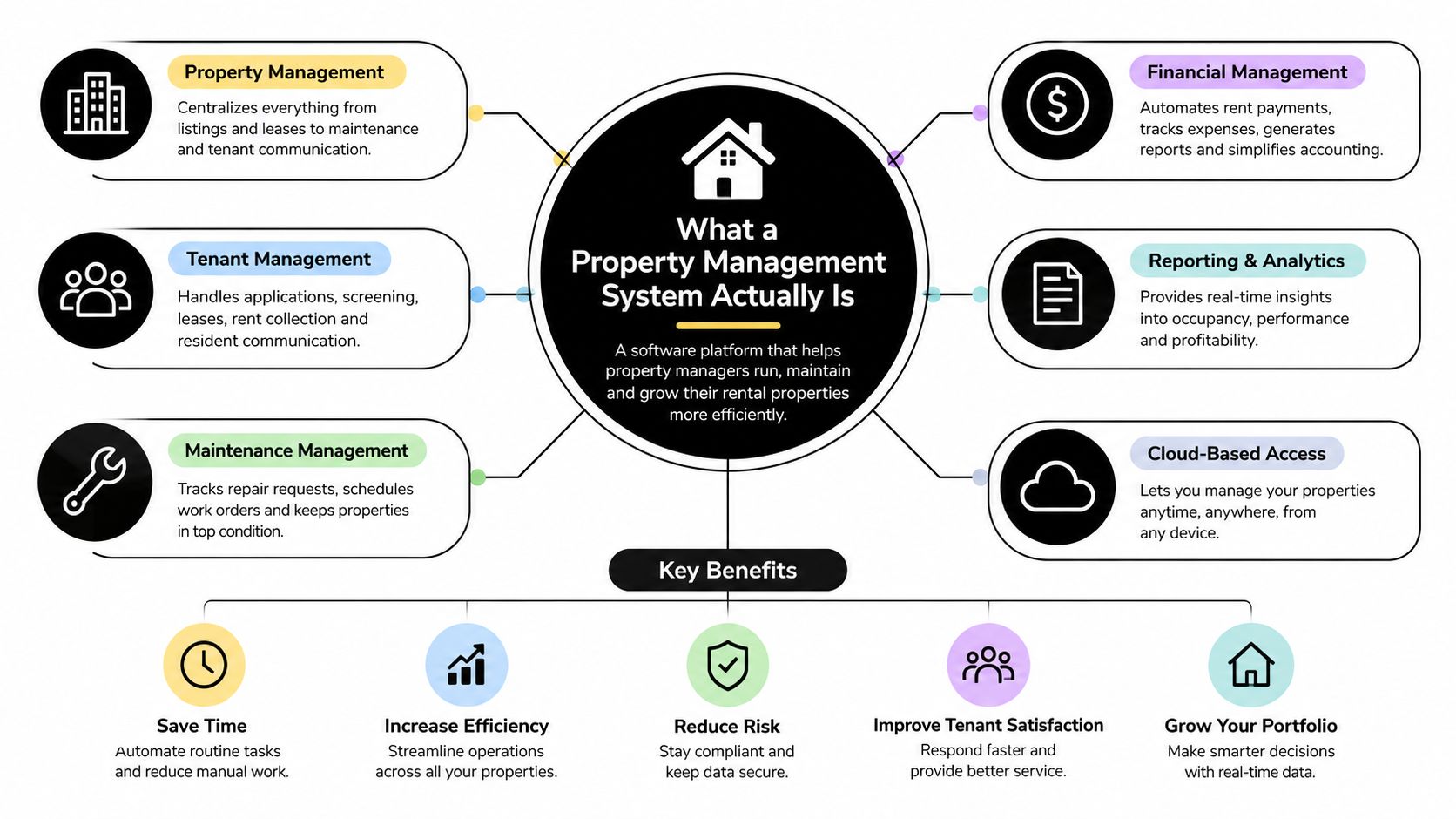
A property management system is software that centralizes the operational and administrative work of running a property, including leasing, rent collection, maintenance, communication, and accounting, in one connected database. It isn't just a calendar or payment app, it's the working record that ties recurring property tasks together.
You may recognize the problem before you know the name. A tenant texts you late at night about a leaking water heater, another rent payment sits in your bank account without a clear reference, and a maintenance request is buried beneath email messages. Your spreadsheet has one version of the story, your bank statement has another, and you're trying to reconstruct both before the owner report is due.
I manage properties in the Fresno area, so this kind of fragmentation is familiar. Central California owners may live nearby, work full time, or oversee a rental from another state. Either way, property operations don't stop when your workday ends. If you're already struggling to make room for these responsibilities, guidance on finding hours for real estate duties can help you assess the time commitment accurately.
The Landlord's Late-Night Spreadsheet Problem
Consider a Fresno rental with a tenant who pays by electronic transfer, a slow drain reported through text, and a renewal date recorded in a spreadsheet. You might copy the payment into one file, forward the maintenance message to a contractor, and search old email for the lease. Each step feels manageable by itself. Together, they create a chain of small opportunities for missed information.
A property management system, or PMS, puts those records into one controlled workspace. The property, unit, tenant, lease, payment, work order, document, and communication history can be connected instead of scattered across personal inboxes, notebooks, bank portals, and spreadsheets.
That connection changes the work. A rent payment can be matched to the correct tenant and lease. A repair request can become a work order with an assigned vendor, approval history, completion status, and invoice. An owner statement can draw from the same financial events that staff recorded during daily operations.
Practical rule: If you have to copy the same property information into several systems, you don't have an integrated workflow. You have several separate tasks that happen to concern the same rental.
This article will explain what a PMS does, how cloud and on-premise systems differ, and which integrations matter for a Fresno, Clovis, or greater Central California owner. It will also address the question behind the software search: whether a system can replace a full-service manager, support you as a self-managing landlord, or work alongside limited human help.
What a Property Management System Actually Is
The simplest useful analogy is this: a PMS is an operating system for property workflows. Your phone's operating system connects contacts, messages, payments, settings, and applications. A property management system connects the records and actions that keep a rental operating.
It starts with shared records. A solid residential PMS should maintain information for each:
- Property and unit: Address, unit details, availability, and operating records.
- Owner and tenant: Contact details, relationships, communications, and permissions.
- Lease: Terms, dates, charges, documents, and renewal information.
- Work order: Request, assignment, approval, status, completion, and invoice.
- Payment and transaction: Amount, date, source, allocation, and accounting treatment.
The benefit isn't merely having those records in one screen. The true value comes from the links between them. A lease record can trigger scheduled rent charges. A delinquency status can create communication and follow-up tasks. A maintenance request can move from intake to vendor assignment, approval, completion, and invoice reconciliation without someone rebuilding the history manually. Research on PMS architecture describes this integration of operational and financial functions as a core capability because managers need one consolidated view of the property record (PMS architecture and integrated property operations).
Why history matters
The PMS concept didn't begin as a fully integrated residential platform. Westin introduced Hoteltype in 1947, Sheraton followed with an automated reservation system called Reservation in 1958, and dedicated computerized PMS technology emerged in the late 1970s as offline, on-premise systems. By the mid-1990s, platforms connected reservations, check-in and check-out, housekeeping, and billing, while online booking appeared in 1995 (history of property management systems).
Residential systems developed around different tasks, but the underlying lesson is the same. A PMS isn't just a digital calendar. It coordinates recurring work and preserves the relationship between an operational action and its financial result.
That distinction helps when you're comparing products. A rent portal may collect payments. A maintenance app may receive repair requests. A spreadsheet may track leases. A PMS connects these activities so you can see what happened, who handled it, what it affected, and what still needs attention. A practical property management software comparison should therefore examine workflow connections, not just the number of features listed on a vendor's website.
Core Features That Do the Daily Work
A residential PMS earns its place by handling ordinary tasks consistently. The software should make the next action clear and preserve enough context that another person can understand the record without calling you.
Rent and resident records
Rent collection is more than a button labeled “Pay now.” The system should associate a payment with the correct tenant, lease, unit, and ledger. Automated reminders can reduce the need to send individual messages, while payment postings create a financial record that accounting staff can review.
Before a PMS, you might search your bank account, identify a transfer, update a spreadsheet, and email a receipt. With a connected workflow, the payment is posted against the resident's account and remains available for reporting. A tenant portal can also give residents a consistent place to submit questions, notices, and requests. For owners evaluating the payment side separately, an overview of a tenant payment portal shows why resident-facing payment tools should be considered alongside the underlying ledger.
Applicant and tenant records matter just as much. Screening information, application documents, lease files, notices, and communications should stay associated with the relevant person and property. That reduces the chance that a renewal decision depends on an incomplete email search.
Maintenance from request to invoice
A text message saying “the water heater is leaking” is an alert, not a complete maintenance workflow. The manager still needs to record the request, confirm the unit, assess urgency, select or contact a vendor, document authorization, verify completion, and connect the invoice to the correct property.
A PMS turns that chain into a work order. The request receives a timestamp and status. Staff can assign a vendor, record approvals, attach photos or documents, and close the job only after the work is complete. Detailed guidance on property management maintenance workflows is useful when deciding whether a platform can handle real repairs rather than just collect messages.
Accounting and owner reporting
Accounting is where disconnected tools become expensive in time and attention. A good system links charges, payments, bills, deposits, adjustments, and owner statements. It should help you understand why a balance changed, not merely display the final number.
The connecting idea is workflow traceability. Every rent collection, repair authorization, tenant interaction, lease renewal, and accounting adjustment should be time-stamped and linked to the responsible user or source document.
The most important feature isn't automation by itself. It's the ability to trace an event from request to outcome.
Permissions complete the picture. Owners may need statements and property-level records. Tenants need their own lease and maintenance information. Vendors need assigned work and relevant access, not the entire accounting database. Separating those roles makes the system easier to use and reduces unnecessary exposure of private information.
Cloud, On-Premise, and the Integrations That Matter
The difference between on-premise and cloud software is where the system runs and who carries the maintenance burden.
An on-premise PMS is installed on computers or servers controlled by the property business. It may offer direct local control, but access can depend on the office network, local hardware, backups, and internal technical support. If you're an out-of-state owner checking a statement while away from California, that setup can be inconvenient unless remote access has been designed carefully.
A cloud-based SaaS PMS is accessed through the web. The provider manages the hosted environment, while authorized users can work from different locations and devices. That doesn't automatically make a system secure or well designed, but cloud access can support standardized permissions, shared records, and near-real-time reporting across locations.
The industry moved from paper processes to computerized client/server systems during the 1980s, then toward SaaS supported by web and cloud technologies by the early 2020s (PMS deployment and cloud technology overview).
What should connect
A PMS normally manages the property's daily operational record. Connected tools may handle banking, accounting, payment processing, applicant screening, external listing distribution, or pricing. Those tools shouldn't be confused with the PMS itself.
For example, a payment processor can move money, but the PMS should explain which tenant account received the payment and how the transaction affects the ledger. An accounting connection can reduce duplicate entry, but you still need to verify how deposits, owner draws, bills, and adjustments are mapped.
The same principle applies to system selection. A platform with more modules may create more work if its data doesn't move reliably between them. Look for clear export options, usable reports, documented ownership of your records, and a practical process for leaving the provider. A definition of integrated software for audit can help frame the question: does the system create one dependable record, or does it merely place multiple tools behind one login?
Automation should serve that record. Resources on automation in property management are most useful when they show how a trigger, action, approval, and result remain connected.
PMS Software vs Hiring a Full-Service Property Manager
Software handles repeatable work. It doesn't automatically make decisions, inspect a home, speak with a frustrated tenant, coordinate a difficult repair, or carry responsibility for compliance. That distinction is central when a Fresno owner asks whether a PMS can replace a manager.
There are three workable paths.
| Path | Who It Fits | Day-to-Day Owner Involvement | Key Trade-Off |
|---|---|---|---|
| Self-manage with a PMS | Owners who want direct control and can respond to residents and vendors | High, even if software reduces administration | Lower dependence on a manager, but the owner remains responsible for decisions and response |
| Hire a full-service manager | Owners who want another team to run recurring operations | Limited, focused on oversight and approvals | Less daily work, with less direct control and a management arrangement to evaluate |
| Hybrid with selective support | Owners who can handle ongoing work but want help with placement or defined tasks | Moderate, based on the agreed handoffs | Flexibility, but unclear responsibilities can recreate the same gaps as disconnected software |
A placement-only arrangement may cover marketing, applicant screening, and lease drafting while the owner manages rent collection, maintenance, communication, renewals, and reporting. That approach can suit an experienced landlord with a small portfolio, but only if the handoff is documented. Who receives the first repair call? Who verifies income information? Who sends notices? Who keeps the lease and applicant files?
The industry itself shows that owners and professionals don't all work from one model. A 2025 survey found that nearly 6 in 10 property professionals relied on a centralized property-management platform, while 3 in 10 still moved among multiple applications (2025 property manager technology survey). Those figures don't prove that one approach fits every portfolio. They do show why integration and handoffs deserve attention.
Software may replace some administrative labor, but it won't replace a full-service manager's judgment and availability by itself. For a Clovis owner who works nearby and has trusted vendors, a PMS may support self-management effectively. For an investor living outside California, human coverage for urgent maintenance, tenant communication, inspections, and local decisions may be more important than having the most extensive software package.
Choosing and Rolling Out a System in Central California
Choose a PMS by testing the work you already do, not by counting icons in a sales demonstration. Ask the vendor to show how a Fresno rental moves from an application to a signed lease, from a payment to an owner statement, and from a maintenance request to a reconciled invoice.
Start with the connections that affect your records:
- Bank and accounting integrations: Confirm how deposits, charges, bills, owner payments, and adjustments transfer.
- Maintenance workflows: Test vendor assignment, approvals, photos, invoices, status changes, and tenant updates.
- Leasing and screening: Check whether applications, screening records, documents, and lease details remain connected.
- Owner statements: Review whether reports are understandable and exportable without vendor assistance.
- Permissions: Verify separate access for owners, tenants, staff, and vendors.
- Data exports: Ask what you can download if you change providers.
- Onboarding support: Confirm who will migrate records, train users, and answer questions after launch.
Security isn't a premium add-on when the system stores leases, payment records, inspection evidence, personally identifiable information, and owner financial data. Use role-based access, multi-factor authentication, encrypted transmission and storage, backups, configurable retention, and a compliant payment processor. Remove access promptly when an employee or vendor leaves.
NIST guidance says audit records should capture what event occurred, when and where it occurred, the outcome, and which identity performed it, while protecting logs from unauthorized access, modification, or deletion and supporting retention and monitoring procedures (NIST audit and accountability controls). Ask vendors to demonstrate those controls with a real example, such as a changed lease date or reversed payment.
Rollout should be controlled rather than rushed:
- Migrate records: Clean tenant, lease, unit, vendor, and ledger information before importing it.
- Configure permissions: Decide what each role can view, create, approve, edit, and export.
- Test one property: Run rent, maintenance, reporting, and communication workflows before expanding.
- Train the people involved: Include owners, staff, vendors, and anyone who answers tenant requests.
- Review exceptions: Keep human review for screening decisions, unusual payments, sensitive communications, and compliance questions.
For Central California owners, local support matters because software doesn't know your preferred vendors, response expectations, or property routines unless people configure and use it correctly.
How Edinhart Puts These Tools to Work for Owners
Edinhart Realty and Property Management applies the same connected-workflow idea through two different operating models. Its Full-Service Monthly Management package covers rent collection, repair coordination, tenant communication, move-in and move-out coordination, lease renewals, rent increases, property inspections, monthly management statements, and annual property reports.
For an owner, the important point is how those activities relate. A repair isn't treated as an isolated message. It belongs to a property, tenant, work order, vendor, approval, and financial record. Automated rent collection, on-call agents, multi-property discounts, and transparent financial reporting support the recurring administrative side, while people remain responsible for communication and decisions.
Edinhart also offers a Placement-Only Service for owners who want to keep day-to-day control. That service includes professional marketing, applicant screening, and lease drafting, after which the owner handles ongoing rent, maintenance, tenant communication, and renewals. The model can work when the owner understands the continuing workload and agrees to clear handoffs.
Compliance is part of the operating process, not a software checkbox. California Association of Realtors forms and ongoing legal updates support lease and transaction work, while professional photography, staging, and strategic pricing address the market-facing side of renting or selling a home. For a Fresno or Clovis owner, the right choice depends on whether the need is administrative support, local operational coverage, leasing assistance, or a combination.
FAQs and What a Good System Returns to You
Which decisions should stay with a person
Automation can send reminders, route maintenance requests, post payments, and prepare communications. Human review should remain in decisions involving applicant screening, exceptions to standard criteria, unusual payment activity, sensitive tenant situations, vendor disputes, lease changes, and possible fair-housing implications.
A system should make the decision easier to document, not hide who made it. Require a manual override, record the reason for an exception, and review automated messages before they create a recurring problem.
Does smarter software create new risks
Yes. A 2025 benchmark based on more than 2,000 property-management professionals reported that AI use rose from 21% to 34% in one year, while about 40% became more concerned about online fraud and 37% more concerned about data security (2025 property management AI and security benchmark).
That combination explains why convenience isn't enough. Review encryption, access controls, vendor data retention, breach procedures, fraud controls, audit logs, role permissions, fair-housing safeguards, and the ability to pause or override an automated workflow.
What does the owner get back
The return isn't limited to a faster payment screen. A well-integrated PMS can return clearer records, fewer missed follow-ups, better visibility into maintenance, more consistent communication, and time reclaimed from manual copying. It can also make a manager's work easier to supervise because the owner can follow the history of transactions and work orders.
The right question isn't “How many features does this platform have?” Ask whether it keeps your property information accurate, traceable, portable, and usable by the people responsible for the home. If you can answer that, you're evaluating a property management system rather than shopping for another app.
If you own rentals in Fresno, Clovis, Friant, or the greater Central California region, Edinhart Realty and Property Management can help you compare full-service management with placement-only support and software-assisted self-management. Visit Edinhart Realty and Property Management to discuss the level of local help, reporting, leasing, and ongoing coordination your properties require.


