

If you're looking at a rental property, you need to know its Net Operating Income (NOI). This number cuts through the noise and tells you the pure profit a property generates from its day-to-day operations.
It's the real measure of a property's financial health, completely separate from things like mortgage payments, income taxes, or big-ticket upgrades.
What Is Net Operating Income in Simple Terms

Think of your investment property like it’s a standalone business—let's say a local coffee shop. The cash coming in from lattes and scones is its revenue. The money going out for coffee beans, milk, staff wages, and the shop's rent are its operating expenses.
The profit that's left over before the owner pays their business loan or taxes? That's its net operating income.
It's the exact same principle for a rental property. NOI shows you how the property performs on its own, stripping away the owner’s personal financing decisions or tax situation. It gives you a clean, unbiased look at how profitable the asset truly is.
What NOI Includes and Excludes
To get an accurate NOI, you have to know what to count and what to ignore. The formula itself is simple, but one misplaced expense can throw off the entire calculation and lead you to make a bad investment decision.
At its core, the calculation includes all the money the property brings in and all the necessary costs to keep the lights on and tenants happy.
Net operating income is the reality check that helps you separate truly profitable properties from those that just look good on paper. It answers one critical question: does this property make money on its own?
Here’s a quick breakdown of what goes into the mix:
- Included Income: This is every dollar the property earns. It's mostly rent, of course, but don't forget other income streams like fees for parking, laundry machines, storage units, or even late payments.
- Excluded Items: NOI deliberately leaves out several major financial pieces. These include loan principal and interest (your mortgage), income taxes, depreciation, and capital expenditures (think major one-time costs like a new roof or HVAC system).
How to Calculate Net Operating Income Step by Step
Working out a property’s Net Operating Income is actually pretty straightforward once you get the hang of its two main parts. The formula itself is simple, but it’s incredibly powerful for getting a clean look at how a property is really doing financially, without all the noise from financing details or taxes.
Net Operating Income = Gross Operating Income – Operating Expenses
Just think of it as the difference between all the cash a property brings in versus all the cash it takes to keep it running day-to-day. Let's walk through each piece of this essential calculation.
Step 1: Figure Out Your Gross Operating Income
First things first, you need to add up every single dollar the property pulls in. We start with the absolute maximum it could make and then bring it back down to reality.
- Calculate Gross Potential Rent (GPR): This is what you’d collect if every unit was rented out for the whole year at the full market rate. For a single-family home renting for $2,000/month, your GPR is $24,000 for the year.
- Subtract Vacancy and Credit Losses: Let's be real—no property stays 100% full all the time. You have to account for empty units or tenants who don't pay. A good rule of thumb is to subtract a percentage of the GPR, usually somewhere between 5% and 10%, depending on what’s normal for your local market.
- Add Other Income: Don't forget the extra cash! This includes money from things like parking spots, coin-operated laundry, pet fees, or storage units.
Once you’ve done that, the number you're left with is your Gross Operating Income (GOI). This is the total income you can realistically expect to see.
This infographic breaks down the simple, three-step flow of the NOI calculation.
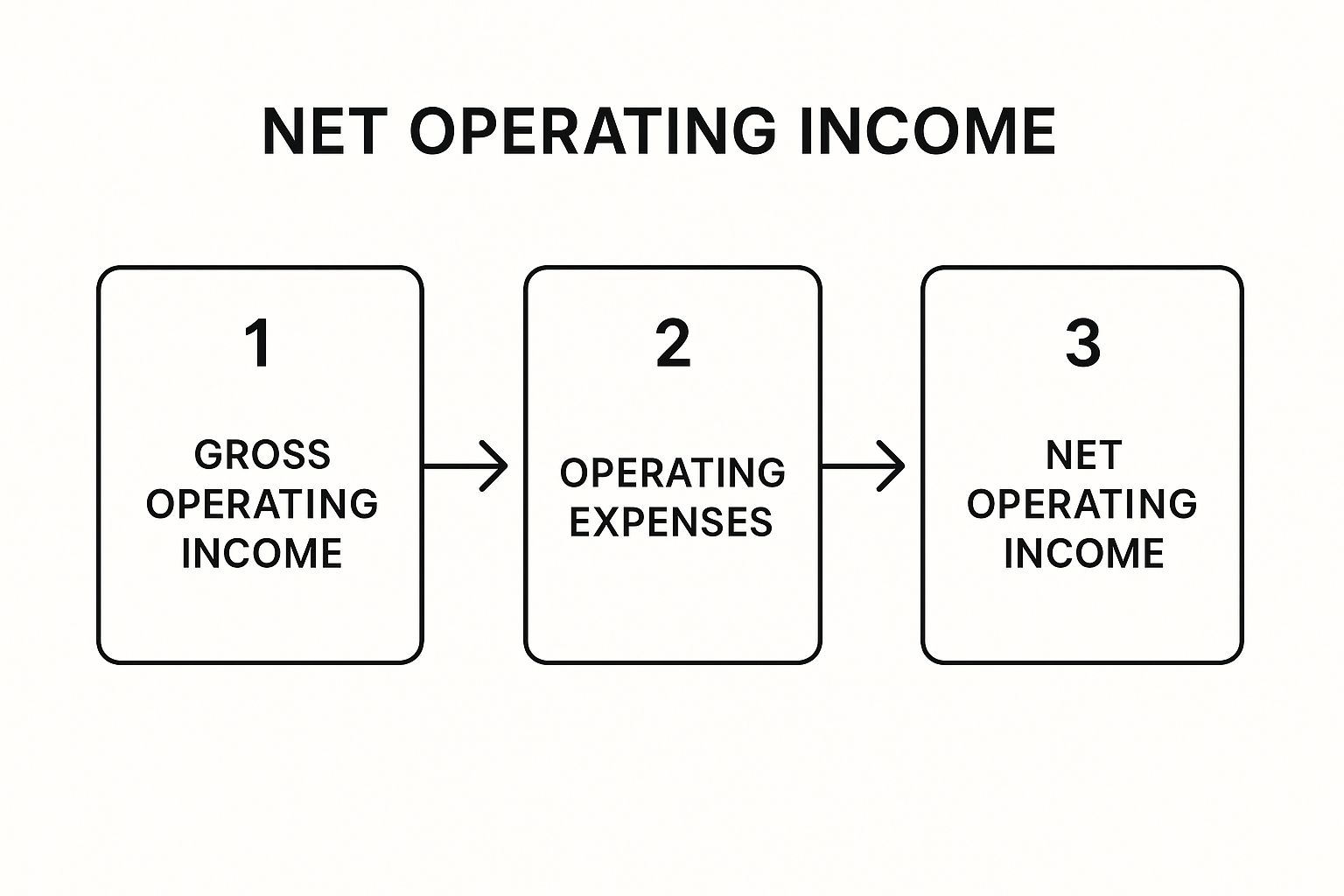
As you can see, it’s a logical path: start with all income, subtract all expenses, and you land on your core profit number.
Step 2: Subtract Your Operating Expenses
Next up, you subtract all the costs required to actually maintain and run the property. These are the expenses that keep the lights on and the place safe, functional, and ready for tenants.
To make sure you're getting an accurate number, it helps to be crystal clear on what counts as an operating expense and what doesn't.
Included vs Excluded Items in NOI Calculation
| Category | Included Items | Excluded Items |
|---|---|---|
| Gross Operating Income | Total Rental Income, Parking Fees, Laundry Income, Pet Fees | Tenant Security Deposits, Loan Proceeds |
| Operating Expenses | Property Taxes, Insurance, Maintenance & Repairs, Property Management Fees, Utilities (if paid by owner), HOA Fees, Landscaping | Mortgage Payments (Principal & Interest), Income Taxes, Capital Expenditures (e.g., new roof, HVAC), Depreciation, Tenant Improvements |
Getting this part right is crucial for an accurate NOI figure that you can actually rely on for making decisions.
Be meticulous here. So many investors make mistakes by either forgetting small expenses that really add up or, worse, including costs that don’t belong. Either error can dramatically skew your results and lead to a bad deal.
So, what are we subtracting? Things like property taxes, insurance, routine maintenance, repairs, property management fees, and any utilities you cover as the owner.
What you absolutely do not include are things like your mortgage payment (both principal and interest), income taxes, or huge one-time capital expenditures like a new roof or a full HVAC replacement. Those are considered owner-specific costs, not true operational ones.
Once you subtract these legitimate operating expenses from your GOI, the number you have is your Net Operating Income. To see how this powerful metric plays into the bigger picture of your investment's health, you can plug it into a detailed rental property ROI calculator and evaluate your total return.
Why Smart Investors Live and Breathe NOI

If you hang around seasoned real estate investors, you’ll hear them talk about net operating income constantly. There's a good reason for that. Simply put, NOI is the ultimate tool for an honest, apples-to-apples comparison between properties.
It cuts right through the noise. It doesn't care about an owner's mortgage, their tax bracket, or any creative financing they've used. All it shows is the pure, unvarnished profitability of the property itself.
Think about two identical duplexes on the same street. One is owned free and clear, while the other is mortgaged to the hilt. By focusing only on their NOI, you can instantly see which one is being managed better and pulling in more cash from its day-to-day operations—the owner's personal debt is completely irrelevant to that picture.
This is why NOI is the first metric you should reach for in your toolkit when you're sizing up potential investments.
The Bedrock of Valuations and Loans
NOI isn't just for comparing properties; it's the engine that drives a property's valuation and your ability to get a loan for it. Lenders and appraisers lean on this number heavily.
When you walk into a bank for a commercial loan, one of the first things they'll ask for is the property's NOI. Why? Because it tells them exactly how much debt the property can realistically handle. A healthy, stable NOI screams "low-risk investment," which almost always translates into better loan terms and more money in your pocket.
Think of NOI as the universal language of real estate investing. It allows you to have a meaningful conversation with lenders, appraisers, and other investors, ensuring everyone is judging the property on its own operational merit.
This number's influence doesn't stop there. NOI is the heart of the Capitalization Rate (Cap Rate) formula, one of the most common ways to determine a property's market value. Mastering NOI is essential to building effective investment strategies in real estate that actually work.
Its importance even extends beyond a single property. On a massive scale, NOI can act as a barometer for the health of entire economic sectors. During the 2008 financial crisis, for instance, the U.S. banking industry reported a jaw-dropping net operating income loss of $35.7 billion in a single quarter.
At the end of the day, understanding NOI is the crucial first step. You can't even begin to accurately calculate the Return on Investment (ROI) until you've got a firm grip on this foundational metric.
Calculating Net Operating Income with Real World Examples
Theory is one thing, but seeing the numbers in action is what really makes a concept like Net Operating Income click. Let's walk through a couple of real-world scenarios to see how it all comes together—first with a straightforward single-family rental, and then with a slightly more involved duplex.
Example 1 The Single-Family Rental
Imagine you own a standard single-family home that you rent out. Here’s what a typical year of finances might look like for an investment like this.
- Gross Potential Rent: The home pulls in $2,200 per month in rent. Over a full year, that adds up to a potential of $26,400.
- Vacancy Loss: No property stays rented 100% of the time. A smart investor budgets for vacancy. If you expect the property to be empty for about a month every two years, a 5% vacancy rate is a safe bet. That's a $1,320 deduction.
- Gross Operating Income (GOI): After accounting for that potential vacancy, your realistic annual income is $25,080 ($26,400 – $1,320).
Now for the fun part—subtracting the expenses that keep the property running.
- Property Taxes: $3,000 annually
- Insurance: $1,200 annually
- Repairs & Maintenance: $1,500 budgeted for the year
- Property Management: 8% of the rent you actually collect, which comes out to $2,006
All those operating costs total up to $7,706.
NOI Calculation: $25,080 (GOI) – $7,706 (Operating Expenses) = $17,374
That final number, $17,374, is your property’s annual NOI. This is the figure that truly matters. It tells you the core profitability of your investment and is a crucial part of the puzzle when you calculate rental property value.
Example 2 The Duplex Property
Let's dial up the complexity just a bit with a duplex. With two units, you have more income streams and a few different expenses to track, but the logic stays exactly the same.
The table below breaks down the annual numbers for a typical duplex.
NOI Calculation Example for a Duplex Property
| Financial Item | Calculation/Details | Amount |
|---|---|---|
| Gross Potential Rent | Unit A: $1,500/mo, Unit B: $1,400/mo | $34,800/year |
| Other Income | Laundry machine revenue | $600/year |
| Gross Potential Income | Total potential income combined | $35,400/year |
| Vacancy Loss | Budgeted at 6% of rent | ($2,088/year) |
| Gross Operating Income | (Potential Income – Vacancy Loss) | $33,312/year |
| Operating Expenses | (Taxes, Insurance, Repairs, Management) | ($10,500/year) |
| Net Operating Income | (GOI – Operating Expenses) | $22,812/year |
As you can see, even with more moving parts, the process doesn't change. You simply add up all the potential income, subtract what you lose to vacancy and what you spend on operations, and what's left is the property’s true, unvarnished profit before any financing costs or taxes.
Common Mistakes That Wreck Your NOI Calculation

Getting your net operating income calculation wrong, even by a small amount, can turn a promising investment into a financial headache. I’ve seen it happen. Even seasoned pros can fall into a few common traps that completely skew their analysis, making a dud look like a diamond.
Knowing where these financial landmines are hidden is the first step to getting a clear, accurate picture of a property's health. Miss just one detail, and your final NOI figure could be wildly off, leading you to overpay or completely misjudge what a property is truly worth.
Mixing Up Capital Expenses and Operating Expenses
This one is huge. The most frequent mistake I see is lumping a major capital expenditure (CapEx) in with regular operating expenses. Think of it this way: an operating expense is a recurring cost for day-to-day upkeep, like hiring someone to fix a leaky faucet. A capital expense is a big-ticket, infrequent purchase that adds real value or extends the property's life.
When you mix them up and include a huge one-time cost in your annual numbers, you artificially crush your NOI. Suddenly, a perfectly healthy property looks like it’s bleeding cash.
- Operating Expense: Patching a small roof leak, paying the monthly trash bill, or hiring a landscaper. These are the "keep the lights on" costs.
- Capital Expenditure: Replacing the entire roof, installing a brand-new HVAC system, or repaving the parking lot. These are major upgrades.
Wearing Rose-Colored Glasses About Vacancy and Costs
It’s so easy to be optimistic when you’re excited about a deal. But assuming your property will be 100% occupied all year is a rookie mistake that almost never pans out in the real world. Forgetting to budget for a realistic vacancy rate will make your income projections look way better than they actually are.
A flawed NOI calculation is worse than no calculation at all. It gives you a false sense of confidence in a property's performance, which can be a costly mistake in the long run.
On that same note, investors often forget all the little miscellaneous expenses that quietly add up. Things like pest control, accounting fees, or the occasional legal consultation are easy to brush aside, but they are very real costs. You have to build in a buffer for these unexpected-but-inevitable expenses to get an honest calculation.
Answering Your Top Questions About Net Operating Income
As you start working with Net Operating Income, you'll naturally have a few questions. It's a key metric, but some of the nuances can be tricky. Let's tackle the most common ones so you can feel confident using NOI in your own property analysis.
Is NOI the Same as Profit?
Not quite, and this is a really important distinction to get right. NOI is not your final profit or cash flow.
Think of it as a crucial halfway point. NOI tells you how profitable the property's day-to-day operations are before you factor in things like your mortgage payment and income taxes. Your actual profit, or what investors call cash flow, is the money left in your bank account after all those bills—including the loan—are paid.
NOI is a pure number for comparing one property's operational health to another, while cash flow is what you actually get to keep.
How Does NOI Relate to the Cap Rate?
NOI and the Capitalization Rate (or Cap Rate) are two peas in a pod. They work together to give you a quick snapshot of a property's value and potential return. The formula is actually pretty simple:
Cap Rate = Net Operating Income / Property Value
If you have a higher NOI and the property value stays the same, you get a higher Cap Rate. A higher cap rate generally signals a more profitable investment for the price you're paying. Seasoned investors use this calculation all the time to quickly size up a deal and see if it's worth a deeper look.
Can a Property Have a Negative NOI?
You bet it can. A negative NOI simply means the property's operating expenses are higher than all the income it's bringing in.
When this happens, the property is losing money from its core business, and that’s before you even think about paying the mortgage. If an investor sees a negative NOI, it's a major red flag. They'd have to figure out a solid plan to either boost the income in a big way or make some serious cuts to the expenses to turn things around.
At Edinhart Realty and Property Management, we specialize in helping investors sharpen their numbers, maximize their NOI, and achieve their financial goals. See how our expertise can work for you at https://edinhart.com.


