

Let's clear something up right away: Fair Market Rent (FMR) isn't the same as the average rent you might see advertised around town. Instead, it’s a specific financial benchmark set by the U.S. Department of Housing and Urban Development (HUD).
Think of it as the government's data-backed estimate of what it should cost to rent a modest, safe, and clean home in a particular area, like Fresno County. Specifically, FMR represents the 40th percentile of gross rents for standard rental units. Its main job is to set the payment standards for federal housing assistance programs.
So, What Exactly is Fair Market Rent?
Here’s an analogy that might help. Think of Fair Market Rent like the Manufacturer's Suggested Retail Price (MSRP) on a new car. It’s a standardized figure that gives everyone a solid starting point, but it doesn't always reflect the final price you'll see on the sticker.
Just like a car's price can go up or down based on its specific features, mileage, and current demand, your property's ideal rent will naturally vary based on its own unique qualities. FMR is the government’s baseline, not the final word.
The primary role of FMR is administrative, especially for programs like the Housing Choice Voucher Program (better known as Section 8). This system ensures that the federal assistance offered to families actually lines up with local housing costs. It's a way to help low-income families find decent housing without being forced into the absolute cheapest—and often lowest-quality—options on the market.
FMR is a Statistical Benchmark, Not a Street Price
It’s crucial to remember that FMR is a statistical calculation, not a simple average of what landlords are currently charging. HUD crunches the numbers and publishes these figures every year.
For example, the proposed national non-metropolitan rent for fiscal year 2026 is $973, with the new rates officially kicking in on October 1, 2025. To see what the FMR is for your specific property, you can dive into the data on the official HUD User Portal.
This screenshot shows the main data portal where you can look up FMRs for any county in the country.
Using this tool is the first step in any rent analysis. It allows you to find the specific figures for your property's bedroom count, giving you an essential piece of the puzzle when setting your rent.
How HUD Determines Fair Market Rent
You might wonder where the Fair Market Rent number actually comes from. It isn't just an arbitrary figure pulled out of a hat. The Department of Housing and Urban Development (HUD) has a meticulous, data-driven process to make sure FMRs reflect local housing costs as accurately as possible. It's designed to be a stable, impartial benchmark for housing programs nationwide.
It all kicks off with a massive pile of data from the U.S. Census Bureau's American Community Survey (ACS). This survey is a goldmine of information, collecting details on what renters are actually paying for housing across the country. HUD uses this five-year survey data to set a baseline rent for different metropolitan areas and counties.
Of course, census data can be a few years old by the time it’s compiled. So, HUD has to bring it up to speed. They apply a "trend factor" based on more recent, local rent surveys and inflation data, like the Consumer Price Index. This is a crucial step that adjusts the historical numbers to reflect what the market looks like today for the upcoming fiscal year.
Calculating the Gross Rent
A key thing to understand here is the concept of gross rent. FMR isn't just the rent payment. It also includes an estimate for essential utilities—think electricity, gas, and water. This is because housing assistance programs need to work with a figure that represents the total cost of living in a modest home.
By bundling utilities into the calculation, HUD creates a more balanced, apples-to-apples comparison. A unit with a lower base rent might actually cost a tenant more out-of-pocket if they have to cover all the utilities themselves. Gross rent levels the playing field so everyone is looking at the same total housing cost.
Key Takeaway: FMR is set at the 40th percentile of gross rents for a specific area. In simple terms, this means 40% of standard rental units in that market are priced at or below the FMR, and 60% are priced above it. The goal is to hit that sweet spot of affordability without dragging the whole market down.
This infographic helps visualize how FMR fits into the bigger picture of rental pricing lingo that landlords use every day.
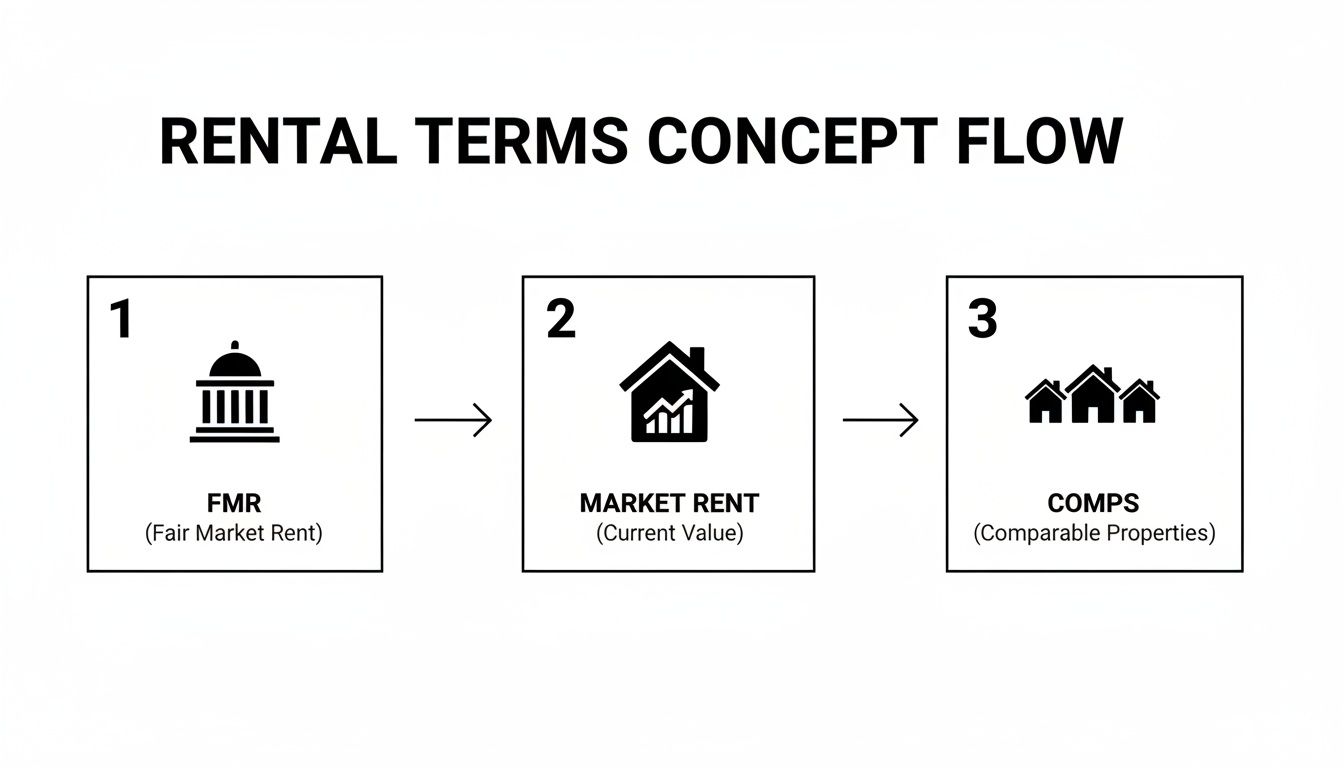
You can see the flow here—from the government-set FMR to the more fluid, real-time market rent and then down to the hyper-specific comparable properties. It shows all the different layers of rental analysis.
The Importance of Geographic Specificity
This whole data-heavy process really underscores why FMR is so localized. The rental market in Fresno is a completely different world from Los Angeles or San Francisco, and the numbers have to reflect that.
HUD establishes separate FMRs for every metropolitan statistical area (MSA) and non-metropolitan county. This ensures that the FMR for a two-bedroom apartment in Fresno County is a true reflection of the Central Valley's market, not the pricey coastal regions.
For us as landlords, understanding this geographic precision gives us confidence in the data. While FMR isn't perfect—it can't always capture the subtle differences between, say, two adjacent neighborhoods—it remains a powerful, statistically sound starting point for any rental property analysis.
How National Rent Trends Impact Your Fresno Property
It’s easy to feel like you’re in a bubble here in the Central Valley, disconnected from the wild housing headlines coming out of places like L.A. or the Bay Area. But the truth is, those macroeconomic waves create very real ripples that reach your Fresno property. What happens on Wall Street or in Silicon Valley has a direct impact on who wants to rent your unit and what you can charge.
Think about it. Major forces like inflation, staggering housing shortages in coastal cities, and the rise of remote work are completely changing the game. As rents and home prices in those major hubs skyrocket, people and even entire companies start looking inland. They’re searching for affordability and a better quality of life, and that search often leads them right here to Fresno.
This isn’t just a hunch; it’s a powerful economic shift we’re seeing firsthand. More and more people are discovering the value and appeal of the Central Valley, which is making the rental landscape more competitive for everyone.
The National Rent Rollercoaster
The U.S. rental market has been on a wild ride over the last few years, and that volatility sets the tone for what happens locally. When the national news is filled with stories of massive rent hikes, it recalibrates what renters and investors everywhere—including Fresno—think is "normal."
And this isn't just media hype; the numbers back it up. Between 2021 and 2026, Fair Market Rents shot up across the country's biggest metro areas. One analysis found that one-bedroom Fair Market Rents in the 50 largest metros jumped by an average of $457. That's a 40.7% increase. Two-bedroom units saw a similar spike, climbing $505, or 37.3%. You can dig into more of this data on national FMR trends and their impact.
This national surge isn't just a number on a page; it creates a new reality on the ground. As renters get priced out of major cities, places like Fresno suddenly look incredibly attractive. This drives up demand and gives savvy landlords an opportunity to optimize their pricing.
What This Means for Your Fresno Rental
So, how does all this national drama play out for your property? It's simple: increased demand. Your pool of potential tenants gets bigger and deeper. But it also means their expectations might be different, shaped by what they’re used to in more expensive markets. They might be looking for more modern amenities or be willing to pay a premium for a well-maintained, professionally managed property.
This is exactly why you need to understand both the big national picture and the nitty-gritty local details. You can't set your rent in a vacuum anymore. By keeping an eye on these larger trends, you can get ahead of shifts in local demand, confidently justify competitive rent, and make smart decisions about property upgrades that attract those high-quality tenants moving into the area.
For a closer look at the local numbers, check out our guide on the average rent in Fresno, CA. Having this full context helps you position your property to meet the market where it’s going, not just where it is today.
Using FMR and Market Analysis to Set Your Rent

Alright, let's turn all this data into an actual strategy you can use to set the perfect rent. Think of Fair Market Rent not as the final price tag, but as your essential starting point—a solid baseline to build your own analysis on. Nailing your rent price is the key to balancing healthy income with minimal vacancies.
The whole process kicks off with one simple step: look up the current HUD FMR for your property's bedroom count right here in Fresno County. That gives you an immediate, data-backed reference. But stopping there is a rookie mistake. The real magic happens when you pair that FMR number with a deep dive into what’s happening on your street and in your neighborhood.
Conducting Your Comparative Market Analysis
This next part is all about rolling up your sleeves and doing a Comparative Market Analysis (CMA). The goal is to find your "comps"—properties that are as similar to yours as possible, right in your immediate area. These are your direct competitors, and whatever they’re charging is exactly what potential tenants will be measuring your unit against.
Your CMA should laser-focus on properties that are a close match in these key areas:
- Location: Stick to a tight radius, ideally in the same neighborhood or even on the same block.
- Size and Layout: If you have a three-bedroom house, you should be looking at other three-bedroom houses.
- Property Type: A single-family home just isn't comparable to a condo in a massive complex.
- Age and Condition: A freshly remodeled unit with all the modern touches can easily ask for more than one that’s a bit dated.
Expert Tip: Don't just get distracted by listing prices. Try to dig up what properties actually rented for. Active listings show what landlords are asking, but rented properties tell you what the market is truly willing to pay.
Adjusting for What FMR Overlooks
This is where your property’s unique personality comes into play. FMR is a broad-stroke statistic; it has no idea about the specific details that make your rental stand out from the crowd. You have to adjust your price—up or down—based on all the things FMR completely ignores.
Does your property have features that justify a higher price? Think about these common value-adds:
- Upgraded Amenities: A sleek, modern kitchen with stainless steel appliances or a beautifully renovated bathroom.
- Desirable Extras: A private backyard, a sparkling swimming pool, or a two-car garage.
- Location Perks: Are you close to top-rated schools, popular parks, or major employers? That’s worth something.
To make this crystal clear, let's walk through a simplified example of how you can start with the FMR and make logical adjustments to find your sweet spot. Getting this process down is a core skill for any landlord, and you can dive deeper into the tools available with our guide to using a fair market rent calculator.
Sample Rent Calculation for a Fresno Property
Here’s a practical look at how this plays out for a hypothetical 3-bedroom home in Fresno.
| Factor | Baseline/Adjustment | Calculated Rent |
|---|---|---|
| HUD FMR (3-Bed) | Fresno County Baseline | $1,850 |
| Adjustment: New Kitchen | Premium Feature | +$125 |
| Adjustment: Pool | High-Value Amenity | +$150 |
| Adjustment: Older A/C | Minor Drawback | -$50 |
| Final Market Rent | Your Target Price | $2,075 |
By following this simple framework—starting with FMR and then layering on a detailed, local market analysis—you go from a generic benchmark to a strategic, competitive price that’s tailored specifically to what your property offers.
Navigating Housing Programs and FMR Compliance
So, where does Fair Market Rent really come into play for a landlord? The most direct answer is government housing subsidy programs, especially the Housing Choice Voucher Program—what most people know as Section 8. This is where FMR stops being just a number on a chart and becomes a crucial tool that shapes your rental agreements.
For landlords in Fresno, your local Public Housing Authority (PHA)—in our case, the Fresno Housing Authority—uses HUD's FMR data as the cornerstone of its voucher system. They take the FMR figure and use it to set something called a payment standard. This standard is basically the maximum subsidy the agency will pay toward a qualified tenant's rent each month.
What Exactly Is a Payment Standard?
Here’s a common mix-up I see all the time: many landlords think FMR is a strict ceiling on what they can charge. That’s not how it works. The payment standard is the maximum amount the government will chip in, not the maximum rent you can legally charge. You absolutely can set a rent that’s higher than the FMR.
But there are a couple of catches:
- The tenant has to be willing and able to cover the difference out of their own pocket.
- The PHA still has the final say. They have to approve your total rent as "reasonable" by comparing it to similar, non-subsidized units in the neighborhood.
This gives you some much-needed flexibility. It means you can participate in the program without having to undervalue your property, especially if you’ve made recent upgrades or have amenities that the broad FMR calculation doesn't capture.
The Pros and Cons of Participating in Housing Programs
Deciding to accept housing vouchers is a big business decision, and it’s smart to look at it from all angles. There are clear upsides and potential downsides, and what works for one investor might not work for another.
Potential Benefits:
- Guaranteed Rent Payments: The PHA's portion of the rent comes straight to you every month like clockwork. That’s a level of consistency and reliability you just don't get in the open market.
- A Much Larger Tenant Pool: By opening your doors to voucher holders, you instantly expand your list of potential applicants, which can dramatically reduce vacancy times.
Potential Drawbacks:
- Property Inspections: Your unit has to pass an initial inspection and then an annual one to make sure it meets HUD's housing quality standards.
- More Paperwork: Let's be honest, there are more administrative hoops to jump through. You're dealing with more forms and compliance rules than you would with a typical lease.
For many property owners, the peace of mind that comes with guaranteed rent is well worth the extra administrative tasks. This is where professional property management really shines. We can handle the paperwork, coordinate the inspections, and manage all communication with the PHA, making the whole process feel seamless for you.
How Professional Management Maximizes Your Rental Income

Knowing what fair market rent is lays the groundwork for a profitable strategy. But honestly, turning that knowledge into the most money in your pocket takes a lot more than just looking up a number. It demands expertise, constant watch over the market, and a solid game plan.
This is where having a professional property manager becomes your biggest advantage, turning those data points into actual dollars.
At Edinhart Realty & Property Management, we don't just glance at FMR data; we dig deeper, blending it with hyper-local, street-level insights. We know which Fresno neighborhoods are commanding a premium and exactly which amenities can justify a higher price tag. Our goal isn't just to set a rent that reflects your property's true value, but one that attracts high-quality tenants fast, cutting down on those painful, costly vacancies.
A Partnership in Profitability
Navigating the rental market is so much more than just picking a price. It’s a whole suite of coordinated services designed from the ground up to protect your investment and boost your returns.
We tackle the common headaches landlords face head-on:
- Professional Marketing: We use high-quality photography and write compelling listings that make it clear why your property is worth a top-market rate.
- Rigorous Tenant Screening: Our meticulous process is all about finding reliable, long-term residents who will treat your property right.
- Compliance Expertise: We’re experts at navigating the rules of housing programs like Section 8, handling all the inspections and mountains of paperwork so you don’t have to.
While rent growth across the country has cooled off a bit, projections for 2026 are pointing toward pricing power coming back. With more competition for tenants, landlords can expect stronger rent growth on renewal leases—often 3% or better—especially when you keep great residents happy.
This kind of forward-thinking is what separates the pros. For landlords looking to fine-tune their operations, checking out specialized solutions for the housing rentals industry can offer some incredibly helpful tools.
Ultimately, think of us as your dedicated partners in hitting your financial goals. By applying smart, strategic rent-setting principles, we help turn your Central California property into a high-performing asset.
Find out more about our approach to expert Fresno property management and see just how we can maximize your income.
Here are some of the most common questions we hear from landlords about Fair Market Rent. Let's clear up the confusion so you can feel more confident about your rental property decisions.
Can I Charge More Than the Fair Market Rent?
Yes, you absolutely can. Think of FMR as a baseline, not a ceiling. It’s a crucial number for subsidy programs, but it is not a legal rent cap for private rentals.
You should always set your rent based on what the actual market will bear. If your property is in a prime location, has great amenities, or is in better condition than average, its true market rate could easily be higher than the FMR.
How Often Does Fair Market Rent Change?
HUD recalculates and updates the FMR figures every single year. The new numbers usually come out in late summer or early fall and officially take effect on October 1st, which kicks off the federal fiscal year. It's a smart habit to check for the latest rates annually.
Key Takeaway: Relying on last year's numbers can throw your pricing way off. FMR is an annual figure, so always make sure you're working with the most current data published by HUD.
Does FMR Differ Based on Bedroom Count?
It sure does. HUD doesn't just issue one blanket number for an area. They provide specific FMRs for different unit sizes, from studios all the way up to four-bedroom homes.
This makes the benchmark much more accurate for the type of property you actually own. When you look up the rates for Fresno, you’ll see a clear breakdown with different values for each bedroom count.
Where Can I Find the Official FMR for Fresno County?
The best and most reliable place to go is straight to the source: the HUD User Portal. It’s on the U.S. Department of Housing and Urban Development's official website.
They have a simple tool that lets you look up FMRs for any county in the country, including ours right here in Fresno. Of course, a professional property manager will always have these figures on hand, too.
Navigating Fresno's rental market takes more than just data—it takes real local expertise. At Edinhart Realty & Property Management, we turn these market insights into maximum returns for your property.
Discover how our expert property management services can boost your rental income.


