

When you're investing in real estate, cash flow is king. It’s the money that's actually left in your pocket after all the bills are paid. Think of it as your property’s take-home pay each month—the real profit, not just the rent you see on paper. It's the truest measure of whether an investment is working for you or against you.
Understanding Your Property's True Profit
At its heart, figuring out cash flow is just like looking at the bottom line of any business. Your property brings in money, mostly from rent, but it also has a list of expenses that need to be covered.
The math breaks down into two simple sides:
- Total Income: This is your monthly rent checks, plus any extra income streams like pet fees, laundry machines, or assigned parking spots.
- Total Expenses: This covers everything from the mortgage payment and property taxes to insurance, HOA fees, maintenance, and property management costs.
When your income is higher than your expenses, you've got positive cash flow. But if those expenses start to creep up and overtake what you're bringing in, you slip into negative cash flow. This single number tells you almost everything you need to know about a property's financial health. You can find more global perspectives on real estate performance from the asset management experts at UBS.com.
Simply put, positive cash flow builds wealth by putting money in your pocket each month. Negative cash flow drains it by forcing you to cover the shortfall.
This is what separates smart investing from pure speculation. Relying only on appreciation is a gamble on what the market might do tomorrow. Positive cash flow, on the other hand, gives you income and stability today. Getting a firm grip on this is the absolute first step you need to take when you calculate rental property value and make decisions you can count on.
Calculating Cash Flow Without Getting Lost in the Numbers
Figuring out the cash flow on a potential investment property might seem like you need a finance degree, but it's really not that complicated. It’s a simple process of addition and subtraction. You just start with all the money coming in and then subtract all the money going out to see what you actually get to keep. Getting this right gives you a clear, honest look at the deal before you ever sign on the dotted line.
First up, you need to know your Gross Potential Income (GPI). Think of this as the absolute best-case scenario—the total rent you’d collect if your property was filled with paying tenants 100% of the time. From there, we get a little more realistic by subtracting an allowance for vacancies and tenants who don't pay. This gives you the Gross Operating Income (GOI), which is a much better number to start your real-world calculations with.
Finding Your Net Operating Income
Okay, now it’s time to account for the bills. The next step is to subtract all your operating expenses from the GOI. These are all the necessary costs to keep the property up and running—except for your mortgage payment. We'll get to that later.
Common operating expenses usually include things like:
- Property Taxes
- Insurance
- Utilities (if you're paying them, not the tenants)
- Repairs and Maintenance
- Property Management Fees
Once you’ve tallied those up and subtracted them, you’re left with a really important number: your Net Operating Income (NOI). It’s a fantastic metric because it shows you how profitable the property itself is, completely separate from any financing you have on it. If you want to dive deeper, you can learn more about what is net operating income and why seasoned investors rely on it.
This quick visual breaks down the whole process, taking you from the top-line income all the way down to your actual cash flow.
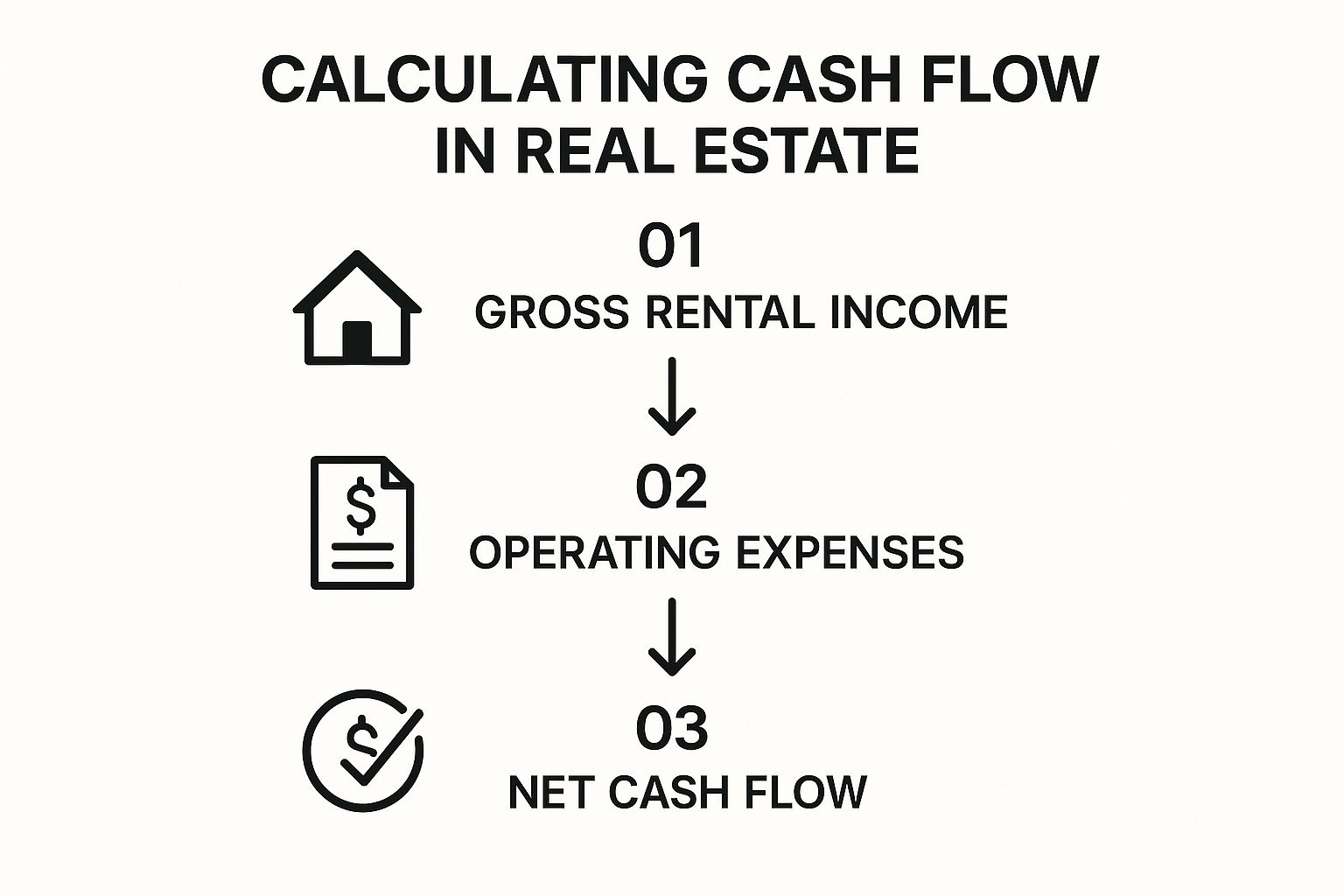
It really simplifies the calculation, showing how each step logically flows into the next to give you the property's true financial picture.
From NOI to Final Cash Flow
We're almost there! This last step is the easiest but also the most critical. You take your Net Operating Income (NOI) and subtract your total mortgage payment—that includes both the principal and the interest. Whatever is left is your pre-tax cash flow. It’s the money that actually lands in your bank account every month.
Cash Flow = Net Operating Income (NOI) – Total Mortgage Payment
A rookie mistake many new investors make is forgetting to set money aside for Capital Expenditures (CapEx). These are the big-ticket items you know you'll have to replace eventually, like a roof, an HVAC unit, or a water heater. Budgeting for CapEx from day one gives you the most accurate and sustainable view of your property’s long-term health. For a more detailed guide, check out this resource on how to analyze property cash flow step by step so you don't miss a single detail.
Why Cash Flow Is Your Most Powerful Investment Tool
Cash flow is more than just a number on a spreadsheet; it’s the engine that actually drives a successful real estate portfolio. While a lot of new investors get caught up chasing the thrill of appreciation—hoping a property’s value will shoot through the roof—the seasoned pros know the real secret. **Consistent, predictable income is the key to building lasting wealth.**
Think about it this way. Relying only on appreciation is a lot like gambling. You're basically betting on future growth that is completely out of your control. Positive cash flow, on the other hand, is like getting a reliable paycheck from your property every single month.
This steady income gives you the financial stability to handle unexpected repairs without sweating it and to ride out market downturns that would crush more speculative investors.
Building a Resilient Portfolio
The real power of cash flow is the momentum it creates. That monthly surplus isn't just extra spending money; it’s a strategic tool you can use to grow.
- Fund Repairs Stress-Free: When a water heater finally gives out, you have a dedicated fund from the property's own earnings to cover it. No panic necessary.
- Weather Vacancies: If a unit sits empty for a month or two, the cash flow you've built up from previous months acts as a critical buffer.
- Generate True Passive Income: This is the dream, right? Income that shows up every month without you having to actively work for it.
This financial cushion is what separates a sustainable investment from a stressful liability. It’s the difference between building a real business and just owning a second, more demanding job.
Strong cash flow is the foundation of a scalable real estate business. It proves to lenders that your portfolio is profitable, making it significantly easier to secure financing for your next property.
With a proven track record of positive cash flow, you can acquire more assets and seriously accelerate your wealth creation. Of course, different sectors will perform differently; for instance, the industrial sector often generates robust cash flow because of high demand. Macroeconomic trends always play a role, but the core principle never changes.
You can discover insights on commercial real estate performance from Deloitte.com to see how these trends affect different areas. But at the end of the day, focusing on cash flow means you're building a resilient investment strategy designed to thrive in any market—not just buying a property and hoping for the best.
Seeing Cash Flow in the Real World
Formulas and spreadsheets are one thing, but where the concept of cash flow really clicks is in the real world. At the end of the day, an investment property either puts money in your pocket or takes it out. That’s it.
Let's look at two very different stories to see how this plays out.
The Steady Midwest Duplex
First, meet Sarah. She buys a duplex in a stable Midwest city, and her total monthly rental income from both units is $2,400. After she pays the mortgage, taxes, insurance, and squirrels away some cash for future repairs, her total expenses add up to $2,150.
That leaves her with $250 in positive cash flow every single month. It might not sound like a life-changing sum, but it's incredibly powerful. Sarah can use that extra cash to pay down her mortgage principal faster, building equity at a quicker pace. She's also saving it for her next down payment, meaning her investment is actively funding its own growth.
The High-Cost Appreciation Gamble
Now, let's consider Mark. He goes a different route, buying a trendy, new-build condo in a pricey coastal city, betting big on rapid appreciation. His property pulls in a hefty $3,000 per month in rent. The problem? His mortgage, HOA fees, and property taxes are sky-high, totaling $3,400 a month.
Mark is left with -$400 in negative cash flow. Every single month, he has to dip into his own savings to cover the shortfall. While his condo's value might be climbing on paper, his bank account is shrinking. He's counting entirely on a future sale to make back his losses and hopefully turn a profit—a high-stakes gamble that offers zero immediate financial stability.
The difference is stark: Sarah's property is a self-sustaining asset that fuels her financial growth, while Mark's is a liability that drains his personal finances month after month.
To really drive the point home, let's put these two properties side-by-side.
Positive Cash Flow Property vs. Negative Cash Flow Property
| Metric | Property A (Positive Cash Flow) | Property B (Negative Cash Flow) |
|---|---|---|
| Gross Rental Income | $2,400 / month | $3,000 / month |
| Total Operating Expenses | $2,150 / month | $3,400 / month |
| Monthly Cash Flow | +$250 | -$400 |
| Investor Action | Reinvests profit, pays down loan faster | Covers shortfall from personal savings |
| Primary Strategy | Steady income & long-term growth | Hopes for future appreciation |
| Financial Health | Self-sustaining, portfolio growth | Financial drain, high risk |
This comparison shows why a "good deal" on paper, fueled by the hope of appreciation, isn't always a smart investment. For most investors looking to build real, sustainable wealth, the steady, predictable income from a positive cash flow property is what provides security and momentum. It's what turns a real estate hobby into a real business.
Actionable Strategies to Boost Your Property's Cash Flow

Knowing what cash flow is and how to calculate it is the first step. The real magic happens when you start actively improving it. Turning a so-so property into a high-performing asset really comes down to a few smart, strategic moves.
You can supercharge your property’s bottom line from two different angles: either bring in more income or slash your expenses. Honestly, the biggest wins happen when you tackle both at the same time. The combined effect on your monthly profit can be powerful.
Smart Ways to Increase Your Income
Generating more revenue doesn't always mean you have to hit your tenants with a drastic rent hike. Sometimes, small, clever additions can create entirely new income streams and naturally justify higher rental rates down the road.
- Perform Value-Add Renovations: Focus on the upgrades that deliver the most bang for your buck, like modernizing a dated kitchen or giving a bathroom a fresh look. These improvements can justify a serious rent increase and tend to attract better-quality tenants.
- Implement Additional Fees: Think about amenities tenants are willing to pay extra for. This could be anything from reserved parking spots and on-site storage units to allowing pets for a reasonable monthly fee.
- Maximize Occupancy: A vacant unit is a cash flow killer, plain and simple. Keeping your property filled starts with great service and clear communication. Our guide on proven tenant retention strategies has some great, actionable tips to keep fantastic tenants happy and staying longer.
Proven Tactics to Reduce Expenses
Now for the other side of the coin. Trimming your operational costs sends more money straight into your pocket. Every single dollar you save is a dollar of pure profit.
A proactive approach here is non-negotiable. Having a solid preventative maintenance plan, for instance, helps you dodge those costly emergency repairs that can wipe out months of positive cash flow in a single afternoon.
Look into refinancing your mortgage. Locking in a lower interest rate can dramatically reduce what is likely your single largest monthly expense. Don't be afraid to shop around for better insurance rates every year, or even challenge your property tax assessment if you think it’s unfairly high.
Beyond these property-specific tactics, it's always a good idea to brush up on essential cash flow management strategies that can strengthen your overall financial position.
Still Have Questions About Real Estate Cash Flow?
Even with a solid grasp of the formula, it's natural to wonder what cash flow actually looks like in the real world. Let's walk through a few of the most common questions that come up for new and even seasoned investors.
What’s a Good Cash Flow for a Rental Property?
Honestly, there’s no single magic number that works for everyone. It really depends on your specific market and what you’re trying to achieve with your investments.
That said, a lot of successful investors I know aim for a minimum of $100 to $200 in positive monthly cash flow per unit. That’s the money you pocket after every single expense and reserve contribution is paid. Another great way to look at it is through the cash-on-cash return, where a target of 8-12% is often considered pretty solid. At the end of the day, a "good" cash flow is simply one that hits your financial targets and leaves a healthy cushion for those inevitable surprises.
Can a Property with Negative Cash Flow Ever Be a Good Investment?
It’s possible, but it’s a high-stakes game usually played by experienced investors who have plenty of cash on hand. Banking on a property with negative cash flow means you are betting entirely on future market appreciation to make any money. In the meantime, you're bleeding cash every single month just to hold onto it.
For anyone looking for financial stability or passive income from their rentals, a property with negative cash flow is rarely the right move. It’s less of a wealth-building asset and more of a monthly financial drain.
How Is Net Operating Income Different from Cash Flow?
This is a super important distinction that often trips people up. Your Net Operating Income (NOI) is simply your property’s total income minus all its operating expenses—but it does not include your mortgage payment.
Cash flow is what’s left in your pocket after you pay the mortgage. Think of it like this: NOI tells you how profitable the property itself is before any financing is involved. Cash flow, on the other hand, shows you the actual money you get to keep.
At Edinhart Realty and Property Management, we help investors maximize their cash flow and achieve their financial goals. Learn how our expert property management services can boost your bottom line today.


