

When you're digging into real estate investing, you'll hear the term capitalization rate, or cap rate, thrown around a lot. It’s a key performance metric that gives you a quick, back-of-the-napkin idea of a property's potential rate of return.
Essentially, a cap rate measures the relationship between a property’s net operating income and what it’s worth on the market today. This gives you a snapshot of its profitability before you even think about getting a loan.
What Is a Real Estate Cap Rate Anyway?

Think of a cap rate as a simple health check for an income-producing property. It's a lot like checking the annual yield on a stock you're considering. It gives you a straightforward, apples-to-apples way to compare different investment opportunities.
This metric is so important because it cuts right through the noise. It focuses purely on the property's income versus its market price, helping you see its raw earning power. It doesn’t care about your mortgage, the current interest rates, or your unique tax situation.
It just answers one fundamental question: "How much annual income does this property generate relative to its price?"
A cap rate translates the cash flow potential of a property to investors by calculating a rate of return. It helps you quickly screen properties based on your return criteria and identify potential risks.
The Foundation of Cap Rate
The cap rate has long been a go-to metric for evaluating income-generating properties. For instance, back in the early 2000s, it wasn't uncommon to see commercial real estate cap rates in major markets hovering around 8-10%. This reflected a different perception of risk and property values compared to today's market. You can dive deeper into the history over at Sage Real Estate Group.
To really get a feel for it, you have to break down its core components. Understanding these terms is the first step to confidently calculating and using cap rates for properties right here in Central California and anywhere else.
To make it simple, let's look at the key pieces of the puzzle.
Cap Rate Key Components at a Glance
This table breaks down the three essential terms you'll need to know.
| Component | What It Represents | Key Takeaway |
|---|---|---|
| Net Operating Income (NOI) | The property's total annual income minus all operating expenses. | This is the property's profit before debt service and taxes. |
| Current Market Value | The price the property would likely sell for in the current market. | This is the denominator in the cap rate formula. |
| Cap Rate | The percentage return based on NOI and market value. | A higher cap rate often suggests higher potential return and risk. |
Once you're comfortable with these three components, you're well on your way to using the cap rate formula like a pro.
How to Calculate the Cap Rate Formula
Figuring out a property's cap rate is a lot simpler than it might seem. The formula itself is pretty direct, but the real power comes from understanding its two main ingredients: the Net Operating Income (NOI) and the property's Current Market Value.
The infographic below gives you a quick visual on how to pull this together using a property's financial documents.
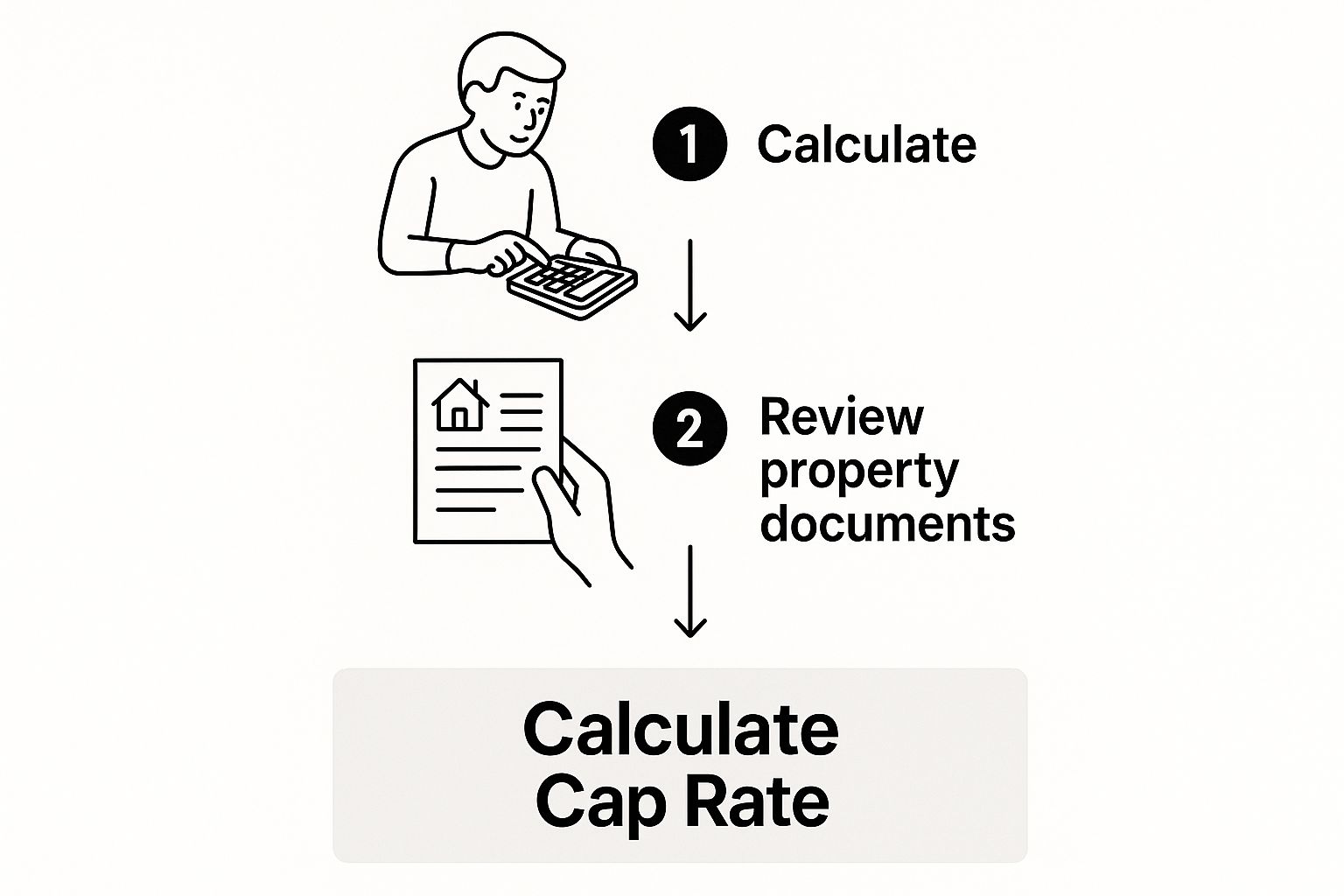
As you can see, the first step is always a deep dive into the property's financials to get a clear picture of its actual income potential.
Here’s the formula in its simplest form:
Cap Rate = Net Operating Income (NOI) / Current Market Value
Let’s pull back the curtain on each piece of this equation so you can start running the numbers on your own with total confidence.
Unpacking Net Operating Income (NOI)
First up, we need the Net Operating Income, or NOI. This number is your property's total annual income after you've paid all the necessary bills to keep it running. Think of it as the property's yearly profit before you touch your mortgage or pay income taxes.
To get the NOI, you'll add up all your income streams and then subtract all the operating costs.
- Gross Potential Income: This is what you’d collect in a perfect world where the property is 100% occupied for the entire year.
- Vacancy & Credit Losses: But no property is full all the time. This line item accounts for empty units or tenants who don't pay.
- Other Income: Don't forget the extra cash from things like laundry machines, reserved parking spots, or even vending machines.
- Operating Expenses: These are all the day-to-day costs, like property taxes, insurance, management fees, basic maintenance, and utilities.
It's crucial to remember that NOI does not include your loan payments (principal and interest), big-ticket capital improvements (like putting on a new roof), or your personal income taxes. For a more detailed look, check out our guide on what is net operating income.
Determining the Current Market Value
The other half of the puzzle is the property's Current Market Value. In plain English, this is what the property would realistically sell for on the open market today. You can nail this down with a professional appraisal, by checking out recent sales of similar nearby properties (we call these "comps"), or by simply using the seller's asking price if you're looking to buy.
A Practical Example in Fresno, California
Let's put this into action with a real-world scenario. Imagine you’re eyeing a small apartment complex in Fresno with a market value of $1,500,000.
- Calculate Annual Gross Income: The property brings in $120,000 in rent each year.
- Subtract Vacancy and Losses: Let's assume a conservative 5% vacancy rate, which works out to $6,000. That leaves an effective gross income of $114,000.
- Subtract Operating Expenses: The yearly cost for taxes, insurance, and maintenance adds up to $44,000.
- Calculate NOI: $114,000 (Effective Gross Income) – $44,000 (Operating Expenses) = $70,000 NOI.
Now, we just pop these numbers into our formula:
Cap Rate = $70,000 / $1,500,000 = 0.0467
To turn that into a percentage, just multiply by 100. The cap rate for this Fresno property is 4.67%. Right away, that single number gives you a solid benchmark to compare this investment against any other opportunities that come your way.
What Is a Good Cap Rate for Investment Properties

It’s the million-dollar question every investor wants answered, but the truth is, there’s no single magic number. A "good" cap rate isn't about hitting a specific percentage; it's about what works for your personal investment strategy and the context of the deal itself. It really all boils down to that delicate balance between risk and reward.
Think of it this way: a lower cap rate usually signals a safer, more stable property. These are often the newer, well-maintained buildings in high-demand areas with solid, reliable tenants—like a Class A apartment complex in a prime neighborhood. Investors are willing to pay a premium for that kind of stability, which pushes the price up and, as a result, drives the cap rate down.
On the other hand, a higher cap rate can point to greater potential returns, but it almost always comes with more risk. This might be an older property that needs a lot of work, is located in a less desirable area, or has a shaky history of tenant turnover. That higher potential return is the market's way of compensating you for taking on that extra headache.
Context Is King: Lower vs. Higher Cap Rates
To really get a feel for what a cap rate is telling you, you have to look at the property’s whole story. A 4% cap rate isn't automatically "bad," and a 10% cap rate isn't always a home run.
Here’s a general idea of what these numbers often suggest:
- Lower Cap Rates (e.g., 4-6%): This range is pretty common for top-tier properties in strong, growing markets. They are seen as lower-risk investments with steady income and a good chance of appreciating over time.
- Higher Cap Rates (e.g., 8-10%+): You'll typically find these in riskier markets or attached to properties with some operational issues. They offer a higher initial cash flow but might come with more management challenges and less certainty down the road.
A "good" cap rate is one that lines up with your personal tolerance for risk and your long-term investment goals. It's about finding the right balance for your portfolio, not just chasing the highest number you can find.
How Location and Property Type Affect Cap Rates
The cap rate has always been a fantastic tool for comparing different opportunities, especially across different markets. For instance, commercial property cap rates in the United States can vary wildly between major urban centers and more suburban areas.
A prime spot in a city like San Francisco might see cap rates around 4-5% simply because property values are sky-high and demand is intense. In contrast, suburban or rural markets can offer higher cap rates, often from 6-8%, which reflects different property values and potential risks.
The type of property matters, too. A multifamily apartment building, which is often seen as a stable and reliable asset, will almost always have a lower cap rate than a more specialized commercial property like a hotel or a retail center. Those can be much more sensitive to shifts in the economy.
Here in Central California, understanding these local market dynamics is absolutely essential. It’s the key to correctly interpreting a cap rate and making a truly smart investment decision.
Comparing Properties Using Cap Rates
This is where the rubber meets the road. Understanding cap rates moves from a theoretical concept to a real-world tool for sizing up potential investments. Think of it as your go-to metric for a quick, apples-to-apples comparison, helping you cut through the marketing fluff to see which property offers a better return right out of the gate.
Let's walk through a practical example. Imagine you’re looking at two different multi-family properties here in Central California. Both are listed for the exact same price: $1,200,000. On the surface, they might look like a coin toss, but their cap rates are about to tell you a much more interesting story.
One property is in Modesto, the other in Visalia. By running the numbers on each, you can instantly see how subtle differences in their income and expenses create two completely different investment profiles.
A Tale of Two Properties
Let’s get into the financials for these two hypothetical properties. Same purchase price, but their day-to-day performance is not the same. This is a classic situation for an investor, and the cap rate is the perfect tool to bring clarity to your decision.
We'll look at their annual income, subtract their unique operating expenses, and nail down the Net Operating Income (NOI) for both. This process reveals which property is really putting in the work for your investment from day one.
Investor Insight: Never assume two properties with the same price tag will perform identically. Digging into the income and expenses to calculate the cap rate is an absolute must-do for any serious investor.
The table below lays it all out, side-by-side, making the comparison crystal clear.
Investment Property Comparison Modesto vs Visalia
Here’s a side-by-side analysis of our two properties. Pay close attention to how income and expenses influence the final cap rate, even when the purchase price is identical.
| Metric | Property A (Modesto) | Property B (Visalia) |
|---|---|---|
| Purchase Price | $1,200,000 | $1,200,000 |
| Gross Annual Income | $105,000 | $95,000 |
| Operating Expenses | -$35,000 | -$25,000 |
| Net Operating Income (NOI) | $70,000 | $70,000 |
| Cap Rate (NOI / Price) | 5.83% | 5.83% |
Hold on a minute—the cap rates are identical! At first glance, it looks like both properties deliver the exact same 5.83% return. This is the point where a smart investor knows it’s time to start asking more questions. Why does the Modesto property generate higher income but also have significantly higher expenses?
Perhaps the Modesto property is older and comes with higher maintenance costs, or maybe property taxes are just steeper in that area. On the other hand, the Visalia property is more efficient to run but brings in less rent. This could actually signal an opportunity to add value through improvements and raise the rental income. For a much deeper dive, a professional rental property value estimator can shed more light on market rents and potential upside.
While cap rate is a vital starting point, many experienced investors also look at other metrics like understanding rental yield to get a complete picture. The cap rate isn’t the final answer; it’s the compass that points you toward the critical questions you need to ask before ever making an offer.
Why Cap Rate Is Not the Only Metric That Matters
While the cap rate is an incredibly powerful tool for a quick first look at a property, relying on it alone can be a rookie mistake. A savvy investor knows its limits.
Think of it this way: the cap rate is just one frame from a movie. It’s a static snapshot that captures a single moment in time.
That single number tells you nothing about the future. It completely ignores critical factors like potential rent growth, the property's appreciation over the years, and the powerful impact of financing, also known as leverage. You could have two properties with the exact same cap rate but wildly different long-term outcomes.
Investor Takeaway: A cap rate is a starting point, not the finish line. It tells you what a property is doing today, but not where it’s headed tomorrow.
Looking Beyond the Initial Return
A low cap rate might seem like a deal-breaker at first glance. But what if that property is in a rapidly developing Central California neighborhood where rents are projected to jump by 15% over the next three years? The cap rate won’t show you that hidden potential.
On the flip side, a high cap rate might catch your eye, but it could be masking some serious future costs. These are the crucial details that don't show up in the basic calculation:
- Capital Expenditures (CapEx): Does the property need a new roof in two years or an HVAC system replacement? These major expenses can absolutely drain your cash flow.
- Lease Terms: A property with a solid, high-quality tenant locked into a long-term lease is far more stable than one with multiple leases expiring soon.
- Market Dynamics: Local economic trends, like a major new employer moving to town, can completely change a property's future value and income potential.
The Power of a Holistic View
This is exactly why combining the cap rate with other metrics is non-negotiable for serious investors. While the cap rate is a crucial tool for a quick valuation, it's just one piece of a bigger puzzle. For many, this analysis fits into a more extensive strategy of comprehensive financial planning for high net worth individuals looking to optimize their portfolios.
Metrics like Cash-on-Cash Return are essential because they factor in your financing and show the actual return on the money you invested out-of-pocket.
Using a detailed rental property ROI calculator can help you model different scenarios and see the full financial picture. By looking at multiple data points, you move from making a guess to making an informed, strategic decision.
Diving Deeper: Your Top Questions About Cap Rates
To really wrap our heads around this, let's tackle some of the most common questions I hear from investors about cap rates. This is where we move past the textbook definition and get into how things work in the real world.
Think of this section as building on what we've already covered, giving you the confidence to use this tool when you're analyzing your next potential deal.
Is a High Cap Rate Always a Good Thing?
Not always. It’s easy to get fixated on a high number, but you have to ask why it's so high. While a high cap rate does point to a better initial return on your money, it's often the market's way of telling you there's more risk involved.
A high cap rate could be a red flag for a property in a rougher neighborhood, one that needs a ton of work, or maybe it has a history of unreliable tenants. On the flip side, a lower cap rate usually signals a more stable, lower-risk property in a great area. The "better" deal is the one that actually fits your own tolerance for risk and what you're trying to achieve financially.
Simply put, a higher cap rate often means the market sees higher risk and is demanding a higher return for taking that risk. A lower cap rate suggests lower risk and, consequently, a lower return.
How Do Interest Rates Play into Cap Rates?
Interest rates and cap rates have a pretty tight relationship, almost like a seesaw. When interest rates go up, the cost to borrow money for a property gets more expensive. Suddenly, other, safer investments like bonds start to look a lot more attractive.
To compete, property prices might have to drop to lure buyers back in, and that pushes cap rates up. Conversely, when interest rates fall, borrowing is cheap, more people want to buy property, and cap rates tend to get squeezed down.
Can I Use a Cap Rate for a Single-Family House?
You technically can, but it's really not the right tool for the job. Cap rates are designed for income-producing properties—think apartment buildings, office spaces, or retail centers—where the whole point of owning it is the cash flow.
For a single-family home, especially one you might live in, you should be looking at completely different factors:
- Comparable Sales (Comps): This is the big one. What are similar houses in the area actually selling for?
- Appreciation Potential: Is the neighborhood on the upswing? Is there new development that could boost future value?
- Personal Use Value: This is the un-quantifiable value of simply enjoying the home and the neighborhood.
Cap rates truly shine when you're lining up several commercial or multi-family properties and need a quick way to compare their income potential side-by-side.
At Edinhart Realty and Property Management, we help Central California investors work through these kinds of questions every single day. If you're looking to buy, sell, or get professional management to maximize your returns, our team is here to help you make smart, confident decisions. Contact us today to get started!


