

If you've ever dreamed of owning commercial real estate without the headaches of surprise repair bills or yearly tax hikes, then you need to understand the triple net lease.
Often called an NNN lease, this type of agreement is a game-changer for property owners. It's about as close as you can get to truly passive income in real estate. The tenant agrees to cover their base rent plus all the major operating costs of the building.
Understanding The Triple Net Lease

Think about it: owning a building where your only job is to collect a check every month. That’s the real appeal of an NNN lease for landlords. It effectively shifts the financial responsibility for taxes, insurance, and upkeep onto the tenant, creating a predictable and stable income stream.
This arrangement gets its name from the "three nets" the tenant is responsible for:
- Property Taxes: The tenant pays the annual property taxes assessed by the city and state directly. No more worrying about rising tax rates eating into your returns.
- Building Insurance: Responsibility for the property insurance policy—both maintaining it and paying the premiums—falls to the tenant.
- Maintenance Costs: This is the big one. It covers everything from fixing a leaky roof and servicing the HVAC system to landscaping and general repairs. All of it is on the tenant's tab.
Triple Net (NNN) Lease At a Glance
To make it crystal clear, here’s a simple breakdown of who typically pays for what in a standard NNN lease.
| Expense Category | Tenant Responsibility | Landlord Responsibility |
|---|---|---|
| Base Rent | ✔️ | |
| Property Taxes | ✔️ | |
| Property Insurance | ✔️ | |
| Common Area Maintenance (CAM) | ✔️ | |
| Structural Repairs | ❌ | ✔️ |
| Capital Expenditures | ❌ | ✔️ |
Essentially, the tenant handles nearly all day-to-day and recurring operational costs, while the landlord remains on the hook for major structural components like the roof and foundation. This division of responsibility is what makes the NNN lease so powerful.
A Hands-Off Investment Model
For property investors, an NNN lease functions a lot like owning a successful franchise. You provide the core asset—the building—and the tenant takes on the operational burden. This structure insulates you from the unpredictable expenses that can chip away at profits, which is why it's a favorite for investors focused on stable, long-term returns.
A well-structured NNN lease with a reliable, creditworthy tenant can provide a consistent income stream for 10 to 20 years or more, making it a cornerstone of many retirement and passive income investment strategies.
This lease structure really took off in the 1980s and 1990s as national retail chains expanded across the country. Today, it’s a dominant force in commercial real estate. NNN leases account for roughly 40% of all commercial retail leases in the U.S. and are used in over 70% of freestanding retail buildings. You can learn more about the history and prevalence of these leases and how they benefit both sides of the deal.
And what's in it for the tenants? For established businesses, this setup offers much greater control over their space. They can manage upkeep and repairs to their own standards and timelines. In exchange for taking on these costs, tenants usually secure a lower base rent than they would with other lease types where the landlord has to budget for these unknown financial risks.
So, What Are the Three Nets Tenants Actually Pay?
That term "triple net lease" might sound like some complicated industry jargon, but it's really pretty simple once you break it down. It just means the tenant agrees to cover the three main operating expenses of a property on top of their regular base rent.
Let's pull back the curtain and see exactly what these "three nets" are.
The First Net: Property Taxes
The first big expense passed on to the tenant is the property taxes. These are the annual taxes your local city and county governments charge based on the property's assessed value. With an NNN lease, the landlord gets the bill from the tax assessor, but they simply forward it to the tenant to pay.
For the property owner, this setup is a game-changer. It walls them off from surprise tax hikes, keeping their investment income predictable and stable. The flip side for the tenant is that their total rent can change each year depending on new property assessments or changes in local tax rates.
The Second Net: Building Insurance
Next up, the tenant is on the hook for the building insurance premiums. It's important to know this is not the tenant's own business liability insurance. This is the policy that covers the physical structure itself—the building, the roof, the foundation—against disasters like a fire or major storm damage.
Typically, the landlord keeps the main insurance policy in their name to make sure the property is always properly protected. But the lease makes it the tenant's job to pay for it. This moves another unpredictable cost off the owner's plate, making the investment that much more hands-off.
The Third Net: Common Area Maintenance (CAM)
The final "net" is Common Area Maintenance, or CAM, and it's often the most detailed part of the lease. Think of CAM as a catch-all category for all the costs of running and maintaining the property's shared spaces.
CAM charges can cover a whole host of things:
- Keeping up appearances: Landscaping, parking lot sweeping, snow removal, and outdoor lighting.
- Inside shared spaces: Janitorial services for lobbies, hallways, and public restrooms in a building with multiple tenants.
- Shared utilities: Water, sewer, trash, and electricity for those common areas.
- General upkeep: Routine repairs on shared systems like the HVAC, plumbing, or elevators.
- Management oversight: Fees paid to the property management company that coordinates all this work.
In a building with just one tenant, CAM basically covers all the maintenance for the entire property. But in a shopping center or office park, these costs get split up among all the tenants, usually based on how much square footage each one occupies.
These NNN charges can really add up, tacking a significant amount onto a tenant's base rent. For example, in a 10,000 sq ft retail space leasing for $25 per square foot, NNN fees could easily add another $5 to $8 per sq ft. That’s an extra $50,000 to $80,000 a year in operating costs that the tenant pays.
Unfortunately, many businesses get this part wrong. Recent data shows that about 30% of NNN tenants underestimate their CAM costs, which can put a serious dent in their budget and even lead to breaking the lease, especially as inflation pushes maintenance prices higher. You can dig into more of the numbers on how pass-through leases affect tenants on VisualLease.com.
It’s crucial for tenants to get a clear picture of these expenses before signing on the dotted line. While a standard NNN lease covers these three main areas, some go even further to create a truly worry-free investment for the owner.
A Quick Word on Absolute NNN Leases
You might also hear the term Absolute NNN Lease, which is sometimes called a "bondable" lease. This is the most extreme, hands-off version for a landlord. In an absolute NNN deal, the tenant is responsible for everything. And we mean everything—including major structural replacements like a new roof or fixing a cracked foundation.
This structure puts virtually all the risk and responsibility on the tenant, making it the purest form of passive real estate ownership you can find.
Comparing NNN Leases to Other Commercial Lease Types
To really get a feel for what makes a triple net lease tick, it helps to see where it fits on the spectrum of commercial agreements. Not all leases are cut from the same cloth. They range from deals where the landlord covers everything to those where the tenant is responsible for almost all the costs—with the NNN lease sitting firmly at that end.
The easiest way to break it down is to follow the money. As you move from one lease type to the next, you can literally see the financial responsibility shift from the landlord’s shoulders over to the tenant.
The Landlord-Friendly Spectrum
On the complete opposite side of the NNN lease, you have the Gross Lease. I like to think of this as the "all-inclusive resort" of commercial real estate. The tenant pays one simple, predictable rental fee every month. That’s it. The landlord handles all the property’s operating expenses—we’re talking property taxes, insurance, and all the maintenance. It's wonderfully simple for the tenant, but it means landlords have to bake all those potential costs and risks into a higher base rent.
As we move down the line, tenants start to take on a bit more of the financial load.
- Single Net (N) Lease: Here, the tenant pays their base rent plus their portion of the property taxes. The landlord is still on the hook for insurance and maintenance.
- Double Net (NN) Lease: The tenant’s share of the responsibility grows. Now they’re paying the base rent plus both property taxes and the building’s insurance premiums. The only major expense left for the landlord is maintenance.
This is where the triple net lease comes in, shifting the last major expense over to the tenant.
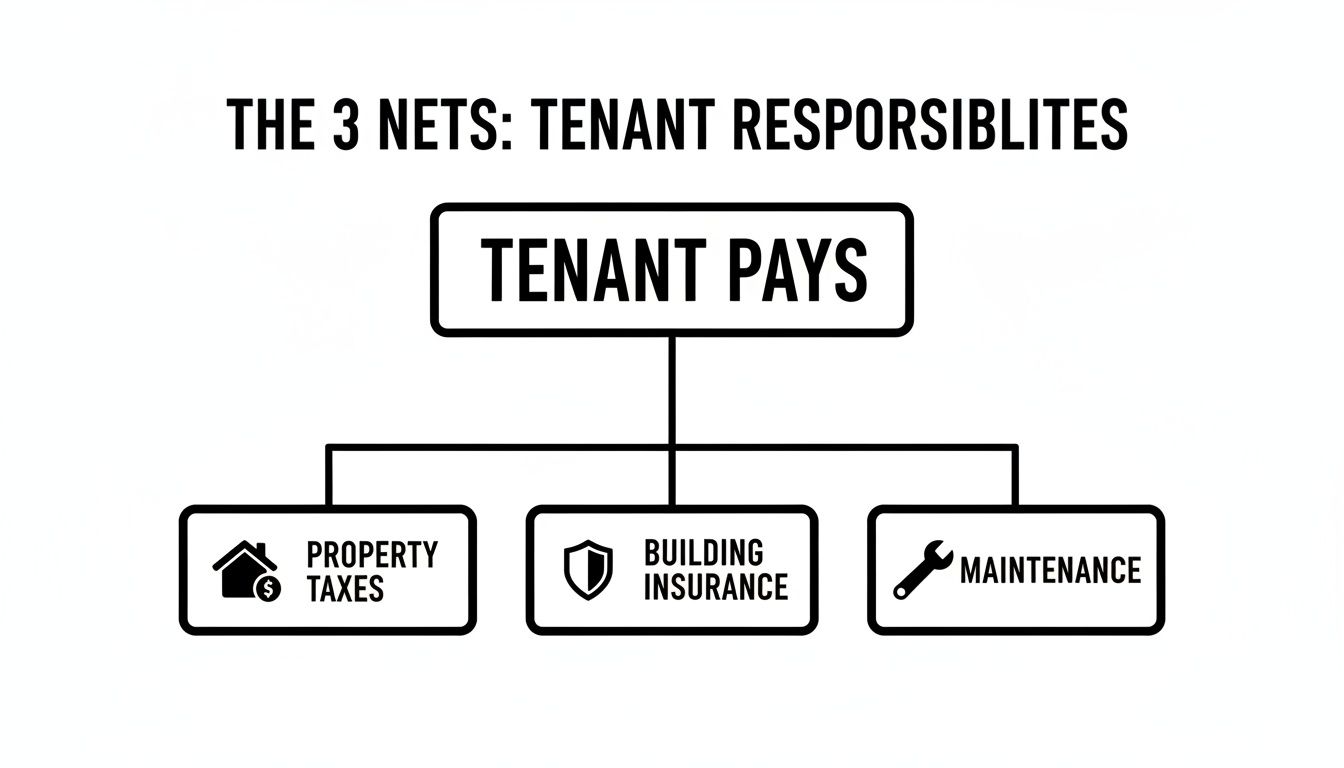
When you finally get to the Triple Net (NNN) Lease, the tenant has taken over all three of those "nets": property taxes, building insurance, and all maintenance costs. This big shift is what creates such a passive and reliable income stream for the property owner.
That predictability is exactly why investors who value stable, hands-off returns love NNN properties. It simplifies the numbers dramatically. For example, figuring out what is cap rate in real estate becomes much more straightforward when your net operating income is this consistent year after year.
A Clear Comparison
Let’s lay it all out side-by-side. This table gives you a quick, at-a-glance look at who pays for what under each of these common lease structures.
Commercial Lease Types Responsibility Breakdown
| Expense | Gross Lease | Single Net (N) | Double Net (NN) | Triple Net (NNN) |
|---|---|---|---|---|
| Property Taxes | Landlord | Tenant | Tenant | Tenant |
| Building Insurance | Landlord | Landlord | Tenant | Tenant |
| Maintenance | Landlord | Landlord | Landlord | Tenant |
At the end of the day, the right lease structure really comes down to an investor's goals. If you're looking for minimal management headaches and a predictable cash flow, the NNN lease is tough to beat. But if you prefer to keep more control and are comfortable managing the operational risks in exchange for potentially higher gross rents, another structure might be the better play.
The Pros and Cons for Landlords and Tenants
Like any lease structure, the triple net (NNN) lease comes with its own unique set of trade-offs. It's a bit of a double-edged sword, offering some fantastic advantages for both landlords and tenants, but it also carries real risks that need to be weighed carefully. Getting a handle on this balance is the only way to know if an NNN agreement is the right move for your situation.
For landlords, the biggest draw is creating a steady, predictable, and mostly hands-off income stream. When you shift the responsibility for property taxes, insurance, and maintenance over to the tenant, you're essentially insulating yourself from the surprise operational costs that can eat into your profits.
This structure really cuts down on the day-to-day headaches of property management. That makes NNN properties a great fit for investors who'd rather not get a call about a leaky faucet or a sudden jump in insurance premiums. It frees them up to focus on growing their portfolio instead of putting out fires.
Landlord Advantages and Disadvantages
For property owners, the upsides are pretty compelling, but the potential downsides can be a major problem if you're not prepared.
Key Benefits for Landlords:
- Predictable Cash Flow: Since the major operating costs are covered by the tenant, landlords get a consistent net rental income they can count on.
- Minimal Management: The tenant is on the hook for most property-related issues, which means far less active involvement for the landlord.
- Protection from Inflation: As taxes, insurance, and maintenance costs inevitably go up, that financial hit is absorbed by the tenant, protecting the landlord's bottom line.
However, that hands-off approach comes with its own set of risks. The single biggest worry is tenant default. If your tenant's business goes under, you're suddenly left with a vacant property and the immediate burden of paying for all those operating expenses yourself.
Another huge risk is deferred maintenance. Because the tenant is responsible for upkeep, they might be tempted to cut corners on non-critical repairs to save a buck. Over time, this can seriously degrade the long-term value of your property.
A study by NAIOP found that a staggering 18% of NNN leases expiring between 2021-2023 saw property values drop by 10-20% because of tenant neglect. This really drives home the importance of scheduling regular property inspections, even when you have a hands-off agreement.
Tenant Advantages and Disadvantages
Looking at it from the tenant's side, an NNN lease gives them a lot more control, but it also opens them up to some significant financial unknowns.
Key Benefits for Tenants:
- Greater Control: Tenants get to manage and maintain the property to their own standards, making sure the space always reflects their brand's image.
- Potential for Lower Rent: The base rent in an NNN lease is typically lower than in a gross lease. That's because it doesn't have a landlord's "best guess" markup to cover future expenses baked in.
- Cost Transparency: Tenants see the real-time costs of taxes, insurance, and maintenance, which gives them the opportunity to find ways to save money.
The main drawback for tenants is the financial risk. They are completely exposed to a sudden, sharp increase in property taxes or a major spike in insurance premiums. A rough winter could mean costly parking lot repairs, or an old HVAC unit could finally give out, leading to a massive bill they hadn't budgeted for.
This financial exposure makes it absolutely critical to plan ahead and negotiate hard. To really understand the financial impact and lock in good terms, both sides need to know how to negotiate a commercial lease effectively. NNN leases are a favorite for investment-grade tenants with solid credit, and they often come with long terms of 10-20 years. In fact, 85% of these leases include rent increases of 10-15% every five years, which adds another layer of long-term financial planning for tenants to consider.
Navigating NNN Leases in California

While the basics of a triple net lease are the same everywhere, California’s unique real estate market adds a few important layers to the conversation. Real estate is always a local game, and getting a handle on the state-specific factors is what turns a good investment into a great one.
One of the biggest local wrinkles is Proposition 13. This famous law puts a cap on how much a property's assessed tax value can go up each year. For a tenant in an NNN lease, this is a huge deal—it gives them a level of predictability for property tax expenses that you just don't see in most other states.
Of course, that stability is balanced by the state’s notoriously complex regulatory environment. You really have to pay attention to the details when navigating landlord-tenant law in California, as the state has some strict requirements that govern commercial agreements.
Common Negotiation Points in California
When we sit down to structure an NNN lease here in the Golden State, a few key items almost always become central to the negotiations. Getting these points dialed in from the start can save both landlords and tenants a lot of headaches and unexpected costs down the road.
- CAM Expense Caps: Smart tenants will always push for a cap on how much their Common Area Maintenance (CAM) charges can increase each year. It’s a crucial protection against getting hit with sudden spikes in operating costs.
- HVAC and Roof Responsibility: You need to get crystal clear on who handles the big-ticket items. Is routine HVAC maintenance on the tenant, but a full roof replacement on the landlord? Getting hyper-specific here is absolutely essential.
- Compliance with State Codes: California has some of the toughest building and environmental codes in the nation, like Title 24. The lease has to spell out exactly who is on the hook financially for keeping the property up to code.
For a landlord, a well-drafted lease is your first line of defense. It makes sure your asset is protected while you collect that passive income. For a tenant, it provides total clarity on what your occupancy will actually cost, way beyond just the base rent.
Successfully managing these details is everything. The state’s legal and financial landscape can feel challenging, but with the right professional guidance, those potential hurdles can become strategic advantages. This is where local expertise is vital for making sure your NNN lease truly aligns with your long-term investment goals.
Is a Triple Net Lease Right for Your Investment Goals?
So, you're weighing your options and wondering if a triple net lease is the right move for your investment strategy. It really boils down to one simple trade-off: are you comfortable with a bit more risk for the chance at a much higher, more passive reward?
A what is a triple net lease can be an incredibly powerful tool for generating steady, hands-off income. But let’s be clear—its success hangs entirely on two critical pieces: an ironclad, meticulously written contract and a high-quality, reliable tenant. If you end up with the wrong tenant, you could be facing property neglect and long, costly vacancies that completely wipe out your returns. This isn't a place for guesswork.
This is exactly where having an expert in your corner becomes non-negotiable, especially for investors here in Southern California. The right partner can make or break your deal. When you're looking at an NNN opportunity, you have to understand how different lease structures impact the various commercial property valuation methods.
The real beauty of an NNN lease is its predictable cash flow. That predictability is what gives your property solid value and makes calculating your net operating income a breeze.
At Edinhart Realty & Property Management, our entire focus is helping local investors like you maximize their income while sidestepping the common pitfalls. We do the legwork to source and vet credible tenants, negotiate lease terms that fiercely protect your asset, and provide the essential oversight needed to prevent property neglect before it starts.
Working with an expert ensures your NNN investment is built for long-term, headache-free success from day one. You can get a better handle on this by digging into what is net operating income and seeing how it directly shapes your investment’s bottom line.
Answering Your Top Questions About Triple Net Leases
Even after you get the hang of the basics, a few specific questions always seem to pop up when investors and business owners start seriously considering a triple net lease. Let's tackle some of the most common ones I hear all the time.
Are NNN Leases Only for Big National Chains?
It's a common misconception that you need a Starbucks or a Walgreens on the hook to have a successful NNN lease. While those big brands are fantastic tenants because of their rock-solid credit, these leases are definitely not just for them.
A financially healthy local business with a great track record can be an equally amazing NNN tenant. What a landlord is really looking for is proof that the tenant can handle their long-term financial promises. For a smaller business, a NNN lease gives them a ton of control over their space, but it also means they have to be sharp with their budgeting to handle those fluctuating operating costs.
What Happens If a Major Repair Like a New Roof Is Needed?
This is where the fine print becomes absolutely critical. Who pays for a huge capital expense like a new roof comes down entirely to what’s written in that lease agreement. This is probably one of the most important things to hammer out during negotiations.
In a standard NNN lease, the landlord usually hangs onto the responsibility for the big structural stuff—think roof, foundation, and exterior walls. But, if you're looking at an "Absolute NNN" lease, the tenant is on the hook for absolutely everything, including those massive, budget-busting repairs.
You have to get this defined clearly in the contract to avoid some really expensive arguments later on. Never just assume you know who pays for what; get it in writing, every single time.
Can a Landlord Just Raise CAM Charges Whenever They Want?
Absolutely not. Landlords can't just jack up the Common Area Maintenance (CAM) charges on a whim. The lease agreement should make it clear that these charges have to reflect the actual, provable costs of keeping the property’s shared spaces in good shape.
Typically, the tenant pays an estimated amount for these expenses each month, and then everything is "reconciled" at the end of the year. This is where the landlord compares what was paid against what was actually spent. To avoid getting hit with a massive, unexpected bill, smart tenants will always negotiate for a "cap" on annual CAM increases. This can limit their exposure to a fixed rate, maybe 3-5% per year, which brings some much-needed predictability to their budget.
Making your way through the details of a triple net lease takes real local knowledge and a solid grasp of commercial real estate. Here at Edinhart Realty & Property Management, we work with investors all over Southern California to put together NNN leases that boost their returns while keeping their assets safe. Whether you're thinking about buying, selling, or just need an expert to manage your property, we have the experience to help you hit your investment goals with confidence. Learn more about our property management services at Edinhart.com.


