

A Property Condition Report (or PCR) is a super-detailed document that locks in the exact state of a rental property at a single point in time. It's packed with written notes and, most importantly, photographic proof.
Think of it as a formal handshake between a landlord and tenant. It establishes a crystal-clear baseline of the property's condition before the lease officially kicks in. This document is your single best tool for avoiding those dreaded security deposit disputes down the road.
What Is a Property Condition Report Really?
Have you ever rented a car? The first thing they have you do is walk around it, pointing out every little scratch, ding, or stain on a form before you even think about driving off the lot. A PCR does the exact same thing for a rental home, just on a much more comprehensive scale.
We're talking about a full inventory of the property's physical state. This goes way beyond just listing the appliances. It’s a deep dive into everything from the scuff marks on the baseboards to the faint hum of the refrigerator. The whole point is to create a shared, undeniable record of the property’s condition that both landlord and tenant sign off on.
The Foundation of a Transparent Tenancy
A properly executed PCR becomes the ultimate reference point. When the lease ends and the tenant moves out, you pull out this report and compare the property's final condition to how it was at the start.
This side-by-side comparison is what separates legitimate, tenant-caused damage from "normal wear and tear"—a notoriously fuzzy area that causes endless arguments.
A property condition report transforms ambiguity into evidence. It replaces "he said, she said" arguments with a clear, time-stamped record, protecting both the owner's investment and the tenant's security deposit.
This documented baseline is crucial for a few key reasons:
- Preventing Disputes: It cuts down on arguments over security deposit deductions by showing clear proof of any pre-existing issues.
- Ensuring Accountability: It fairly holds tenants responsible for any new damages they cause that go beyond normal use.
- Protecting Landlords: It serves as rock-solid evidence if a disagreement ever has to be settled in a legal setting.
For a quick overview, this table breaks down the core functions of a PCR.
Property Condition Report at a Glance
| Key Aspect | Primary Function |
|---|---|
| Documentation | Creates a detailed, time-stamped record of the property's condition at move-in. |
| Evidence | Provides objective proof to differentiate between pre-existing issues and new damage. |
| Accountability | Establishes a clear standard for the property's condition at the end of the lease. |
| Protection | Safeguards the landlord's asset and the tenant's security deposit. |
Ultimately, the report serves as a neutral, factual foundation for the entire tenancy.
More Than Just a Formality
This isn't just busywork; it's a cornerstone of professional real estate management. The global market for property condition assessments was valued at roughly $3.2 billion and is expected to hit $5.32 billion by 2029, which just goes to show how vital this practice has become.
To make sure a report is truly thorough and credible, it helps to follow the high benchmarks that guide professional evaluations. You can see how professional standards from organizations like RICS shape these reports. Here at Edinhart Realty, we bring this same meticulous approach to protect every single one of our Fresno and Clovis clients.
What Goes Into a Truly Great Property Report?

A truly effective property condition report (PCR) is much more than a generic checklist. It's a detailed story of your property, backed up with undeniable visual proof. Think of it as the difference between just saying "the living room is in good shape" and creating a professional, airtight record that holds up under pressure.
The secret is all in the details. A weak report might just list "walls" or "flooring" for an entire room. But a high-impact report gets granular, capturing the tiny imperfections that often become huge sticking points in a security deposit dispute.
Thinking Room-by-Room
To build a report that has real teeth, you have to tackle the property systematically. Document each room and area as its own separate chapter. This meticulous approach not only ensures you don't miss a thing, but it also adds a layer of professionalism that tenants can't help but respect. Vague notes leave the door open for arguments; precise details shut them down cold.
Take a look at the difference.
- Vague Entry: "Living room walls"
- Specific Entry: "Living Room, South Wall: Two minor scuffs near the electrical outlet, each about an inch long. No other marks or damage."
Or how about for an appliance?
- Vague Entry: "Kitchen appliances"
- Specific Entry: "Kitchen Stove: All four electric burners heat correctly. Oven light works. Interior is clean. One small scratch on the front control panel."
This is the kind of detail that answers questions before they're even asked and leaves no room for confusion. When a tenant signs off on a report this thorough, they're agreeing to a shared, factual reality. It’s exactly this approach that Edinhart Realty uses to protect our clients' investments.
The Power of Pictures
Words are one thing, but visual evidence is king. A solid PCR should always be paired with a library of clear, well-lit photos and even videos. You're essentially creating a time capsule of the property's condition that no one can argue with later.
A timestamped photo is the ultimate truth-teller in a property dispute. It provides objective, third-party validation that words alone just can't match.
Your visual library should be just as detailed as your written notes. Don't just snap one wide-angle shot of a room and call it a day. Get close-ups of any pre-existing issues you noted, like those wall scuffs or the scratch on the stove. Flick on the appliances and record short videos showing they work perfectly. This creates a record that is simply undeniable.
To get started with a solid framework, you can use a well-designed guide. Our team put together a helpful property inspection report template to make sure you hit all the key areas with the right level of detail. By weaving together specific written descriptions with matching visual proof, you build an ironclad report that safeguards your investment from day one.
Your Legal Shield in California Landlord-Tenant Disputes
When you’re a landlord in California, the Property Condition Report isn't just another piece of paper to file away. Think of it as your single most important piece of evidence if a dispute over the security deposit ever lands you in a tough spot.
Without a detailed, signed report, any disagreement over the property's condition can quickly spiral into a frustrating "he said, she said" battle. And in those situations, you have very little solid proof to back up your claims.
The PCR is your best friend because it creates a clear, agreed-upon snapshot of the property's condition right from day one. When your tenant moves out, this document is what allows you to confidently—and legally—tell the difference between normal wear and tear and actual tenant-caused damage. That distinction is everything when it comes to making fair security deposit deductions.
Justifying Deductions Under California Law
California law is very specific about how a security deposit can be used. California Civil Code Section 1950.5 lays it all out, stating that a landlord can only deduct for three things: repairing damages beyond "normal wear and tear," covering unpaid rent, and cleaning the unit to get it back to its original condition.
A well-documented PCR gives you the legal muscle to enforce this. It’s the undeniable proof you need to justify every single dollar you withhold. Without it, a tenant could easily fight your claims, potentially dragging you into a costly legal fight or even facing penalties for improperly withholding their deposit.
The quality of your Property Condition Report directly correlates to the strength of your legal position. A vague report offers weak protection, while a detailed, photo-documented report is an ironclad defense.
For property managers, having a rock-solid understanding of what a tenant is responsible for is a must. A thorough PCR is the ultimate tool for this, as it sets the standard for move-out, a topic covered well in this detailed property managers' guide to exit cleaning requirements. This helps sidestep arguments over what "clean" really means when the tenancy ends.
The Edinhart Realty Standard
At Edinhart Realty & Property Management, we don't see the PCR as a formality—we see it as a strategic asset. We strictly use the official California Association of Realtors (C.A.R.) forms because they’re designed to be incredibly thorough and legally sound. This turns a simple report into a powerful shield for your investment.
This dedication to meticulous documentation is at the heart of what we do. By creating an airtight record, we protect our clients from baseless claims and ensure that any deductions from the security deposit are fair, transparent, and completely defensible under state law. You can dive deeper into these rules in our complete guide to landlord-tenant law in California. Our approach isn't just about managing properties; it's about protecting the people who own them.
PCR vs. Home Inspection: Understanding the Difference
It’s a common mix-up, even for seasoned property investors. People often use the terms "Property Condition Report" (PCR) and "home inspection" as if they’re the same thing. While both involve a close look at a property, they have completely different jobs and happen at totally different times in your real estate journey.
Getting this right isn’t just about semantics—it’s about protecting your investment in the right way at the right time.
Think of it like this: a home inspection is like a full-body MRI for a potential buyer. Its whole purpose is to find the deep, hidden problems that could cost you a fortune down the road. We're talking about a failing foundation, ancient wiring, or plumbing that's about to give up. It’s the deep-dive diagnostic you run before you buy the asset.
A Property Condition Report, on the other hand, is more like a routine check-up before a new tenant moves in. It’s all about documenting the property's current state of health and appearance on the surface. It’s not hunting for structural issues; it’s simply noting the scuff marks on the paint, the condition of the carpet, and making sure the dishwasher turns on.
Scope and Purpose
The biggest difference between the two really comes down to scope. A home inspection is an exhaustive, top-to-bottom investigation of a property's vital systems. A licensed inspector is going to crawl through the attic and get on the roof, scrutinizing everything from the HVAC and electrical panel to the structural integrity. Their report is your guide to the property's long-term health and potential big-ticket costs.
In contrast, the scope of a what is a property condition report is much tighter and more focused on aesthetics. It’s all about the visible, day-to-day condition of the home. The goal isn’t to predict when the water heater will fail, but to create a crystal-clear baseline of the property’s condition at move-in. That baseline is your best friend when it comes time to fairly assess any new damages at move-out.
A home inspection answers the question, "Should I buy this property?" A Property Condition Report answers the question, "What did this property look like the day the tenant moved in?"
This distinction is absolutely crucial. It helps manage everyone's expectations and protects your investment during both the buying process and the entire rental cycle.
Comparing Property Reports: PCR vs. Home Inspection
To lay it out as clearly as possible, let's break down the key differences between these two essential reports.
| Feature | Property Condition Report (PCR) | Home Inspection Report |
|---|---|---|
| Primary User | Landlord and Tenant | Potential Home Buyer |
| Main Goal | Document surface-level condition for rental agreements and security deposit purposes. | Identify major structural and system defects before a real estate purchase. |
| Timing | Completed just before a new tenant moves in. | Conducted during the due diligence or escrow period of a home sale. |
| Focus | Cosmetic details, cleanliness, and functionality of existing items (e.g., scratches, appliance operation). | Major systems (HVAC, plumbing, electrical), structural integrity, roof, and foundation. |
| Outcome | Serves as a legal baseline to assess damages beyond normal wear and tear at move-out. | Informs the buyer's decision to proceed with the purchase, negotiate repairs, or back out of the deal. |
Knowing when to use each report—and why—is fundamental for any serious Fresno real estate investor. They are two distinct but equally vital tools in your toolbox, each designed to protect your assets at critical moments in the ownership lifecycle.
How to Do a Flawless Property Walkthrough
A truly great property condition report all comes down to a systematic, collaborative walkthrough. This isn’t just a quick glance around the rooms; it's a careful inspection designed to capture every little detail. Get it right, and you leave zero room for arguments down the line.
The walkthrough itself is a massive trust-builder. It sets the stage for a transparent, honest tenancy right from day one.
The trick is to have a process that’s both exhaustive and easy to follow. Don't just wander aimlessly. We've found the best way is to pick a pattern—like moving clockwise through every room—to make sure you never miss a wall, an outlet, or a light fixture. This structured approach is what makes your final report airtight and defensible.
The Systematic Inspection Process
A perfect walkthrough is methodical. When you treat it like a professional audit instead of a chore, you eliminate all the guesswork and create an undeniable record of the property’s condition. You just need to be meticulous, patient, and focused on the details.
Here’s the step-by-step process we’ve honed over the years:
- Schedule and Prepare: Pick a time for the walkthrough when both you and the tenant can be present without feeling rushed. Always bring your checklist, a good smartphone for photos, and a notepad for extra details.
- Move Methodically: We always start at the front door and move through the property in the same direction, usually clockwise. This simple habit keeps you from accidentally skipping an entire wall or closet.
- Test Everything: Don't just look—actually interact with the property. Flip every light switch. Run every faucet to check for hot water and leaks. Open and close every window and door. Turn on every single appliance to make sure it works.
- Document with Detail: In each room, make specific notes on the condition of the floors, walls, ceilings, and fixtures. Be painfully specific about any existing dings, scratches, or stains, no matter how small you think they are.
- Capture Visual Evidence: Photos are your best friend. Take clear, well-lit pictures of everything. Start with wide shots to capture the whole room, then zoom in on any specific scuffs or wear you’ve noted down. It's also a great idea to snap photos of appliance model and serial numbers.
This infographic helps show the difference between what we're doing here and what a home inspector does. The PCR is all about the current, visible condition for the tenancy.
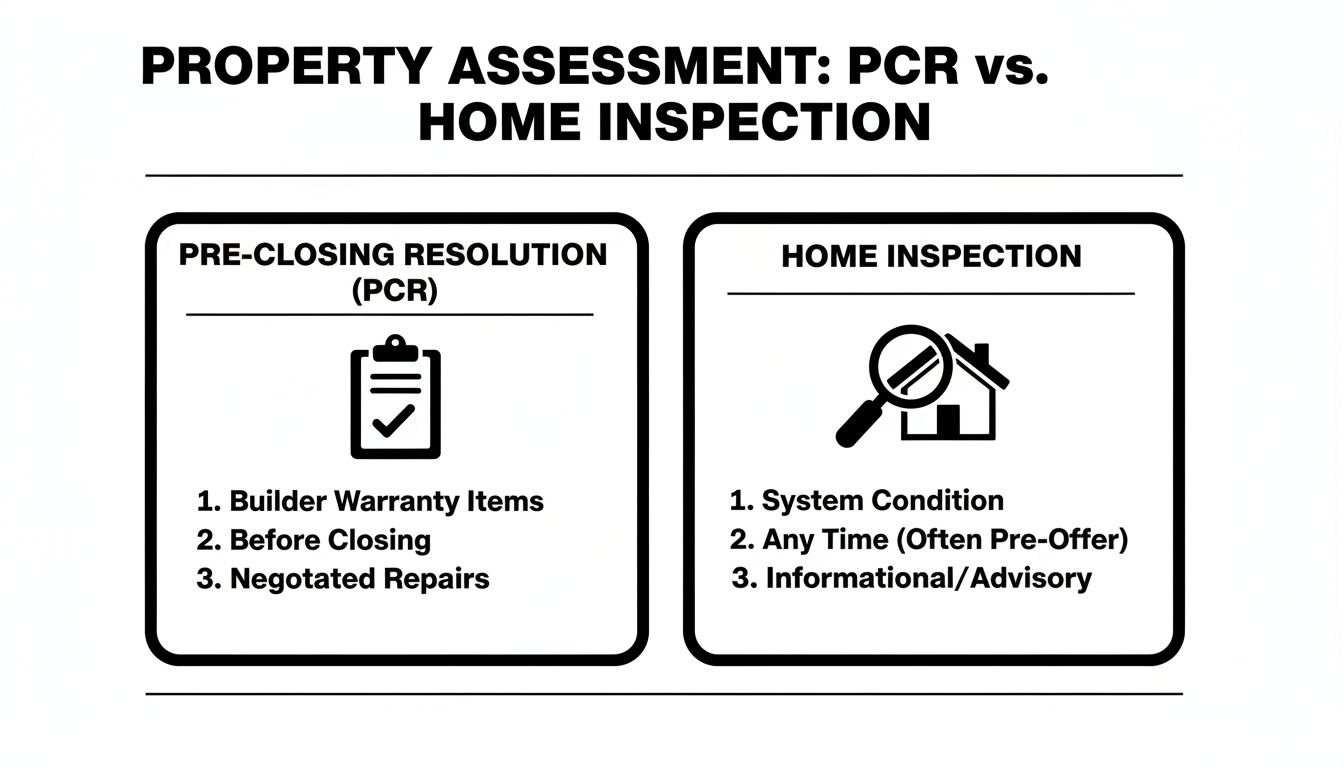
As you can see, the PCR is about documenting the starting line for a rental, while a full-blown home inspection is for a buyer digging into the property's major systems.
The Real Secret: Tenant Collaboration
Honestly, the secret to a report that no one can argue with is getting the tenant involved. Having them walk through the property right alongside you is an absolute game-changer. It turns a boring administrative task into a collaborative agreement.
When tenants are actively participating, they’ll point out things you might have missed and ask questions on the spot. This shared process makes sure they understand and agree with the property's condition from the very beginning.
When a tenant signs a report they helped create, they aren't just acknowledging a document; they are co-signing a shared reality. This simple act drastically reduces the likelihood of future claims that "it was already broken."
Their signature becomes a firm agreement on the property's baseline condition. It’s a collaborative approach we use every single day at Edinhart Realty, and it's the strongest foundation you can build for a positive landlord-tenant relationship.
How Edinhart Realty Puts PCRs to Work for You
Knowing what a property condition report is and how to fill one out is just the start. The real magic happens when you apply that knowledge meticulously, every single time a new tenant moves in. This is where a great idea transforms into a powerful strategy that protects your investment and gives you genuine peace of mind.
At Edinhart Realty, this isn't an optional add-on; it's a fundamental part of how we look after our clients' properties. Our process is built to deliver the full protective power of a professional PCR, whether you want us to handle everything or prefer a more hands-on approach.
For Our Full-Service Management Clients
If you’re in our Full-Service Management program, we’ve got it all covered. Our team handles the entire process from start to finish, conducting an exhaustive move-in walkthrough with the tenant. We create a comprehensive library of photos and videos to document everything and get the tenant's signature on the dotted line.
Fast forward to the end of the lease, and we use that original report as our guide for the move-out assessment. This level of detail ensures any deductions from the security deposit are fair, fully defensible under California law, and practically bulletproof against disputes. It’s a critical step in keeping vacancy times short and protecting your property’s value for the long haul.
A professional property management system turns the Property Condition Report from a simple defensive tool into a proactive strategy for maintaining your asset's quality and ensuring smooth, profitable tenancies.
For Our Placement-Only Clients
Maybe you prefer managing the day-to-day yourself. Our Placement-Only service is designed to set you up for success right from the start. We equip you with the robust, C.A.R.-approved forms and the expert guidance you need to establish a strong, clear tenancy from day one.
This gives you the professional framework to create your own defensible record of your property's condition before handing over the keys.
Whether we manage the process for you or empower you to do it yourself, our goal is the same. We provide the tools and expertise to make sure every tenancy in your Central California property begins on a solid foundation of clarity and legal strength.
Common Questions About Property Condition Reports
Even when you have a good handle on what a property condition report is, the real world has a way of throwing curveballs. Let's tackle some of the most common questions and tricky situations landlords run into with these crucial documents.
A big point of confusion is always "normal wear and tear." What does it actually mean? In California, think of it as the natural, gentle aging of a property from someone living in it. We're talking about things like paint that's slightly faded from the sun or carpet that’s a bit worn down in high-traffic areas.
It is not damage caused by carelessness or neglect. A huge hole punched in a wall or a cracked window from a baseball isn't "wear and tear"—it's damage. Your PCR is your "before" picture, the definitive proof that separates one from the other.
What If a Tenant Refuses to Sign?
It happens. A tenant might get nervous or just be difficult and refuse to sign the move-in report. Don't panic.
Your next move is simple: document their refusal right on the form itself, making sure to note the date. Then, send them a copy anyway. Use a method that gives you proof of delivery, like an email with a read receipt. This shows you made a good-faith effort and protects you if a dispute ever pops up down the road.
Are Digital Reports Legally Sound?
Another question we get all the time is about going digital. Are they as good as paper? The answer is a resounding yes.
In fact, digital PCRs are often better. High-resolution, timestamped photos and videos provide objective, undeniable proof that’s incredibly powerful if you ever have to defend your decisions. It’s hard to argue with a crystal-clear photo.
A property condition report is a living document that establishes the baseline at move-in and serves as the final measuring stick at move-out. Consistency in its application is key to its effectiveness.
Finally, how often should you actually do one? The two that matter most are the ones that bookend the tenancy: one at move-in and one at move-out. These are the critical moments for protecting your property and correctly handling the security deposit.
For a deep dive into that final walkthrough, our landlord move-out inspection checklist will guide you through comparing the property's final condition back to your initial report, step by step.
At Edinhart Realty & Property Management, weaving these best practices into every tenancy isn't just an option—it's how we operate. We make sure our clients are protected from day one. To see how our meticulous approach can safeguard your investment, visit us online.


