

A new landlord usually meets the ledger the hard way. A tenant says rent is paid in full. Your bank account shows a deposit. Then you notice a small unpaid late fee from two months ago, or a partial payment that never fully caught up. Suddenly the disagreement isn't about one month's rent. It's about whose records count.
That's where a ledger stops being paperwork and starts being protection.
In California property management, the ledger is the account history that settles basic questions fast. What was charged. What was paid. When it was paid. Whether a fee was posted under the lease. Whether a balance still remains. If that history is clear, most disputes cool down quickly. If it's sloppy, even a minor balance can turn into a bigger problem.
That matters because this document often carries real legal weight. The ledger is a mandatory supporting document in 60% of eviction cases filed in state courts for non-payment of rent, and digital ledger use has reduced payment discrepancies by 45% nationwide according to the ACLU 2022 analysis and the Journal of Property Management%202022%20analysis,%20Journal%20of%20Property%20Management). Even outside court, it's the cleanest way to keep the landlord-tenant relationship professional instead of personal.
For a California landlord, understanding what is a ledger for an apartment isn't optional. It's part accounting record, part compliance tool, part dispute file. If you manage even one unit, you need one that is complete, chronological, and easy to read.
Introduction Beyond the Rent Check
A common call in property management sounds like this: “My tenant insists they don't owe anything.” Then you pull the file and find the issue. Last month's rent came in short. A late fee posted after the grace period allowed under the lease. The tenant paid the next month's rent, but not the prior balance. From the tenant's point of view, they paid rent. From the landlord's point of view, the account is still short.
Both people can honestly think they're right.
Where disputes usually start
Small accounting gaps cause a lot of friction because informal records are weak. A text saying “sent rent,” a screenshot from a payment app, or a handwritten note on a lease copy doesn't show the full account picture. It doesn't show whether the payment was partial, whether a prior charge remained unpaid, or whether a credit was already applied.
A proper apartment ledger fixes that by giving one chronological history for the tenancy. It shows every charge and every payment in order. There's no guessing and no rebuilding the story from memory.
Practical rule: If you can't hand the tenant a clean ledger and explain the balance line by line, your records aren't ready for a dispute.
For California landlords, this matters even more because rental issues often turn into documentation issues. You may need records for a notice, a security deposit reconciliation, an owner review, or a court filing. In those moments, the ledger becomes the version of events that people rely on.
Why the ledger changes the relationship
The best landlords don't use a ledger only when something goes wrong. They use it every month so nothing becomes unclear in the first place. That changes the tone of management. Instead of saying, “I think you still owe this,” you can say, “Here's the account history, and here's where the balance comes from.”
That kind of transparency protects both sides.
- For landlords: It creates a defensible record.
- For tenants: It shows that charges weren't invented after the fact.
- For managers: It keeps communication focused on facts instead of frustration.
If you're new to rentals, this is the shift to make early. Don't think of the ledger as a rent checklist. Think of it as the financial timeline for the tenancy. Once you manage with that mindset, a lot of common problems become easier to prevent and much easier to resolve.
The Apartment Ledger Explained
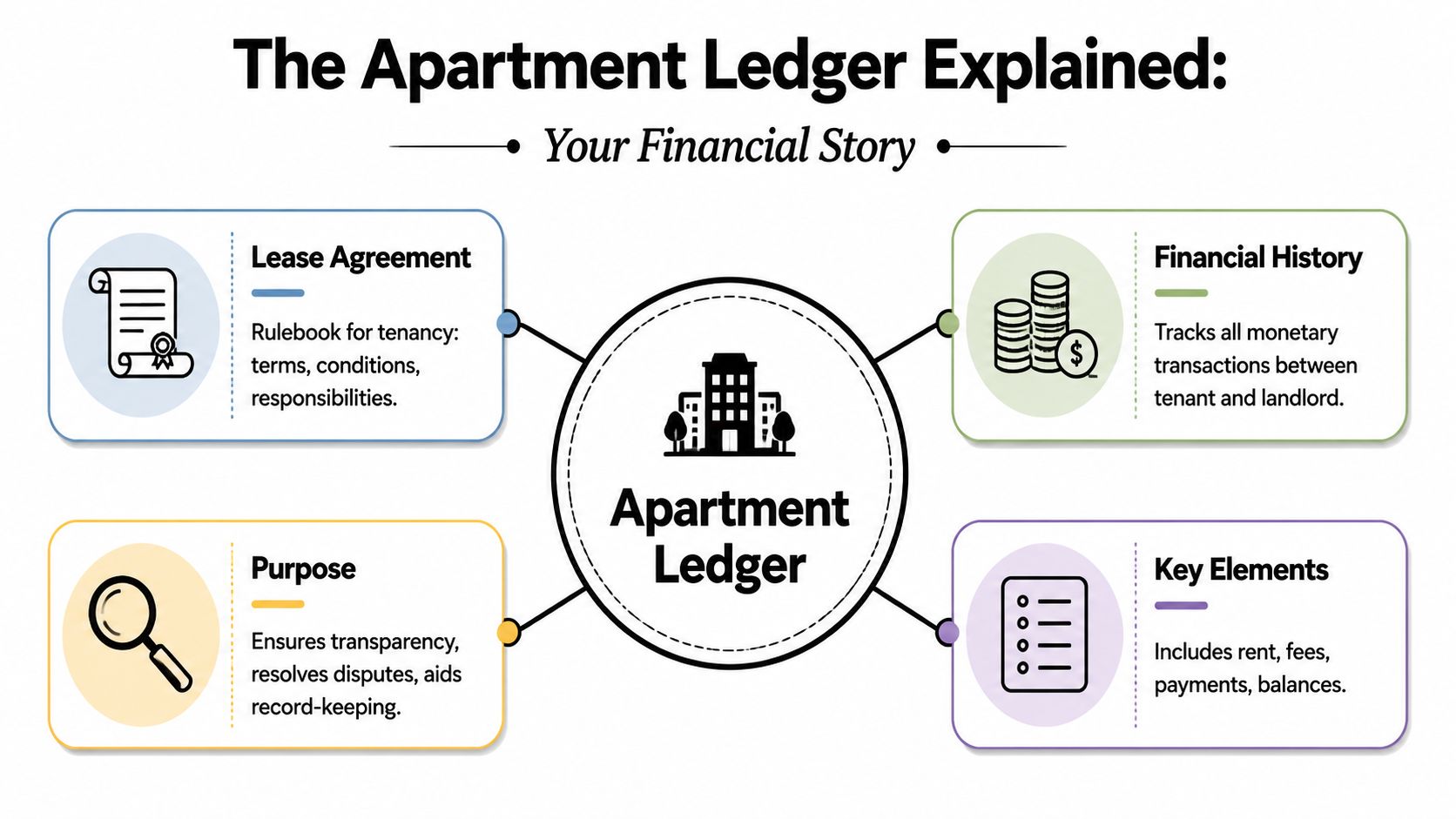
If the lease is the rulebook, the ledger is the scorecard.
An apartment ledger is the chronological financial record for one tenant or one unit. It tracks what the tenant was supposed to pay, what the landlord received, what fees or credits were added, and what balance remained after each entry. That's why a ledger answers the practical question behind what is a ledger for an apartment better than a simple payment list does. It shows the full account, not just isolated deposits.
More than a list of rent payments
A lot of new landlords think their bank statement is enough. It isn't. A bank statement shows money entering an account. It does not show which unit the money belongs to, whether it was for current rent or arrears, whether a late fee was charged under the lease, or whether the tenant made only a partial payment.
A proper ledger works like a tenant-level account statement inside your property accounting. It's the clean record you can hand to an owner, tenant, bookkeeper, or attorney and say, “This is the transaction history.”
If you want another plain-English overview, VerticalRent's explanation of what is a tenant ledger is a useful companion resource.
What makes it so valuable
A primary benefit is dispute prevention. The National Association of Realtors reported that 72% of rental disputes involving late fees or security deposits were successfully resolved within 14 days when a ledger was presented, compared to an average resolution time of 60 days without one according to the National Association of Realtors report%20report).
That difference makes sense in practice. When the account history is clear, arguments tend to narrow fast. The tenant can see the entries. The landlord can explain the charges. Everyone is working from the same document.
A lease tells you what can happen. A ledger shows what did happen.
What does not work
These shortcuts create trouble:
| Record type | What it misses |
|---|---|
| Bank deposits only | No tenant-specific account history |
| Handwritten notes | Hard to audit, easy to misread |
| Texts and emails | Fragmented, incomplete, not chronological |
| Loose spreadsheets without controls | Easy to overwrite or miscalculate |
What works is one consistent ledger per tenant account, updated promptly and kept in the same format every month. That's how professional operators maintain clean records, and it's how small landlords avoid turning a simple balance question into a larger legal or accounting problem.
Anatomy of a Tenant Ledger
Once you see a real ledger, it stops looking mysterious. It's a row-by-row account history. Each line answers one question: what changed on this tenant's account on that date?
A proper rent ledger functions like a subledger, tying each tenant to expected rent, actual receipts, and fees. Key fields include the tenant identifier, lease dates, rent due, payment date, payment method, and a running balance, which creates an audit trail to reduce disputes, as described by LeaseRunner's rent ledger guide.
The fields that matter most
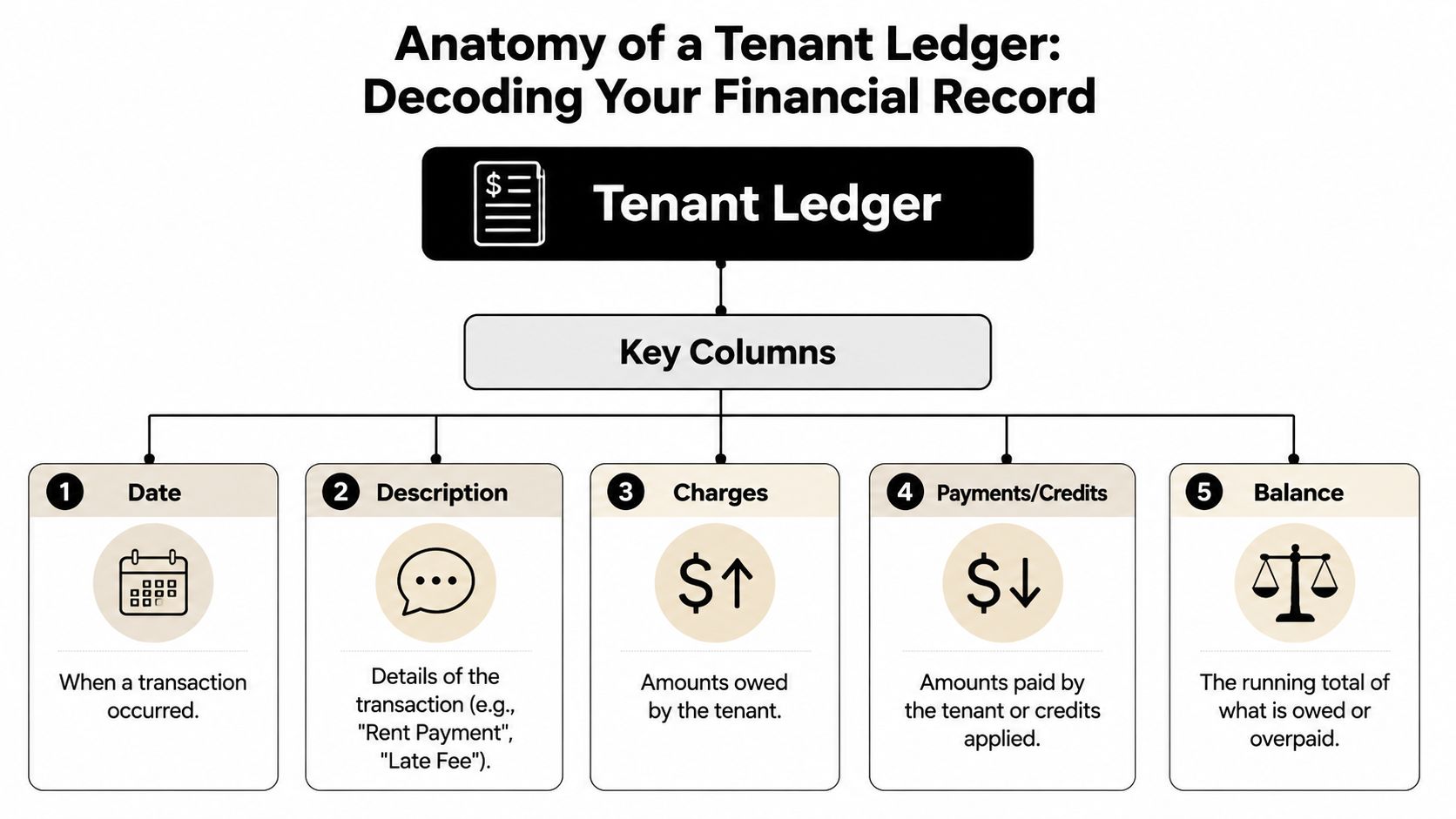
Here's the core structure most landlords should expect to see:
- Tenant and unit details identify whose account the ledger covers. That usually includes the tenant name, unit identifier, and property address.
- Lease dates show the period the account relates to. That matters when reviewing move-in charges, renewals, or move-out items.
- Charge entries record rent, fees, or other approved debits posted to the account.
- Payment and credit entries show what the tenant paid and when, including method if your system tracks it.
- Running balance shows the account status after every line item. This is the most important column because it turns isolated transactions into a readable story.
A landlord managing several units should also understand how the tenant ledger differs from broader property reporting. If you want that distinction spelled out clearly, this explanation of a rent roll report helps separate unit-level account history from portfolio-level occupancy and income reporting.
Why the running balance matters
The running balance is where many self-managed landlords go wrong. They record that rent was due. They record that money came in. But they don't keep a balance that updates after each entry. Without that, you can't quickly tell whether the tenant is current, short, or carrying an older unpaid item.
That's what makes the ledger an audit trail instead of just a receipt log.
When the running balance is accurate, you don't have to reconstruct the account from scratch every time someone asks a question.
A simple breakdown
| Column | What it tells you |
|---|---|
| Date | When the transaction was posted |
| Description | Rent charge, payment, late fee, credit, or adjustment |
| Charges | Amount added to what the tenant owes |
| Payments or credits | Amount reducing the balance |
| Balance | What remains owed or overpaid after that line |
In California practice, completeness matters more than fancy formatting. A plain ledger with all essential fields is better than a polished report missing dates, descriptions, or balance changes. If the ledger can't show the sequence clearly, it won't help much when the account is questioned.
How to Read and Interpret a Ledger
It's easy to overcomplicate the ledger the first time you look at it. Don't. Read it from top to bottom like a timeline. Every line either increases the amount owed, decreases it, or explains why the balance changed.

Read it like an account story
Start with four checks:
- Confirm the tenant and unit. Make sure you're reading the right account.
- Look at the opening entries. You want to see the recurring rent charge and any prior balance brought forward.
- Match payments to dates. A payment posted after the due date may still leave a fee or temporary balance.
- Focus on the final running balance. That tells you where the account stands at the moment the ledger was generated.
The description line matters almost as much as the amount. “Rent charge,” “partial payment,” “late fee,” “credit,” and “security deposit refund” are not interchangeable. If a ledger uses vague labels, it becomes harder to review.
A common monthly pattern
A typical ledger month might read like this in plain language:
- Rent charge posts at the start of the month.
- Partial payment arrives a few days later.
- Late fee posts if the lease and timing support it.
- Second payment arrives and clears the remainder.
- Balance returns to zero if the tenant is now fully current.
That sequence is normal. The key is that each step appears in order and the balance updates after each line. If the tenant questions the charge, you can walk them through the account without arguing about memory.
Here's a practical video walkthrough for seeing how ledger entries and balances are commonly reviewed in rental management:
What to look for when something feels off
When a ledger doesn't make sense, the problem is usually one of these:
- A missing payment entry because someone received money but didn't post it correctly.
- A duplicated charge entered twice by mistake.
- A payment applied to the wrong month or wrong tenant account.
- An unexplained adjustment with no usable description.
If you're a landlord, fix those items before sending the ledger out. If you're a tenant reviewing one, ask for backup on the specific line item instead of saying the whole ledger is wrong.
The best ledger review starts with one question: which exact entry do we disagree with?
That keeps the conversation productive. It also helps you separate true accounting errors from simple misunderstandings about timing, lease terms, or partial payments.
Legal Standing and Its Importance in California
In California, the ledger is not just an office document. It often becomes evidence.
When rent disputes escalate, people stop caring about informal understandings and start asking for records. A landlord may believe the account is delinquent. A tenant may insist the balance is wrong. At that point, the issue turns on documentation. The cleaner your ledger, the stronger your position.
Why courts and counsel care about it
A ledger gives a neutral timeline. It shows when charges were posted, when payments were received, and whether the account remained short. That makes it useful in nonpayment disputes, notice support, and security deposit accounting.
If a matter is moving toward litigation or formal eviction review, landlords are smart to understand how attorneys evaluate documentation. For a legal perspective on dispute and eviction issues in California, Lerner & Weiss APC offers useful context on the seriousness of properly documented rent claims.
This is also why California landlords should stay current on the broader rules around notices, accounting, and tenant protections. A reliable overview of California landlord-tenant law helps connect ledger practice to the legal framework that governs how you enforce lease obligations.
Security deposit accounting in California
Security deposits are one of the most common places where landlords get themselves into avoidable trouble. California Civil Code § 1950.5 requires a detailed accounting when deductions are taken from a tenant's security deposit. If your records are vague, your explanation of deductions usually looks vague too.
A strong ledger helps because it preserves the financial timeline of the tenancy. Even when a separate move-out statement is required, the ledger gives you the source history for unpaid rent, posted charges, credits, and related account activity. It won't replace photos, invoices, or repair documentation where those are needed, but it gives the accounting backbone.
What holds up and what falls apart
The practical trade-off becomes clear at this point.
| Approach | Likely result |
|---|---|
| Consistent digital ledger with dated entries | Easier to explain, review, and defend |
| Manual notes assembled after a dispute begins | Looks reactive and incomplete |
| Charges without descriptions | Hard to justify |
| Separate records spread across texts, emails, and deposit slips | Difficult to reconcile under pressure |
California landlords don't get much credit for saying they were organized. They get credit for being able to prove it.
Good ledger practice also protects tenants. A clear account history limits surprise charges and forces landlords to tie claimed balances to actual entries. That's what transparency looks like in management. It's not about being aggressive. It's about being precise.
If you own even one rental in California, treat the ledger as part of compliance and risk management, not just bookkeeping. That habit pays off long before a dispute ever reaches a lawyer or a courtroom.
Practical Tips for Ledger Management and Auditing
Most ledger problems come from delay. Someone waits to enter a payment. A fee is posted later from memory. A credit gets handled in email but never reaches the accounting record. Once that happens, the ledger stops being your source of truth.
The fix is consistency.
What works for landlords
Automated property-management software reduces manual entry errors and makes it easier to generate tenant-specific histories on demand. This granular documentation is critical for identifying chronic late payers and validating security-deposit deductions, as explained in Landlord Studio's rent ledger overview.
If you're choosing systems or tightening your accounting process, this guide to rental property accounting software is a good place to compare practical options. For owners who also want a broader accounting workflow perspective, Saleswise's guide to professional property management is worth reviewing.
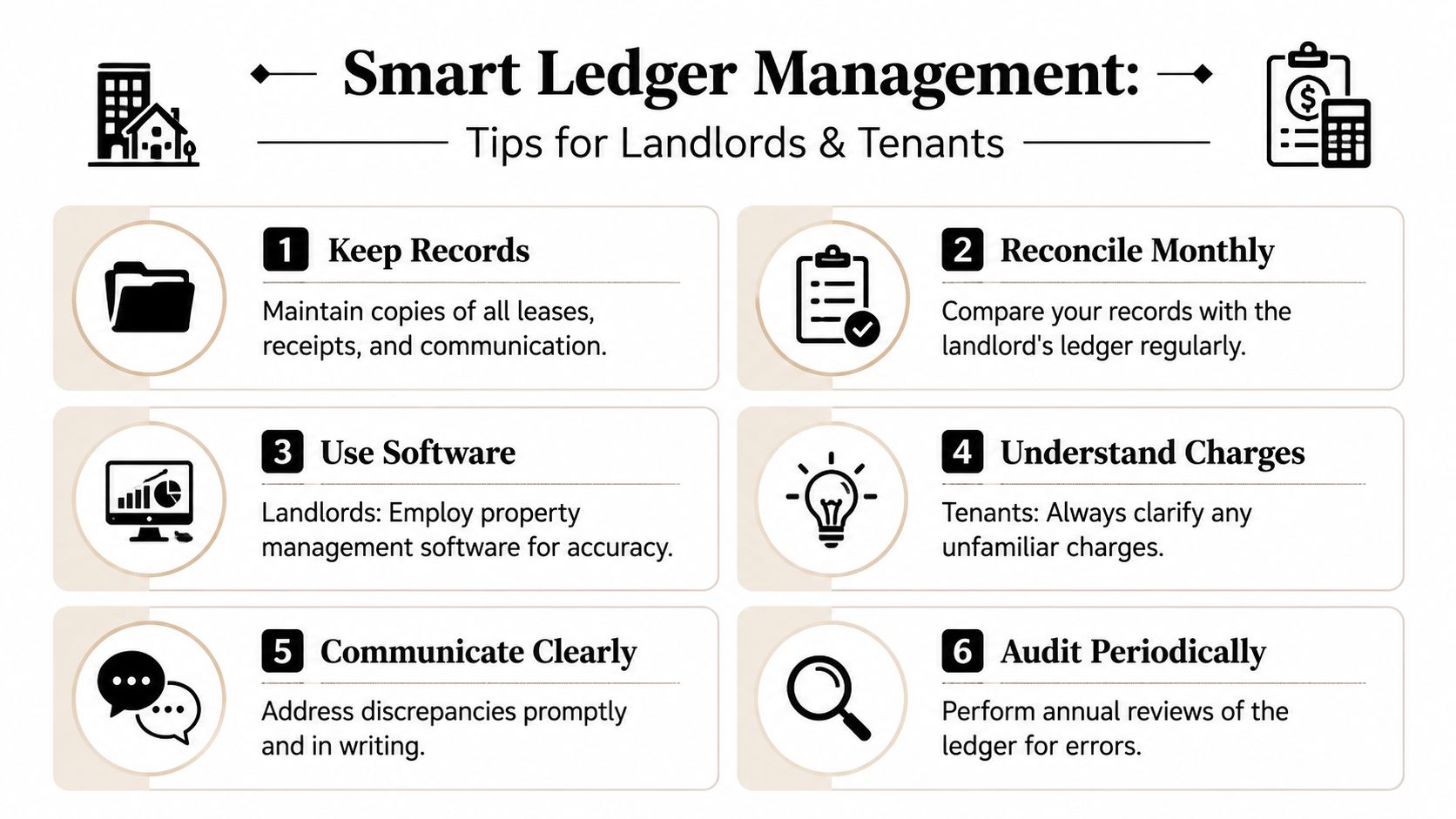
Here's the routine that tends to hold up best:
- Post charges on schedule. Rent, approved fees, and credits should hit the ledger when they occur, not at the end of the quarter.
- Match every payment to the tenant account. Don't leave money sitting in a general deposit view without posting it to the right ledger.
- Review balances monthly. A short monthly review catches issues while they're still easy to fix.
- Keep support documents. Lease copies, receipts, notices, and move-out records should back up the ledger, not live in separate chaos.
What tenants should do
Tenants should ask for a copy of the ledger when there's a question about rent status, fees, or move-out accounting. Review it line by line. Check dates, descriptions, and whether each payment you made appears correctly.
If something looks wrong, respond in writing and identify the exact entry you dispute. That approach works better than broad objections.
Ask for the line item, the posting date, and the reason for the charge. Specific questions get specific answers.
A simple self-audit checklist
- Check beginning balances against the prior period.
- Scan for blank descriptions or entries that would confuse an outside reviewer.
- Verify payment dates against your receipt records.
- Confirm final balances make sense before sending statements or notices.
- Review move-out accounts carefully before any deposit reconciliation goes out.
A ledger doesn't need to be complicated. It needs to be current, readable, and complete. That's what keeps small issues small.
If you want help keeping tenant ledgers, rent collection, notices, and accounting records clean from the start, Edinhart Realty and Property Management provides professional property management support for owners across Fresno, Clovis, Friant, and the greater Central California region. Whether you need full-service management or placement-only help, a strong management process starts with accurate records and clear financial reporting.


