

Owning a rental usually feels manageable right up until the week everything lands at once. The garbage disposal jams after dinner. Your tenant says the rent check will be late. The lease renewal is sitting in your inbox. You meant to compare Fresno rents before relisting the place, but now you're also wondering whether that repair needs a licensed vendor, whether your notice language is right, and whether you documented the last inspection well enough.
That's the moment most first-time landlords start asking a bigger question. What does a rental property manager do, exactly? Not the short version. The version.
In Fresno, that answer matters more than people think. California rules are tighter, the paperwork matters, summers are hard on HVAC systems, and even a simple turnover can turn into a chain of small decisions that affect rent, vacancy, repairs, and legal risk. A good manager isn't just a person who deposits checks. They're the one keeping the whole rental operation from wobbling.
The Moment Every Landlord Eventually Faces
Most owners don't start out wanting a property manager. They start out wanting one clean, paying tenant and a house that mostly behaves itself. Then real life shows up.
A Tuesday night call about a leaking supply line doesn't arrive politely during business hours. It hits while you're cooking dinner, or driving back from Clovis, or trying to remember where you saved the lease. At the same time, another tenant wants to know whether they can renew, and you're not sure if the current rent still matches the Fresno market.
That's where the role gets misunderstood. People often think management means a person who collects rent and sends a plumber. In practice, the job is much wider. The manager is the one who handles the listing before a tenant ever applies, screens applicants, prepares lease paperwork, tracks money, coordinates repairs, documents inspections, and keeps the owner from stepping into a California compliance problem by accident.
Practical rule: If a rental has a tenant, a deadline, money coming in, or a repair going out, a property manager is usually involved.
The confusion usually comes from seeing only the most visible tasks. Owners notice the maintenance call and the rent payment because those interrupt the day. They don't always see the quieter work in the background: reviewing applications against objective criteria, keeping move-in photos organized, logging vendor invoices, handling lease renewals, or making sure communication is documented if a dispute starts brewing.
That's why it helps to think of the job by timing. A rental manager works before tenancy, during tenancy, and at turnover. Who handles what, when, and why, that's the cleanest way to understand the role.
What a Rental Property Manager Actually Is
A rental property manager is the owner's agent for the day-to-day running of a rental. In California, that usually means the work is performed under a real estate broker's license. That alone separates the role from a handyman, bookkeeper, or leasing assistant.
Industry descriptions show how broad the job really is. Jobs and Skills Australia defines the role as leasing rental properties on behalf of owners and includes duties such as setting rental value through inspections, advertising vacancies, screening tenants, preparing leases, collecting rent, coordinating repairs, resolving complaints, and handling budgeting and financial reporting. The same profile notes that maintenance and repairs and rent collection are each handled by about 80% of property managers, leasing and advertising by 77%, inspections by 74%, and accounting by 57% in the profession's work mix, according to the property manager occupation profile.
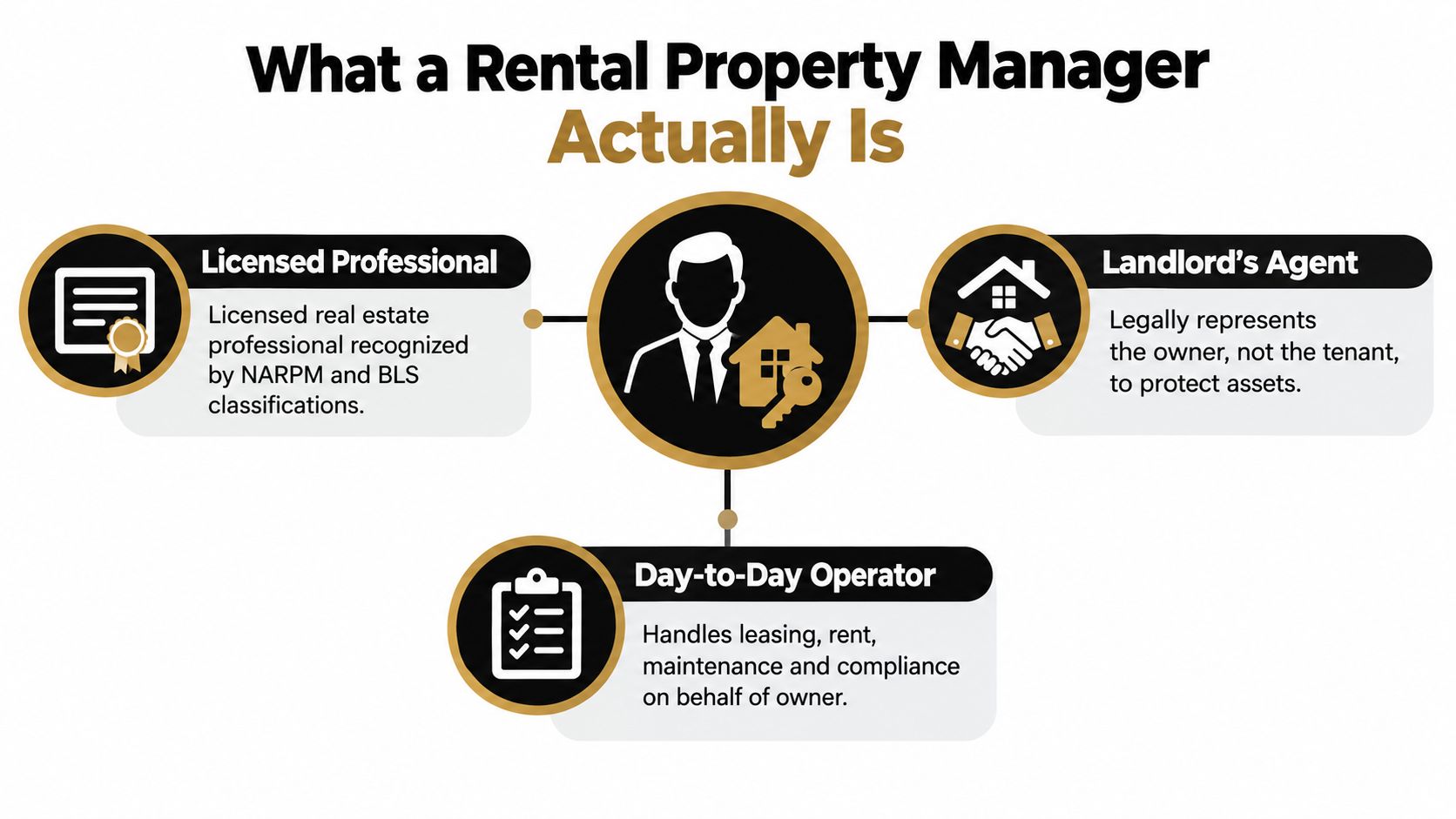
Think chief of staff, not rent collector
The easiest analogy is this: a property manager is the chief of staff for a rental house. The owner sets the goal. Keep the place occupied, protected, and producing income. The manager handles the moving parts that make that happen.
Those moving parts usually fall into five pillars:
- Marketing and leasing means pricing the home, creating the listing, fielding inquiries, scheduling showings, and moving a vacant unit toward an approved tenant.
- Screening means applying consistent criteria, checking income and rental history, and documenting decisions carefully.
- Rent and accounting covers payment collection, ledger accuracy, owner statements, and records that make tax season less painful.
- Maintenance and vendor coordination means triaging repair requests, dispatching the right vendor, and watching habitability issues closely.
- Legal compliance includes lease paperwork, notice handling, fair housing practices, and staying aligned with California rules.
If you're comparing roles, a leasing agent helps fill a vacancy. A handyman fixes physical problems. A bookkeeper records transactions. A manager sits above all three and coordinates the whole operation. For a broader local primer, this overview of what property management means in practice is useful.
Why the role has become more specialized
The profession is large enough now that owners don't have to improvise. A 2026 industry summary cites about 466,100 U.S. property, real estate, and community association manager jobs in 2024, with projected growth of roughly 3.6% over 2024 to 2034. The same summary says the broader property management workforce reached about 707,721 workers and 78,886 establishments in 2023, and notes historical roots going back to the Cruikshank Company founded in 1794, as outlined in these property management industry statistics.
On the business side, owners and managers also pay attention to demand signals and local inventory trends. If you're trying to understand how operators identify neighborhoods and owner opportunities, this roundup of property management lead generation data gives helpful market context.
Core Duties of a Full-Service Rental Property Manager
Full-service management is the version most owners picture when they want fewer day-to-day headaches. The cleanest way to understand it is to follow one Fresno rental from vacancy to renewal.
From empty unit to signed lease
It usually starts with pricing. A manager walks the property, compares condition, location, layout, and current competition, then recommends a market rent that gives the home a realistic shot at leasing without dragging into unnecessary vacancy.
Then comes the listing. Photos, ad copy, showing coordination, inquiry follow-up, and application handling all sit in that first stage. The manager isn't just putting the home online. They're shaping who applies and how quickly the property gets in front of qualified renters.
Industry guidance also treats tenant acquisition and screening as one of the manager's most important functions, alongside rent collection, maintenance coordination, lease enforcement, and compliance, as explained in this overview of property management responsibilities.
| Lifecycle Phase | Manager's Duty | Fresno Example |
|---|---|---|
| Vacancy | Set rent and launch marketing | Compare similar homes in North Fresno, Tower, or Clovis-adjacent areas, then publish a fresh listing with current photos |
| Leasing | Show property and screen applicants | Coordinate showings around work schedules and review applications using written criteria |
| Lease-up | Prepare paperwork and collect move-in funds | Use California lease forms and gather the security deposit and first payment before key release |
| Occupancy | Collect rent and handle issues | Respond when a tenant reports an AC problem during a heat wave |
| Renewal | Review terms and prepare renewal documents | Offer a renewal with updated terms before the lease expires |
| Turnover | Inspect, document, and ready the unit | Compare move-out condition against the move-in file and line up cleaning and repairs |
During the tenancy
Once the tenant moves in, the work shifts from leasing to operations. Rent collection becomes routine until it isn't. If a payment comes in late, the manager tracks the ledger, sends the proper communication, and follows the lease terms consistently rather than making it up month by month.
Maintenance is where many owners underestimate the workload. A full-service manager triages whether a problem is urgent, habitability-related, cosmetic, or tenant-caused. They contact the vendor, coordinate access, document the issue, and keep the owner informed without asking the owner to stop work and become a dispatcher.
For many managers, that maintenance lane is one of the most visible parts of the profession. It's also one reason owners look for support with property maintenance coordination and repair handling, especially when they don't have a trusted vendor bench already built.
A good repair process isn't just "send somebody out." It's deciding how urgent the issue is, who should handle it, what the lease says, and how to document the result.
Screening, deposits, records, and the paper trail
The turnover and compliance side matters just as much as the repair side. Neutral industry guides describe standard manager duties as credit checks, income verification, rental-history review, background checks, lease drafting and renewal, move-in and move-out coordination, and owner reporting in a documented workflow, as outlined in this guide to property management duties and responsibilities.
In California, that often means detailed move-in photos, written condition notes, and careful handling of the security deposit under Civil Code 1950.5. When a tenant moves out, the manager has to compare condition against the original file, sort normal wear from chargeable damage, and line up cleaning or repairs quickly enough to keep the next leasing window from slipping.
A practical owner resource at turnover is this security deposit cleaning guide, which helps clarify what a unit should look like before final inspection. It doesn't replace legal advice, but it does help owners and tenants speak the same language about move-out readiness.
At the back end, full-service also means owner statements, invoice tracking, reserve handling, and records organized well enough for year-end tax prep. If the tenancy goes sideways, the manager may also coordinate notices and unlawful detainer support with the owner and counsel.
How a Placement-Only Property Manager Works
Placement-only management is simpler in scope. The manager helps you get the tenant in. After that, you take the wheel.
For a Fresno owner, that usually means the manager handles rent analysis, listing setup, photos, marketing exposure, inquiry response, showing coordination, application processing, background and credit checks, rental history review, lease drafting, collection of initial move-in funds, and key handoff. Once the tenant is placed, the engagement ends.
Where the handoff happens
This model is easiest to understand if you draw a line at possession. Before the tenant gets the keys, the placement-only manager is doing the leasing work. After move-in, the owner becomes the active manager.
That means you take back:
- Rent collection after the first payment
- Late-payment follow-up and notices
- Maintenance calls and vendor scheduling
- Lease renewals and rent adjustments
- Bookkeeping and owner records
- Lease enforcement if the tenant violates terms
- Eviction coordination if it comes to that
A recent industry guide describes modern rental management around five end-to-end functions: marketing, screening, rent collection, maintenance coordination, and owner reporting. It also notes that regulatory changes in some markets now require clearer price disclosure in advertising, which shows how management has expanded beyond basic administration, according to this rental property management guide.
| Task | Placement-Only Manager Handles | Owner Takes Back |
|---|---|---|
| Pricing the rental | Yes | No |
| Creating listing and marketing | Yes | No |
| Showings and inquiries | Yes | No |
| Screening applicants | Yes | No |
| Lease drafting and move-in funds | Yes | No |
| Monthly rent collection | No | Yes |
| Maintenance coordination | No | Yes |
| Renewals and notices | No | Yes |
| Ongoing accounting | No | Yes |
When placement-only makes sense
Say you moved out of Fresno but kept your former home as a rental. You don't want to self-market from another state, guess at screening criteria, or draft California lease paperwork from scratch. A placement-only firm can get the property leased properly, and then you manage the tenancy yourself once things stabilize.
This model usually appeals to owners who are organized, responsive, and comfortable being on call once the tenant is in place. It can also work for the landlord with one long-term rental who doesn't mind handling repairs and rent, but wants professional help filling vacancies without cutting corners on fair housing or screening practices.
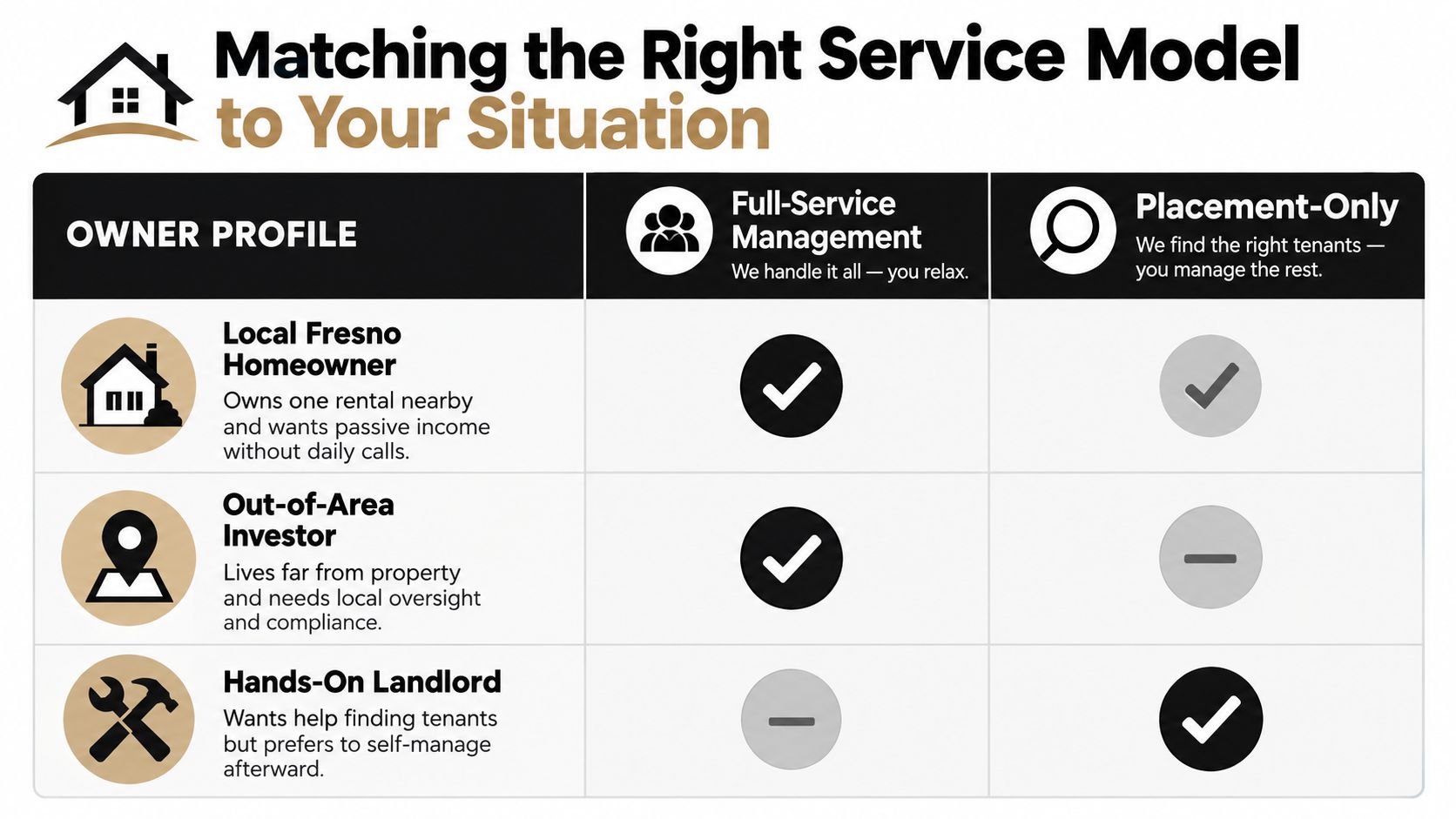
Matching the Right Service Model to Your Situation
The better question isn't "Which model is better?" It's "Which model fits the way you live and manage?"
The owner who wants the income, not the interruptions
This is the Fresno homeowner with one rental who still has a full-time job, family obligations, and no interest in taking a call about a toilet backup on a holiday weekend. For this owner, full-service usually fits best because the goal is steady oversight without being pulled into every decision.
The value isn't only convenience. It's consistency. The same person or company handles leasing, payment follow-up, repairs, renewals, and documentation in one system.
The owner who lives far away
If you're out of state, full-service tends to move from helpful to necessary. Distance turns simple issues into delays. Delays turn into tenant frustration, deferred maintenance, and sometimes legal exposure if a habitability problem isn't addressed fast enough.
Local presence matters. Someone has to know Fresno vendors, show the property, inspect conditions, and keep records current. Remote ownership works best when local operations are already in place.
The owner who likes control
Some landlords prefer staying hands-on. They answer calls quickly, know their property well, keep strong files, and are comfortable managing people and process. For them, placement-only can be a good fit.
They still get help with the part that benefits most from market visibility and formal screening. After that, they retain control over communication, repairs, and renewals.
If you like making operating decisions but don't want to gamble on marketing or applicant review, placement-only often lands in the sweet spot.
A simple way to choose
Use these filters instead of comparing service names alone:
- Distance from the property. The farther away you live, the more full-service makes sense.
- Number of units. One stable house is different from several doors with overlapping issues.
- Tenant stability. A long-term, low-drama tenant is easier to self-manage than frequent turnover.
- Legal comfort. California paperwork and notice handling aren't forgiving of guesswork.
- Time available. If you can't reliably respond, the tenant still needs someone who can.
- Budget tolerance. Lower service cost can mean higher owner workload.
The right answer can change over time. A landlord who starts with one house and plenty of free time may eventually add units and decide that full-service is worth it because the system needs to scale.
California and Fresno Considerations That Change the Job
Property management in California isn't just busier. It's more technical. The daily work has more legal edges, and that changes what a competent manager does.
California compliance changes the routine
The first big difference is habitability. California Civil Code Section 1941 and the implied warranty of habitability shape how managers respond to repair requests. Some issues aren't just annoying. They touch health and safety, and that means slower response or sloppy documentation can create real exposure for the owner.
Security deposit handling is another place where California sharpens the job. The legal limits and itemization rules matter, and so does the condition file created at move-in and move-out. A manager who doesn't document thoroughly makes the owner weaker if a deposit dispute starts.
State rules also affect rent increases and termination decisions in many situations. AB 1482 can apply depending on the property and tenancy, and the analysis isn't always obvious to a first-time landlord. For a local overview, this guide to California landlord-tenant law helps frame the issues owners commonly run into.
Fresno realities change the day-to-day
Then you add Fresno itself. Summer heat puts HVAC systems under stress. That means more AC complaints, more urgency around cooling, and more attention to vendor response times when the forecast is brutal.
Air quality can matter too. Valley smoke and seasonal conditions don't create the same legal issue every time, but they do affect tenant communication, filter changes, and owner decisions about maintenance timing.
Fresno also has leasing patterns that feel local. Homes near Fresno State, commuter-friendly neighborhoods, and family-oriented school zones don't all market the same way. A manager working this market has to understand not only who the likely renter is, but how quickly that renter expects response, access, and unit readiness.
Documentation becomes part of the service
One reason owners hire licensed California managers is the paper trail. The modern role now extends into pricing transparency, compliance, and operational reporting, while owners also want clearer answers on whether a manager helps vacancy speed, applicant quality, and rent-setting decisions, as discussed in this breakdown of what to expect from property management roles and costs.
That doesn't mean a manager guarantees a perfect outcome. It means they document each step so the owner isn't relying on memory when a tenant challenges a charge, a notice, or a maintenance timeline.
Common Misconceptions About Rental Property Managers
A lot of owners hear the management fee first and stop there. That's understandable, but it's incomplete.
"Managers just collect rent"
They don't. The public-facing job may look like rent collection and repair calls, but the actual role covers operations, compliance, vendor coordination, applicant handling, documentation, and owner reporting. If all you needed was a payment processor, you wouldn't need a manager.
"Self-managing is always cheaper"
Sometimes it is. Sometimes it only looks cheaper because the hidden costs don't show up on one invoice.
| Common Misconception | Typical Reality for Fresno Rental |
|---|---|
| A manager is just an extra bill | A manager often replaces owner time, after-hours calls, repair coordination, and leasing admin |
| Any local person can do the job | California rules, lease handling, and notice procedures reward licensed experience |
| Placement-only is the same as cheaper full-service | It is a narrower service with a real handoff point and more owner responsibility afterward |
| Good tenants make management unnecessary | Even stable tenancies need renewals, records, compliance, and repair response |
The biggest hidden cost in self-management is often interruption. The second is mistakes. Misstated notices, inconsistent screening, poor files, and delayed repairs can cost more than owners expect, even when the rent keeps coming in.
"Any property manager will do"
Local knowledge matters. Fresno isn't Los Angeles, and California isn't Arizona or Texas. A manager who knows California forms, security deposit handling, and local vendor response patterns will usually make cleaner decisions than someone treating the job like generic admin work.
The best fit is rarely the cheapest proposal on paper. It's the manager whose scope matches the way you actually need the property run.
One local option owners compare is Edinhart Realty and Property Management, which offers both full-service monthly management and placement-only leasing for Fresno-area rentals. That kind of split model is useful when you want to choose your workload instead of forcing every property into the same service package.
Deciding If a Property Manager Is Right for You
If you're still on the fence, keep it simple. Ask yourself three questions.
The three-question check
- How far away do you live? If you can't get to the property quickly, full-service usually makes more sense.
- How much time can you realistically give the rental each month? If your answer depends on the week, you're probably less available than you think.
- How comfortable are you with California landlord-tenant rules? If notices, deposits, habitability, and lease enforcement feel fuzzy, professional help is usually cheaper than learning under pressure.
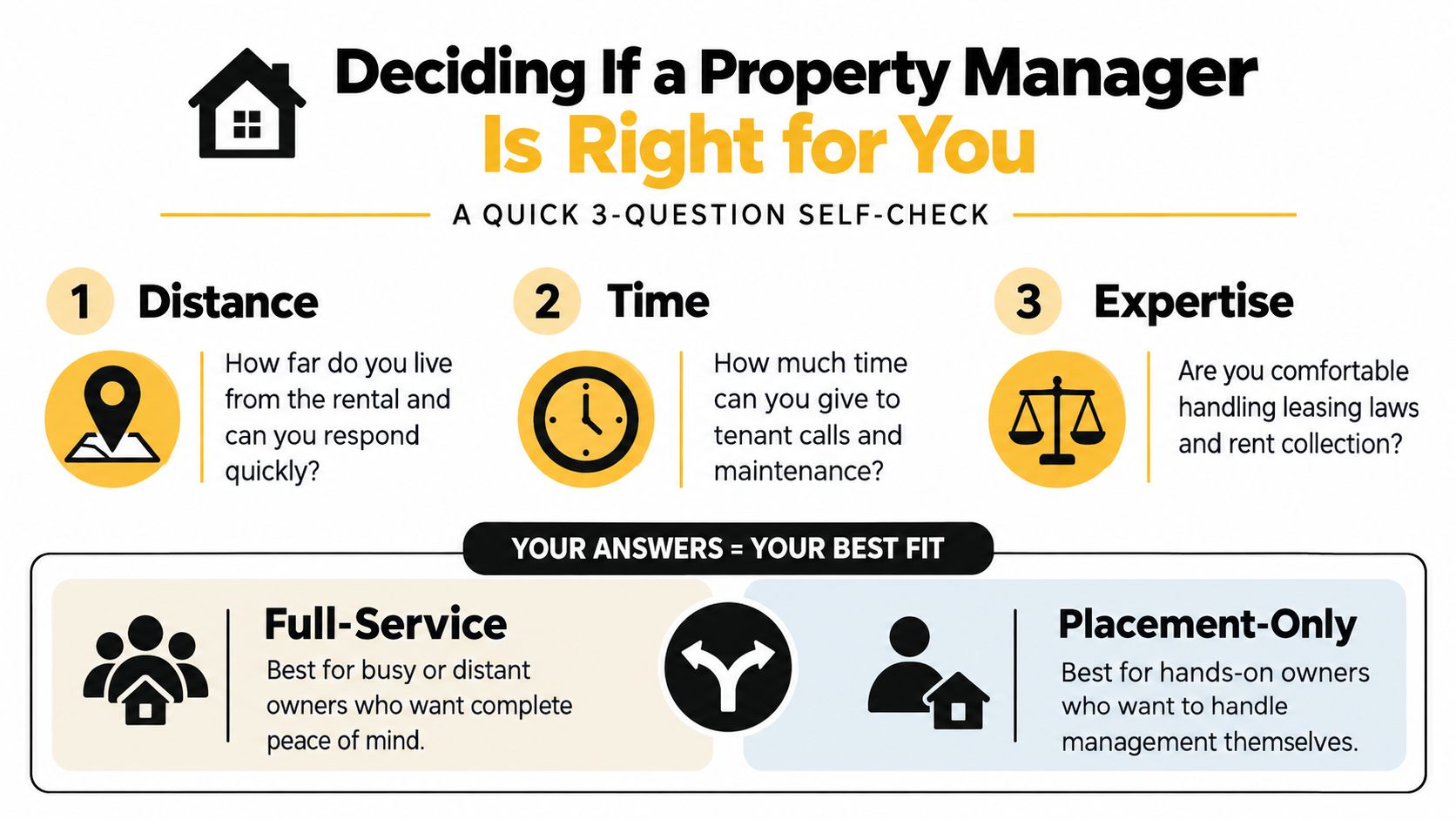
If you're local, organized, and willing to handle maintenance and rent yourself, placement-only may be enough. If you're remote, busy, or want the rental to behave more like an investment and less like a side job, full-service is usually the better fit.
A practical next step is to interview a few licensed Fresno managers, ask for a sample owner statement, ask how they document move-ins and repairs, and verify the broker license before signing anything. The right choice isn't about handing off responsibility blindly. It's about putting the right person in charge of the parts you don't want to mishandle.
If you're weighing full-service against placement-only for a Fresno rental, Edinhart can help you compare the day-to-day scope, not just the fee line. They offer both leasing support and ongoing management for owners in Fresno and nearby communities, so you can choose the model that fits how involved you want to be. Visit Edinhart Realty and Property Management to see how their rental services are structured and what they handle for local owners.


