

A lot of landlords notice the water heater only when a tenant says the shower went cold, the pilot won't stay lit, or there's water on the garage floor. That's too late. The better time to look is during turnover, when the unit is quiet and you can still fix documentation gaps before a new tenant moves in.
In Fresno and across Central California, I've seen the same pattern repeatedly. An owner checks the tank age, maybe the straps, maybe the vent, but ignores the label because it looks like old manufacturer clutter. Then the label is faded, painted over, or half-peeled off, and nobody can say what warning was visible to the tenant, what temperature risk was communicated, or whether the unit's operating information could even be read.
That's where water heater warning labels stop being a maintenance detail and become a liability issue.
Why a Faded Sticker Could Be Your Biggest Liability
A Fresno property manager doing a final walkthrough spots an aging water heater in the garage. The tank is still operating. No active leak. No obvious rust-through. But the warning label is curling at the edges, the print is sun-faded, and a prior painter left overspray across the most important text.
That's the kind of detail many owners skip past. They shouldn't.
Water heater labels became a major consumer-information tool through federal policy, and the yellow EnergyGuide label is part of a standardized system that helps buyers compare operating cost. That matters because heating water is typically the second-largest use of energy in a home, after space heating and cooling, according to the Rheem overview of the EnergyGuide label. In a rental setting, that label also serves as a record of what safety and operating information was attached to the appliance.
Why landlords get in trouble
A damaged label doesn't automatically create liability. But it removes one of the easiest pieces of proof that you maintained the appliance in a reasonable, documented way.
If a tenant or child is injured, the argument from the other side is predictable:
- The hazard was foreseeable: Hot water can scald, gas appliances can create combustion hazards, and pressure systems can fail if neglected.
- The warning wasn't legible: If the label was unreadable, you can't point to a visible warning that remained with the unit.
- The maintenance trail is weak: If there are no photos, no turnover notes, and no service records, the label problem becomes part of a broader negligence story.
California landlords already operate under a general duty to keep rental property reasonably safe. If you want a plain-language overview of how injury claims are framed, the LA Law Group, APLC premises liability guide is a useful starting point. Water heater warning labels fit into that same logic. A known hazard plus poor documentation is where claims get expensive.
Practical rule: If the label is unreadable, treat that as a compliance problem, not a cosmetic problem.
A small sticker with insurance implications
Most owners buy coverage and assume that's enough. It isn't. Insurance helps pay for covered losses, but it doesn't erase sloppy maintenance habits or poor records. If you need a refresher on how protection works at the ownership level, review landlord liability insurance basics, then compare that to your actual inspection process.
A visible, legible label won't solve every dispute. But a missing one can become the first exhibit in a negligence file. That's why I tell new landlords to treat water heater warning labels as part of the unit's safety equipment.
Decoding the 5 Key Water Heater Warning Labels
Most residential units carry the same warning themes, even when wording differs by manufacturer. The mistake landlords make is reading them as boilerplate. In practice, each label points to a separate management duty.
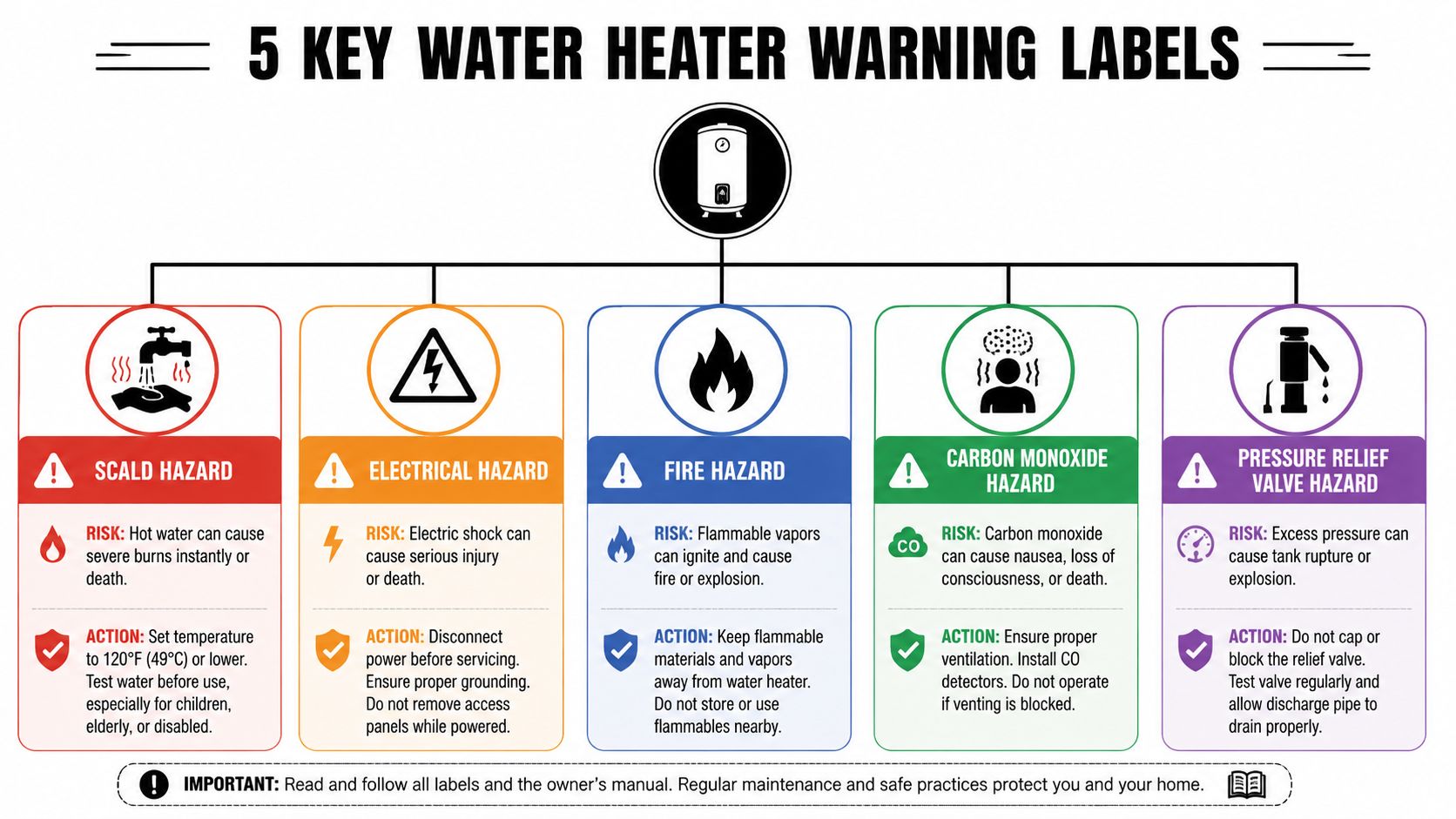
Under federal labeling rules, water-heater labels must present standardized, model-specific performance information, including estimated annual energy consumption and first-hour rating, which helps property managers match a unit to demand load. That makes the label an enforceable compliance signal, not just sales language, as shown in the FTC rule text for water-heater labeling.
The labels that matter most
Scald hazard
This is the label landlords underestimate most often. It warns that hot water can injure occupants quickly, especially children, older adults, and people with disabilities. In rental housing, this label connects directly to thermostat setting, fixture output, and tenant complaints about “not enough hot water.”
If you ignore the label and turn the unit up to quiet complaints, you've made a risk decision. You own that decision.
Flammable vapors
Gas water heaters often carry strong warnings about gasoline, solvents, and other vapors. The rental issue isn't just whether the appliance can ignite fumes. It's whether you allowed storage conditions around the unit that made ignition more likely.
In California garages, this comes up constantly. Tenants store paint thinner, gas cans, landscaping fuel, or oily rags near the heater. The label is warning about a normal-use hazard, not a rare event.
Temperature and pressure relief valve warning
This label points to one of the unit's critical safety components. If the T&P valve, discharge pipe, or termination is wrong, the label is telling you there is pressure and heat that must be controlled safely.
A landlord doesn't need to be a plumber to understand the management rule here. Never treat the relief system as optional hardware.
Electrical shock risk
Electric units carry warnings about power hazards behind access panels and around wiring. In rentals, this matters during turnover when handymen, residents, or unlicensed workers remove panels to “take a look.”
A visible warning helps, but your process matters more. If electrical work is needed, route it correctly and document who performed it.
Maintenance and operating instructions
These labels often get ignored because they don't look dramatic. That's a mistake. They may identify operating cautions, service precautions, and manufacturer-specific instructions that become relevant after a complaint, leak, or heating problem.
Water Heater Warning Label Cheat Sheet
| Warning Label | Associated Risk | Landlord Responsibility |
|---|---|---|
| Scald Hazard | Burn injury from delivered hot water | Verify thermostat setting, check complaint history, document any adjustment |
| Flammable Vapors | Ignition of gasoline or solvent vapors near gas units | Keep storage area clear, enforce lease rules on hazardous storage, note conditions during inspections |
| T&P Relief Valve | Pressure or hot water discharge hazard if valve or piping is improper | Visually inspect valve area and discharge configuration, refer defects for licensed repair |
| Electrical Shock Risk | Injury from unsafe access to energized components | Restrict panel access, use qualified service personnel, document repairs |
| Maintenance Requirements | Unsafe operation from neglect or incorrect servicing | Keep service records, follow manufacturer guidance, note missing or unreadable labels |
A water heater warning label is only useful if your inspection process turns its warning into action.
What works and what doesn't
What works:
- Reading the label during turnover: Don't wait for a maintenance call.
- Matching capacity to actual occupancy needs: The label gives performance clues beyond tank size.
- Using the label as an inspection prompt: Each warning should trigger a related visual check.
What doesn't:
- Assuming all tanks of similar size perform the same
- Treating labels as disposable because “the unit is old”
- Relying on brand reputation instead of model-specific information
For landlords, the practical move is simple. Every label should answer one question: what hazard is this unit warning about, and what did I do to control it?
From Sticker to Lawsuit The Legal Weight of Labels
A warning label doesn't prevent every injury. A wet floor sign doesn't stop a spill either. But if someone falls and there was no warning, the missing sign becomes part of the case. Water heater labels work the same way.
In California landlord practice, two ideas matter a lot: duty of care and foreseeable risk. A landlord has to act reasonably to address hazards that are known or should have been known. Hot water that can scald, pressure systems that require proper discharge, and combustion appliances that need safe conditions are not surprise hazards. They are ordinary, foreseeable ones.
Why plaintiffs focus on labels
If a child is burned by water that is too hot, a plaintiff's attorney won't just ask whether the heater functioned. They'll ask:
- Was the warning label present?
- Was it legible?
- Was the unit set in a way that increased scald risk?
- Did the landlord inspect the heater before move-in or renewal?
- Is there any written or photographic proof?
Manufacturer warnings commonly advise that settings above 125°F can cause severe burns or death from scalding, as shown in this manufacturer warning document. That's why a visible label matters. It supports the argument that the owner recognized the hazard and kept the warning in place.
Labels are evidence of reasonableness
A label by itself is not a legal shield. If the thermostat is too high, the T&P setup is defective, or the venting is wrong, the sticker won't save you. But a maintained, legible label does help establish that you didn't ignore obvious manufacturer safety information.
If the label is painted over, torn off, or hidden behind stored items, a plaintiff can argue the warning existed in theory but not in practice.
That distinction matters. Judges, carriers, adjusters, and juries all respond to simple facts they can understand. “The landlord kept the warning visible and documented the setting” is stronger than “the warning was probably there at some point.”
What weakens your defense
The most common self-inflicted problems are operational, not technical:
- No turnover photo of the heater
- No notation of thermostat setting after service
- No record of tenant complaints about water temperature
- Labels obscured by paint, dust, storage, or corrosion
- Handwritten maintenance notes with no date or signature
Those gaps let the other side build a story that you were casual about a known hazard. In my experience, that's what increases exposure. The issue usually isn't one sticker. It's what that sticker says about your management habits.
California Code Highlights for Property Managers
California landlords need to connect labels to installation reality. A warning about pressure means very little if the discharge piping is wrong. A combustion warning means very little if the unit sits in unsafe conditions. At this point, field inspection matters more than paperwork.
The code issues that show up most often
In California, seismic strapping is one of the first things to check. If the water heater isn't properly secured, earthquake movement can turn a routine appliance into a rupture, flood, or gas hazard. New landlords often focus on the tank itself and miss the restraint hardware completely.
The T&P relief system deserves the same level of attention. The discharge pipe should be gravity-fed and installed so released water can discharge safely. If the setup looks improvised, modified, capped, or otherwise questionable, that's not a “watch it later” item. It needs correction.
Code guidance also highlights installation details that many warning-label discussions leave out, such as proper vent connector slope on gas equipment. The larger point is this: a label can identify the hazard, but code-compliant installation controls the hazard.
A practical California checklist
Use this quick field review during turnover or annual inspection:
- Check seismic restraint: Confirm the tank is strapped in a way that appears secure and purpose-built for earthquake protection.
- Look at the T&P valve area: Verify the valve is present and the discharge piping appears intact and directed for safe drainage.
- Review the venting path on gas units: Watch for disconnected sections, obvious back-pitch, or makeshift repairs.
- Clear the surrounding area: Don't allow storage to block visibility, service access, or warning labels.
- Read the labels in place: If the warning is unreadable, note it immediately and begin replacement steps.
Field standard: If a label warns of heat, pressure, or combustion risk, inspect the component that controls that risk during the same visit.
Where California landlords get exposed
Owners get exposed when they separate “maintenance” from “compliance.” In practice, they're linked. A unit can still produce hot water and still be a liability problem.
For California-specific landlord compliance context beyond the water heater itself, it helps to keep a current reference on California landlord-tenant law. That broader framework matters because inspection failures often become habitability, injury, or documentation disputes later.
What works in the field is simple. Don't evaluate the label alone. Evaluate whether the installation and operating conditions honor what the label is warning about.
Your Inspection and Documentation Protocol
Most landlords don't lose arguments because they never looked at the water heater. They lose because they can't prove what they looked at, when they looked at it, or what condition it was in at the time.
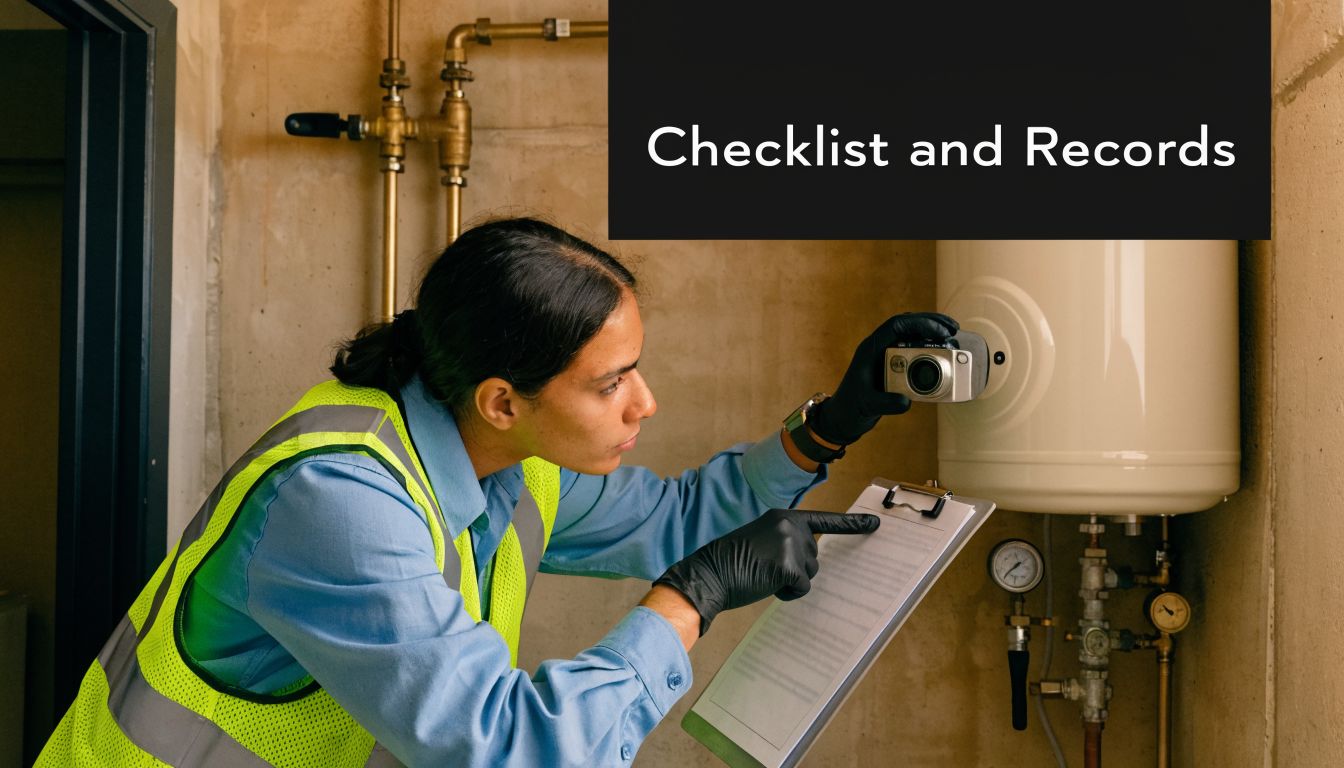
A usable protocol has to be short enough that your staff will follow it. If it takes too long, corners get cut. If it's vague, records become useless.
The four-part inspection routine
1. Locate every label
Start by finding all visible manufacturer and warning labels on the unit. Don't stop at the large front warning. Check side panels, EnergyGuide information, service markings, and labels near controls or access points.
If a label is blocked by shelving, tenant storage, or debris, document that condition too. Visibility matters.
2. Photograph for legibility, not just proof of presence
One wide photo of the heater isn't enough. Take:
- An overview shot: Show the full unit in its installed location.
- Close photos of each label: The text should be readable when zoomed in.
- A controls photo: Capture the setting indicator if visible.
- A safety hardware photo: Include the T&P area and straps.
Date-stamped digital records are best. Save them in the property file the same day.
3. Note operating and safety conditions
Your written inspection note should mention more than “water heater okay.” Record observations that would matter later:
- Label condition: legible, faded, peeling, painted over, missing
- Access condition: clear, obstructed, or unsafe
- General setup: gas or electric, garage or interior closet, storage nearby
- Follow-up needed: plumber, replacement label request, tenant notice, further evaluation
4. Track corrective action to closure
An open item without follow-up is where management systems fail. If the label is damaged, create a work order. If the thermostat setting is adjusted, log the date. If the service vendor recommends correction, save the invoice and completion photo.
Building a defensible file
A clean digital folder for each property is enough. You don't need complex software if the records are organized and searchable. During routine turnovers, many managers already use a rental property inspection checklist to capture room-by-room conditions. Add a dedicated water-heater label review to that process so it happens every time, not only when someone remembers.
One practical option in the local market is Edinhart Realty and Property Management, which handles repair coordination, move-in and move-out workflows, and detailed accounting records. For owners who self-manage, the lesson is the same even if you use your own system. Build a repeatable paper trail.
Good documentation does two jobs at once. It helps you catch hazards early, and it helps you prove you weren't ignoring them.
What actually holds up later
The best records are boring. Clear photos. Short notes. Dates. Work orders. Completion confirmations. Tenant communication saved in one place.
What fails later are vague comments like “looks fine,” missing photos, and service histories spread across email threads and text messages. If you want water heater warning labels to protect you, your records have to show that someone read them, understood them, and acted on them.
Replacing and Supplementing Damaged or Missing Labels
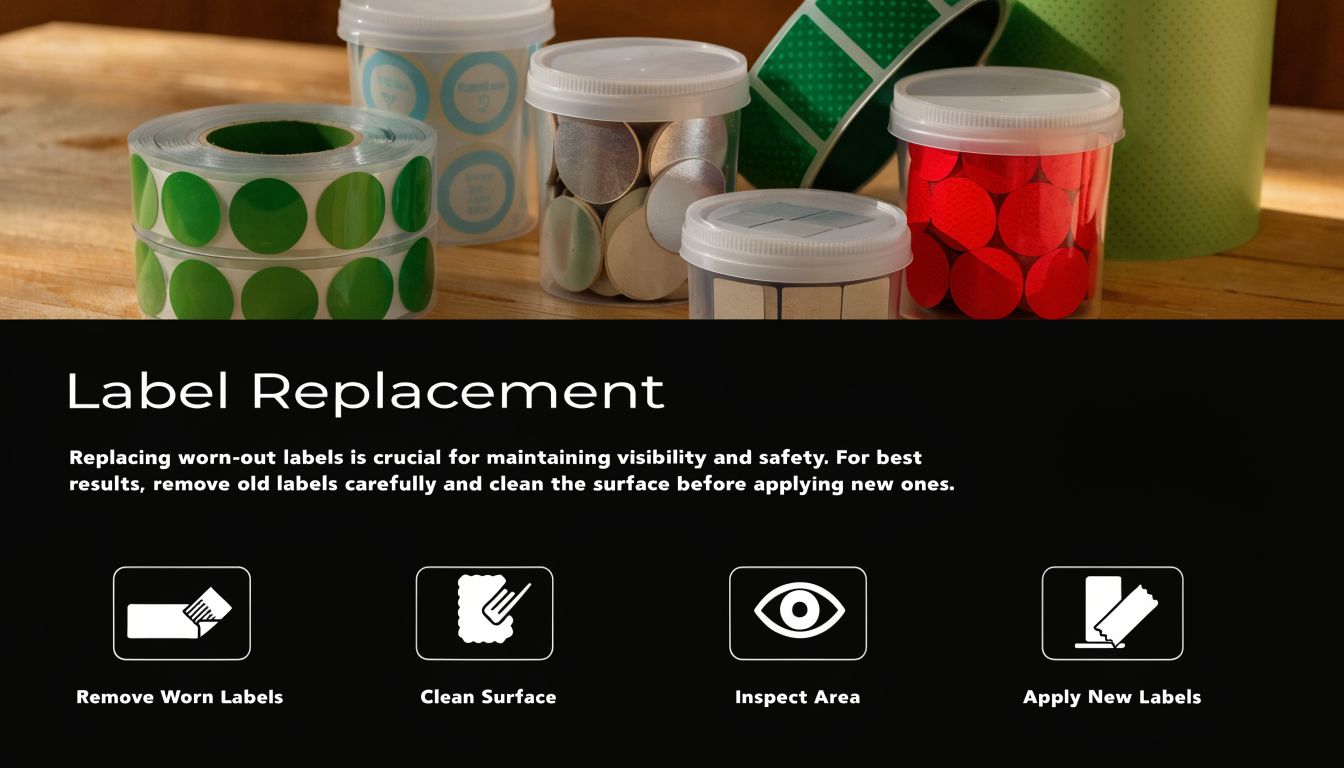
Older units often have missing labels, especially in garages, exterior closets, or utility spaces that get heat, dust, overspray, and rough handling. When that happens, the first choice is the manufacturer. A model-specific replacement label is the cleanest fix because it matches the original warnings and layout.
The best replacement path
Use this order of operations:
- Identify the unit clearly: Photograph the data plate and model information.
- Request manufacturer-specific replacements: This is the strongest option when available.
- Use supplementary safety labels if needed: If original labels can't be sourced promptly, add durable safety warnings that address the actual hazard while you evaluate the unit further.
- Document installation of the new label: Take a before-and-after photo.
When a missing label means more than a missing label
If all warnings are gone, the data plate is unreadable, and the tank shows broader wear, don't treat this as a sticker-only problem. Missing labels can be a sign that the unit has been in service a long time, has seen poor upkeep, or has changed hands without proper documentation.
A supplementary label can help restore visible warning language, but it doesn't cure deeper problems with age, corrosion, bad piping, or questionable controls.
Replace labels when you can. Replace the unit when the label issue is part of a bigger pattern of deterioration.
What not to do
Avoid homemade printouts taped to the tank. They fall off, smear, and look weak in a dispute. Also avoid placing new labels where they're hidden by shelving or stored items. A warning that can't be seen has little practical value.
If you're deciding between label replacement and unit replacement, use a simple test. Ask whether you're restoring a sound appliance or trying to dress up one that already needs a larger correction.
Frequently Asked Questions for California Landlords
My tenant says the water isn't hot enough at 120°F. Can I turn it up?
You can, but that decision creates risk. Consumer safety organizations recommend setting residential water heaters to 120°F for safety and energy savings, while also warning that temperatures below 120°F can allow unhealthy bacteria to grow, according to the National Board safety discussion on water heaters. That's the balancing act.
If a tenant complains, don't jump straight to a higher setting. First check whether the complaint is really about recovery time, fixture performance, mixing valve issues, or an undersized unit. If you do adjust settings, document why, who authorized it, and what follow-up you performed.
If all the warning labels are present, does that mean the water heater is safe?
No. Labels communicate hazards. They do not confirm safe installation, current maintenance, or proper operation. A unit can have every label intact and still have an unsafe discharge setup, poor venting, blocked access, or a problematic delivered temperature.
Treat labels as one part of a control system. They support inspection. They do not replace it.
How should I balance bacteria concerns with scald risk?
Handle it as a management decision that needs documentation, not guesswork. If you're concerned about water temperature safety, assess the actual use pattern, occupant profile, complaint history, and unit performance. Households with children, elderly occupants, or disabled residents call for extra caution on scald risk.
The key is consistency. Pick a documented approach, communicate it clearly, and avoid casual adjustments made after a single complaint.
If the warning label mentions scald risk, when is it a setting issue versus a replacement issue?
It's usually a setting issue when the unit is otherwise sound, the controls work properly, and the problem can be corrected through adjustment and monitoring. It leans toward replacement when the label problem sits alongside larger signs of deterioration, unreliable temperature control, unreadable identification, or recurring service problems.
A landlord should separate three questions. Is the warning visible? Is the unit operating correctly? Is the installation compliant? If the answer to more than one is no, replacement deserves serious consideration.
If you want a property management team to handle inspections, repair coordination, tenant communication, and compliance-minded turnover procedures in Fresno and the surrounding Central California market, Edinhart Realty and Property Management offers both full-service management and placement-only support for owners who want stronger documentation and fewer preventable liability problems.


