

You bought your house to be a home, not an investment on a spreadsheet. But life happens, plans change, and suddenly you might be staring at a new opportunity: becoming an "accidental landlord."
This isn't a detour from your financial plan—it's often one of the smartest wealth-building moves you can make, especially right here in Central California.
The Accidental Landlord: A Smart Wealth-Building Move

The idea of turning your primary residence into a rental can feel a bit overwhelming. One minute you're a homeowner, the next you're running a business. But that shift in mindset is exactly where the power lies.
Instead of selling and walking away, you get to hold onto a valuable asset that generates steady income and continues to grow in value.
Why This Strategy Works in Central California
If you're a homeowner in Fresno, Clovis, or our surrounding communities, you're in a great spot to make this work. Our regional economy keeps rental demand strong, and property values haven't skyrocketed to the same level as the coast, making it easier to generate positive cash flow.
Across the country, more owners are doing this to capture rising rents and long-term appreciation. For a Central California owner, even a conservative cash flow of $400–$600 a month after all your expenses adds up to $4,800–$7,200 in pre-tax income each year.
That’s on top of the wealth you’re building as your tenant pays down your mortgage and the property appreciates, which has historically averaged around 3–4% a year nationwide. You can find some more great insights on rental property returns over on mjcpa.com.
Becoming a landlord transforms your home from a personal expense into a financial engine. It's not just about collecting rent; it's about leveraging your largest asset to build a more secure financial future.
This guide is your roadmap. We’ll walk through every practical step—from updating your insurance and understanding the tax perks to deciding if you should self-manage or bring in a pro. Our goal is to give you the confidence to make a smart, profitable decision for your future.
Your Financial and Legal Preparedness Checklist
Before you can even think about listing your property, you need to get your financial and legal ducks in a row. This is the behind-the-scenes work that protects you, your investment, and your future tenants. Getting this foundation right isn't just a suggestion—it's the most critical first step in turning your home into a successful rental.
Have a Frank Conversation With Your Lender
Your first call? It should be to your mortgage lender. This might seem like a small detail, but it’s a big one.
Your current mortgage was approved with the understanding that you, the owner, would be living there. When you convert it to a rental, you're changing the game. Not telling your lender could technically trigger the "due-on-sale" clause in your contract. This scary-sounding term means they could demand you pay the entire loan balance immediately.
Is that likely to happen? Probably not. But it’s a massive risk you don’t need to take. A simple, honest conversation keeps you in compliance and avoids any potential headaches. It also opens the door to discuss other financial options, like a cash-out refinance if you need some capital for pre-rental repairs or upgrades.
Get the Right Insurance—This Is Non-Negotiable
Next up is your insurance. A standard homeowner's policy (often an HO-3) simply won't cut it once a tenant moves in. It’s designed for an owner-occupied home, period. You absolutely have to switch to a landlord policy, which is sometimes called a Dwelling Fire policy (DP-3).
This switch is essential for protecting your asset. A landlord policy is built from the ground up for rental situations.
- Property Protection: It covers the physical structure—the house itself—from damage, just like your old policy.
- Liability Coverage: This is the most important upgrade. It protects you if a tenant or their guest gets hurt on the property and you're found to be at fault.
- Loss of Rent Coverage: If a fire or other covered event makes the home unlivable, this feature helps replace your lost rental income while repairs are underway.
Trying to skate by on a homeowner's policy is a huge gamble. If you have to file a claim, it will almost certainly be denied, leaving you exposed to devastating financial loss.
Shifting from a homeowner's policy to a landlord policy isn't just paperwork—it's your primary financial shield. It redefines the property as a business asset and protects you against the unique liabilities that come with being a landlord.
Homeowner Insurance vs Landlord Insurance Key Differences
It's easy to get these confused, but understanding the difference is vital. One policy protects your personal home, while the other protects your business investment. Here's a quick look at where they differ.
| Coverage Area | Standard Homeowner's Policy (HO-3) | Landlord Policy (DP-3) |
|---|---|---|
| Primary Focus | Protects the homeowner, their personal belongings, and liability. | Protects the landlord's financial interest in the property and from rental-specific liabilities. |
| Personal Property | Covers your furniture, electronics, clothing, and other personal items. | Does not cover the tenant's personal belongings. Tenants need their own renter's insurance for this. |
| Liability | Covers injuries to guests but may have limitations or exclusions for tenant-related incidents. | Specifically designed to cover landlord liability, such as a tenant's injury due to property negligence. |
| Key Feature | Comprehensive coverage for both the structure and the owner's personal life within it. | Includes specialized options like loss of rental income coverage, which is absent in HO-3 policies. |
Making this switch ensures that your investment is properly covered from the unique risks that come with renting out a property.
Know the Lay of the Legal Land in California
Finally, you have to get up to speed on California's landlord-tenant laws. The legal landscape here is notoriously complex and heavily weighted toward tenant protection. Operating without a firm grasp of the rules is just asking for trouble.
A major piece of legislation to know is the Tenant Protection Act of 2019 (AB 1482). This statewide law set limits on rent increases and, more critically, established "just cause" eviction rules. Essentially, after a tenant has lived in your property for 12 months, you can only end their tenancy for specific, legally-approved reasons.
You can't just decide you want the house back on a whim. It has to be for a valid reason, like the tenant not paying rent or seriously violating the lease. For a much deeper look into these rules, you can check out our detailed guide on landlord-tenant law in California.
Beyond state laws, your best defense is an iron-clad lease agreement. Don't download a generic template from the internet. Using a professionally drafted lease, like the forms provided by the California Association of Realtors (C.A.R.), is the only way to go. These documents are constantly updated to reflect new laws and cover every detail, from security deposits to maintenance, making sure you’re protected and compliant from day one.
Navigating the Critical Tax Implications and Benefits
Deciding to turn your home into a rental is a huge financial step. It’s about more than just finding a tenant and cashing a check. The real game-changer is understanding the tax rules. Some can save you a fortune, while others offer steady, year-over-year benefits. This isn't just for your CPA to worry about; it's essential knowledge for any homeowner looking to make a smart move.
One of the most powerful—and time-sensitive—tax breaks you need to know about is the Section 121 Exclusion. This is the capital gains exclusion on a primary home, and it’s a massive advantage that homeowners often overlook when they choose to rent out their property instead of selling.
The "2-Out-of-5-Year" Rule: Your Golden Ticket
The rules are pretty straightforward but come with a strict deadline. Under federal law, you can typically exclude up to $250,000 of capital gains from the sale of your main home. For most married couples filing jointly, that number doubles to a whopping $500,000.
The catch? You must have owned and lived in the property as your primary residence for at least two of the five years immediately preceding the sale. This simple rule creates a critical three-year window. Once you move out and it becomes a rental, the clock starts ticking. Sell within three years, and you can still pocket those gains completely tax-free.
The Three-Year Window in Action
Let's look at a real-world scenario. Imagine a Fresno couple, Mark and Sarah. They bought their house ten years ago for $300,000. Today, it’s worth $700,000, leaving them with a $400,000 gain on paper.
They decide to buy a new home and rent out the old one. If they sell it anytime within the next three years, their $500,000 joint exclusion means they pay zero capital gains tax. But if they wait and sell in year four, that exclusion is gone. They could be looking at a tax bill of $60,000 or more, between federal and California state taxes.
This timeline shows just how important it is to get your financing, insurance, and legal ducks in a row before a tenant ever moves in.
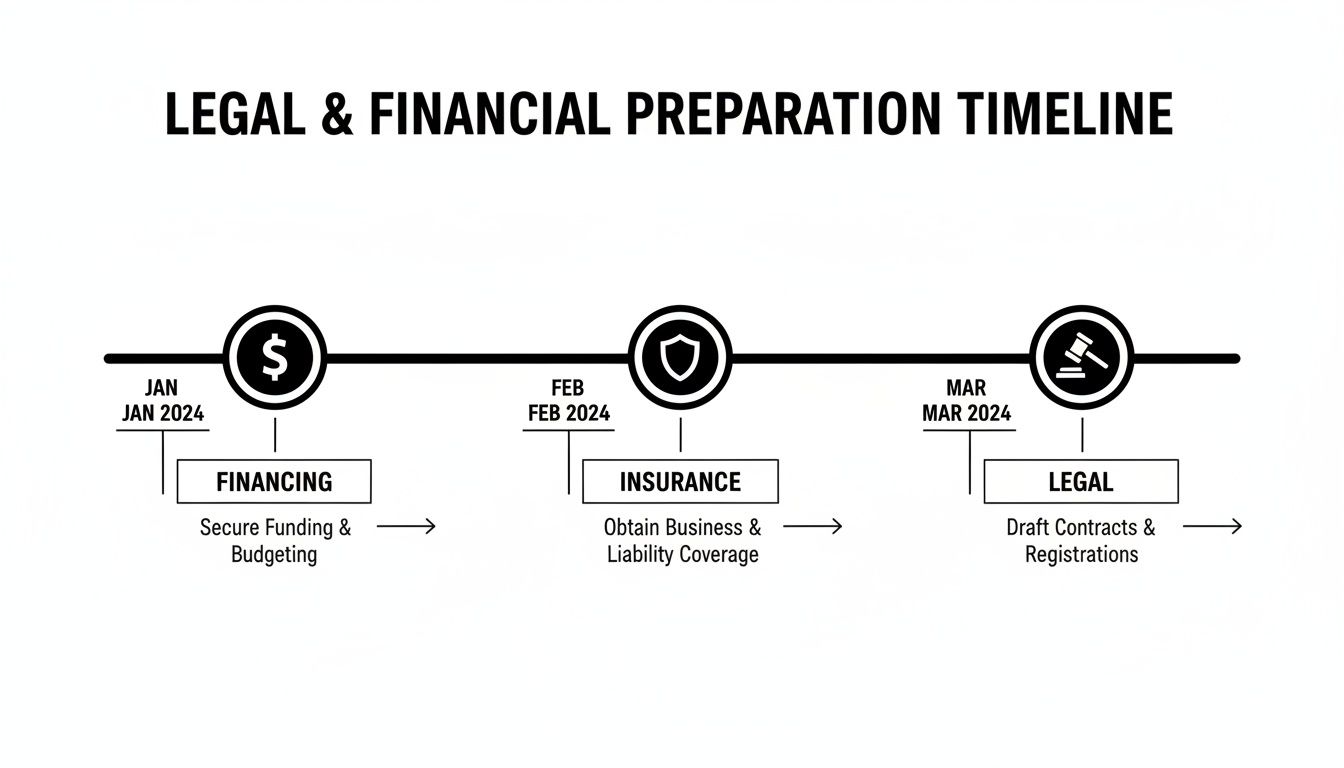
As you can see, these foundational steps have to be handled in the right order to ensure you’re making a smooth—and legally sound—transition from homeowner to landlord.
Deciding to rent your home doesn't mean you forfeit the capital gains exclusion forever, but it does put you on a deadline. The three-year window is your opportunity to keep the option of a tax-free sale on the table while you test the waters as a landlord.
Unlocking the Power of Depreciation
While the capital gains exclusion is about avoiding taxes on a future sale, another major benefit kicks in the moment your property becomes a rental: depreciation. Honestly, this is probably the single most significant tax advantage for rental property owners.
The IRS allows you to deduct a portion of your property's cost basis each year. It’s a "paper loss" that reflects the normal wear and tear on the building over time. You can’t depreciate the land, only the structure. For residential rentals, this deduction is spread out over 27.5 years.
This annual depreciation expense can dramatically lower your taxable rental income. In many cases, it can even create a tax loss, even when you have positive cash flow hitting your bank account every month.
- Calculate Your Basis: This is generally what you paid for the property, plus certain closing costs, minus the value of the land.
- Divide by 27.5: This simple math gives you your annual depreciation deduction. For a structure valued at $275,000, that’s a $10,000 deduction each year.
- Offset Your Income: That $10,000 deduction directly reduces your taxable rental profit, which could save you thousands in taxes annually.
Meticulous Expense Tracking is Non-Negotiable
To get the most out of these tax benefits, you have to keep flawless records. Every single dollar you spend on the property—from repairs and insurance to property management fees and mortgage interest—is a potential tax deduction that lowers what you owe.
Understanding how to maximize your short-term rental tax deductions and turn expenses into savings is crucial. Keeping organized digital or physical records of every receipt and invoice is the only way you can confidently claim everything you’re entitled to. For a deep dive into what you can and can’t write off, check out our guide on common rental property tax deductions here: https://edinhart.com/rental-property-tax-deductions/.
Ultimately, the tax side of being a landlord is complicated. The rules can be nuanced and are always subject to change. That's why one of the best investments you can make is sitting down with a qualified tax professional who specializes in real estate. They’ll help you build a strategy that fits your unique financial picture and long-term goals.
Getting Your Home Ready for the Rental Market
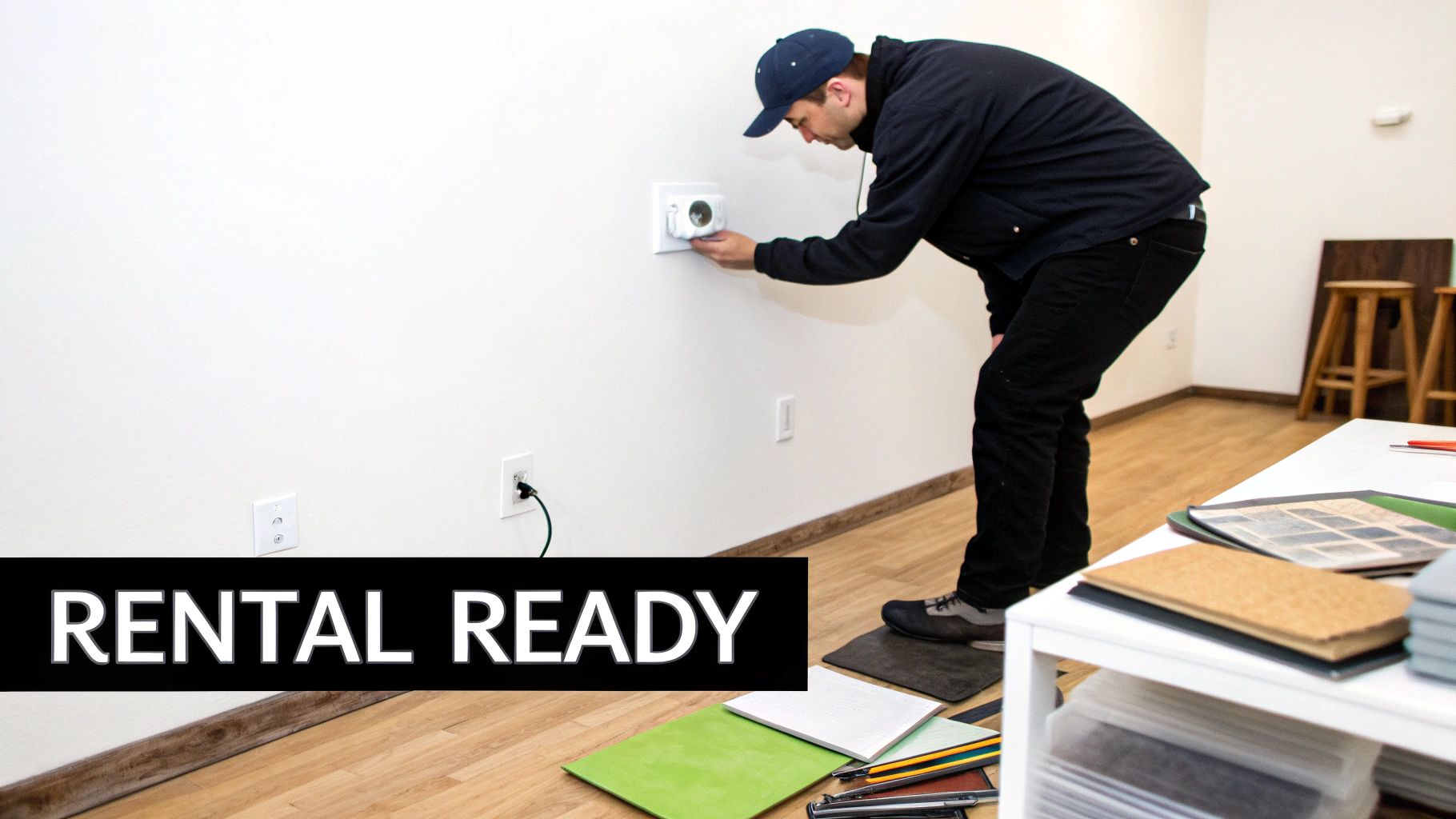
This is where the big shift happens. You have to stop thinking like a homeowner and start thinking like a business owner. Your personal tastes and design quirks take a backseat to what makes a property safe, durable, and appealing to the widest audience of quality tenants.
Getting this part right is what sets you up for success. It’s about prioritizing function over flash and making smart investments that will pay off for years to come. Think durability, not delicate design.
Focus on the Repairs That Actually Matter
Before you even dream of picking out paint colors, you need to get under the hood of the property. A tenant won’t care about new countertops if the AC gives out during a brutal Fresno summer or a pipe bursts over the winter. The absolute first priority is making sure the home is safe and everything works.
I always tell new landlords to make a no-nonsense checklist and hit the big stuff first.
- HVAC System: Get it professionally serviced. A clean bill of health here is your best defense against frantic late-night emergency calls.
- Plumbing & Electrical: Check for even the smallest leaks under sinks and around toilets. Flip every switch and test every outlet to make sure they're working and properly covered.
- Roof & Gutters: A quick look for loose shingles or clogged gutters can save you from a catastrophic water damage bill down the line.
- Appliances: Run every single one—fridge, stove, dishwasher, washer, dryer. Make sure they all work as they should.
While you're at it, it’s critical to spot and address common issues like mold to guarantee a healthy home for your tenants. Nailing these fundamentals builds a solid foundation for your rental business.
Don't Skimp on Safety Measures
Here in California, landlords are legally on the hook for providing a safe and habitable home. Cutting corners isn't just a bad idea; it can land you in serious legal and financial trouble. This isn't the place to save a few bucks.
Your safety checklist should be non-negotiable. We're talking about working smoke detectors in every bedroom and on each floor, plus carbon monoxide detectors. California law is also specific about security, requiring things like deadbolts on all exterior doors.
A rental property isn't just a building; it's someone's home and your responsibility. Investing in safety measures like proper locks and detectors is not just about legal compliance—it's about protecting lives and your livelihood.
"Landlord-Proofing" for the Long Haul
Once the core systems are solid and the safety checks are done, it’s time to think about longevity. "Landlord-proofing" is all about making smart, cost-effective choices that can handle the wear and tear of tenants and still look good.
This is where you have to emotionally detach. That feature wall you loved? It’s probably got to go. The goal is a clean, neutral, and tough-as-nails canvas.
Flooring and Paint Choices:
- Flooring: If you have old, stained carpet, tear it out. I'm a huge fan of Luxury Vinyl Plank (LVP), especially in high-traffic areas. It's practically indestructible, waterproof, and gives you the look of hardwood without the headache.
- Paint: A fresh coat of paint works miracles. Stick with a neutral color like a warm off-white or an agreeable gray. It makes rooms feel bigger and brighter, and tenants can easily picture their own stuff in the space. Use a satin or eggshell finish—it's way easier to wipe clean than flat paint.
Finally, the deep clean. And I mean deep. The property needs to be absolutely spotless before you take a single marketing photo. To make sure you don't miss anything, a professional rental property cleaning checklist is your best friend. These kinds of strategic, rental-focused upgrades don't just pull in better tenants; they often justify a higher rent, making that initial investment work for you right away.
Choosing Your Management Path: Self-Manage or Go Pro?

With your property prepped and your finances sorted, you've hit a major fork in the road. How are you actually going to run this new rental business? This isn't just about cashing a check; it's a decision that shapes your lifestyle and business model from here on out.
You can either roll up your sleeves and manage everything yourself, or you can bring in a professional to handle some (or all) of the heavy lifting. The right call comes down to your time, your stomach for stress, and what you ultimately want out of this investment.
The Realities of Self-Managing
Going the DIY route looks great on paper, especially when you’re trying to maximize every dollar. You pocket the management fees and keep total control over your property. But you have to be brutally honest with yourself about what this job really means.
Being a landlord isn't passive income. It’s a second job, and it couldn’t care less about your 9-to-5 schedule.
- You’re the 24/7 emergency contact. When a toilet overflows on a holiday weekend, you’re the one getting the call and scrambling to find a plumber.
- You’re the rent collector and bookkeeper. This means chasing late payments, dealing with bounced checks, and keeping meticulous records for tax time.
- You’re the legal expert. It’s on you to stay up-to-date on California's incredibly complex and always-changing landlord-tenant laws, from fair housing to eviction procedures.
One simple mistake in how you screen a tenant or handle a security deposit can land you in a costly legal mess. Those "savings" on management fees can disappear in a flash.
Self-management puts you in the driver's seat, but it also means you're the sole mechanic, navigator, and customer service rep. It demands a specific skill set and, more than anything, the time and temperament to handle problems without losing your cool.
The Professional Alternative: Placement-Only Service
What if you're comfortable with the day-to-day stuff but get anxious thinking about the high-stakes beginning? This is exactly where a Placement-Only Service comes in—it’s the perfect middle ground. It’s designed for the hands-on owner who wants to de-risk the most critical part of the whole process: finding and placing a fantastic tenant.
With this model, you hire a pro to tackle the front-end work.
- Expert Marketing: We’re talking high-quality photos, a compelling description, and getting your home listed across dozens of platforms to attract a deep pool of qualified applicants.
- Rigorous Tenant Screening: A professional team runs thorough background checks, credit reports, employment verifications, and rental histories—all while staying in strict compliance with fair housing laws.
- Airtight Lease Execution: A legally sound, state-compliant lease (like the official C.A.R. forms) is drafted and signed, protecting both you and your new tenant.
Once the tenant moves in and pays the first month's rent, the keys are handed back to you. From that point on, you manage maintenance, future rent collection, and all tenant communication. It’s a smart blend for owners who want professional peace of mind where it matters most.
The Ultimate Solution: Full-Service Monthly Management
For most new landlords—especially those juggling busy careers, families, or living out of the area—the goal isn't just to make money. It’s to build wealth without adding another full-time job to their plate. This is the promise of Full-Service Monthly Management.
This is your true "set it and forget it" option. A professional property manager becomes the buffer between you and your tenant, handling every single aspect of the rental. They field the routine maintenance calls, collect rent, navigate difficult conversations, and coordinate move-outs.
This comprehensive approach does more than just free up your time; it can directly boost your bottom line. For homeowners in markets like Fresno or Clovis, gross rental yields can often hit 5–7% annually. Professional management—with its focus on minimizing vacancy, setting the right rent, and systematic screening—is often the key to turning a marginal return into a solid, risk-adjusted investment for the long haul. You can find more data on how property values and rental incomes stack up in global housing markets on statista.com.
Choosing this path transforms your rental property from a hands-on chore into a genuine investment, letting you get on with your life while the experts handle the business.
You've now got the entire playbook for turning your home into a rental property. But let's be real—this is about more than just finding a tenant and cashing a check. It's a major business move.
The trick is to honestly balance the incredible financial upside, like that sweet monthly cash flow and watching your equity grow, against the very real, boots-on-the-ground responsibilities of being a landlord.
Are you energized by the idea of tax write-offs like depreciation, or does the thought of late-night maintenance calls and keeping up with California's landlord-tenant laws give you pause? Are you playing the long game for maximum wealth, or do you need the cash from a sale right now?
Making the leap to become a landlord isn't just a financial choice; it's a commitment. The right decision has to fit your bank account, your lifestyle, your tolerance for risk, and where you see yourself in five or ten years.
Answering these questions head-on is the only way to get the clarity you need.
The good news is, you don't have to figure this all out on your own. Sometimes, you just need a second set of experienced eyes. If you're ready to crunch the numbers and see what your property could really do as a rental, our team at Edinhart is here. We can give you a personalized analysis to help you make the next move with total confidence.
A Few Common Questions We Hear
Thinking about turning your home into a rental brings up a lot of questions. Here are some of the most common ones we get from homeowners in the Fresno area, along with our straightforward answers.
How Much Can I Realistically Rent My Fresno Home For?
This is always the first question, and for good reason. The honest answer is: it depends. The right rent requires a deep dive into the local market, looking at your home's location, size, condition, and what it offers compared to similar rentals nearby. Little things, like being in a great school district in Clovis or close to popular shopping centers in Fresno, make a big difference.
Online rent estimators can give you a ballpark figure, but they often miss the local nuances. That's where a professional Comparative Market Analysis (CMA) comes in. We run a detailed CMA to find that sweet spot—a competitive rent that attracts great tenants fast. Getting this right from the start is absolutely crucial for cutting down on those expensive weeks or months of vacancy.
Do I Have to Allow Pets in My California Rental Property?
Generally, no, you are not required to allow pets in your rental. The big exception here is service animals, which are not considered pets under the Fair Housing Act and have specific legal protections. You can't discriminate against a tenant because they have a service animal.
That said, many landlords find that having a pet-friendly policy is a smart business move. It can seriously widen your pool of qualified applicants, and you can often charge a bit more through an additional deposit or monthly "pet rent." A home that welcomes pets can really stand out and reduce the time it sits empty.
Deciding on your pet policy is a business decision. While it's your call, being flexible can be a powerful marketing tool. It gives you a competitive edge and opens the door to a larger number of responsible tenants who are often looking for a long-term home for their entire family, pets included.
What Happens If I Sell the House While a Tenant Is Living In It?
You can absolutely sell your property with a tenant in place. The key thing to remember is that the lease agreement is tied to the property, not to you. When you sell, the lease transfers to the new owner, and they have to honor its terms until it expires.
California law is also clear about tenant rights during this process. You're typically required to give the tenant at least 24-hour written notice before any showings. Selling a tenant-occupied home can be a great opportunity for an investor who wants immediate cash flow, but it might turn away buyers who are looking for a home to move into right away. A good real estate professional can help you balance everything, making sure your tenant's rights are respected while you work toward your sale.
Ready to talk through your specific situation? Whether you need a detailed rental analysis for your property or are just curious about what professional management could look like, the team at Edinhart Realty and Property Management is here to help you make a smart, profitable decision. Give us a call or send a message today to get started.


