

You hired a property manager so you wouldn't have to chase rent, coordinate repairs, or wonder what's happening inside your rental. Then the statement arrives late, a maintenance deduction appears without an invoice, and your calls go unanswered. Instead of peace of mind, you're left checking bank activity and asking whether the property is being managed.
That situation doesn't always mean someone is acting dishonestly. Often, it means the management system is opaque. The agreement may use broad language, the reports may combine too many expenses, and nobody may have explained how tenant screening, maintenance approvals, or urgent communication works.
Transparent property management gives you something more useful than a promise of honesty. It gives you records, schedules, disclosures, and communication practices you can check. The standard is simple: you should be able to follow the money, understand important decisions, see what work was completed, and reach the right person when a problem can't wait.

This guide moves from the basic meaning of transparency to the systems owners can audit each month. By the end, you'll have sharper questions for a property manager, a practical way to compare answers, and a short checklist for verifying whether the service matches the promises.
Introduction Why Transparency Matters More Than Ever
Property management sits between your investment, your tenant, and a long list of decisions that affect both. A tenant needs to know what they'll pay and how repairs are handled. You need to know whether rent was collected, why an expense was approved, and what action is being taken when occupancy or maintenance becomes a concern.
The need for visible performance is now built into parts of the housing system. The UK's Transparency, Influence and Accountability Standard came into effect in April 2024, requiring registered social housing providers to calculate and publish tenant satisfaction measures annually across areas such as repairs, safety, complaints, tenant engagement, and neighbourhood management. In 2024/25, almost half a million tenant perception surveys were completed for these measures, according to the UK government's Tenant Satisfaction Measures technical requirements. That framework applies to UK social housing, not every private rental, but it illustrates an important shift: transparency can be treated as an operating requirement with standard measures, not merely a matter of personal trust.
For a Fresno owner, the practical lesson is straightforward. You don't need a report full of impressive language. You need a repeatable process that shows what happened to your rent, what your tenant was told, what a repair cost, and when your manager will update you.
Practical rule: If you can't verify a management activity from a statement, portal record, invoice, message, or documented policy, ask how that activity is tracked.
A transparent relationship also protects your time. You can remain involved enough to make informed decisions without handling every work order yourself. The right manager should make the property easier to understand, not harder to question.
What Transparent Property Management Really Means
Transparent property management means making important information visible before confusion becomes a dispute. That includes financial transactions, maintenance decisions, tenant-facing charges, screening rules, and communication responsibilities.
Think of the difference between a clear glass dashboard and a locked black box. A dashboard doesn't require you to inspect every engine component. It does show the information needed to operate safely, such as speed, fuel, warnings, and direction. A property management system works the same way. You don't need to supervise every vendor call, but you should be able to see the financial result, the current issue, the action taken, and the next decision.
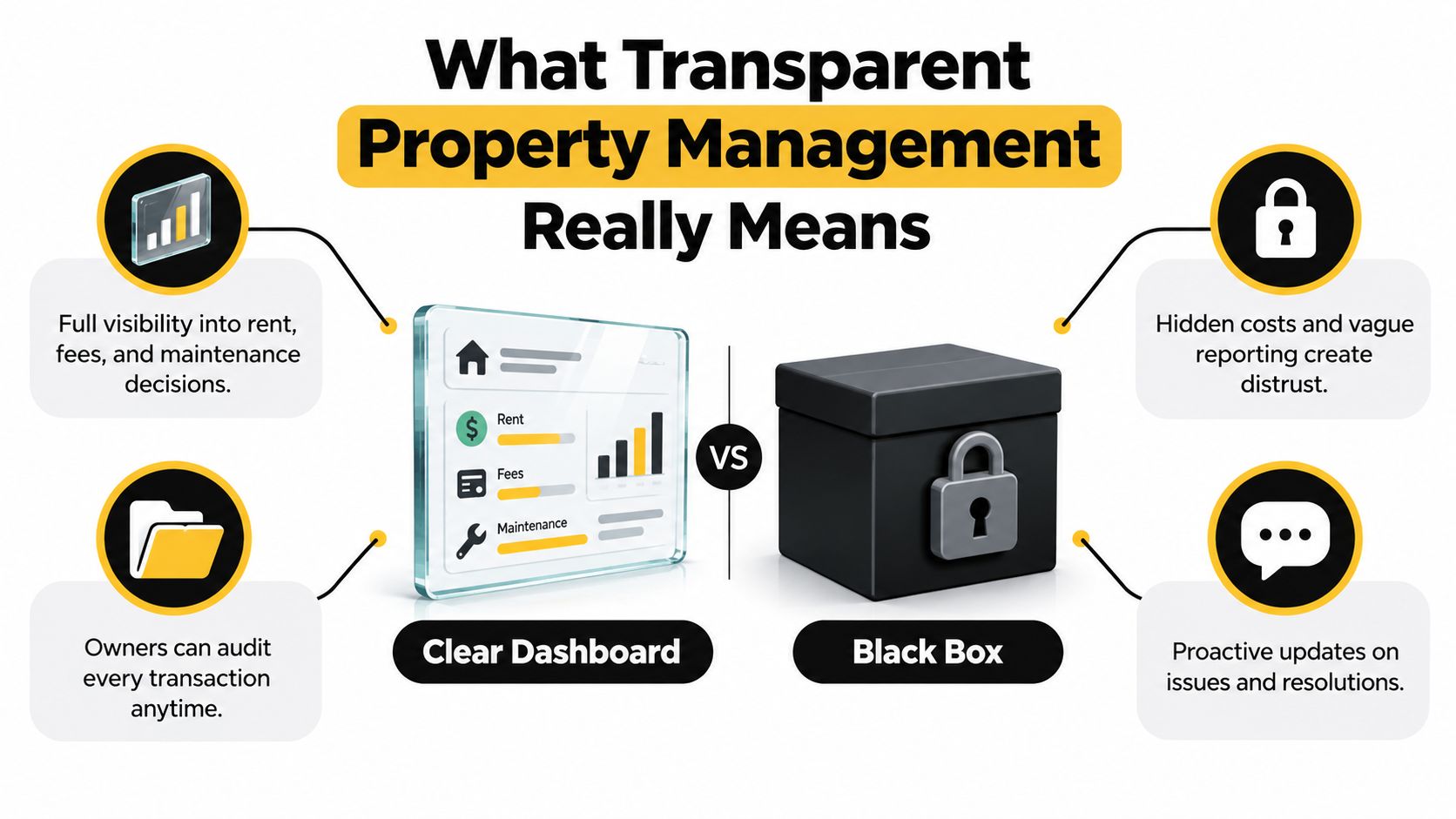
The four areas you should be able to see
Financial transparency starts with a statement that explains income and expenses in plain terms. You should know what rent was scheduled, what was collected, what was lost to vacancy or nonpayment, and which fees or repairs reduced the amount sent to you.
Operational transparency shows how the property is being cared for. Maintenance records should identify the problem, the response, the vendor or technician, the cost, and the completion status. If a repair needs your approval, the manager should explain the options rather than presenting an unexplained charge after the fact.
Screening transparency means applicants understand the rules before they pay application fees. The Urban Institute's guidance on tenant screening recommends sharing a written tenant selection plan before application and explains why screening firms should disclose the quality of data cleaning and record matching. Missing unique identifiers can create mismatches between eviction filings and actual evictions, so a documented process helps reduce avoidable denials and disputes.
Communication transparency defines who responds, through which channel, and under what circumstances. A tenant should know how to submit a repair request. An owner should know how urgent issues are escalated and when a routine update will arrive.
Transparency is a system, not a personality
A friendly manager can still provide poor visibility. A serious-sounding manager can still leave you with vague deductions. Judge the process instead: ask for sample reports, written policies, fee schedules, and examples of how updates are recorded.
Transparency isn't “trust me.” It's “here's how you can check.”
Benefits and Risks Owners Should Understand
Transparency improves decision-making because it reduces guesswork. When you can connect rent collected, vacancy, expenses, and maintenance activity, you can decide whether a repair should be approved, whether a lease strategy needs review, or whether a property is performing differently from your expectations.
Tenants benefit from the same clarity. A renter who sees mandatory charges, understands how utilities are billed, and knows how to contact the manager is less likely to feel surprised after moving in. Recent UK survey evidence reported that 83.3% of renters in 2025 wanted property management companies to be more transparent about mandatory fees, with extra charges beyond advertised rent identified as the top requested detail. The same renter transparency report identified utility billing practices as a concern for 64.8% of renters and internet service provider agreements for 44.1%.
Those concerns matter in California too, even though the cited survey reflects another housing market. The principle travels well: renters evaluate the full cost and service experience, not only the advertised monthly rent.
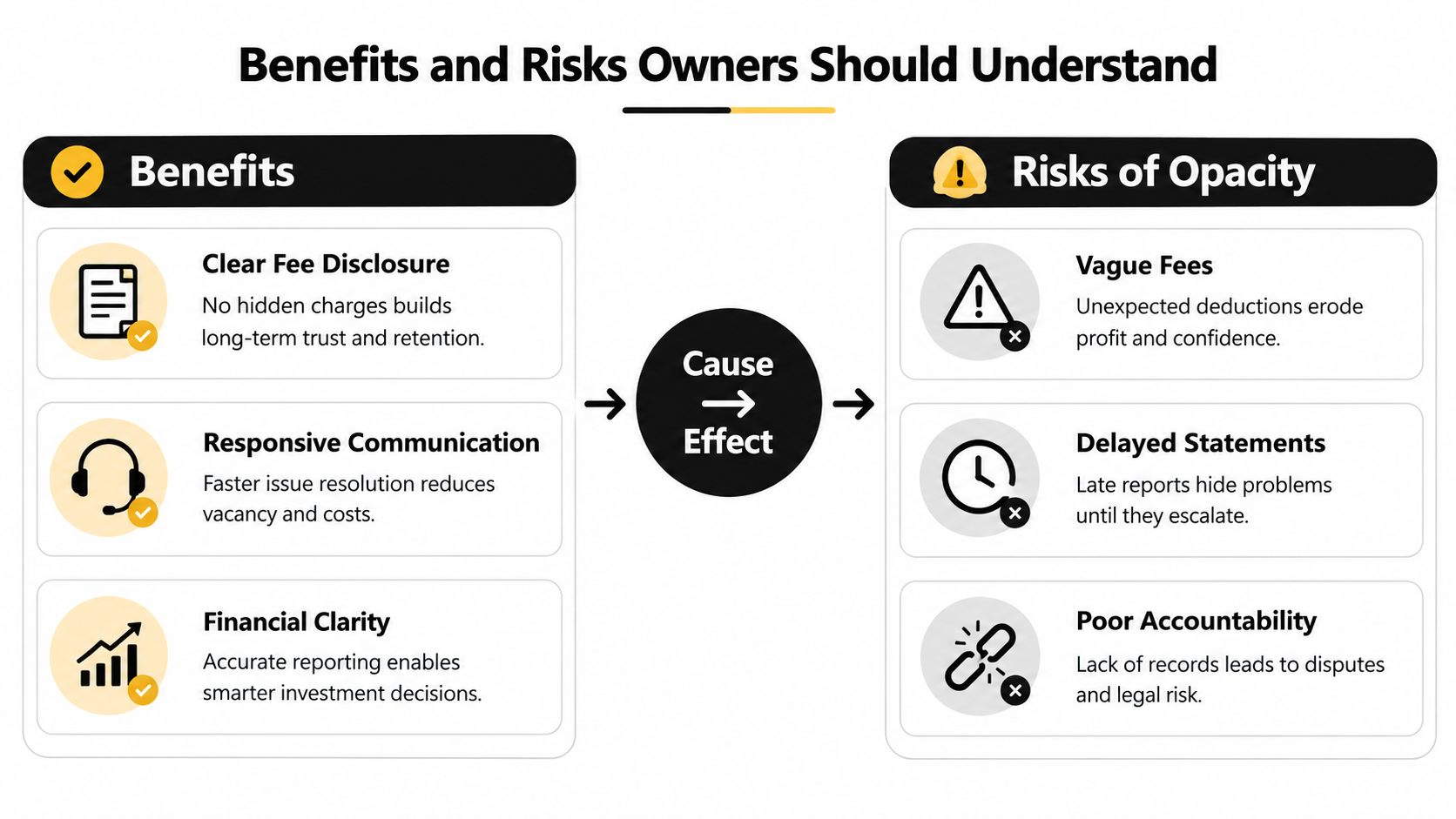
What owners gain from visible systems
Fewer financial surprises: An itemized statement makes it easier to challenge an unfamiliar charge while the transaction is still fresh.
Better tenant relationships: Clear explanations give residents a fair path to ask questions or report problems. That can support cooperation during repairs, inspections, and lease decisions.
Earlier problem detection: A report that separates scheduled rent from collected rent can reveal nonpayment or vacancy before the issue becomes buried in a general balance.
Stronger accountability: Standardized performance reporting shows how service quality can be measured across repairs, safety, complaints, engagement, and neighbourhood management. The UK framework cited earlier demonstrates how a regulator can turn broad expectations into published measures.
Opacity creates the opposite pattern. A vague fee can become a tenant dispute. A late statement can hide a collection problem. An undocumented repair can create disagreement about whether work was necessary or completed. When records are missing, you may have less information for insurance questions, tax preparation, tenant claims, or a disagreement over responsibility.
A manager doesn't need to promise perfect outcomes. Rentals have vacancies, emergencies, and difficult conversations. The important question is whether the manager records what happened, communicates the available choices, and makes the financial effect visible.
Measurable Reporting and Communication Practices to Expect
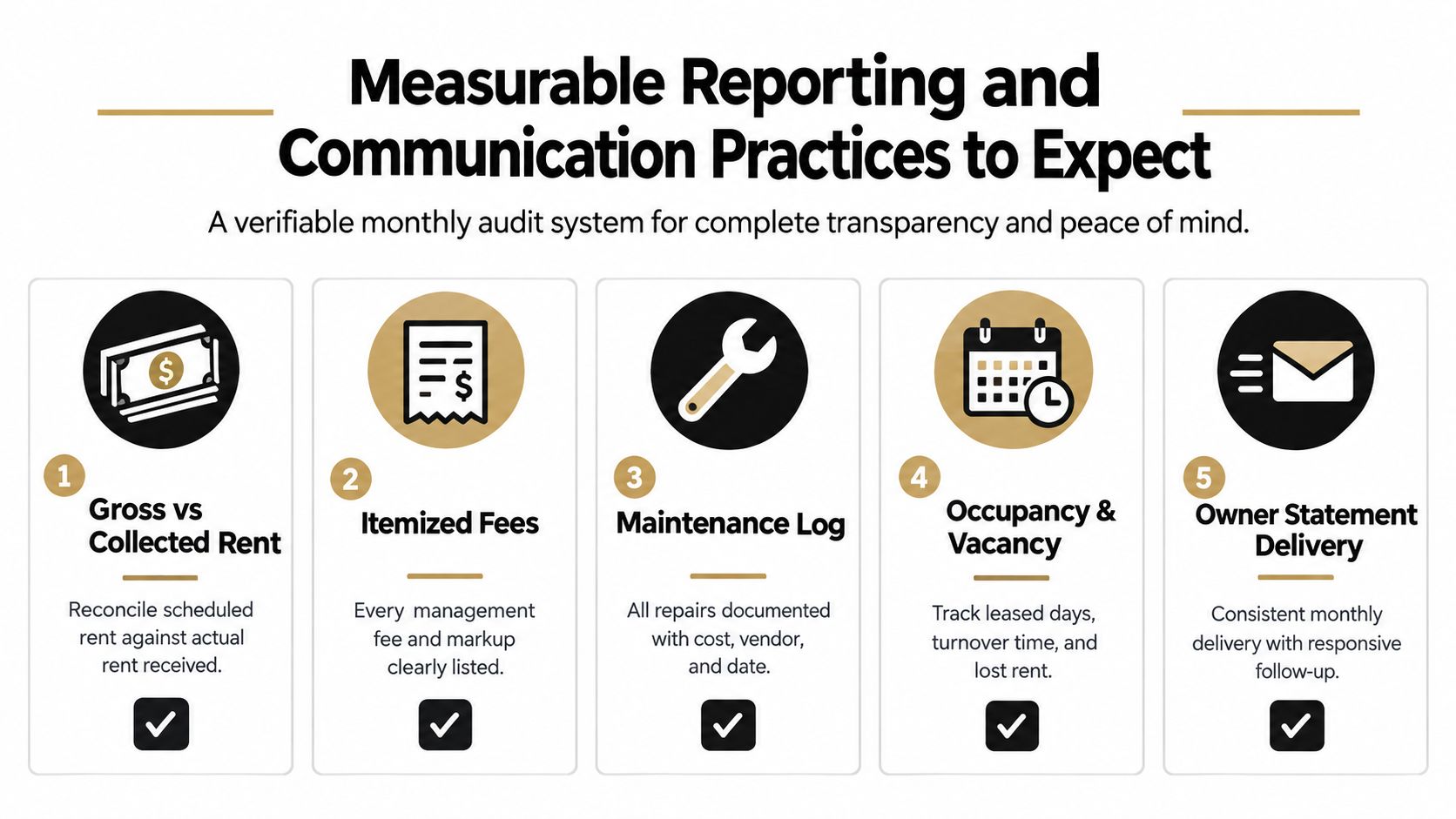
A useful monthly system should let you start with the rent and trace the calculation to the amount available for you. The statement shouldn't force you to reconstruct the property's performance from scattered emails, bank entries, and invoices.
A strong owner statement reconciles:
- Gross scheduled rent: The rent expected under the current lease terms.
- Actual rent collected: The amount received, with unpaid or partial amounts shown clearly.
- Vacancy losses: Rent not earned because the property was vacant or otherwise unavailable.
- Operating expenses: Property costs recorded by category, such as approved maintenance or other operating items.
- Management fees: The agreed charge, listed separately from other deductions.
- Net operating income: The resulting operating income after the statement's listed expenses and fees.
Industry reporting guidance describes standardized monthly statements built around these reconciliations and explains that owner portals can provide continuous access to property-level balances, downloadable statements, rent-roll status, and pending maintenance invoices. It also notes that management fees are commonly benchmarked at 8% to 12% of collected rent, though your agreement may use a different structure and should state it plainly. See this financial transparency guidance for property management for the reporting framework.
Treat the portal as an audit trail
A portal is useful when it contains records, not just a balance. Look for downloadable statements, inspection reports, maintenance notes, invoice attachments, and the current rent-roll status. A 24/7 login can be convenient, but access matters most when the records are complete enough to answer ordinary owner questions.
For example, if you see a plumbing expense, you should be able to identify the related work order, date, vendor, approval path, and invoice. If the property is vacant, you should be able to see the leasing status and the activity being taken to market it.
Communication needs a defined rhythm
Ask how tenants submit requests, who handles after-hours issues, and how owners receive urgent updates. “We're available” is less useful than a clear channel and an assigned responsibility.
Use Edinhart's record-keeping best practices as a reference point when evaluating whether records are organized for future review. Your goal isn't to demand a particular software platform. Your goal is to confirm that important decisions leave a usable record.
A written communication standard should answer practical questions:
- Routine updates: When will you hear about leasing, maintenance, inspections, or renewal activity?
- Urgent issues: What qualifies as urgent, and who contacts you if approval is needed?
- Maintenance documentation: Where will estimates, invoices, photos, and completion notes appear?
- Follow-up: How does the manager confirm that the tenant's issue was resolved?
video overview can provide another visual way to think about the reporting process, but the test is the sample statement and workflow you can inspect before signing.
How to Vet a Property Manager With the Right Questions
Interviewing a manager shouldn't feel like asking whether they're honest. Most companies will say yes. Ask questions that require documents, examples, and specific explanations instead.
Start with the fee schedule. Request every charge that could apply beyond base rent, including leasing, renewal, inspection, maintenance coordination, after-hours work, and administrative items. Ask whether tenant-paid utilities, required services, or internet agreements are disclosed before the tenant commits.
Then examine screening. Ask for the written tenant selection plan and find out when applicants receive it. The process should explain the criteria, the data sources used, how identity and record matches are checked, and what happens when information appears incomplete or inconsistent.
Fraud prevention adds another layer. One industry source reported that 93% of rental companies experienced fraud in the past year, while another reported that AI-generated fraudulent documents increased nearly fivefold between April and December 2025. These figures appear in Experian's rental technology fraud defenses infographic. A transparent manager should explain the checks being used without publishing details that would help someone bypass them.
| Transparency Area | What to Ask For | Green Flag | Red Flag |
|---|---|---|---|
| Fees and charges | A complete written fee schedule | Each possible charge has a clear trigger and amount or calculation method | “It depends” with no follow-up document |
| Tenant selection | The written screening criteria before application fees are paid | Criteria, data sources, and review steps are explained | Applicants learn the rules only after applying |
| Record matching | An explanation of how screening results are validated | Staff can describe dispute and correction procedures | Automatic rejection with no review path |
| Fraud checks | A plain-language description of document and identity checks | The manager explains the purpose and escalation process | The process is either secretive or casually bypassed |
| Communication | The contact route for owners, tenants, and emergencies | Roles and response expectations are documented | Every issue goes to an undefined shared inbox |
For additional interview prompts, use Edinhart's questions to ask a property management company as a practical worksheet. Bring the answers back to evidence. A manager who shares a sample statement, a blank fee schedule, and a screening policy gives you more to evaluate than one who relies on polished assurances.
How Edinhart Implements Transparent Systems in Practice
Edinhart Realty and Property Management serves owners in Fresno, Clovis, Friant, and the broader Central California region through two distinct service models. The important transparency question isn't which model sounds more complete. It's whether the model clearly assigns each responsibility and produces records the owner can review.
With Full-Service Monthly Management, the operating loop includes automated rent collection, tenant communication, repair coordination, move-in and move-out coordination, lease renewals, and detailed accounting statements. Each part answers a different owner concern. Automated collection creates a consistent rent process, accounting statements show the financial outcome, and maintenance coordination connects a tenant request to the work performed and the resulting expense.
The company also uses professional marketing, photography, and staging as part of its leasing and real estate workflow. Those activities matter to transparency because an owner should be able to understand how a property is presented, what marketing work is being done, and how leasing decisions connect to occupancy.
For owners who want to handle daily operations themselves, Placement-Only Service separates the initial leasing work from ongoing management. The service includes professional marketing, applicant screening, and lease drafting. That arrangement can suit an experienced landlord, but the handoff needs to be explicit. Before engaging a placement-only service, confirm who handles repairs, notices, rent collection, tenant questions, and compliance after the lease is signed.
Compliance and access belong in the same conversation
Edinhart's use of California Association of Realtors forms and ongoing legal updates is part of the documentation side of management. Forms and updates don't replace owner review, but they help establish a repeatable process for leases and related communications.
The company also lists on-call agents, multi-property discounts, owner reporting, and automated rent collection among its operating features. Owners evaluating any manager can use the same test: identify the feature, ask where its record appears, and confirm who acts when something needs attention. A portal, for example, is more meaningful when it provides statements, inspection information, and maintenance status rather than only a payment summary.
For more context on how automation can support visibility and consistency, review Edinhart's automation in property management. The useful takeaway is not that technology makes a manager transparent by itself. Technology helps when the team uses it to preserve records, communicate clearly, and make owner decisions easier to verify.
Your Next Steps Toward Confident Ownership
Start with three requests before choosing or renewing a manager.
- Request a sample monthly statement. Check whether it separates scheduled rent, collected rent, vacancy, expenses, fees, and the resulting operating income. Ask how you'd verify a maintenance deduction.
- Request the written fee schedule and screening plan. Confirm that mandatory tenant charges are disclosed, applicant criteria are available before application fees are paid, and disputed screening information has a review process.
- Test the communication path. Send a practical question and ask who handles urgent maintenance, how owner approvals work, and where the final update will be recorded.
Then score the manager on evidence rather than presentation. Can you find the document? Can you understand the charge? Can you identify the person responsible? Can you see what happened after the request was made?
Your confidence checklist is short:
- Money: The statement reconciles income and deductions.
- Maintenance: Work orders, costs, vendors, and completion status are documented.
- Screening: Rules and data handling are explained before applicants pay.
- Fees: Mandatory charges and owner fees are visible in writing.
- Communication: Tenants and owners have defined contact routes.
- Compliance: Lease and management processes use current, appropriate documentation.
Transparency is a habit built into workflows. If a manager can show those workflows before you sign, you're in a much better position to protect your rental income and make calm decisions when an unexpected issue appears.
Edinhart Realty and Property Management offers full-service monthly management and placement-only leasing support across Fresno, Clovis, Friant, and Central California, with automated rent collection, detailed accounting, applicant screening, lease drafting, and on-call communication. Visit Edinhart Realty and Property Management to request a clear explanation of the service model, reporting process, and fees for your property.


