

What does a blank Social Security number field tell you about whether someone will pay rent and care for a home? In most cases, nothing. Tenant screening without Social Security number isn't a shortcut around verification. It's a different route to the same questions: is this person who they say they are, can they afford the rent, and have they met tenancy obligations before? Handle it loosely and you invite fraud. Treat the missing number as an automatic no and you invite fairness problems.
Can You Screen a Tenant Without an SSN?
Yes. A blank field is not proof of ineligibility, risk, or dishonesty. It usually means you're meeting one of three situations.
The Three Situations Behind a Blank Field
- Never issued one: The applicant is new to the United States, files taxes with an ITIN, or otherwise isn't eligible for an SSN.
- Has one but won't share it: The applicant fears identity theft or objects to how the number will be stored. That's a conversation about security, not a verdict.
- Number returns nothing useful: The SSN produces no file or a mismatched record, so the automated route fails anyway.
Housing type changes the rules. Under HUD's federal housing guidance, applicants in HUD-assisted public housing who have an SSN generally must disclose and verify it, but a housing authority may not require a person who does not have an SSN to obtain one. When someone consistently reports having none, the authority can ask whether they've ever worked, maintained a U.S. bank account, received government benefits, or attended school in the United States. If the answer is no, the applicant can sign a certification confirming the absence of an SSN.
Private landlords have more flexibility, but not more discretion to improvise. Your written criteria should assess identity, rental history, income, employment, and assets through documentation that fits the applicant. I would point owners who want a worked example of that approach to this guide to alternative tenant screening with VerticalRent, then adapt it to your own state rules.
Core principle: Verify identity through documents and history. Judge eligibility only on factors relevant to the tenancy.
Identity Documents That Work and What Each One Proves
Start with what you'll accept, written down before the first application arrives.
| Document | What It Verifies | Limits to Note |
|---|---|---|
| U.S. or foreign passport | Full legal name, date of birth, photo, nationality | Check expiry date and whether the photo matches the applicant |
| Foreign driver license | Name, date of birth, photo | Often no U.S. address; pair with a passport |
| State non-driver ID card | Name, date of birth, address | Issued only by U.S. states; address may be outdated |
| Consular ID card | Name, photo, home-country identity | Accept only if your written policy allows it; confirm issuing country |
How to Read the Table
A passport is your strongest single document because it ties name, date of birth, and photo together. A foreign driver license confirms the person but often says nothing about where they live now, so pair it with a passport or proof of current address. An ITIN assignment letter, if an applicant offers one, proves the number was issued. It doesn't prove the person holding it is the person named, so it always needs a photo ID beside it.
Don't skim this step. In 2023, 93.3% of apartment owners, managers, and developers surveyed reported experiencing application fraud, a figure published by ResMan in 2024. That fraud starts with documents nobody examined closely.
What Goes Wrong in Practice
Watch for expired documents, photocopies so poor that security features and photos can't be checked, and photos that don't resemble the applicant. Any of those is a reason to pause, not to accuse.
- Unclear copy: Ask for an in-person review or a live video call where the applicant holds the document beside their face.
- Expired ID: Ask for a current document or a second form of ID your policy allows.
- Storage: Keep copies in a restricted folder with named access, never in a shared inbox.
Finish by marking, in your written policy, which documents stand alone and which require a second one. That single line removes most front-desk guesswork.
How to Run an SSN-Free Screening Step by Step
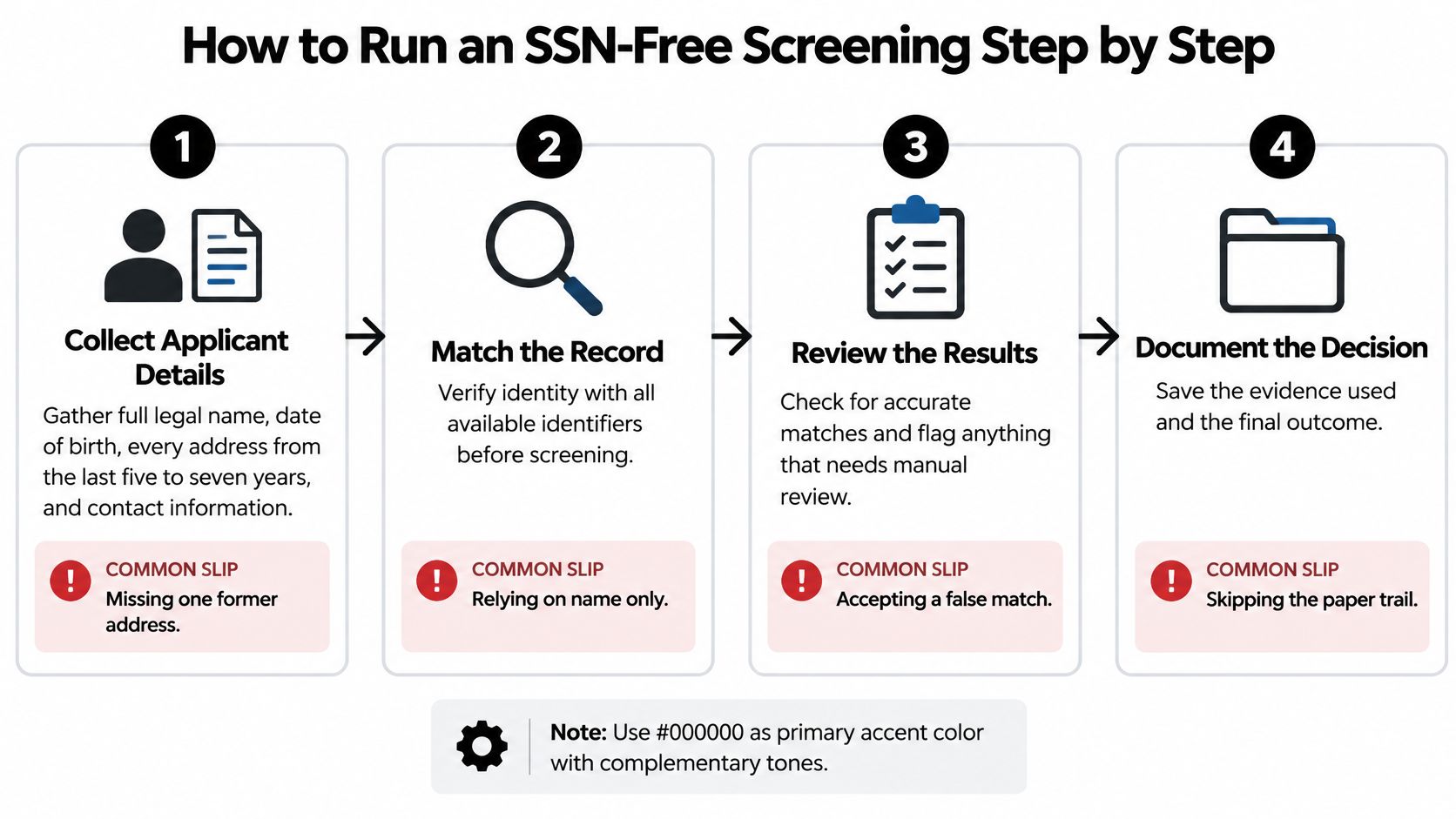
A missing SSN changes how you match records; it should not lower the evidence standard or raise it for one applicant. Set the compliance controls first: confirm a permissible housing purpose, get written authorization, certify the limited housing use to the screening company, and use reasonable procedures to prevent identity errors. Those controls govern every consumer report you pull, with or without an SSN.
The Five-Step Workflow
Collect identifiers first. Take the full legal name, date of birth, every address from the last five to seven years, contact details, and signed authorization. These fields let a screening company associate records with the right person. Common slip: one missing former address breaks an otherwise clean match. Structured intake forms that streamline data collection workflows cut down on those gaps.
Inspect government-issued photo ID. A passport or foreign driver license can anchor identity. The California Department of Real Estate guide recognizes government-issued photo identification as an alternative when an applicant can't provide an SSN or driver license number, and it prohibits inquiries into immigration status.
Verify sources you found yourself. Use the employer's published number rather than the phone number on the application. Look up the prior landlord through tax or rental records where you can. Applicant-supplied phone numbers are the oldest fraud route in this business. If you plan to outsource those calls, review what local tenant screening services cover before you commit.
Run only products that match on non-SSN identifiers. Ask the vendor directly whether the search uses name plus date of birth plus address history, and how it separates people with similar names. If it needs an SSN to function, it isn't the right tool for this applicant.
Resolve discrepancies by hand. Compare every name, date of birth, and address result against the ID and the intake form before you decide. Software can flag records; it should not close the file.
A missing SSN or thin credit file is a matching limit, not proof of poor payment behavior. Apply the same evidence standard to every applicant.
The Audit Trail
Require at least two corroborating identifiers for any record you accept as belonging to the applicant. Then log the source, date, verifier, and outcome of each match. That record shows you treated the missing number as a fairness and fraud problem to manage, and it makes the decision defensible if it's questioned six months later.
Mismatched Identities and How to Resolve Them
The biggest accuracy risk in SSN-free screening is name-only matching, where a vendor decides a record belongs to your applicant using first and last name alone. That shortcut is efficient for fraud prevention and unfair in practice: common surnames, transliteration, and thin files mean one name can pull several people into the same report, while the applicant with the least conventional history has the hardest time disproving a bad match.

A mismatch usually has a boring cause before it has a fraudulent one. Read each conflict as a formatting problem first, then treat it as possible deception only after the documents still fail to line up.
| Mismatch | Likely Cause | Fix |
|---|---|---|
| Name spelling differs | Transliteration or alternate spelling | Compare with passport spelling and request an alias list |
| Date of birth off by a day or month | Day-month format confusion | Confirm the format against the passport before rerunning |
| Address missing from history | Recent move or shared household | Request proof of the prior address such as a utility bill or lease |
| Common name returns several records | Name-only search | Rerun with date of birth and last address; do not accept by name alone |
| Hyphenated or compound surname splits | Different surname conventions across countries | Search each surname part and match on date of birth |
The Decision Rule
Treat identity as confirmed only when name, date of birth, and at least one address agree with the ID. Work the file in this order: spelling, date format, address gap, then true duplicate. Ask for an alias list or proof of a prior address, rerun the search, and record what changed. If a record still cannot be tied to the applicant through those identifiers, exclude it rather than guessing.
The short video below walks through how mismatched records get untangled in practice.
Hold one rule: no adverse decision rests on a name-only match.
Alternative Evidence for Income and Rental History
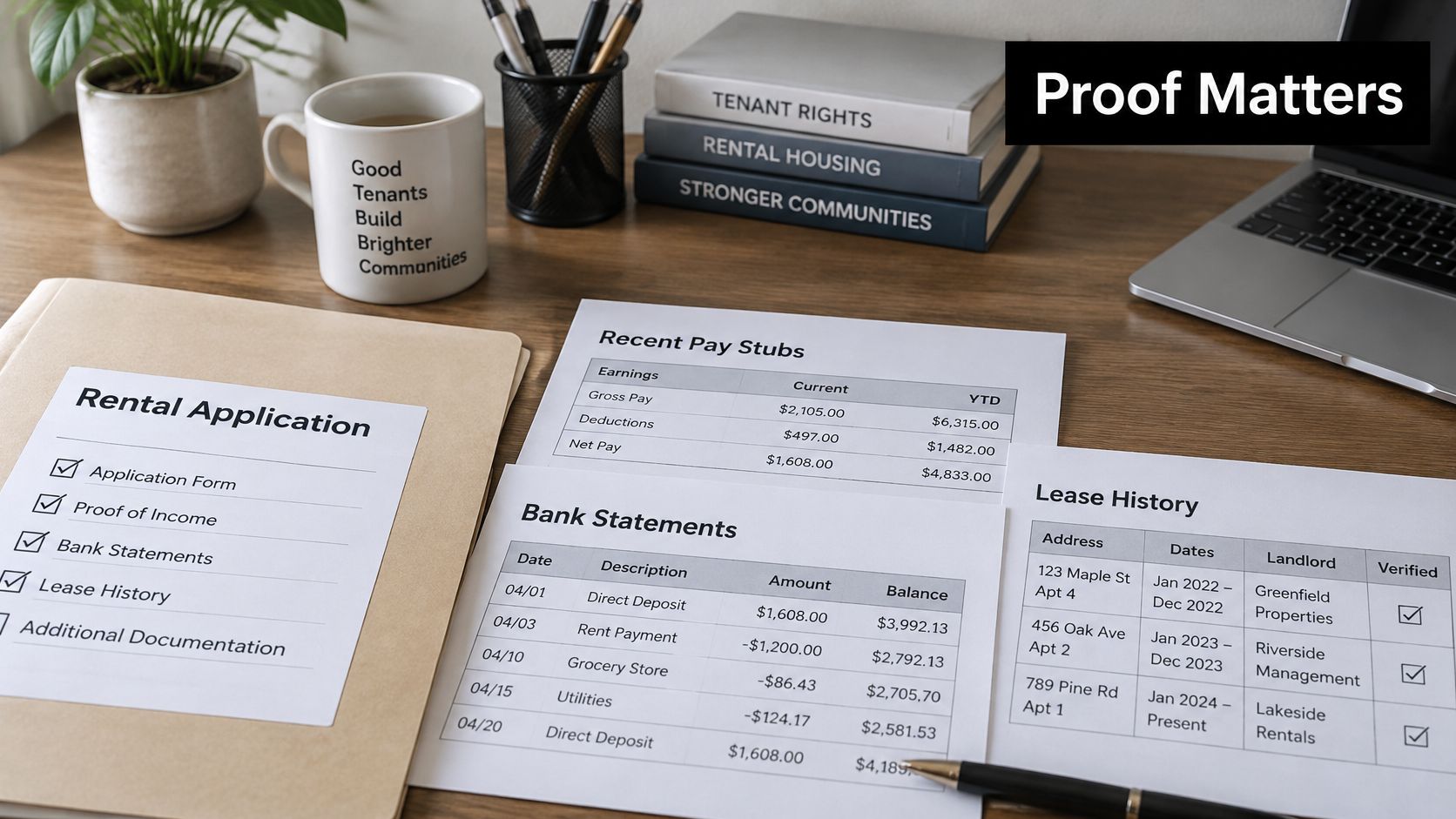
Replace the missing credit pull with a documented alternative-evidence matrix, not a one-off exception you invent per applicant.
The documents on this desk are the raw material of that matrix.
| Check | Accepted Evidence | Who to Confirm With |
|---|---|---|
| Income | Recent pay stubs, bank statements, offer letter | Employer or payroll department |
| Benefit income | Current award letter from the issuing agency | Agency, only with applicant consent |
| Self-employment | Filed tax returns, including ITIN-based returns, plus bank deposits | Accountant or bank statement review |
| Rental history | Prior lease, ledger and move-out statement | Previous landlord or property manager |
Working the Matrix
For income, pay stubs show the claim and direct employer confirmation tests it. If bank statements arrive in unfamiliar formats, you can check supported financial institutions to confirm the statement layout matches the issuing bank. For a fuller walkthrough of document standards, see these notes on tenant income verification.
For rental history, call the previous landlord and ask the same four questions every time. Were rent payments on time? Were there lease violations or notices? Was the deposit settled fairly? Would you rent to them again? Fixed questions produce comparable answers across applicants.
The FTC's landlord guidance on using consumer reports sets the backstop: if a report contributes to a denial, higher deposit, or co-signer requirement, send an adverse-action notice naming the reporting company and explaining the right to dispute inaccurate information.
Store It Like It Matters
Keep the matrix in a dated policy document stating accepted evidence per check, who confirms it, and who approves a deviation. Redact account numbers you don't need and restrict access. Passports, foreign IDs, and financial records raise your identity-theft exposure every day they sit unsecured.
Fair Housing, Privacy and Adverse-Action Rules
Test your process with a simple question: would an applicant with an SSN face the same burden? If not, you'd better have a documented, tenancy-related reason.
Vermont's approach shows where the line sits. The Vermont Human Rights Commission fair housing guide for landlords states that landlords may not reject an applicant merely for failing to provide an SSN and should accept an unexpired government ID, including foreign-government ID, an ITIN, or an SSN if supplied. California takes the same direction by allowing identity verification while barring inquiries into immigration status.
The Tradeoff Nobody Mentions
Newer tools combine document checks, database matching, device intelligence, facial comparison, and automated income verification. They can widen access for applicants with limited U.S. credit history. They also add privacy, accuracy, and language-access risks, especially when a vendor can't read a foreign document and scores it as a failure. Review your obligations under the background check requirements before any tool goes live.
Before adopting a tool, answer three questions in writing.
- Same pathway: Is the alternative route offered to every applicant, or only some?
- Failure mode: What happens when the vendor can't match a foreign document?
- Challenge route: How does an applicant dispute a wrong result, and who reviews it?
Safeguards That Hold Up
Collect only what you need, restrict who sees it, and set retention limits so files don't live forever. Offer manual review whenever an automated match fails. Close the loop with the adverse-action notice whenever a consumer report contributes to a denial or tougher terms. The notice names the reporting company and explains the dispute right. Skip it and a defensible decision becomes an indefensible process.
Set Up Your SSN-Free Screening Policy This Week
Don't wait for the next blank SSN field to force an improvised decision. Write the policy now, in this order.
Six Items, in Order
- List accepted identity documents. Mark which ones require a second document. One page is enough.
- Define the evidence matrix. Cover income, benefits, self-employment, and rental history, with a named confirmer for each row.
- Set the match rule. Name, date of birth, and at least one address must agree with the ID before any result counts.
- Name the manual-review triggers. I'd include any name-only match, unreadable document, or unresolved address gap.
- Prepare the adverse-action template. It names the reporting company and explains the dispute process. Draft it before you need it, not after a denial.
- Schedule the outcome review. After the first ten applications, compare approval rate, manual-review rate, false-match reversals, and later delinquency against your ordinary applications.
Assign one owner for the policy and one for the audit trail. File the signed policy with each applicant file so any decision can be reconstructed later. Consistency is the whole point. A strict policy applied evenly protects you. A lenient one applied unevenly doesn't.
Hands-on management justifies its fee through dedicated effort. Our Full-Service VIP Property Management features extremely detailed tenant screening, and that detail only works because the criteria stay fixed across every applicant. If you'd rather talk through how that would look for your property, call 559-400-5011 and we'll set up a time to check it out.
If you'd rather not build and audit an SSN-free screening process on your own, Edinhart Realty and Property Management can run detailed, consistent screening as part of full-service or placement-only management across Fresno, Clovis, and the Central Valley. Visit us to talk through your property, your criteria, and how we'd document every decision before the next applicant knocks.


