

The usual advice about tenant screening software starts with speed, price, and how quickly a platform returns an approval score. That's the wrong order. A fast recommendation isn't useful if the manager can't identify the record behind it, correct an error, or explain why an applicant didn't qualify.
For California rental owners, the better comparison starts with auditability and dispute handling, then considers workflow and cost. Choose software that helps a person make a documented decision, not software that asks the owner to trust an unexplained rating.
Core Screening Checks Compared Side by Side
Tenant screening checks compared by coverage and accuracy risk
| Check | What the report reads | Main accuracy risk | What to verify |
|---|---|---|---|
| Criminal background | Court and public criminal records | Mismatched identities and outdated records | Offense type, severity and recency |
| Credit history | Consumer reporting agency data | Misattributed or outdated accounts | Identity match and dispute route |
| Eviction records | Court filings and judgments | Filings treated as completed evictions | Case outcome and date |
| Income and employment | Verified pay and employer records | Unverified stated income | Source documents on file |
| Rental payment history | Landlord and ledger data | Incomplete reporting from prior landlords | Ledger proof and reference contact |
| Adverse-action notice | Automatically generated FCRA notice | Missing or late notice | Template content and delivery log |
A package label such as full-scope screening doesn't tell you whether the vendor supplies source records, estimates, or a recommendation. Compare the actual report fields. Ask the demonstrator to open a result and show the identity information, source, record date, and correction process.
The federal regulatory submission discussing tenant-screening research describes automated eligibility assessments built from criminal, eviction, and credit information, along with landlord reliance on displayed recommendations. That makes the distinction between record coverage and decision quality important: retrieving a record doesn't establish that it belongs to the applicant or supports the conclusion.
Where report packages differ most
For criminal and credit checks, inspect the matching process. A similar name or inconsistent birth date should trigger verification, not an automatic negative result. Credit accounts need a clear dispute route when an applicant says the debt belongs to someone else.
Income verification requires a different inspection. Determine whether the platform checks employer or financial records, analyzes uploaded documents, or merely accepts an applicant's stated earnings. Our tenant income verification guide helps owners distinguish an income claim from supporting evidence.
Rental-payment history also needs careful interpretation. A blank field isn't proof of missed payments. Request ledger evidence and a reference contact when the automated report doesn't establish the applicant's history.
Buying rule: Treat a check without an identifiable source as a coverage gap, not an extra feature.
Finally, test the notice function separately from the background checks. A vendor may provide detailed reports but leave the manager to assemble and deliver the decision notice manually. Mark each product against every row before comparing its headline price.
Which Software Fits Full-Service and Placement-Only Managers
Screening software needs by management model
| Management model or situation | What the software must do | Output the owner needs | Fits best when |
|---|---|---|---|
| Full-Service | Writes screening into the ongoing account and links applicant and resident records | Report, decision log and portal access | Owner wants one contract for leasing and management |
| Placement-Only | Delivers professional screening output the owner can act on | Clear recommendation, full report and drafted lease | Owner self-manages tenant communication and accounting |
| Multiple properties | Applies one set of criteria across every unit | Per-unit decision records | Owner holds several homes |
| Out-of-state ownership | Gives remote access to reports and decision reasons | Full report and written reason for each decision | Owner reviews the process remotely |
The management model determines what happens after screening. Full-service managers need continuity between the application, lease, resident account, rent collection, tenant communication, and renewal workflow. Placement-only owners need an understandable handoff they can retain without continuing to use the manager's software.
The operational differences are summarized below.
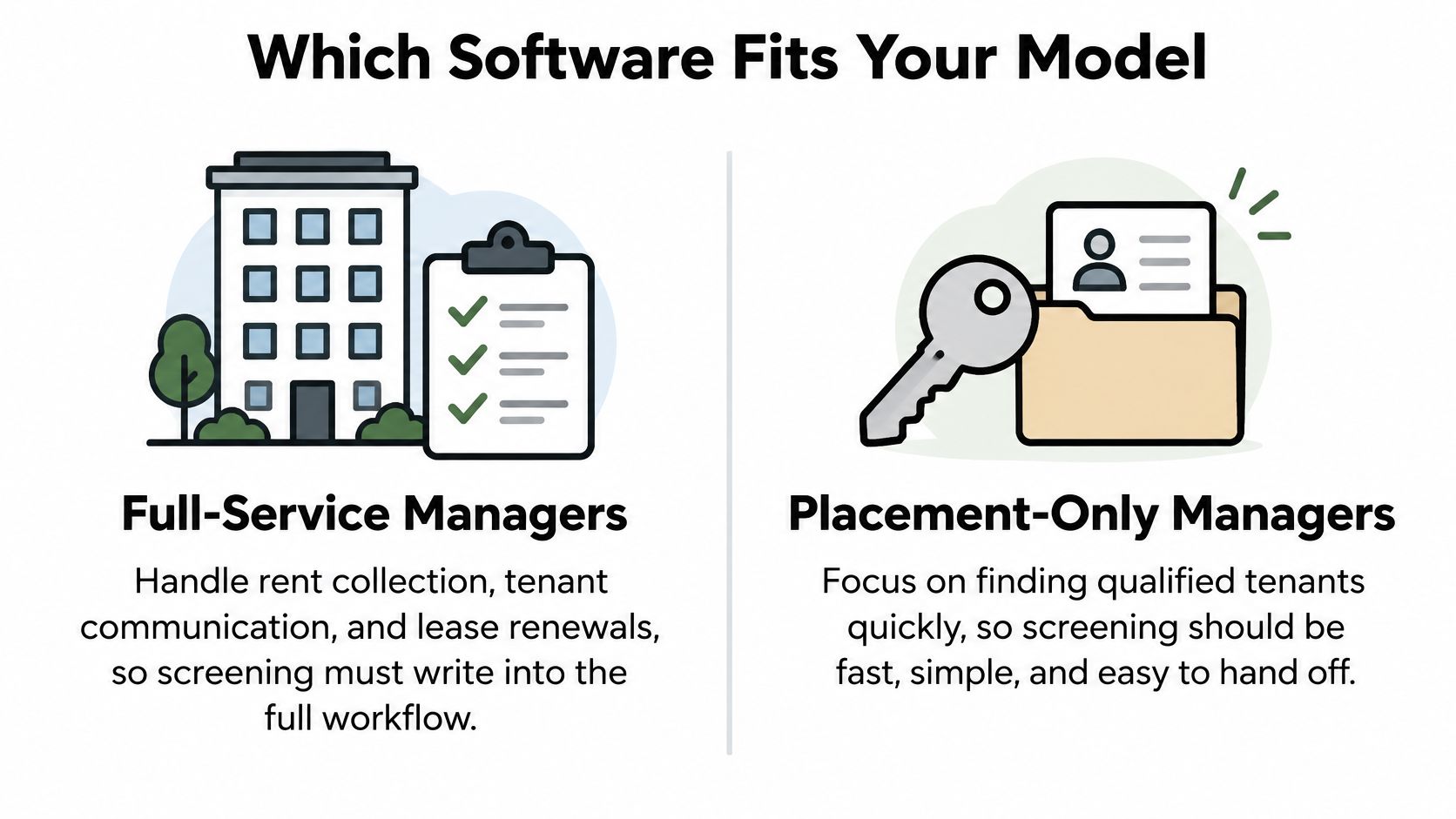
Match the output to the owner's work
Our Full-Service VIP Property Management includes extremely detailed tenant screening. For an owner choosing ongoing management, evaluate how the screening decision becomes part of the continuing property file. The owner shouldn't have to reconstruct the leasing decision from scattered messages when a question arises later.
Our Placement-Only Service is designed for experienced property owners who prefer to manage their own rental. It includes professional photography, professional mass marketing, online applications, screening, presentation of the most qualified applicants with recommendations, and drafting of the final lease on the owner's behalf.
For that owner, exportability matters more than an elaborate ongoing dashboard. The recommendation should be understandable without access to a proprietary scoring interface, and the handoff should distinguish verified facts from unresolved questions. Keeping your own monthly accounts doesn't eliminate the need for a readable screening record.
Adjust for portfolio and ownership needs
With multiple properties, prioritize centrally controlled criteria and property-specific decision records. Staff shouldn't change standards because a different owner is impatient to fill a vacancy.
For an out-of-state owner, prioritize secure remote review and written reasoning. An in-person meeting isn't a substitute for verification, and remote ownership shouldn't mean receiving only a green approval badge.
A strict screening standard requires configurable rules and documented exceptions, not automatic rejection whenever the software flags something. In 2024, 36.5% of landlords surveyed across California, Georgia, and North Carolina followed a tenant-screening report's recommendation without additional review, according to TechEquity. Whatever your management model, require the full report and a written reason before following a score.
Pricing Models and What Each One Really Costs
Tenant screening pricing models compared
| Pricing model | How it charges | Best for | Watch for |
|---|---|---|---|
| Pay per report | Fee per applicant screened | Owners with few applications a year | Costs rise with several applicants per unit |
| Monthly subscription | Flat fee plus included reports | Managers screening many applicants | Unused reports and overage fees |
| Bundled with full-service management | Included in the monthly management fee | Full-Service owners wanting one contract | Confirm screening depth is written into the agreement |
| Placement fee | Charged per leased unit | Placement-Only owners | Confirm whether screening is included or billed separately |
Compare written quotes with equivalent scope, not advertised starting prices. A quote that includes only database searches isn't directly comparable with one that also includes income verification, reference calls, record review, and applicant follow-up.
Pay-per-report pricing suits intermittent screening because there's no recurring software commitment. Its weakness appears when several people apply for the same property, a report needs correction, or a separate verification service adds another charge. Ask whether a corrected report or rerun creates a new bill.
Subscription savings require actual usage
A subscription can work for a manager processing applications regularly. It's less attractive when included reports expire unused or a busy leasing period pushes the account into overage charges. Compare the contract against your application history rather than the vendor's ideal usage example.
Bundled screening simplifies purchasing, but included doesn't describe the depth of review. Put the checks, verification work, and decision documentation in the service agreement. For placement pricing, establish whether the fee covers screening work or whether separate screening charges remain payable.
The same scope-first discipline applies to property preparation. Painters North Shore's resource to compare exterior house painting contractors is relevant when evaluating turnover work: compare what each quote includes before treating the lowest total as the best value.
A cheaper report can create a more expensive leasing process if staff must chase missing documents and rebuild the decision file.
Account for vacancy and handoff costs
Our business doesn't charge a property management monthly fee while a home isn't receiving rental income, including between tenants while a placement is being processed. That matters when comparing ongoing management costs during a vacancy, but it shouldn't be confused with a promise that every placement-related expense disappears.
Build your comparison around cost per leased unit. Include screening charges, allocated subscription costs, verification add-ons, and staff review time, then divide by completed placements over the same period. Keep unrelated management services separate so the comparison remains useful.
The lowest cost per report isn't necessarily the lowest cost of reaching a documented, usable leasing decision.
Compliance Steps Your Software Must Automate
Compliance is a workflow, not a badge on the vendor's website. The FTC's guidance for landlords using consumer reports states that a landlord needs a permissible purpose to obtain a report and that report-based adverse action includes denial, requiring a co-signer, increasing rent, or imposing a higher deposit.
Use the following workflow as a software acceptance test, with California and applicable local requirements reviewed separately.
Confirm purpose and authorization before retrieval. Record the rental application's connection to the report request and capture applicant authorization in the workflow. Don't allow staff to pull reports merely because they can access the account.
Match the applicant to the report. Require staff to resolve identity discrepancies before using potentially adverse information. A retrieval result shouldn't automatically become an accepted fact in the decision file.
Restrict access and control retention. Store reports securely, assign role-based permissions, and establish a documented retention and disposal policy. Protecting the applicant's information requires more than attaching a PDF to a broadly shared email.
Log the decision and its reason. Save the criteria applied, the supporting information, the reviewer, and any manual override. This creates evidence of how the manager reached the decision rather than leaving only the vendor's recommendation.
Generate the appropriate adverse-action notice. The template should identify the reporting company, include its contact information, explain that it didn't make the rental decision, and describe dispute and free-report rights. Test conditional decisions too, because denial isn't the only adverse action.
Preserve the relevant report version for disputes. Applicants generally have 60 days after notice to request a free report from the screening company under the FTC guidance linked above. Keep the decision evidence available under an appropriate retention policy, and don't mistake that request window for a complete retention rule.
The diagram summarizes the core checkpoints, but the software must retain the supporting details.
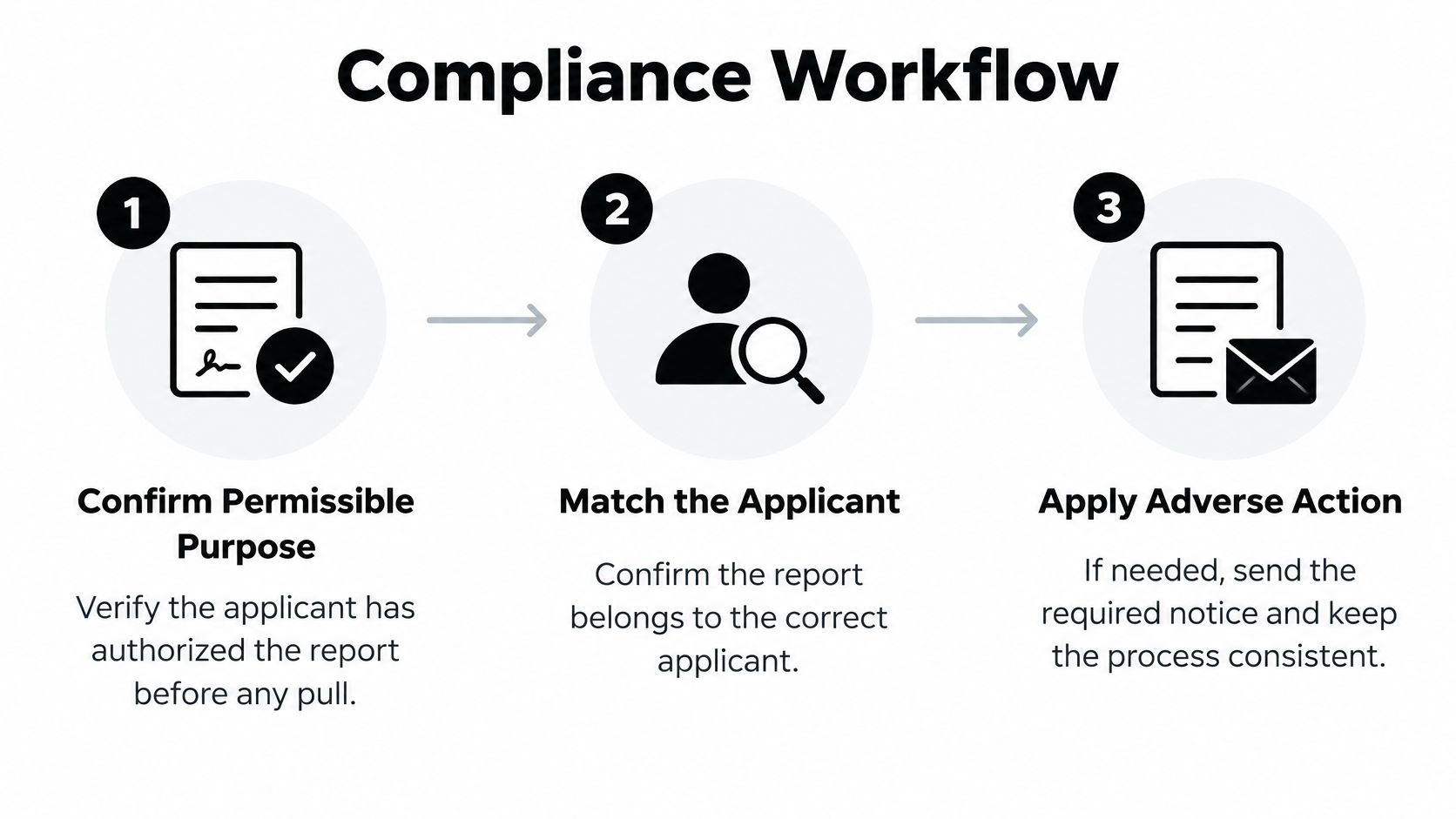
Test the exceptions, not just approval
A score alone can't establish whether the provider used a permissible report, considered the correct person's records, or delivered the necessary notice. The housing provider remains responsible for its decision.
Use our background-check requirements guide when mapping the process. Before buying, have the vendor demonstrate a disputed identity, a conditional approval, and an override, including what the applicant receives and what the manager retains.
Criteria Your Platform Should Let You Set
Decision support must be configurable and explainable. A platform that hides its criteria behind a proprietary recommendation leaves the manager unable to distinguish a policy choice from a database error.
HUD's applicant-screening guidance warns that algorithms may embed prohibited bias, return inaccurate information, fail to predict risk reliably, or effectively make the housing decision for the provider. Its guidance supports relevant, reliable criteria rather than blanket exclusions, including assessing criminal records by nature, severity, and recency instead of using arrests as a proxy for risk.
Controls worth inspecting
- Tenancy-related thresholds. Connect credit, income, and rental-history rules to payment or lease obligations. Require a written purpose for each exclusion.
- Narrow criminal-record settings. Specify permitted record types, offense categories, and lookback rules rather than rejecting anyone with a record.
- Retained evidence. Save the exact report used, not just the latest refreshed version.
- Visible sources. Let reviewers identify the court, bureau, employer, or other supporting record.
- Human review. Allow a reviewer to resolve discrepancies and consider mitigating information.
- Rationale logging. Record both the standard rule outcome and the reason for an exception.
Source documentation deserves particular attention. From January 2019 through September 2022, approximately 26,700 screening-related complaints were submitted to the CFPB, with about 17,200 involving inaccurate information, according to the Government Accountability Office.
Vendor demonstration: Ask to see the criteria screen, the source behind a flagged result, and the override log for a sample decision.
Don't accept a slide deck in place of those screens. Identical information should produce the same rule outcome, while any exception should be attributable to a named reviewer with a recorded explanation. For California properties, have the proposed settings reviewed for applicable restrictions before activating them.
Eviction Records and Scores That Need Human Review
More records don't necessarily produce a better decision. Adding a duplicate filing, an unresolved case, or another person's court record can make a report look thorough while making its recommendation less reliable.
The CFPB's tenant background-check market report describes missing, outdated, misleading, and mismatched eviction information and cites a study in which 22% of state eviction cases reported by screening companies were ambiguous or false. The report also discusses cases that were dismissed, dropped, resolved for the tenant, or initiated for reasons other than nonpayment.
The useful review happens at the record level, not at the approval badge.
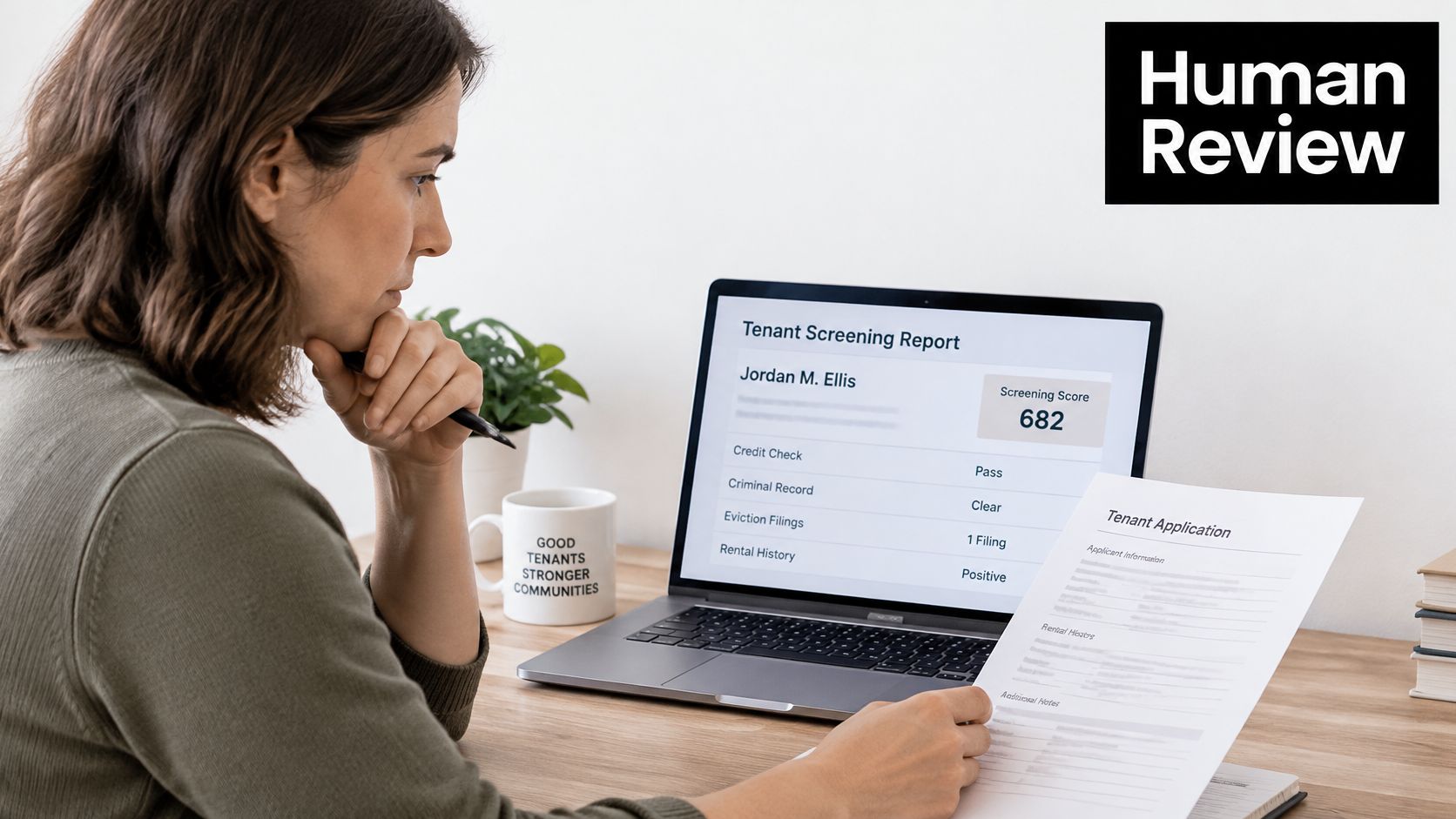
Review the case in a fixed order
- Confirm identity. Compare the available identifiers and address history. Don't resolve uncertainty by assuming the negative match is correct.
- Check outcome and date. Locate the disposition rather than relying on the filing entry.
- Separate filing from judgment. A landlord's initiation of a case isn't the court's final conclusion.
- Identify the cause. Establish what the case concerned and whether that fact is relevant to the written screening criteria.
- Consider recency. Apply the approved lookback policy consistently, without inventing a new standard for an individual applicant.
- Record the conclusion. Document what was verified, what remained uncertain, and how the decision followed the criteria.
Say a report flags a case, but the applicant provides documentation showing dismissal. The manager should verify that outcome, correct the case interpretation, and evaluate the application on the remaining supported information. A dismissal shouldn't remain a completed eviction merely because the vendor's score hasn't refreshed.
Use exceptions without abandoning standards
A structured exception process gives applicants a defined way to submit corrections or mitigating circumstances. Set the same submission route and review responsibilities for everyone. That's different from making informal exceptions for applicants who happen to reach a sympathetic staff member.
The CFPB report also discusses the limited documented evidence connecting specific indicators, such as filing counts or record age, to future lease performance. A score therefore shouldn't be treated as proof that someone will or won't pay rent.
Use this video alongside a sample report to focus the review discussion on the underlying evidence.
Automation bias becomes a practical problem when staff stop investigating after seeing a recommendation. Require the reviewer to identify the supporting record before accepting a negative result.
Verification-based screening remains rigorous. It rejects unsupported conclusions, not screening standards, and helps avoid turning a database mistake into a false rejection.
Integrations That Matter for Your Property Management System
An integration is useful only if it transfers the right information into the right file. A vendor's integration logo doesn't establish whether the connection carries application fields, report access, decision status, notices, accounting entries, or signed documents.
Start with the tasks your staff perform. A standalone screening service can be workable if the handoff is controlled and documented. An integrated system is preferable when it eliminates repeated entry without weakening report access or permissions.
Inspect the handoffs
- Application to screening. Applicant information should transfer without retyping sensitive identifiers. Confirm that approval status returns to the originating application.
- Screening to accounting. Where supported, reconcile screening charges and deposits to the correct ledger without duplicating transactions. Establish which system controls the accounting entry.
- Documents to portal. Check which documents applicants, residents, owners, and staff can access. A portal login shouldn't automatically expose an entire consumer report.
- Lease to file. Electronic signature should return the completed lease to the correct property and resident record, with a clear completion status.
- Override to audit trail. A changed decision should remain traceable after systems synchronize, rather than appearing as an unexplained status replacement.
Our Full-Service VIP Property Management includes an online portal. We also offer electronic signature options that let clients sign documents from home or their smartphone. Those conveniences are separate from the technical question of which screening fields a particular vendor can exchange, so confirm the connection rather than assuming it exists.
Prevent duplicate applicant records
A common integration failure starts with inconsistent names. One system receives a full legal name; another receives a shortened name or a differently spaced surname. If the connection treats those as separate people, staff can attach a report, payment, or lease to the wrong record.
Use a stable applicant identifier across systems, with a review queue for possible duplicates. Don't solve the problem by letting staff merge records without checking identity and preserving the history.
Our property management software comparison can help frame the broader platform choice. During a demonstration, follow a sandbox applicant from submission through decision, notice, and lease storage, then inspect both systems for missing or duplicated information.
Online access can reduce routine document requests, but permissions still need ownership. Confirm who can see reports, who can change a decision, and whether access logs remain available after an applicant becomes a resident.
Test One Applicant Before You Sign
Choose the management model first, the pricing structure second, and the software third. Otherwise, it's easy to buy an extensive platform for a placement-only handoff or a lightweight report tool for an ongoing management operation.
Get written confirmation that the deliverable includes the full report rather than only a score, that screening depth appears in the agreement, and that the cost per leased unit is understandable. These are acceptance conditions, not items to negotiate after onboarding.
Use this final evaluation sequence before committing.
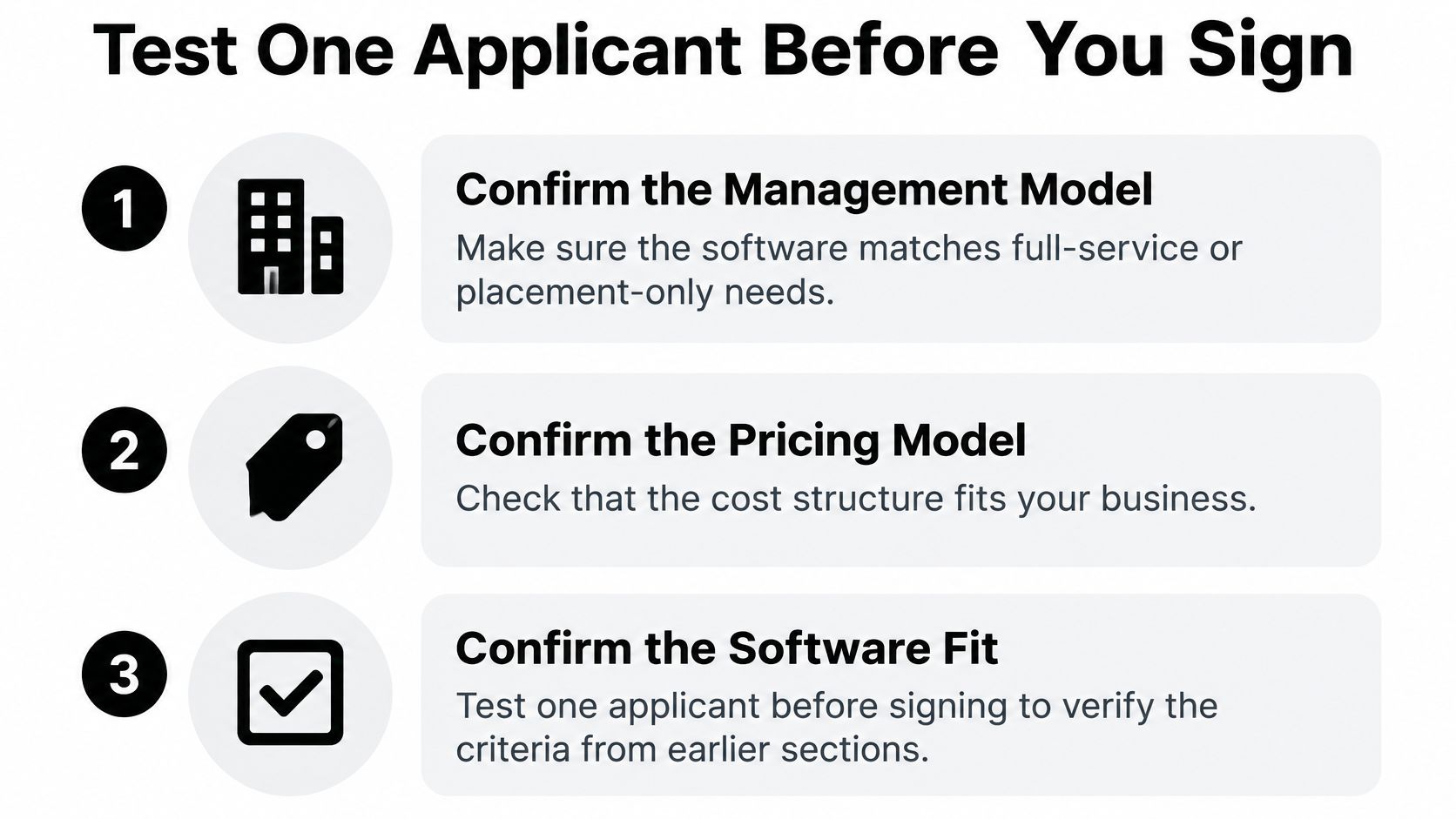
Run a controlled demonstration
Use a vendor-provided sandbox applicant, not an unauthorized real consumer report. Follow the application through identity matching, retrieval, a reasoned decision, and a generated adverse-action notice that identifies the reporting company and explains dispute rights.
Then change the decision through a manual override and inspect the audit trail. Introduce an alternate spelling of the test name and confirm it doesn't create a second applicant in the portal or accounting ledger.
Record any failed handoff and require a successful retest before using the workflow for real applicants. A polished demonstration isn't enough if the exported file loses the decision reason or the notice never reaches the test recipient.
Your first step is deciding whether you want ongoing management or intend to self-manage after placement. That choice determines which outputs, fees, and integrations deserve priority.
We offer extremely detailed screening through Full-Service VIP Property Management and a Placement-Only Service for experienced owners who prefer to manage their rentals themselves. Visit Edinhart Realty and Property Management for a free consultation, or call 559-400-5011 to discuss your property and arrange a time for us to check it out.


