

A Fresno-area owner with one vacant house usually isn't searching for tenant screening services near me because they want the closest storefront. They're trying to answer a more practical question. Should they run a standalone report, ask the renter to pay for screening through an online portal, or use a broader leasing workflow that also handles applications and documents?
That choice matters because tenant screening now sits inside a regulated decision process, not just a convenience tool. The CFPB says landlords commonly use tenant screening reports to decide whether to rent and how much security deposit to charge, and the FTC treats tenant background check reports as consumer reports under the Fair Credit Reporting Act, which triggers disclosure and adverse action duties when a landlord uses them in a rental decision (CFPB tenant screening overview). So “near me” usually means fit: which service gives you the checks you need, presents fees clearly, works with your applicant flow, and supports a process you can document.
This comparison focuses on seven common workflows: credit and ResidentScore availability, criminal and eviction data, income verification, convenience, pricing presentation, who pays, portability, and integration. Availability, fees, and legal limits can change by market, so confirm the details before using any platform, especially in California.
Edinhart Realty & Property Management's Placement-Only Service belongs in the same decision set. It's a local option for owners who want professional marketing, applicant screening, and lease drafting, while keeping day-to-day management in their own hands.
1. TransUnion SmartMove
A common local-owner scenario looks like this. You already found an applicant through a yard sign, a referral, or Facebook Marketplace. What you need next is a documented screening step, not a full leasing stack. SmartMove fits that workflow better than tools built around listing syndication or all-in-one property management.
Its position in this seven-service comparison is fairly specific. SmartMove emphasizes report delivery, applicant identity verification, and pay-per-use access. It does less on application intake, document workflow, and platform-level lease-up coordination. That makes it easier to justify for occasional landlords, but less useful if you want one system to handle marketing, applications, screening, and forms in one place.
How the workflow compares
SmartMove can include credit data, ResidentScore, criminal background screening, eviction-related reporting, and optional Income Insights. The practical advantage is coverage from a recognizable consumer reporting provider without a subscription requirement. The trade-off is review depth. You receive the report package, then you still need to apply your criteria, document the decision path, and handle any required notices yourself.
This applicant payment model also matters. Depending on local rules, the landlord or applicant may pay. For small owners screening only a few finalists each year, that flexibility can lower carrying costs. For higher-volume leasing, the lack of a broader built-in workflow can create extra admin because the screening step sits apart from advertising, scheduling, and document collection.
Best fit, and where it starts to feel limited
- Good fit for placement-light owners: Useful if you already have your own lead sources and separate application process.
- Clear package structure: Easier to compare than services that hide screening behind a larger software bundle.
- Low commitment: No subscription model is helpful for owners with one unit or infrequent turnover.
- Limited portability value: The report serves your decision process, but SmartMove is not primarily designed as a reusable application passport across multiple landlords.
- Less platform integration: Owners who want listing distribution, application management, and lease document workflow in one interface may outgrow it quickly.
One practical comparison point is local fit. If you self-manage a single house or duplex, SmartMove often covers the screening piece without asking you to adopt a larger operating system. If you want a local service that handles screening inside a placement-only process, Edinhart's leasing-focused approach belongs in the same decision set because it adds applicant review and lease drafting rather than only delivering a report. For a broader side-by-side framework, see this guide to best tenant screening services.
Use SmartMove when screening is one step in a process you already control. Choose something else if you need stronger integration between application flow, review, and lease-up tasks.
For platform details, visit TransUnion SmartMove.
2. RentSpree
A common small-owner scenario looks like this: inquiries come from a yard sign, a referral, and a listing portal at the same time. The hard part is not getting a report. The hard part is keeping applications, supporting documents, screening consent, and follow-up in one review path.
RentSpree is strongest in that middle layer of the workflow. Its screening uses TransUnion data, including credit, ResidentScore, background, and eviction checks, with optional income verification. The service matters less as a raw data source than as a way to collect the file cleanly before you decide.
That changes where RentSpree fits in this seven-service comparison. SmartMove is closer to a report-first model. Zillow is closer to a listing-first model. RentSpree sits between them, which is useful if you want more structure than a stand-alone screening link but do not want to build your process around a large property management platform.
Three trade-offs define the decision:
- Data coverage: Broad enough for standard rental screening, with optional income verification adding another review layer.
- Applicant payment model: Screening costs are commonly passed to the applicant, so transparency and duplicate-fee risk matter more.
- Portability: Better than a one-off email workflow, but still centered on your application path rather than a widely reusable tenant passport.
Local owners should pay attention to review depth. RentSpree can organize documents and screening results well, but it does not replace owner judgment on criteria, consistency, or local compliance. In California especially, that distinction matters because fee handling, disclosures, and adverse-action steps need a process you can explain and repeat.
The Consumer Financial Protection Bureau notes that application fees are often used to cover screening costs in its tenant background checks market report. For applicants comparing several properties, the main friction is repeated payment paired with repeated data entry. RentSpree addresses part of that problem by giving applicants a more orderly submission flow, especially on mobile, but it does not remove the broader market issue.
One practical example. If you manage a fourplex and want applicants to submit documents from their phone, authorize screening, and move into a documented review queue, RentSpree is easier to run than collecting PDFs by email. If your priority is hands-on applicant evaluation and lease drafting as part of a placement-only service, Edinhart belongs in the same decision framework because the value shifts from software workflow to reviewed placement support.
If you are still deciding how much weight to give the credit file versus income and background findings, this guide on how to check credit for a tenant helps frame that review.
For product details, visit RentSpree.
3. Zillow Rental Manager
A common local-owner scenario starts with the listing, not the screening report. You post a vacancy on Zillow, inquiries arrive there, and you want the application, document collection, and screening request to stay tied to the same lead record. Zillow Rental Manager fits that workflow better than tools built primarily around standalone report ordering.
Its advantage is integration. Screening sits inside a listing and application system that many independent owners already use, which reduces handoffs between marketing and review. Zillow also allows invites for applicants who did not originate on Zillow, so the process is not limited to marketplace leads.
For comparison across this guide's decision factors, Zillow is strongest on platform integration and basic workflow control. It is less distinctive on portability. It is also less suited to owners who want a more manual, placement-style review process, where a local manager may weigh income documents, communication history, and lease terms before deciding whether to run screening or how to structure an offer.
Where the workflow falls short
Zillow works best when speed and consolidation matter more than report customization. If you want a highly specific screening sequence, bureau preference, or a process separated from the listing platform, the fit gets weaker.
Three practical trade-offs stand out:
- Data coverage: Credit and background screening are built into the application flow, but the product is designed around standard leasing steps rather than a customized review path.
- Applicant payment model: The standard setup keeps landlord cost low, which can help small owners control expenses.
- Fit for local owners: Strong for self-managing landlords who want one dashboard. Less aligned with owners who prefer a local placement service such as Edinhart, where screening is only one part of a reviewed placement and lease-drafting process.
The compliance angle matters here. Zillow's screening flow accounts for local rule variation inside a large platform environment, which is useful if you want more structure than email-and-PDF screening. But structure inside a marketplace is not the same as review depth. If your main question is how to keep listing, applications, and screening connected, Zillow is efficient. If your main question is who is evaluating the file and preparing the lease package, a placement-only local service belongs in the same comparison.
For platform details, visit Zillow Rental Manager tenant screening.
4. ApplyConnect by CIC
A renter tours three listings on Saturday and wants to apply to all of them before Monday. In that situation, ApplyConnect's core difference matters. It centers the workflow on a reusable applicant-paid report that can be shared with multiple landlords for a limited time, instead of restarting screening for each address.
That places ApplyConnect in a different lane from listing-led platforms. The main advantage is portability. The trade-off is control. If you want every applicant to move through one property-specific sequence inside your own platform stack, a shared report can feel less customized than a fresh pull tied to one unit and one decision.
For comparison against the other services in this guide, ApplyConnect is strongest on these points:
- Portability: Higher than most one-property screening flows because the applicant can reuse the report with multiple landlords.
- Applicant payment model: Usually renter-paid, which can reduce direct screening cost for owners.
- Data coverage: Best evaluated as a standard screening package rather than a highly customized review workflow.
- Review depth: Better for landlords who already know how they will interpret incoming reports than for owners who want more hands-on file review.
- Platform integration: Weaker than tools built first around listing management dashboards.
- Fit for local owners: Useful for small landlords in active rental markets. Less aligned with owners who want screening bundled into placement support and lease drafting, such as Edinhart's placement-only model.
The compliance piece is more concrete than many landlords realize. Washington law addresses reusable tenant screening reports directly in RCW 59.18.257, including disclosure rules on what will be checked, what may lead to denial, and the consumer reporting agency used when a report is part of the decision. Even outside Washington, the statute is a good reminder that portable screening only works well when your criteria are written down and applied consistently.
One practical example: if an applicant sends a recent portable report, you still need a repeatable method for deciding whether that report satisfies your stated standards for income, credit history, rental history, and any other lawful criteria you use. Portability reduces duplicate fees. It does not reduce the need for a documented review process.
ApplyConnect is a strong fit if your priority is lower friction for applicants and fewer repeated screening charges across multiple applications. It is a weaker fit if your priority is deeper landlord-side review, tight listing-platform integration, or a local service that carries the process through screening, placement, and lease preparation.
For product details, visit ApplyConnect.
5. MyRental by SafeRent
An owner with five similar applications can review them two ways. One method is line-by-line reading across credit, eviction, criminal, and identity records. The other is a score-led workflow that puts each file into the same frame first, then pulls supporting details underneath. MyRental is built for the second method.
That difference matters in this seven-service comparison. MyRental is less about report portability or listing-platform reach and more about standardizing how a landlord reviews multiple applicants. SafeRent's scoring model sits at the center, with credit, criminal, eviction, and identity-related checks available around it.
The trade-off is straightforward. A score can speed triage and make one vacancy look more like the next. It also creates a review-depth question: are you using the score as an index to a full file, or as a substitute for reading it closely?
Where MyRental fits in the decision framework
For data coverage, MyRental can cover the core checks many landlords expect, but its distinguishing feature is not breadth alone. It is the way those inputs are summarized into a consistent screening workflow.
For applicant payment model and portability, it is a weaker match for renters who want to reuse one report across multiple listings. Owners comparing all seven options should place MyRental closer to the process-control end of the spectrum than the portability end.
For review depth, the right use case is a landlord who already has written criteria and wants a faster first pass. A local owner who wants screening tied directly to placement support, lease drafting, and market-specific help may find Edinhart's placement-only screening model more aligned, because the screening step sits inside a broader leasing workflow rather than inside a scoring-centered software process.
A compliance point follows from that structure. HUD said in a 2024 announcement that third-party screening companies using AI still must comply with the Fair Housing Act and give applicants an equal opportunity to be evaluated on their own merit, and the same update discussed a settlement involving an AI-based screening score (HUD guidance and settlement announcement). For landlords, the practical conclusion is simple. If you use a score, keep the underlying criteria, supporting records, and exception process clear enough to explain later.
MyRental fits owners who value consistency across files and who do not need strong platform integration or report reuse across listings. It is less persuasive for landlords whose main priority is portability for applicants, deeper manual review, or a local service that carries the work from tenant placement through lease preparation.
For product details, visit MyRental.
6. RentPrep
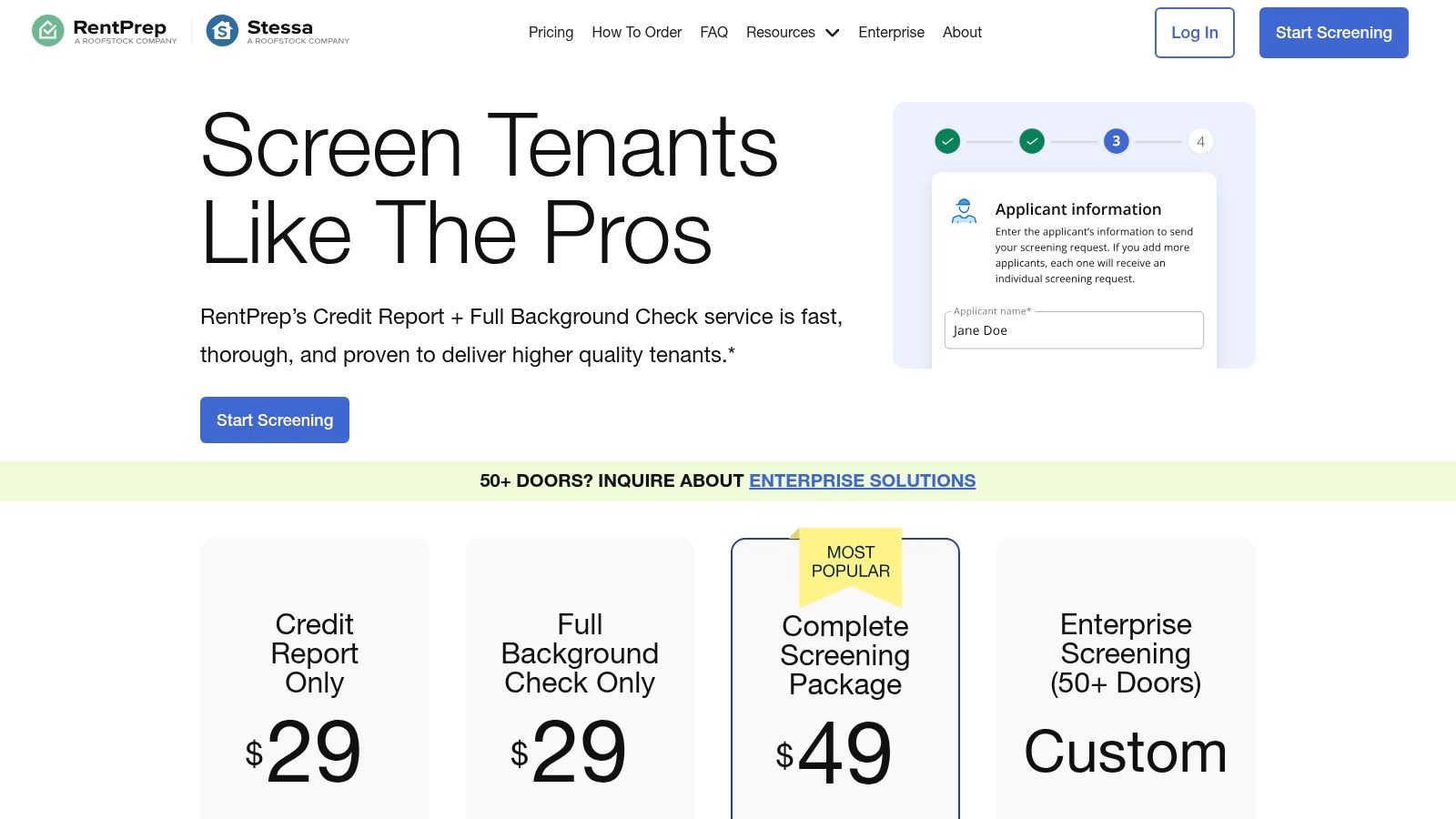
A common local-owner problem looks like this: one applicant has strong income, another has a record that may need context, and a third is only worth a lighter credit check before you spend more. RentPrep fits that kind of uneven pipeline because the workflow is modular. You can order narrower reports for one file and fuller checks for another, instead of forcing every applicant through the same package.
That choice matters in this article's comparison framework. On data coverage, RentPrep gives owners more menu-level control than the fixed-package tools above. On review depth, it stands out because some background checks include researcher review rather than relying only on automated output. The trade-off is straightforward. More customized screening can mean a less standardized process, and a less standardized process usually asks more from the landlord.
RentPrep is less about applicant portability or broad platform integration and more about file-by-file judgment. If your priority is an applicant-paid report that easily follows the renter across multiple listings, other services are stronger. If your priority is deciding how much screening to buy, and when, RentPrep is one of the clearer fits.
Two practical use cases make the distinction clearer:
- A landlord testing demand on a lower-cost unit may start with a lighter screen and add more only after the written application looks viable.
- An owner reviewing a record that could be incomplete or easy to misread may prefer a researcher-reviewed background check over a purely automated result.
- A manager who wants listing, application, screening, and lease steps in one connected system may find RentPrep less efficient than an integrated platform.
That puts RentPrep in a different position from Edinhart's placement-only screening and lease-drafting service. Edinhart is not mainly a self-serve screening tool choice. It fits owners who want screening handled inside a local leasing workflow that also covers placement and lease preparation. RentPrep fits owners who still want to run the decision process themselves, but with more control over report scope and a stronger human-review option than many instant platforms provide.
Compliance is where this flexibility cuts both ways. A more selective ordering approach can be useful, but landlords still need written criteria applied consistently, clear adverse-action procedures, and a process for handling disputed or corrected information, as noted earlier in the article. More discretion can improve review quality. It also increases the need for discipline.
For landlords who value adjustable coverage and added review context more than portability or all-in-one software, RentPrep is a credible middle ground. For product details, visit RentPrep.
7. TurboTenant
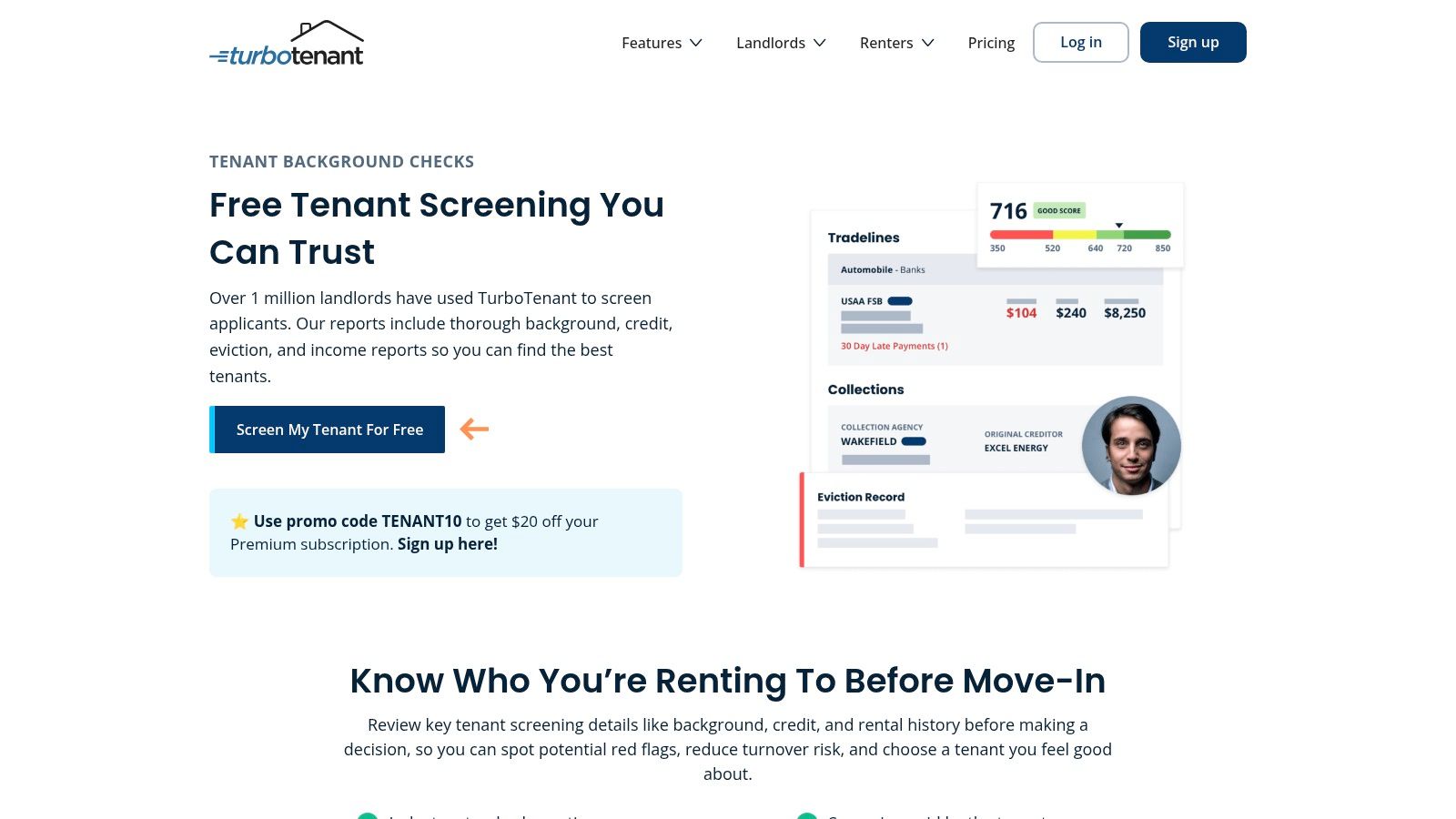
A local owner with two or three units often faces a practical choice. Keep screening as a standalone step, or run it inside the same system that handles listings, applications, rent collection, and lease administration. TurboTenant is stronger in the second role.
That distinction matters in this seven-service comparison. TurboTenant does not stand out because its screening data is unusually different from other TransUnion-based options. Its position comes from workflow design: applicant intake, identity checks, screening, and follow-up actions sit in one landlord-facing platform. For owners who self-manage and want fewer handoffs, that can reduce friction. For owners who care more about report portability or custom review depth, the trade-off is less favorable.
A useful way to evaluate TurboTenant is by six factors used across this article:
- Data coverage: Core screening categories many landlords expect, delivered through TransUnion.
- Applicant payment model: Often a fit for applicant-paid screening, which can lower owner out-of-pocket cost.
- Portability: Less applicant-portable in spirit than services built around reusable reports.
- Review depth: Better for fast operational use than for owners seeking a more manually reviewed or selectively layered process.
- Platform integration: One of its strongest advantages, especially for small DIY portfolios.
- Fit for local owners: Better for hands-on landlords who want software support. Less aligned with owners who want a local firm to handle placement and lease drafting for them.
That last point separates TurboTenant from Edinhart's placement-only screening and lease-drafting service. Edinhart fits a landlord who wants screening handled inside a local leasing process and wants help turning an approved applicant into a finished lease. TurboTenant fits a landlord who plans to run the workflow personally through software.
The compliance question is narrower than "does it include a background check?" The better question is whether the platform helps you apply written criteria consistently, document timing, and respond clearly if an applicant disputes a report item. For local owners, that is especially relevant where rules affect when you can charge fees, what screening factors you can use, or how adverse action must be handled. An integrated dashboard can help with recordkeeping, but it does not replace policy discipline.
TurboTenant makes the most sense if your main problem is process sprawl rather than lack of raw screening access. If you want one system to carry a vacancy from listing through applicant review and ongoing management, it is a practical option. If your decision framework puts more weight on portable reports, local placement help, or deeper case-by-case screening review, other services in this list will likely fit better.
For product details, visit TurboTenant tenant screening.
Top 7 Tenant Screening Services Comparison
| Service | Implementation complexity (🔄) | Resource requirements (⚡) | Expected outcomes (📊 / ⭐) | Ideal use cases (💡) | Key advantages |
|---|---|---|---|---|---|
| TransUnion SmartMove | 🔄 Low, simple online setup and same-day verification | ⚡ Low, pay-as-you-go, no subscription; optional add-ons | 📊 Fast delivery; ⭐ Solid credit + basic criminal/eviction checks (local limits apply) | 💡 Solo landlords who want flexible who-pays options and quick screening | Clear package pricing, fast turnaround, landlord/renter-pay options |
| RentSpree | 🔄 Moderate, end-to-end application workflow with compliance features | ⚡ Low–Moderate, applicant-pay common; optional income/doc add-ons | 📊 Comprehensive workflow; ⭐ TransUnion-backed credit + CA-focused compliance tools | 💡 Agents/property managers needing integrated apps and CA compliance guidance | CA-specific compliance resources, smooth mobile experience, invite flow |
| Zillow Rental Manager | 🔄 Low, integrated with Zillow listings and dashboard | ⚡ Low, free for landlords; applicant pays variable fee | 📊 Good exposure and centralized management; ⭐ Experian/CIC credit & background checks | 💡 Independent landlords listing on Zillow who want free screening and reach | Free for landlords, integrated listings, one place for applications |
| ApplyConnect (CIC) | 🔄 Low, applicant purchases and shares a portable report | ⚡ Low, one-time applicant fee; report shareable up to 3 landlords (30 days) | 📊 Full Experian credit + nationwide criminal/eviction searches; ⭐ reusable report reduces duplicate checks | 💡 Renters touring multiple properties and landlords accepting portable reports | Shareable portable reports, flat pricing, Experian-based detail |
| MyRental (SafeRent) | 🔄 Low–Moderate, self-service with configurable add-ons | ⚡ Variable, pricing varies by package/state; renter-pay in supported states | 📊 Predictive SafeRent Score plus standard credit/criminal/eviction checks; ⭐ consistent risk scoring | 💡 Landlords who want a consistent predictive risk score and customizable depth | SafeRent predictive score, flexible add-ons, simple workflow |
| RentPrep (now Stessa) | 🔄 Moderate, choice of automated or human-assisted background reviews | ⚡ Moderate, à‑la‑carte pricing; extra fees for human review and income verification | 📊 Flexible depth; ⭐ high accuracy when researcher-reviewed | 💡 Owners who want control over report components and human-reviewed research | Human-reviewed background checks, clear à‑la‑carte packaging |
| TurboTenant | 🔄 Low, end-to-end landlord platform (listings → screening → rent) | ⚡ Low, applicant-fees per application; fees charged on submission; bundled tools available | 📊 Smooth marketing-to-screening flow; ⭐ soft-pull credit and clear renter fees | 💡 Small portfolios seeking a bundled workflow from listing to rent collection | All-in-one platform, easy invite flow, well-documented processes |
Choose the Level of Help You Actually Need
The best choice usually comes down to how much of the rental process you want the software to handle.
Choose SmartMove or RentPrep if you want focused, pay-as-you-go screening without committing to a larger operating system. SmartMove is cleaner when you want direct, package-based convenience. RentPrep is better when you want more control over report components or the option of deeper review.
Choose RentSpree or TurboTenant when applications, documents, and broader rental workflow matter as much as the screening report itself. RentSpree leans toward a smoother application-driven leasing path. TurboTenant makes more sense when you want a broader landlord dashboard that can continue after placement.
Choose Zillow Rental Manager when listing integration and no landlord screening cost are priorities. It's strongest when your lead flow already lives inside Zillow's ecosystem and you want one place to manage the vacancy from inquiry through report review.
Choose ApplyConnect when report portability can reduce repeated applicant fees and repeated friction. That model won't fit every owner, but it addresses a real pain point that many “tenant screening services near me” pages barely discuss.
Choose MyRental when a consistent SafeRent Score and configurable add-ons fit how you review applicants. Just remember that a score is a screening aid, not a substitute for a documented process.
Edinhart's Placement-Only Service differs from all of the above because it's not only software. It combines professional marketing, applicant screening, and lease drafting for owners who want placement support without handing over ongoing day-to-day operations. For some local owners, that's the better comparison set. Not “which app has the most features,” but “do I want to run every leasing step myself, or do I want a local team to handle placement cleanly and then hand the property back to me?”
Before you choose, compare the exact checks included, whether the applicant or landlord pays, what income verification means, whether criminal or eviction data is limited by local rules, how notices and records are handled, and what the dispute or correction process looks like. If you also need property upkeep support after placement, it can help to think beyond screening alone and look at service partners tied to rental operations, including Pine Country Window Cleaning for properties.
If you'd rather not stitch together listing sites, application portals, screening reports, and lease paperwork on your own, Edinhart Realty & Property Management offers a Placement-Only Service that covers professional marketing, applicant screening, and lease drafting while you keep day-to-day management. For Fresno-area owners who want a stricter, more hands-on local placement process instead of a purely self-serve platform, visit Edinhart Realty and Property Management.


