

You've got an application for your vacant rental, income documents in your inbox, and a screening report with an eviction flag. The applicant says the case was dismissed. You want to protect your property, but you also need to know whether that flag belongs in the decision at all.
A reliable tenant screening process gives you a way to answer that question without guessing. For a California landlord, strict screening should mean verified evidence, relevant standards, and a decision you can explain from the file, not an automatic rejection whenever a database returns a match.
Why Your Tenant Screening Process Needs Written Rules
The first screening mistake often happens before a landlord orders a report. The owner hasn't decided what qualifies an applicant, what requires clarification, or what would justify denial. When an application arrives, the owner starts making those decisions around the person instead of the property's established requirements.
Written criteria separate the standard from the applicant. They also make you identify what you're trying to evaluate: payment ability, documented rental performance, and compliance with lease obligations. A credit score alone doesn't answer all those questions.
Treat a report as evidence, not a verdict
Tenant-screening reports commonly combine identity, credit, eviction, criminal, and rental-payment information through automated searches of aggregated databases. That makes the report useful for identifying issues to investigate, but it doesn't make every entry accurate.
The scale of the problem matters. The U.S. Government Accountability Office reported that the Consumer Financial Protection Bureau received approximately 26,700 screening-related complaints from January 2019 through September 2022, with about 17,200, roughly 64%, involving inaccurate information, according to this tenant-screening comment submission discussing GAO findings.
Reported problems included outdated records and information belonging to someone else. An owner who treats every database entry as established fact can reject an applicant for something that never happened to them.
Practical rule: A screening result should tell you what to verify, not relieve you of deciding what the evidence means.
Define what each result would change
A useful screening policy does more than name the reports you'll order. It explains how relevant findings affect the application and when the reviewer needs additional information.
For example, a policy that considers verified rental-payment history needs a method for handling an unavailable landlord reference. Otherwise, a reviewer may treat silence as a negative reference even though nobody supplied negative information.
There's a trade-off. Written rules take preparation, and careful verification can slow an individual file. But improvisation creates its own delays when applicants submit different documents, owners request new information late, or reviewers disagree about what counts.
For a Fresno landlord, the practical question is whether you can operate the process consistently during a busy vacancy. For an out-of-state owner, it's whether someone else can follow your instructions without calling for a fresh judgment on every application.
Build the process around intake, verification, report review, legal review, and a documented decision. A stronger file is one another reviewer can understand, even if they never spoke with the applicant.
Collecting Applications and Verifying Identity and Income
Start intake before the listing goes live. Prepare property-specific criteria, identify acceptable supporting documents, and explain how applicants can submit missing information. Publish those requirements before accepting applications so nobody encounters a new standard halfway through review.
Use the same application and intake instructions for similarly situated applicants. Don't require extra paperwork merely because someone's work arrangement is unfamiliar.
This checklist keeps the application documents and verification tasks together.
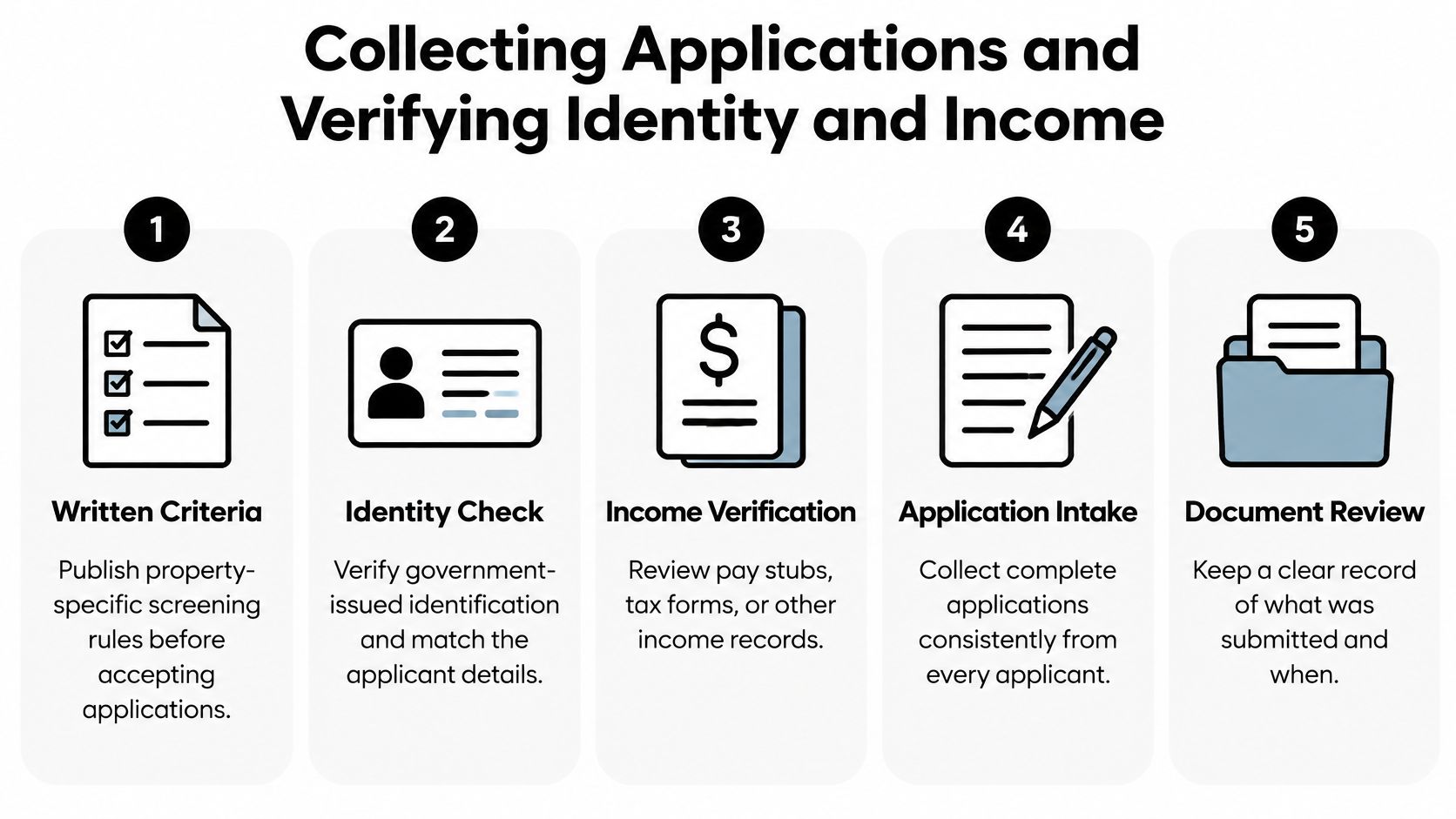
Establish who applied and what's missing
Collect a complete application and the applicant's consent before requesting screening reports. Complete the screening provider's permissible-housing-purpose certification rather than assuming access to the platform is sufficient authorization.
For identity verification, compare the application details with government-issued identification through an appropriate verification method. Investigate discrepancies in names, addresses, or identifying details before attaching third-party records to the file. A spelling variation needs clarification, not an accusation.
Use a short intake log:
- Received: Record the application, consent, and supporting documents submitted.
- Unresolved: Identify the specific missing field or inconsistent detail.
- Requested: Note what clarification you asked for and when.
- Verified: Record the evidence that resolved the question and who reviewed it.
Keep requests limited to what you need for the screening decision. Collecting more personal information isn't a substitute for checking the documents already provided.
Verify payment ability without making assumptions
Review recent pay documentation and confirm employment through a reliable employer contact. For applicants with other income arrangements, identify suitable records under your established policy rather than forcing everyone into an employee-pay-stub format.
A practical tenant income verification workflow helps distinguish a documentation problem from an actual failure to meet the income criterion.
Consider a hypothetical file in which the applicant's employer doesn't respond. Don't mark the applicant as unemployed. Log the unsuccessful contact, explain the outstanding issue, and request recent supporting statements and written employment confirmation through the same alternative-document procedure you'd offer comparable applicants.
Cross-check the employer name, payment dates, and income description across the submitted records. If something conflicts, ask a precise question about that conflict. A broad demand to prove everything again wastes time and makes the process harder to follow.
Rental-history verification deserves the same discipline. Confirm the reference's relationship to the property, then request factual information about tenancy dates, payments, and documented lease performance.
Unverified isn't the same as disproved. Keep that distinction visible in the log until you have enough evidence to apply the written rule.
Checking Credit, Background and Eviction Records Accurately
An eviction search returns a court filing. That tells you a case was initiated, not how it ended. Before the entry affects the application, you need to determine whether it belongs to this applicant and what the court ultimately decided.
The accuracy concern isn't theoretical. A 2025 Urban Institute summary of a study covering 3.6 million administrative records reported that 22% of eviction records contained ambiguous information or incorrectly represented a tenant's eviction history, as described in its discussion of eviction-record errors and automatic sealing.
Read the underlying record
A credit report can help you examine reported accounts and payment history. A criminal search may return arrests, charges, or convictions. An eviction search may identify filings and case information. None of those categories should be interpreted without checking what the entry represents.
Names alone can create uncertainty, particularly when identifiers are incomplete. Compare the available identifying details before assuming a record belongs to the applicant. Use a documented background-check review procedure rather than accepting the vendor's match label without review.
Record Checks to Verify Before Relying on Them
| Record Type | What to Confirm | Why It Matters |
|---|---|---|
| Credit | Applicant identity, disputed entries, and relevant account details | A score doesn't explain whether a specific negative entry is accurate or relevant |
| Eviction | Court, case number, applicant match, final disposition, and duplicate entries | A filing isn't equivalent to a judgment against the tenant |
| Criminal | Identity, charge versus conviction, disposition, and record date | An allegation and a verified conviction require different treatment |
| Rental reference | Reference identity, tenancy dates, and factual support | A general opinion shouldn't outweigh documented rental performance |
Resolve the eviction flag before judging it
Obtain the final disposition from a reliable court record or request clarification through the reporting provider. Look for dismissal, a judgment, or an outcome in the tenant's favor. Check whether apparent repeat incidents are duplicate entries from the same case.
If a record is sealed, incomplete, or otherwise questionable, don't try to work around the problem by treating the original database summary as conclusive. Determine whether the information is legally usable and sufficiently reliable before considering it.
Give the applicant a specific opportunity to explain a disputed entry. Ask for available disposition documents or other relevant evidence, then compare that explanation with verified rental references.
A landlord's accusation, a court filing, and a judgment are different pieces of information. Your decision memo should preserve those distinctions.
The trade-off is reviewer time. Pulling an outcome takes more work than accepting a red flag, but rejecting someone on a misleading filing isn't rigorous screening. It's an unresolved verification task presented as a final decision.
Staying Within Fair Housing and California Rules
A rule can apply to everyone on paper and still exclude protected groups unnecessarily. Consistency matters, but it isn't the entire compliance test. You also need a defensible reason for using the criterion.
Keep the application and its supporting evidence together while reviewing the policy's legal boundaries.
Ask whether the criterion measures rental risk
HUD guidance reports that fewer than one in five renters are Black, while more than half of all eviction cases are filed against Black renters. That disparity helps explain why blanket eviction exclusions deserve scrutiny rather than being treated as automatically fair because their wording is neutral. See HUD's guidance on screening applicants for rental housing.
A defensible approach asks what the verified outcome establishes about the proposed tenancy. Rejecting every applicant associated with an eviction filing skips that question.
For every potentially disqualifying criterion, document:
- Business purpose: Identify the tenancy-related concern the rule addresses.
- Evidence required: Specify what would establish that concern reliably.
- Review method: Explain how the reviewer considers relevant context.
- Alternative approach: Consider whether a narrower rule could address the concern without unnecessary exclusion.
Federal enforcement guidance warns that background policies can create unlawful discriminatory effects. It also describes examining applicant and rejection patterns, which supports reviewing outcomes where legally permissible rather than checking only whether the policy uses neutral language. The relevant framework appears in HUD's criminal-record enforcement implementation guidance.
Use the video as a prompt for discussion, then check your actual policy against current requirements.
Keep California policy review separate from applicant review
California owners also need to account for state tenancy protections. AB 1482 established statewide rules, including just-cause protections for many tenants after lawful occupancy requirements are met. Those protections concern the tenancy relationship; they shouldn't be treated as an applicant-screening shortcut or a reason to adopt broader exclusions.
Have qualified California counsel review applicable state and local requirements before you implement or revise screening standards. A practical fair-housing compliance review can help organize the questions that need attention.
Don't reject applicants merely because they use lawful rental assistance. Don't change documentation demands based on assumptions about a household.
The practical test is direct: Would you apply this rule to every comparable applicant, and can you explain why it is necessary? If either answer is unclear, revise the policy before using it to deny housing.
Making the Approval, Conditional or Denial Decision
At decision time, place the application, verification notes, and reviewed reports beside the criteria used for that property. Resolve material discrepancies before selecting an outcome. Don't let a vendor's recommendation substitute for the owner's documented decision.
The decision flow should distinguish qualification, lawful conditions, and denial rather than treating every imperfect file alike.
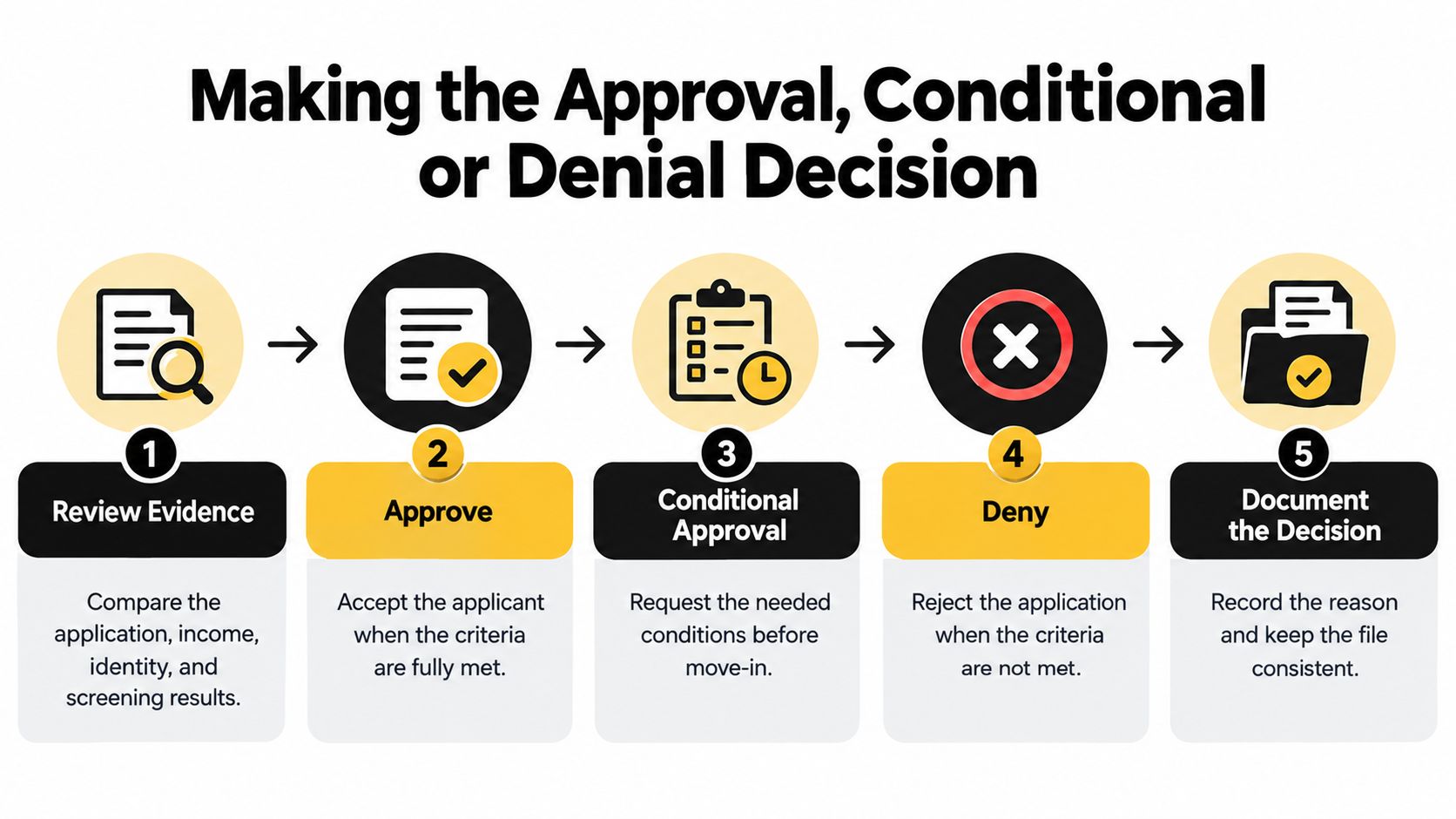
Match the outcome to the evidence
Approval means the verified file satisfies the applicable criteria. Record that conclusion and move to lease preparation without adding last-minute requirements.
Conditional approval means an established, lawful condition addresses a specific qualification issue. Don't invent a larger deposit or co-signer requirement because the applicant made you uneasy. Check that the proposed condition is permitted under applicable California requirements.
Denial needs an identifiable unmet criterion supported by usable evidence. A vague statement about the applicant not being a good fit doesn't explain the decision.
Criminal-history review requires particular care. HUD states that criminal history isn't necessarily a good predictor of housing success and recommends considering payment ability, rental history, and references. It also warns about blanket exclusions and arrest-only decisions in its guidance on applying fair-housing standards to criminal records.
For a verified conviction that may lawfully be considered, assess its nature, severity, age, and relevance to tenancy. Review rehabilitation or mitigating information through the established assessment procedure. An arrest without a conviction shouldn't trigger automatic denial.
Deliver notices and preserve the reasoning
Under the FCRA, tenant background reports are consumer reports. If report information contributes even partly to denial or less favorable terms, such as a higher deposit or required co-signer, an adverse-action notice is required. The FTC's landlord guidance on consumer reports explains the reporting-company identification and applicant dispute information the notice must contain.
Use a compliant notice template, not an improvised rejection email. Keep the delivery record with the application.
The decision memo should capture:
- Criterion applied: Identify the policy requirement and version used.
- Evidence relied on: Reference verified documents and the report version.
- Review completed: Record disputed information and relevant explanations.
- Outcome and communication: State the decision, conditions if any, and notice delivery.
File standard: Another reviewer should be able to reconstruct the decision without relying on your memory.
Keep the application, consent, verification log, reports, memo, and required notices together. A complete record explains both what you decided and how you reached it.
Choosing Who Runs Your Screening and Where to Start
The right operating model depends on which responsibilities you want to keep. Buying access to reports is different from managing an application file. Before choosing a provider, decide who will verify documents, investigate discrepancies, communicate with applicants, and authorize the decision.
Compare responsibility, not just service labels
With self-managed screening, you retain direct control over the workflow. You also handle employer calls, reference checks, disputed records, policy updates, and notices. This approach suits an owner who can give each file sustained attention and maintain a reliable recordkeeping system.
The trade-off is availability. If you're traveling or managing another job, an unanswered verification request can sit unresolved. A checklist helps, but someone still has to complete the work.
A Placement-Only Service separates leasing from ongoing management. A provider handles professional marketing, applicant screening, and lease drafting while you retain day-to-day operations after placement. This can suit experienced landlords who want help evaluating applicants but prefer to manage the tenancy themselves.
Ask how recommendations reach the owner. You need to know whether the provider supplies a verified summary, identifies unresolved issues, and documents the basis for its recommendation.
Full-Service Monthly Management extends the relationship beyond placement. Rent collection, repair coordination, tenant communication, move-in and move-out coordination, lease renewals, and detailed accounting statements become part of the service scope. The main distinction is ongoing delegation, not a different screening report.
Evaluate the workflow behind the software
Ask any prospective provider to explain its process using a hypothetical disputed eviction record. Who obtains the disposition? Who speaks with the applicant? Who decides whether the information is relevant?
Useful questions include:
- Human review: Who can override an incorrect vendor recommendation?
- Policy control: Does the owner approve the screening matrix before marketing?
- Record access: What verification notes and decision documents remain available?
- Dispute handling: How does the team track corrections and recurring source errors?
For broader vendor-selection context, Digital Footprint Check's resource on choosing compliant screening tools for HR offers a separate employment-screening perspective. Don't transfer employment criteria into rental decisions. Housing requires its own permissible purpose, standards, and legal review.
This week, audit a completed rental file against your current criteria. Look for unsupported conclusions, missing dispositions, undocumented exceptions, and incomplete notices. Then identify which tasks you can reliably keep and which you want a provider to handle.
A preapproved screening matrix and an accessible audit trail are useful under any operating model. The goal isn't to eliminate judgment. It's to make judgment explainable.
Edinhart Realty and Property Management, based in Fresno and serving Clovis, Friant, and greater Central California, offers Placement-Only Service and Full-Service Monthly Management, including applicant screening. Bring your current rental criteria and questions about disputed records to a consultation so you can discuss a documented process for your property. Visit Edinhart Realty and Property Management to request that consultation.


