

You post a unit, you get three applications, and one applicant is clearly strong on paper. The temptation is to move fast, take the safest-looking file, and call it done. In California, that's exactly how landlords end up defending a screening decision they thought was routine.
Tenant Screening in California works like a compliance queue, not a casual first impression. You're not just choosing a renter, you're proving that you used written criteria, applied them in order, handled fees correctly, and stayed inside the state's limits on what you can ask, charge, and consider. If you build the workflow the right way, the paperwork supports the decision instead of fighting it.
Why California Tenant Screening Feels Different
A Sacramento landlord can do everything “right” in the everyday sense, accept the first applicant who looks solid, and still get hit with a dispute on Monday if the process wasn't documented. That's reality here. California layers tenant-protective rules on top of ordinary landlord judgment, so the question is never just who looks best, it's which applicant you can defend under a written, chronological process.
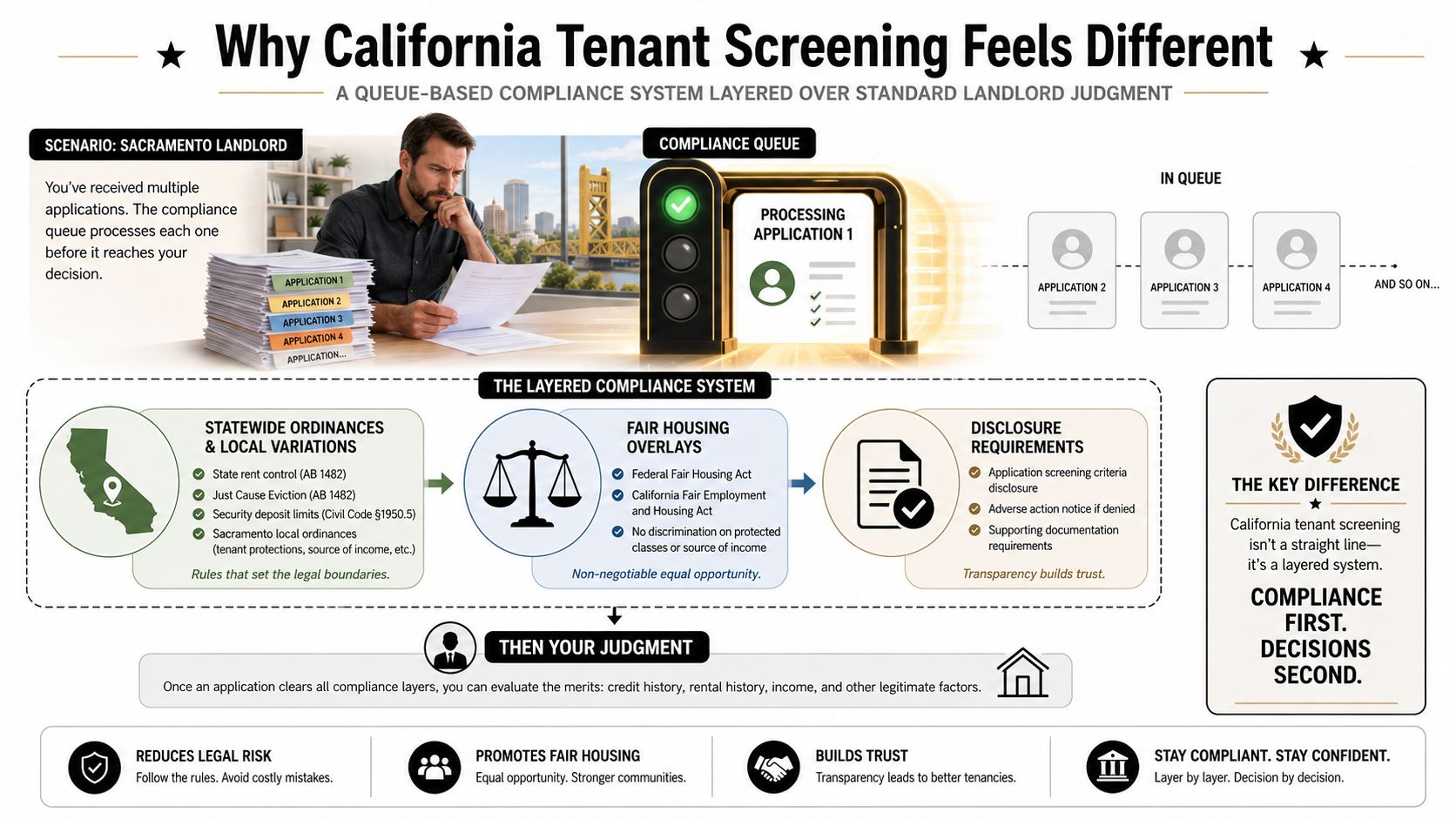
Screening here is a queue, not a hunch
AB 2493 changed the fee and workflow rules in California's tenant screening system, and it did more than tweak language. It requires landlords to think in terms of availability, written criteria, and order of review, not vague preference. The law says you can't charge an application screening fee when you know, or should know, no unit is available now or within a reasonable period, and it keeps the fee tied to actual out-of-pocket screening cost, with the $30 per applicant cap preserved in the statute AB 2493 text.
That matters because the strongest screening file isn't the one you liked most. It's the one that fits the process you published before anyone applied. If you manage a gated property, the same mindset applies to access, because orderly entry systems and orderly applicant screening both depend on controlled, documented rules. A practical resource on that kind of operational discipline is this overview of gated community access control.
The rules stack, they don't stand alone
California's eviction-record sealing rules narrow what you can use, and source-of-income protections limit how you treat voucher holders and other lawful subsidies. Under Civil Code section 1161.2, many unlawful detainer filings never become usable public screening records, which means landlords can't rely on the kind of eviction history they may expect in other states NLIHC summary of California tenant protections. The Civil Rights Department also says subsidy recipients still get screened under lawful criteria, and since January 1, 2024, housing providers must let subsidized applicants show verifiable evidence that they can cover their share of rent California source-of-income FAQ.
The takeaway is simple. In California, tenant screening in California is a paper trail exercise as much as a judgment exercise. If your criteria are written, your queue is chronological, your fees are documented, and your notices are consistent, you'll have a screening process that can survive scrutiny instead of triggering it.
The AB 2493 Screening Rules You Must Follow
AB 2493 is the statute that forces landlords to stop improvising. It amended Civil Code Section 1950.6, and the operational message is blunt, write the rules before you advertise, then follow them in the same order for every applicant AB 2493 text. If your process is loose, you're not just inefficient, you're exposed.
Build the file before the first inquiry
Your screening packet should exist before the listing goes live. That packet needs a written screening criteria sheet, a copy of the application, a fee receipt template, and a documented way to show whether you used an in-order review or a reusable screening platform. The state's process rule is not a suggestion, it's the structure that makes your fee collection defensible.
A good practice is to treat the criteria sheet like a pre-commitment document. Put it in the listing, hand it out with the application, and keep the exact same version in your file. If a denial ever gets challenged, your best defense is showing that the applicant was measured against the same standards every other applicant saw.
What the workflow has to prove
AB 2493 also ties the screening fee to actual cost and requires a first-qualified style process when you're using the in-order model. That means you need records showing when each completed application arrived, when it was reviewed, who met the criteria, and when the fee was charged. If you reuse a screening report, keep the report itself in the file, because the paper trail is part of the compliance story.
For landlords comparing screening vendors or trying to understand report handling, this background check requirements guide is a useful operational reference. The point isn't to collect paperwork for its own sake. It's to make every fee, every review, and every approval traceable.
Practical rule: if you can't show the order in which applications were considered, you don't really have a first-qualified process, you have a guess.
Allowable Screening Criteria Under State Law
California doesn't ban screening. It narrows it. If you want defensible screening, build your criteria around credit, income, rental history, and criminal background, then treat each category as a separate decision step with its own records. That is how you keep the policy and the file aligned.
Credit and income need clear guardrails
A landlord can still review credit, but the standard has to be written down and applied the same way to every applicant. AB 2493's process rules mean your file should show the order of review, the criterion that was applied, and why the application kept moving or stopped. If credit leads to a denial, your notice and response process needs to be ready before you open the first file.
Income verification belongs in its own lane. California's source-of-income rules mean a voucher, SSI, or other lawful funds cannot be treated as a shortcut to rejection once the unit is properly listed, as set out in the California source-of-income FAQ. If you let income review drift into vague judgment, you create confusion in the file and give the applicant an easy complaint.
Rental history and criminal history are not the same thing
California's eviction-record sealing rules limit what you can pull from rental history. Many unlawful detainer filings are not available as usable screening records, so your intake workflow has to separate verified rental history from whatever a database happens to surface. The right habit is simple, record the prior landlord references you relied on and ignore records you are not allowed to use. For a clear operational example of how these records get handled in practice, the NLIHC summary is useful.
Criminal screening has its own limits. California practice points toward individualized review, not blanket exclusion, so the file should focus on the offense, how much time has passed, and any rehabilitation evidence. That means one step for income, one step for rental history, and one step for criminal review. If your workflow blends them together, you will have trouble defending the decision later.
| Screening Criterion | What Landlords Typically Look At | California Restriction |
|---|---|---|
| Credit | Payment history, delinquencies, score, collections | Must be applied through written criteria and the fee process in Civil Code 1950.6 |
| Income | Gross monthly income, verified employment, subsidy documentation | Subsidy status can't be used as a proxy for denial once lawful evidence is provided |
| Rental history | Prior leases, late rent, prior evictions | Many unlawful detainer records are sealed and may not be usable screening records |
| Criminal history | Convictions, recency, relevance to tenancy | No blanket exclusion, use individualized assessment and lawful screening limits |
If your software cannot keep those categories separate, fix the workflow before you fix the policy. Good screening is not just a rule sheet, it is a recordkeeping system. The guide for product teams is a useful reference for how to structure that separation in the product and in the file.
Building Your First-Qualified Screening Workflow
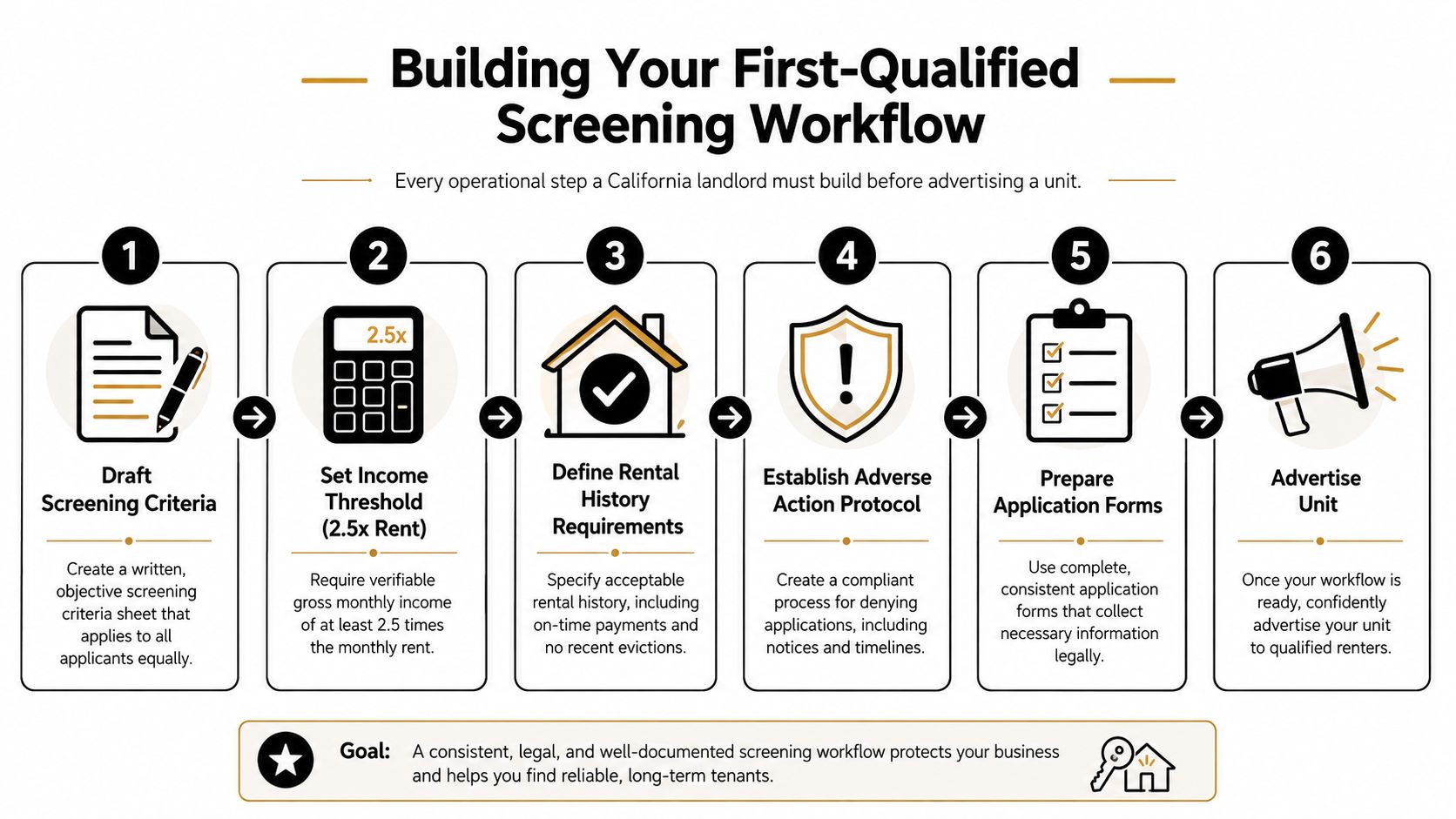
The first-qualified model works when the queue is honest. That means every application is timestamped, every criterion is written, and no one gets special handling because they sounded promising on the phone. Landlords who skip those basics usually discover the problem only after a complaint or a refund demand.
Start with one written standard
Your screening criteria sheet should be a single document, not a moving target. State the income threshold, rental history standards, credit expectations, occupancy rules, and any document requirements in plain English. If you want a cleaner operational reference for credit review setup, this credit screening guide is a useful companion piece.
Then make your intake process match the policy. Collect applications in the order received, log the exact time, and don't run reports until the application is being considered. If you charge a screening fee, issue a receipt and itemize the cost basis, because your ledger should show what was spent and what was returned if the cost came in lower.
Document the queue like it might be audited
The file should tell the story without your memory. Keep the score sheet, the denial reason, the applicant timestamp, and the final decision in one place. The practical habit that saves landlords is boring but effective, save every version of the criteria and every notice you send.
Operational rule: if two applicants meet the standard, the first one who qualified should be the one you approve, not the one you liked more.
A lot of landlords also need vendor help, especially when the property count grows or the owner travels. For that kind of support, Edinhart Realty and Property Management offers placement-only screening and lease drafting for California owners, which is one of several ways to structure the workflow without rebuilding it from scratch. Whatever system you use, keep the records long enough to defend the decision, because the paper trail is the product here.
A Real Fresno Landlord Scenario Walkthrough
Maria owns a four-unit bungalow in Fresno and lists a two-bedroom after a tenant gives notice. Three applications land within 48 hours, and she does the part many landlords skip, she timestamps each one and reviews them in order. That simple workflow carries more weight than her opinion about any applicant.
The first applicant is close, but not enough
The first applicant has strong credit, steady work, and a clean rental history. Maria still denies the file because the applicant misses her written income standard, then sends the adverse-action notice and returns the unused portion of the screening fee. Good credit does not excuse a failed threshold. Her intake log, fee receipt, and denial notice line up, so the decision is easy to defend later.
The second applicant fails for a reason Maria can defend
The second applicant has a five-year-old misdemeanor that was dismissed, but the conviction history still falls inside the screening limits Maria uses, based on the state and federal guidance she follows. She does not guess, and she does not turn the file into a moral judgment. She writes down the reason, sends the compliant notice, and keeps the record with the rest of the application packet.
The third applicant gets the unit because the file fits
The third applicant uses a Section 8 voucher, and Maria accepts the application because source-of-income status is not a lawful shortcut to denial. The applicant also has a sealed 2019 eviction judgment, which Maria does not treat as usable public screening material because sealed-record rules limit how that filing can be used in screening. See NLIHC summary. She approves the third applicant as the first-qualified file and keeps the queue notes clear.
That is the difference between a screening process and a hunch. Maria did not pick her favorite. She followed the rule set, kept the file tight, and ended with a result she can defend.
Choosing Between First-Qualified and Reusable Reports
A landlord in California usually ends up choosing between two workable systems. First-qualified rewards order and consistency. Reusable reports reward speed across multiple listings. The better fit depends on portfolio size, admin capacity, and how much documentation you are willing to keep clean when a denial gets challenged.
Small portfolios usually want simplicity
If you own a duplex or a few scattered rentals, first-qualified is usually the cleaner path. You control the queue, review applications in order, and keep the file easy to defend without building a more complicated intake process. That is why smaller landlords usually do better with a direct screening workflow than with a reporting marketplace.
Higher-volume operators need portability
Once applications start stacking up, reusable reports start to make more sense. A tenant who can carry one report from listing to listing cuts duplicate work, which matters when you screen often or manage several turnovers at once. If you want a practical vendor comparison, this guide for product teams is useful because it shows how screening tools get built into a real intake workflow instead of treated as a loose manual step.
The question is how your process holds up after the first decision. A first-qualified system works best when your intake log, fee receipt, and denial file all match the order you reviewed applicants. A reusable report system works best when your staff can accept outside documentation without improvising side rules for different tenants.
| Factor | First-Qualified Workflow | Reusable Screening Report |
|---|---|---|
| Admin load | Lower for small landlords, higher when volume grows | Easier to scale across multiple listings |
| Queue control | Strong, because you review one pool in order | Less manual review if the report is accepted as provided |
| Risk profile | Easier to document if you are organized | Better when your process needs portability and consistency |
| Best fit | Owners with occasional turnover | Property managers and higher-volume portfolios |
My view is simple. If you screen only a handful of applicants a year, first-qualified keeps the process tighter and easier to explain. If you manage constant turnover, reusable reports usually save time, as long as you keep your intake, receipts, and recordkeeping disciplined.
Common Screening Mistakes California Landlords Make
Most California screening complaints start with ordinary habits, a fee that was not itemized, a denial letter that said too little, or an applicant who was handled differently because the landlord was rushing. Audit the workflow, not just the written policy.
The same errors show up again and again
- Charging too much or charging too early. Tie the screening fee to actual out-of-pocket cost, and collect it only when the application enters your written review process.
- Rejecting subsidy holders by reflex. Screen lawful source-of-income applicants under the same criteria and let them show verifiable proof of their rent share.
- Using sealed or unusable eviction records. Check whether the record can be used for lawful screening before you rely on it.
- Applying one standard to one person and a different standard to another. Use the same written criteria, in the same order, every time. That is what keeps the file defensible.
- Skipping a proper adverse-action notice. Send the denial notice with the required disclosures, then keep a copy in the file.
A lot of landlords call this flexibility. In practice, it usually creates uneven treatment that is hard to defend later. If your fee ledger, income worksheet, and denial letters do not line up, your process is already weak. The fix is boring but effective, standardize the intake step, document every receipt, and make sure the denial file matches the order you reviewed applicants.
Your Screening Checklist and What Comes Next
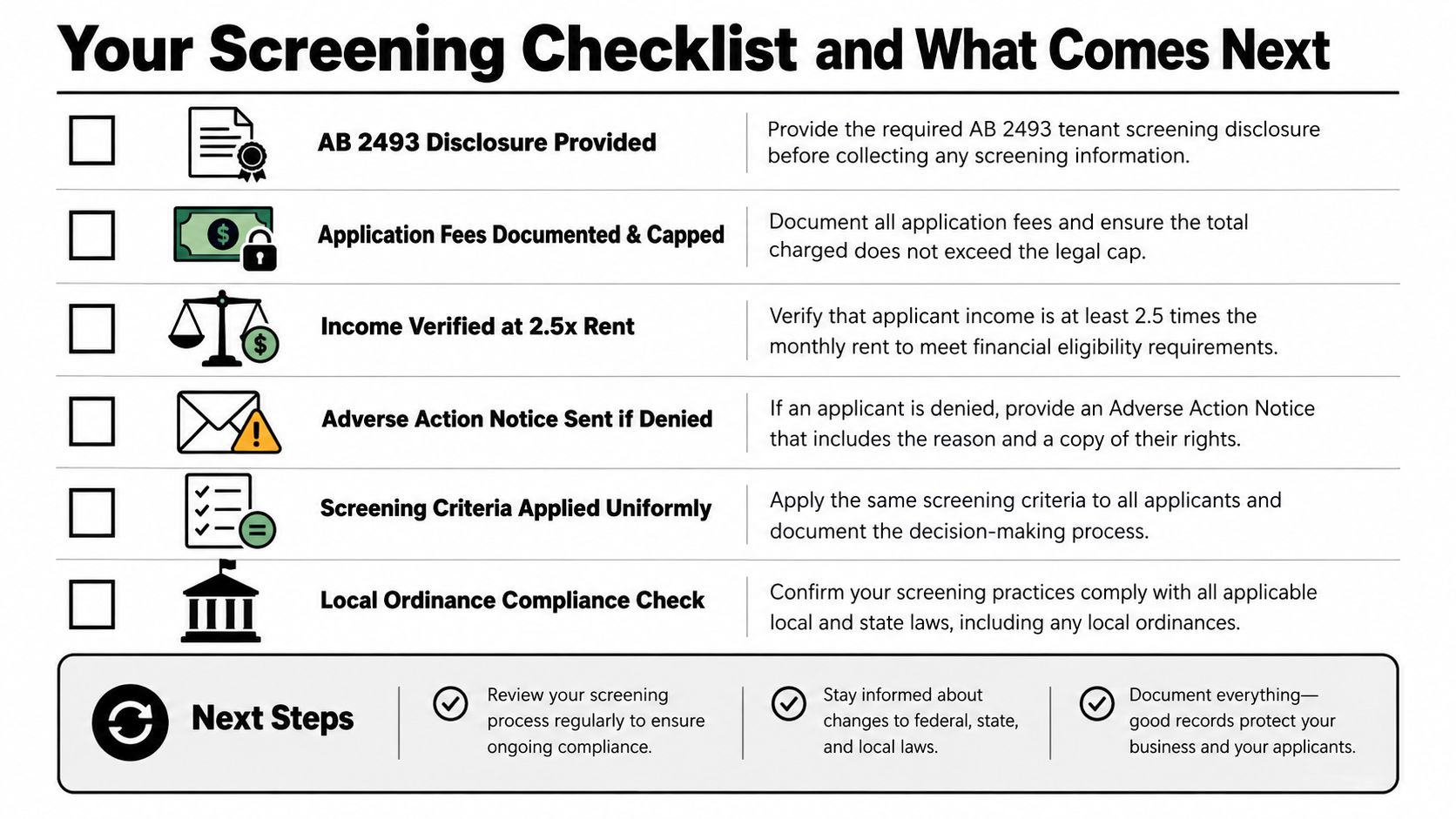
Keep this next to the leasing desk
Use a single-page checklist and make it part of your normal leasing routine.
AB 2493 Disclosure Provided
Give applicants the written screening criteria before you collect money.Application Fees Documented and Capped
Track the actual screening cost, issue receipts, and keep the file clean.Income Verified at 2.5x Rent
Apply your written income standard consistently and separately from other criteria.Adverse Action Notice Sent if Denied
Keep a copy of the notice and the reason the applicant did not qualify.Screening Criteria Applied Uniformly
Review applicants in the same order and under the same standards.Local Ordinance Compliance Check
Confirm city or county rules before you publish the listing.
If you want to pressure-test the rest of your process, a sex offender check for school volunteers is a reminder that background screening in any context only works when the policy matches the actual review steps. The same principle applies here.
The next wave in California is portability and tighter control around report handling. AB 1963 is part of that shift, with guidance pointing toward portable screening reports, HCD-approved providers, and stricter timing and fee rules in 2026-focused discussions AB 1963 guidance. If you're building your system now, build it so it can absorb that change without a full rewrite.
If you want help putting a California-compliant screening workflow in place, Edinhart Realty and Property Management handles placement-only screening, lease drafting, and California-focused property management for local owners. Visit Edinhart Realty and Property Management if you want a process that's built around documentation, fair housing discipline, and the realities of screening in California.


