

You've got a vacant rental, applications coming in, and a screening app that makes rejecting someone almost effortless. Say you decline an applicant after glancing at their credit score, then receive a complaint asking which written criterion they failed. If your only explanation is that the app flagged them, you don't have much of a decision file.
Tenant screening for landlords works best when it verifies payment capacity and produces a defensible record. Stricter exclusions aren't automatically better risk control. The useful work is confirming facts, distinguishing unresolved problems from misleading records, and applying a documented process without improvising.
Why Screening Goes Wrong Without a Standard
A screening report gives you information, not a finished decision. Aggregated records can be incomplete, outdated, or attached to the wrong person. If you treat a recommendation as proof, you can reject a qualified renter without ever examining the issue that triggered the recommendation.
The stakes aren't limited to large apartment operators. The Census Bureau's 2019–2023 American Community Survey release counted 44.6 million rented units, including 20.0 million housing-cost-burdened rented units, where residents spent more than 30% of monthly income on housing. Affordability pressure is common, but it doesn't tell you whether a particular applicant can meet the lease obligation.
Practical rule: Use a report to identify questions worth verifying, not to replace your judgment.
A landlord who records verified income, payment history, and the reason a criterion wasn't met can explain the decision. A landlord who saves only a rejection screen can't show what information was checked or whether the same standard applied to other applicants.
Start with criteria written before advertising. Identify acceptable verification documents, define how you'll handle disputed information, and keep a decision worksheet for each completed application. The criteria, verification steps, and California compliance checks should work together, rather than operate as separate tasks.
Screening Criteria and Benchmarks to Write Down
| Criterion | Common benchmark | Verify with | Watch for |
|---|---|---|---|
| Income-to-rent ratio | A written, property-specific affordability standard, adjusted lawfully for assistance | Pay stubs, offer letter, tax returns | Self-employed applicants need averaged income |
| Verified liquid reserves | An accessible reserve requirement defined in the policy | Recent bank statements covering a consistent review period | Read the balance trend, not a single day's balance |
| Rental payment history | On-time or satisfactorily explained payments over the published review period | Independently verified prior landlord and payment ledger | Distinguish an explained late payment from a repeated pattern |
| Credit | A written minimum score or defined serious-delinquency standard, subject to applicable law | Consumer report obtained with a permissible purpose | A low score can reflect medical debt or a disputed account |
| Eviction records | Verified adverse outcomes within a defined, legally permissible review period | Court case index and prior landlord | A filing alone isn't a judgment |
| Criminal history | Only legally usable information relevant to a documented property concern | Consumer report reviewed under current state and local rules | Don't treat an arrest as proof of criminal conduct |
| Employment | Current employment or another verified income source | Employer contact through an independently located business number | Application-supplied numbers can be fake |
These are policy design choices, not universal legal minimums. Don't copy a score cutoff, reserve requirement, or income formula just because another landlord uses it. A standard should address a property-related risk, accept appropriate verification, and survive review under the rules governing your rental.
For an additional checklist to compare against your application packet, the Royal LePage Brookside Realty screening checklist can help organize your questions. Use it as an operational reference, not as authority for California requirements.
Set thresholds without building in guesswork
An income multiple is easy to administer, but it can be blunt. Decide what income counts, whether you're measuring gross receipts or usable earnings, and how assistance affects the obligation you're evaluating. Don't tighten the formula midway through a search because an applicant makes you uneasy.
Reserves help explain how someone with variable earnings could bridge a weak month. They aren't a substitute for checking whether the money is accessible or whether a large recent deposit is recurring income, a transfer, or borrowed money. Record the distinction.
Read credit as a pattern, not just a score. Recent unresolved housing debt raises a different question from an isolated disputed account, and your policy should identify how you'll investigate each.
Define the exception process in advance
An applicant who narrowly misses a threshold shouldn't trigger an improvised negotiation. Decide beforehand whether a verified raise, documented reserves, or a legally permitted guarantor can satisfy an alternative pathway. Apply that pathway to every similarly situated applicant.
Keep the criteria sheet inside the application packet. Applicants should see the same standard the reviewer uses, including accepted documentation and the process for correcting inaccurate information.
How to Screen an Applicant in Eight Steps
Keep the workflow visible to whoever handles applications, including an assistant or outside manager.
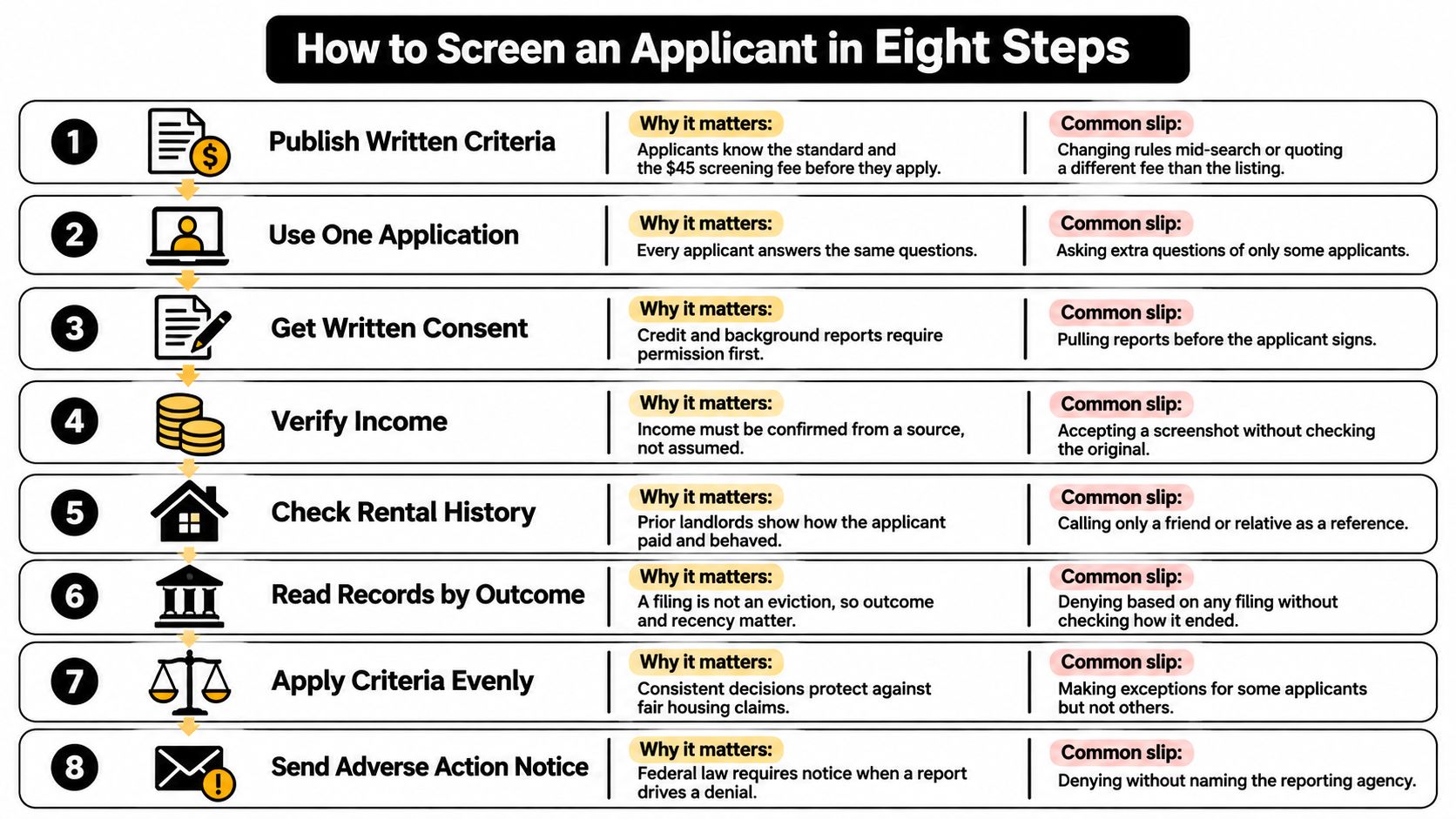
Treat any fee shown in a generic workflow as illustrative, not as a California fee limit.
Publish the criteria and fee policy. Put the qualification standards and screening-fee terms where applicants can review them before paying. Changing either after applications arrive creates avoidable disputes about what applicants were told.
Use a complete application and signed authorization. Collect the same core information from every applicant and obtain authorization before requesting credit or background reports. Don't fill gaps by asking intrusive questions of only the applicants you find unfamiliar.
Confirm a permissible housing purpose. Certify to the reporting company that you're obtaining the report for the rental application. Access to a screening account isn't permission to investigate someone for unrelated reasons.
Verify identity securely. Check the application against government identification and use the reporting provider's secure identity-verification process for sensitive identifiers. Don't circulate Social Security numbers by ordinary email or assume that a matching name establishes identity.
Verify income and employment independently. Find the employer's contact information yourself and reconcile pay-stub net pay with corresponding deposits, allowing for split deposits and payment timing. Snappt identified 6.4% of the rental applications it analyzed in 2024 as fraudulent, according to Commercial Observer's reporting on rental-application fraud, which supports checking documents rather than trusting their appearance.
Check rental history and usable court records. Confirm the reference's connection to the property, then ask about tenancy dates, payment history, and documented lease issues. A friendly reference or an unexplained court-search result isn't enough to establish what happened.
Evaluate completed files consistently. Track completion order, compare verified information with the written criteria, and invite a written response to material discrepancies. Don't move a preferred applicant ahead without a documented reason or treat a disputed entry as settled fact.
Record the decision and send the required communications. Write a concise rationale for each criterion, identify the evidence used, and store the report under a secure retention policy. An unexplained approval or rejection leaves the next reviewer guessing.
Handle notices and California fees deliberately
Under the FTC's guidance on consumer reports for landlords, rejection, higher rent or a deposit, or a required co-signer based partly or wholly on a consumer report constitutes adverse action. The notice must identify the reporting company, explain that it didn't make the decision, and describe the applicant's dispute right and right to a free report within 60 days.
For California fee-charging workflows, have counsel confirm the applicable written-criteria, application-order, first-qualified-applicant, and refund requirements before accepting payment. Match your actual fee handling to the published policy, and verify current limits rather than copying another property's amount.
Use a background-check requirements checklist to organize the administrative work. Keep sensitive reports in restricted storage, not in a shared inbox alongside maintenance requests.
Verifying Income When Rent Comes From Assistance
Say an applicant receives a housing voucher and doesn't meet your gross-income formula against the apartment's full rent. That calculation may overlook the central fact: the applicant isn't responsible for paying the entire amount from personal income.
A 2025 Housing Studies study on voucher holders and tenant screening found that voucher holders generally meet rent-to-income thresholds because subsidies reduce their rent burden, yet credit scores, bankruptcy history, and debt still create barriers. Separate the ability to pay the contractual tenant share from indicators of past financial hardship.
Verify the obligation before testing affordability
For a subsidized application, follow this sequence:
- Confirm the subsidy payment. Verify the portion payable to the landlord through the housing authority or administering organization.
- Check continuing terms. Establish whether assistance will be effective at lease commencement and identify relevant approval conditions.
- Determine the tenant share. Use the documented allocation rather than assuming the applicant owes the full advertised rent.
- Assess that obligation. Review the applicant's verified income, payment history, and permitted reserve evidence against the amount they're responsible for.
Don't confuse identical treatment with identical paperwork. An employed applicant and a retired applicant may need different documents to establish the same fact: reliable funds available for rent.
| Income source | How to verify | Counts toward income test | Common mistake |
|---|---|---|---|
| Wages from current employer | Recent pay stubs plus employer confirmation | Yes, verified gross monthly amount under the policy | Trusting pay stubs without confirming the employer |
| Self-employed or gig work | Tax returns and a representative bank-deposit history | Yes, averaged after separating business receipts from usable income | Using a strong month as the baseline |
| Housing voucher | Housing authority documentation showing subsidy and tenant shares | Test the applicant's tenant share; verify the subsidy separately | Refusing the voucher or ignoring payment terms |
| Disability benefits, including SSI or SSDI | Current award letter | Yes, if continuing | Excluding benefits because they aren't wages |
| Pension or retirement income | Current benefit statement | Yes, if continuing | Asking for unnecessary tax documents |
| Family or third-party support | Signed commitment and transfer records, or an appropriate guarantor agreement | Only with a documented, ongoing commitment | Accepting a verbal promise |
For seasonal or self-employed applicants, choose a representative review period and apply it consistently. Separate transfers between accounts from earnings, and avoid counting the same money twice.
Different verification documents can support the same affordability standard. Different standards based on who receives the income are the problem.
A written tenant income verification process helps reviewers make those distinctions. Record any approved alternative and its supporting evidence rather than leaving an unexplained exception in the file.
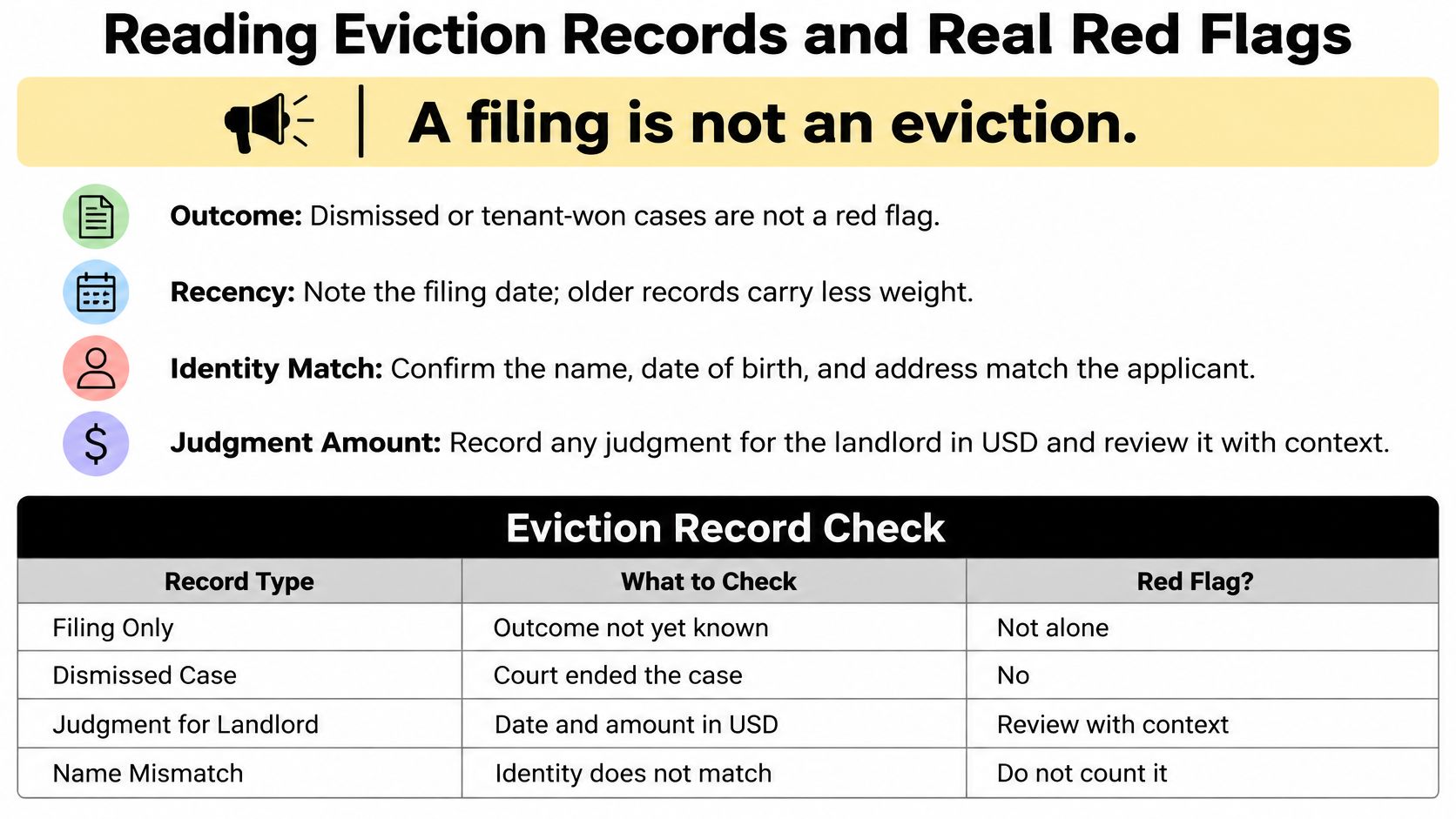
Reading Eviction Records and Real Red Flags
A filing is not an eviction. Read the outcome, confirm the applicant's identity, and establish what remains unresolved before assigning the record any weight.
The Urban Institute's 2025 analysis of tenant screening describes false matches from name-based searches and finds little evidence that a past eviction filing alone predicts a future eviction. A report entry is therefore a starting point for verification, not a reliable yes-or-no disqualifier.
| Record shows | What it may mean | Next step |
|---|---|---|
| Filing dismissed or withdrawn | No adverse court finding established by that disposition | Don't count it as an eviction or infer misconduct |
| Judgment for the tenant | The landlord didn't win the case | Don't treat the outcome as a negative mark |
| Judgment for the landlord, later paid or settled | An adverse judgment followed by resolution | Request an explanation and documentation of satisfaction or settlement |
| Recent judgment for the landlord with no documented payment | Possible unresolved rent or other liability | Verify the judgment, amount, status, and applicant's explanation |
| Executed eviction with possession lost | Confirmed possession loss, still requiring context | Review dates, circumstances, pattern, and subsequent payment history |
| Name match without supporting birth-date or address identifiers | An unverified match, possibly another person | Resolve identity before considering the record |
Use the visual guide as a prompt to check the underlying case, not as a replacement for it.
Red flags should trigger verification
- Pay and deposit discrepancies. Reconcile net pay, payroll dates, and deposits before concluding that a document is false.
- Questionable employer contact. Independently locate the business when the supplied number reaches a personal phone.
- Unexplained address gaps. Ask for clarification without assuming homelessness, caregiving, or temporary housing means poor tenancy.
- Vague landlord references. A refusal to disclose information isn't proof of misconduct; seek a ledger or another verifiable source.
- Repeated short tenancies. Ask whether employment moves, temporary leases, or another documented circumstance explains the pattern.
- Requests to bypass screening. Keep payment and application handling inside the published process.
- Inconsistent document details. Check mismatched dates, fonts, names, and totals against original or independently verified records.
A single old, resolved problem deserves a different assessment from a recent unresolved pattern. Neither a professional-looking document nor an awkward explanation settles the question.
Invite a written explanation before deciding on an eviction-related item. Save the response, the verification result, and the reason the information did or didn't affect the decision.
Fair Housing Rules and California Protections
A rule can look neutral on paper and still exclude people for reasons that aren't closely connected to rental performance. Consistency matters, but consistently applying an unnecessarily broad rule doesn't make that rule defensible.
Review policy language and supporting documents together rather than treating compliance as a final checkbox.

HUD's fair-housing white paper describes April 2024 guidance addressing potentially discriminatory effects from credit screening, criminal records, eviction filings, and income-source rules, including voucher exclusions. It also reports that HUD and partner agencies received 11,741 housing-discrimination complaints in fiscal year 2022, with disability the most common alleged basis, followed by race and sex.
Those concerns have practical consequences. An automatic exclusion can discard information showing that an applicant is able to pay, that a record belongs to someone else, or that a relevant accommodation needs consideration.
Apply a defensibility test
- Use the same written criteria for similarly situated applicants. Different documentation can be appropriate, but selective hurdles aren't.
- Verify disputed information before deciding. Record what you checked and whether the dispute changed the assessment.
- Avoid blanket exclusions where lawful alternatives exist. Ask whether a narrower, relevant standard addresses the actual concern.
- Document legitimate business reasons. Replace subjective impressions with the criterion, verified fact, and resulting decision.
For California properties, have counsel review source-of-income protections, voucher handling, criminal-history restrictions, and any additional local requirements. Don't publish a no-voucher policy or assume a generic nationwide screening package incorporates every applicable protection.
Use this video as a discussion aid alongside a property-specific policy review.
Keep a fair housing compliance checklist with your application materials, but have a California real estate attorney review the actual criteria and notice templates. Use the adverse-action requirements in the screening procedure when a consumer report influences the outcome.
This is practical guidance, not legal advice. A standardized workflow helps you administer a policy; legal review helps establish whether that policy is appropriate for the property and jurisdiction.
Confirm Your Process Before the Next Application
Start with a concise criteria sheet and a reusable decision-file template. Run a past application through the workflow without changing the original decision, and identify missing authorization, unverifiable references, unclear income calculations, or incomplete notices.
Check the application packet before advertising
- Criteria visibility. Make sure applicants can review the qualification standards before applying.
- Fee consistency. Confirm that the published policy matches what you charge, process, and refund.
- Notice readiness. Check that the template identifies the reporting company and explains the applicable dispute rights.
Decide who owns each task, including follow-up on disputed records. A checklist without a responsible reviewer can still leave an application stalled or a notice unsent.
If you'd rather delegate, choose between placement support and ongoing management based on the work you want to retain. Placement-only service suits an owner who wants help marketing, screening, and preparing the lease but will manage the tenancy. Full-service management is the more relevant option when you also want rent collection, tenant communication, and operational coordination handled.
Edinhart Realty and Property Management offers a Placement-Only Service covering professional marketing, applicant screening, and lease drafting, plus Full-Service Monthly Management for ongoing rental operations. Visit Edinhart Realty and Property Management to review current service details and discuss a documented screening process for your Fresno-area rental.


