

You've got two applications on the table. One applicant has steady employment and a clean rental reference, but a screening report flags a criminal record. The other looks straightforward until you notice that the identity details don't quite match. A quick approve-or-deny decision may feel efficient, but the application process needs to tell you what to verify, what criteria to apply, and how to explain the outcome.
A tenant screening application is more than an intake form. It starts a consumer-reporting process that can affect an applicant's access to housing and expose a landlord to legal and financial risk if information is inaccurate or applied inconsistently. The practical aim isn't to collect as much data as possible. It's to gather relevant information, check it carefully, and document a consistent decision.
Why a Tenant Screening Application Matters More Than Ever
A prospective renter submits an application for a Central California home. Their employer confirms a stable job, and a previous landlord gives a positive reference. Then a background report shows a criminal-record entry. That result may belong to the applicant, or it may reflect a mistaken identity match, an outdated record, or information that needs context. A report is a lead to check, not a decision by itself.
That distinction matters because tenant screening has changed. Before the 1990s, landlords often relied on a few phone calls to confirm rental history and employment. Today, screening commonly draws on credit records, eviction and civil-court information, criminal-history data, and identity details. A 2017 TransUnion survey of 669 landlords found that 90% reported running credit and criminal-background checks, while 85% ran eviction reports on all rental applicants (research on tenant-screening practices).
The application sets the rules
The form shapes what happens next. If it asks for authorization in unclear language, fails to explain the screening process, or collects information without a defined purpose, it can create confusion before anyone reviews a report. Written criteria, plain disclosures, and a clear way to raise a correction concern make the process easier to apply consistently.
Screening also has a direct cost for applicants. Application fees are often used partly to pay for reports, and a screening fee may be paid before the landlord makes a decision. That makes disclosure and accuracy practical responsibilities, not formalities.
Practical rule: Treat every field, authorization, and decision note as part of the record you may need to explain later.
A credit entry, eviction filing, or criminal-history hit can inform a decision, but it shouldn't trigger automatic rejection without review. Screening reports can help verify identity, income, rental history, credit, and prior evictions; they don't, by themselves, establish how someone will behave as a future renter. The application should therefore support a fair, evidence-based decision rather than turn a database result into a substitute for judgment.
Building the Application Step by Step
A useful application collects what you need to evaluate every applicant under the same written criteria. It shouldn't ask for sensitive information because a form template includes it. Build it in layers, and make the purpose of each layer clear.

Start with identity and authorization
Ask for the applicant's legal name, contact details, current address, and prior addresses relevant to rental history. Explain that you may obtain consumer reports for a housing decision, and obtain written authorization before ordering them. In the United States, the landlord must have a permissible housing purpose and certify that purpose before obtaining a consumer report. Make sure the authorization language and your process match the requirements that apply to your property.
A form should also state the property-specific screening criteria before applicants pay a nonrefundable fee. That gives people a chance to understand the basic requirements before sharing personal information or paying for a report.
Collect information that helps evaluate tenancy
Include employment history, income sources, gross income, current and prior landlord contacts, proposed move-in date, and the number of intended occupants. Ask for documentation that can reasonably verify the information, such as pay records, an employer letter, or other income documents. Give applicants a way to explain irregular work or a recent job change rather than treating a gap as proof of risk.
Request supporting documents only when they're relevant to your criteria. A photo ID can help with identity checks; vehicle details may be needed for parking administration, but they shouldn't become a proxy for deciding who qualifies. Include a signature and date section, and make sure each adult applicant completes the required authorization.
Copy-ready form checklist:
- Identity: Legal name, contact information, and address history.
- Tenancy details: Proposed move-in date and intended occupants.
- Financial information: Employment and lawful income sources, with appropriate verification documents.
- Rental history: Prior landlord contacts and residence dates.
- Authorization: Clear consent for relevant consumer reports and a signed, dated acknowledgment.
Keep the form focused. A shorter application with clear disclosures is more useful than a longer one that gathers information you won't use consistently.
California Disclosure and Fair Housing Rules to Know
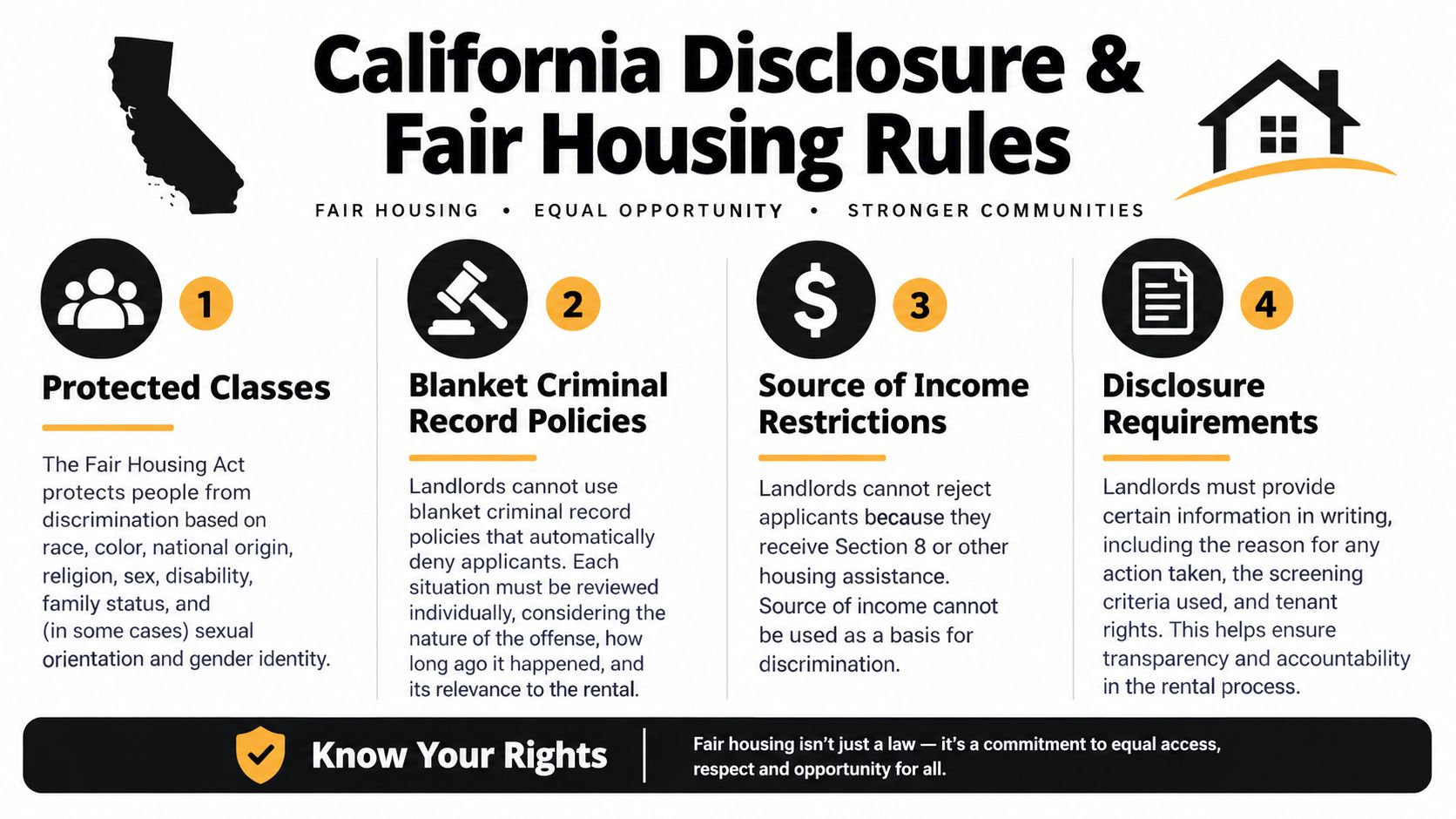
Federal fair-housing requirements apply to the way landlords market a home, collect applications, and make rental decisions. The Fair Housing Act prohibits discrimination in housing transactions based on protected characteristics. California landlords also need to consider state and local requirements, including rules affecting screening fees, source of income, and the use of consumer reports. Set criteria that relate to tenancy obligations, then apply them the same way to each applicant.
A blanket criminal-record policy is a poor substitute for an individualized review. An audit by Fair Housing Advocates of Northern California found that 83% of investigated properties screened for criminal records, and 83.3% of tests showed evidence of criminal-history screening policies with a disparate impact on Black applicants (CFPB tenant background-check market report). Those findings underline why a landlord should consider relevant, current information instead of automatically denying someone based on an arrest or an old record.
Understand fees and reusable reports
California Civil Code section 1950.1 governs application screening fees and permits landlords to accept reusable screening reports that an applicant paid for through a consumer reporting agency, subject to disclosure and timing requirements (analysis of California screening-fee and reusable-report rules). In practice, don't assume that a report an applicant offers automatically meets the applicable requirements. Check whether it qualifies under the law, whether it's current and usable for the decision, and what disclosures you must provide.
Before collecting a fee, explain in writing how it will be used and what screening process it covers. Keep your fee practices tied to an actual screening process, and don't sell or repurpose applicant data outside a lawful purpose. If an applicant offers a qualifying reusable report, have a consistent procedure for assessing it rather than accepting one applicant's report and rejecting another's without a documented reason.
Source of income also deserves careful attention. Evaluate lawful income based on whether it satisfies the property's written requirements, not on whether it comes from wages, benefits, or a housing subsidy. For additional guidance on applying requirements consistently, review Edinhart's fair-housing compliance information.
Verifying Identity, Income, Credit and Background With Confidence
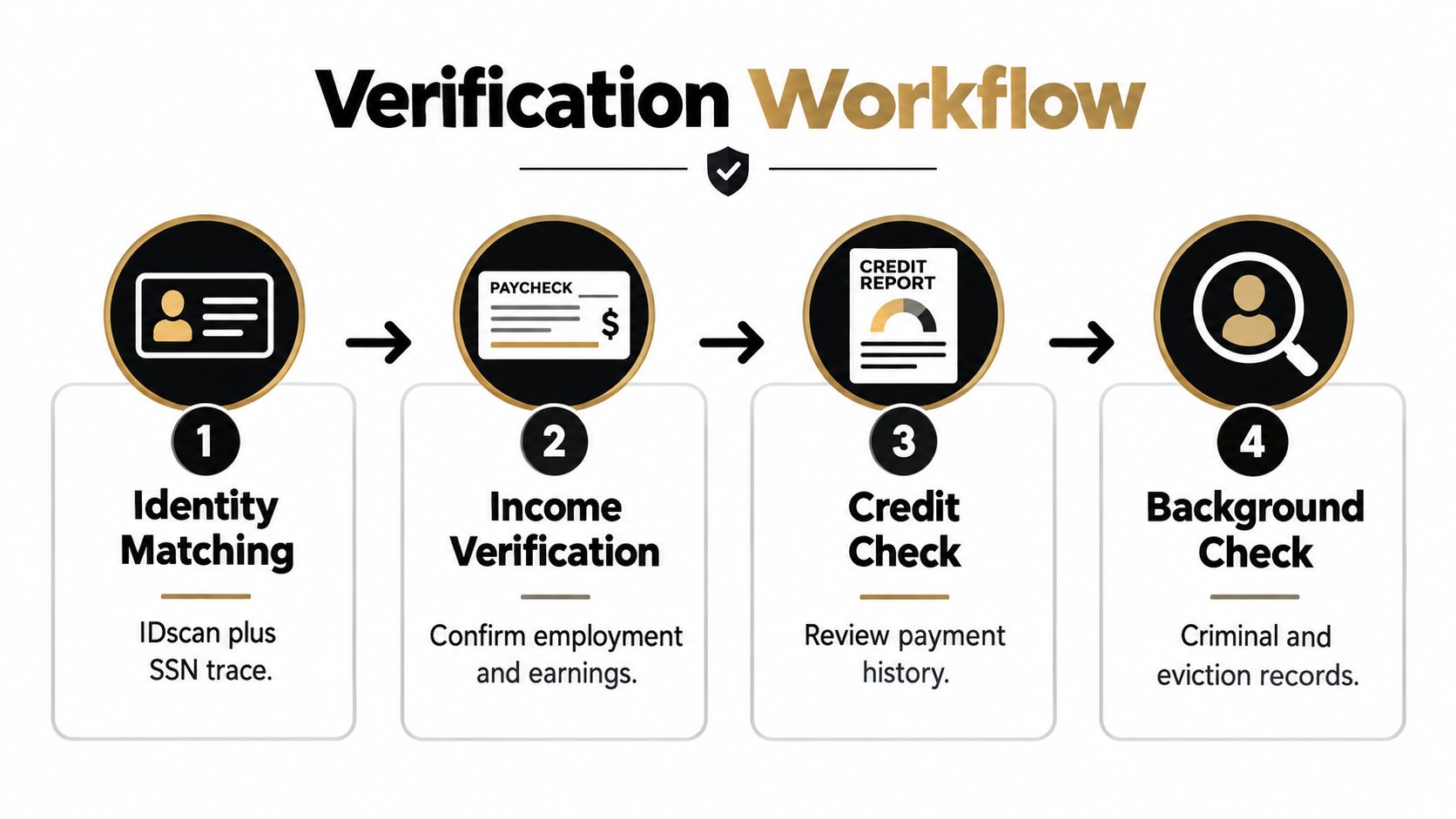
Run checks in an order that helps you catch mismatches before they become a denial. Start with identity, then verify the information that bears on your written criteria. A consumer report is useful only if it belongs to the applicant and reflects records that are relevant and current.
Work through the evidence
Identity comes first. Compare the applicant's identifying information with the information in the report. A name-only match should prompt additional review, not an immediate adverse decision. If names, addresses, or other details conflict, pause and confirm the record with reliable information before relying on it.
Verify income and employment next. Pay records, employer confirmation, or other appropriate documents can help establish the income information the applicant provided. A mismatch between an application and a document is a reason to ask a specific follow-up question, not to assume the applicant misrepresented their finances. For a practical overview of identity checks, see this PeopleFinder verification guide. For income documents and review considerations, use Edinhart's tenant income verification guidance.
Review credit and rental records against the criteria you disclosed. Look for relevant payment history and rental-related obligations, not just a score or a list of negative entries. For an eviction or civil-court result, check the relevant court record when a material detail needs confirmation. Distinguish an allegation or filing from a final disposition.
Review criminal-history information only where legally relevant. Confirm that the record belongs to the applicant and understand its disposition and timing before considering it. Don't treat an arrest as proof of conduct, or rely on data that may be sealed, expunged, stale, or linked to another person.
Document what you checked
Record the report version, the information you relied on, any discrepancy you verified, and which written criterion informed the decision. The FTC's landlord guide says a landlord must have and certify a permissible housing purpose before obtaining a consumer report. If information in a report contributes to denial or another adverse action, the landlord must send an adverse-action notice identifying the reporting company (FTC guidance on consumer reports for landlords).
This sequence catches problems that a broad bundle of checks can miss. More data doesn't improve a decision if it's attached to the wrong person or interpreted without context.
Red Flags That Actually Matter and the Ones to Ignore
A screening result deserves attention when it connects clearly to an applicant's ability to meet the lease, but a flag isn't automatically proof of risk. The distinction matters: a recent, verified eviction judgment may be relevant to a written rental-history criterion, while a name-only database match may be a clerical error.
Accuracy problems are common enough to justify a pause-and-check process. The CFPB analyzed more than 24,000 tenant-screening complaints and reported over 16,000 involving incorrect information, along with roughly 4,500 involving obstacles to correcting errors (CFPB report on tenant background-check complaints). When an applicant raises a plausible error, give the information a human review before treating it as a reason to deny.
| Category | High-Signal Flag | Likely Noise |
|---|---|---|
| Identity | Core identifying details don't verify after reasonable follow-up. | A name match without enough identifiers to confirm it belongs to the applicant. |
| Rental history | A verified, relevant judgment that meets a written criterion. | A filing without a confirmed outcome or a record tied to another person. |
| Income and employment | Material information remains inconsistent after the applicant has had a chance to clarify it. | Irregular earnings or an employment gap with a plausible explanation. |
| Credit | A verified housing-related debt that's relevant to the published criteria. | A medical collection or unrelated account treated as an automatic disqualifier. |
| Criminal history | A verified conviction that is legally relevant to the decision. | An arrest without a conviction, an old record, or an inaccurate match. |
Pause, verify, and record the reason
When a report flags an issue, identify the exact record and the question it raises. Check primary sources where possible, confirm the record's status and jurisdiction, and give the applicant a clear way to point out a mistake. A report that combines an allegation, an outdated record, or a mistaken identity match with other information can look decisive until someone verifies the details.
A short note in the decision log should say what you checked and why the information did or didn't meet a written criterion. That practice protects applicants from avoidable errors and helps landlords explain that they applied the same process consistently.
When Automated Scores Deserve a Second Look
An automated score can summarize information quickly, but a landlord still needs to know what the score means and which factors drove it. Recent California research found that 57.5% of surveyed landlords received reports containing an AI-generated score or recommendation, while 16% received predictive information from screening companies (California research on tenant screening and automated recommendations). A number without understandable reason codes can make a decision harder to defend, not easier to make.

That's especially important for applicants with housing vouchers, benefits, irregular earnings, or little conventional credit history. If a model treats a thin credit file as a negative without considering verified rental payment history, or overlooks lawful income because it isn't wages, the result may not reflect the criteria the landlord intends to apply. Evaluate total lawful income, verify the relevant details, and document how the same standard applies to each applicant.
Put a person behind the score
Ask the screening vendor to explain the inputs used, provide reason codes for adverse outcomes, and make a correction process available. If the vendor can't explain why an applicant received a particular result, don't let the score make the decision on its own. Review the underlying report, check for inaccurate or irrelevant entries, and record the evidence that supports the landlord's decision.
An applicant who relies on a voucher may need a different document to verify income than an applicant paid by an employer. That difference in paperwork isn't a reason to apply a different standard. Use a consistent method to assess whether the documented income meets the property's requirements, and note any individualized review without turning it into an undocumented exception.
For a visual overview of what a score-based screening process may involve, view the video below.
Strictness isn't the same as accuracy. A uniform policy that automatically rejects applicants for an unexplained score can still produce an unfair or poorly supported outcome. Transparent inputs, human review, and a real correction path make screening more rigorous because they let a landlord check whether a result deserves to affect the decision.
Integrating Screening With Placement-Only Property Management
A placement-only service can fit owners who want professional help finding and screening a renter but plan to handle ongoing management themselves. The important question isn't just whether a provider runs checks. It's what the owner receives, and whether the handoff leaves a clear record of how each applicant was evaluated.
Before hiring a placement provider, ask how it handles written criteria, identity mismatches, disputed information, and adverse-action notices. The provider should be able to explain which checks it performs, how it verifies discrepancies, and what decision materials it gives the owner. A thumbs-up or thumbs-down without the underlying reasons doesn't give an owner much to review.
Specify what the handoff includes
A useful placement file should contain:
- The written screening criteria used for the property, in the version applicants saw.
- An applicant-by-applicant decision log that connects the outcome to those criteria.
- Copies or records of the reports obtained, along with the report versions relied on.
- Notes on verification and disputes, including how potential identity or record errors were handled.
- Adverse-action materials, ready to send when report information contributes to an adverse decision.
California Civil Code section 1950.1 also makes reusable screening reports part of the operational conversation. Confirm that the provider has a consistent process for evaluating a report an applicant supplies, and that the required disclosures and timing rules are addressed before a fee is collected. A report supplied by an applicant still needs to be assessed for relevance, accuracy, and applicability to the decision.
In the Fresno, Clovis, Friant, and greater Central Valley market, owners may also want support before screening even begins. Professional marketing and photography can present the property clearly; application review and reference checks can then feed into a documented decision; lease drafting can carry the approved terms through to signing. Edinhart Realty and Property Management offers placement-only support that includes marketing, applicant screening, and lease drafting, for owners who prefer to manage day-to-day operations themselves.
When comparing providers, look at how the screening work connects with the rest of the placement process and what remains your responsibility after handoff. A clear description of what property management fees may include can help owners distinguish placement tasks from ongoing management services.
Put the process on a practical schedule
First 30 days: Update the application form and publish property-specific criteria before accepting applications. Add the relevant fee disclosures, permissible-purpose language, and applicant authorization.
Days 31 to 60: Confirm that screening vendors provide understandable reason codes. Set a written identity-match review process and prepare adverse-action notices that identify the reporting company and explain the applicant's rights.
Days 61 to 90: Review decision logs for consistent application of criteria. Check how disputes were handled, and assess whether the results suggest a need for clearer criteria, better verification, or a different placement arrangement.
A documented handoff doesn't remove the owner's responsibility to make a lawful decision. It does give the owner a clearer record to review, a way to follow up on errors, and a more useful basis for explaining an outcome.
Edinhart Realty and Property Management provides placement-only services that include professional marketing, applicant screening, and lease drafting for Central California owners. If you want a documented screening process without ongoing management, visit Edinhart Realty and Property Management to discuss your property and placement needs.


