

Before you can even think about starting an eviction in California, you have to answer one critical question: do you have a legally valid reason, or "just cause"? California law is incredibly specific about this.
Your reason for eviction splits the entire process into two distinct paths: at-fault and no-fault. This isn't just legal jargon; it dictates the type of notice you serve, how long the tenant has to respond, and even whether you owe them thousands in relocation assistance.
Understanding Your Legal Grounds for Eviction
The bedrock of any eviction is having a clear, legally sound reason. In California, you can’t just ask a tenant to leave because you feel like it, unless your property happens to be exempt from the Tenant Protection Act (TPA).
For most of us, every eviction must begin by pinpointing the specific "just cause." This framework is there to keep things fair, preventing landlords from removing tenants on a whim while providing a clear process for legitimate issues like unpaid rent or serious lease violations.
Think of it as the rulebook for a very serious game. Knowing which rules apply to your specific situation is the first and most important move you'll make.
At-Fault Just Cause
An at-fault eviction is exactly what it sounds like—the tenant has done something wrong. These are, by far, the most common reasons landlords have to start this process.
A few classic examples include:
- Failure to Pay Rent: This is the big one. The tenant has blown past their due date and any grace period outlined in your lease.
- Breach of a Lease Term: This covers everything from sneaking in an unauthorized pet to renovating the kitchen without permission. For many of these, you have to give the tenant a chance to "cure" (fix) the problem.
- Creating a Nuisance: We're talking about behavior that genuinely disturbs others, like constant loud parties or other disruptive conduct.
- Committing Waste: This is more than just normal wear and tear. It means the tenant has caused significant damage to the property, tanking its value.
In any at-fault scenario, your lease agreement is your best friend. A rock-solid, well-written lease makes proving a violation straightforward. If you're putting together a new lease or updating an old one, referencing a strong rental lease agreement template can help you make sure your terms are crystal clear and legally enforceable.
No-Fault Just Cause
A no-fault eviction has nothing to do with the tenant's behavior. Instead, it’s driven by the landlord’s own plans for the property. When this happens, you're looking at a longer notice period and, in most cases, a mandatory relocation payment to the tenant.
Common no-fault reasons are:
- Owner Move-In: You or a direct family member plan to make the unit your primary home.
- Withdrawing the Property from the Rental Market: You're taking the property off the rental market entirely. This is often referred to as an Ellis Act eviction.
- Substantial Remodel: You're planning major renovations that are so extensive it's impossible (and unsafe) for anyone to live there while the work is being done.
Getting the distinction between at-fault and no-fault right isn't a minor detail—it's the core of your entire legal strategy. One wrong move here can get your case thrown out of court, forcing you to start all over again. That means more lost rent, more legal fees, and a whole lot more frustration.
To help clarify the differences, here's a quick breakdown of common eviction reasons and how they're categorized under California law.
At-Fault vs No-Fault Just Cause Evictions in California
| Eviction Reason | Category | Typical Notice Type | Relocation Assistance Required? |
|---|---|---|---|
| Failure to Pay Rent | At-Fault | 3-Day Notice to Pay or Quit | No |
| Lease Violation (e.g., unauthorized pet) | At-Fault | 3-Day Notice to Cure or Quit | No |
| Creating a Nuisance or Committing Waste | At-Fault | 3-Day Notice to Quit (Uncurable) | No |
| Owner or Family Member Move-In | No-Fault | 60-Day Notice to Terminate | Yes |
| Substantial Remodel | No-Fault | 60-Day Notice to Terminate | Yes |
| Withdrawing from Rental Market (Ellis Act) | No-Fault | 120-Day Notice (or 1 year for seniors/disabled) | Yes |
As you can see, the path you take depends entirely on the initial cause.
Of course, the best way to handle eviction is to avoid it. Proactively managing tenant relationships and rent collection is key. For some great strategies, check out this guide on how to effectively collect rent from tenants.
Interestingly, for all the strict rules, formal court-ordered evictions in California are less common than you might imagine. One industry analysis showed that before the pandemic, California had the lowest eviction filing rate among the 10 largest states—just 2.2 filings per 100 rental households.
For property owners in Fresno and Clovis, this data underscores a key point: while most tenancies end on good terms, when an eviction does become necessary, the state's demanding legal framework requires you to be precise and prepared.
Preparing and Serving the Correct Eviction Notice
Once you’ve established legal grounds for eviction, it's time to act. In California, the official start to the eviction process isn't a heated phone call or a strongly-worded email—it’s the delivery of a formal, written notice. Think of this document as the legal starting gun. Firing it improperly can get your entire case thrown out before it even begins.
This simple flowchart shows how a signed lease can lead to a violation and the formal notice that follows.

As you can see, the formal notice is a direct and necessary response when a tenant breaks the rules you both agreed to in the lease.
Choosing the Right Notice for the Situation
California law is incredibly specific about which notice to use for which violation. Sending the wrong one is a fast track to losing in court. Let's walk through the three main types you'll encounter.
3-Day Notice to Pay Rent or Quit
This is the workhorse of eviction notices in California, used when a tenant is behind on rent. The notice absolutely must state the precise amount of rent owed, the name and address of who to pay, and the rental period it covers. Don’t get this wrong. Overstating the amount due, even by a few dollars, can make the entire notice invalid.
Data out of Los Angeles shows just how common this is. Between February 2023 and September 2025, the LA Housing Department saw over 245,000 eviction notices filed. An overwhelming 93% were for non-payment of rent, and 89% of all notices were 3-day notices. For landlords here in Fresno and Clovis, this just underscores how crucial solid rent collection procedures are.
3-Day Notice to Cure or Quit
You'll use this notice for lease violations that the tenant can actually fix. For instance, maybe they snuck in a dog despite your no-pets policy, or they have an unauthorized roommate. This notice gives them three days to "cure" the problem—get rid of the dog or have the extra person move out. If they comply, the issue is resolved. If not, you can move forward with the eviction.
30-Day or 60-Day Notice to Quit
These are generally used to end a month-to-month tenancy without a specific "at-fault" reason, where local ordinances permit. If your tenant has lived in the unit for less than a year, you serve a 30-Day Notice. If they’ve been there for a year or more, the law requires a 60-Day Notice. These can also apply to certain "no-fault" just cause evictions, like an owner move-in, but be warned—those often come with their own set of complex rules.
Pro Tip: Specificity is your best friend. When you're drafting a notice, especially a "Cure or Quit," don't be vague. Instead of just writing "lease violation," state exactly what's wrong: "Violation of Paragraph 14 of the lease agreement, which prohibits pets, by housing a brown terrier mix in the unit." This leaves no room for confusion or argument.
How to Legally Serve the Notice
Writing a flawless notice is only half the battle; you also have to serve it correctly. A simple procedural mistake here can make your notice completely useless in the eyes of the court. California law gives you three ways to do it.
Personal Service: This is the gold standard. You, or another adult acting on your behalf, physically hand a copy of the notice to the tenant. It's direct, effective, and very difficult for them to dispute.
Substituted Service: If you try to serve the tenant personally but they aren't home, you can leave the notice with another responsible adult at the property (like a roommate) and then mail a second copy to the tenant. The key is that you have to mail that second copy the very same day.
Posting and Mailing ("Nail and Mail"): This is the last resort, only to be used if you've tried and failed with the first two methods. You post a copy of the notice somewhere obvious, like the front door, and—you guessed it—mail another copy. And yes, it must be mailed that same day.
Improper service is one of the most common and easily avoidable mistakes landlords make. You have to document everything. Fill out a Proof of Service form that details the date, time, and method of delivery. This piece of paper becomes critical evidence if your case ends up in court. For a deeper dive into these requirements, check out our guide on how to issue a notice to a tenant.
Time to File the Unlawful Detainer Lawsuit
So, the notice period has come and gone, and your tenant is still in the property. Whether they haven't paid rent or haven't fixed a lease violation, this is the point where things get formal. It's time to take the matter to court by filing what's called an Unlawful Detainer lawsuit.
While the name sounds pretty intense, it's simply the official legal term for an eviction lawsuit in California. It’s a structured, and very specific, process.

This is precisely where all that diligent record-keeping you've been doing starts to pay off. To kick things off, you'll need to pull together your key evidence: the signed lease agreement, a copy of the notice you served, and, crucially, the Proof of Service form for that notice. These documents are the foundation of your entire case.
Getting Your Court Forms in Order
Filing an Unlawful Detainer means you'll be filling out some very specific legal forms and submitting them to the right courthouse. Let me be clear: the details here are not just suggestions; they are rigid requirements. One tiny mistake can get your case thrown out, forcing you to start all over again.
Here are the three main forms you'll be working with:
- Summons — Unlawful Detainer (SUM-130): This is the official court paper that tells the tenant they're being sued and gives them a deadline to respond.
- Complaint — Unlawful Detainer (UD-100): This form tells your side of the story. It lays out the legal reasons you're entitled to get your property back, detailing exactly how the tenant failed to follow the notice you gave them.
- Civil Case Cover Sheet (CM-010): A more general form that gives the court the basic details about the type of case you’re filing.
You have to file these forms in the superior court located in the same county as your rental property. Get ready for filing fees, too. They usually run between $240 and $450, depending on the county and how much back rent you're trying to recover.
The Critical Step: Serving the Lawsuit
Once you’ve filed the paperwork and the court clerk has stamped it, the lawsuit must be "served" on the tenant. This is a big one: you absolutely cannot serve these papers yourself. California law requires a neutral third party—someone over 18 who has no stake in the case—to deliver the documents.
Most experienced landlords will hire a professional process server or have the county sheriff’s department handle it. These professionals know the strict rules for legal service and will provide you with a signed Proof of Service of Summons. You must file this form with the court, as it's your official proof that the tenant was legally notified of the lawsuit.
After being personally served, the tenant generally has just five business days to file a formal response (called an "Answer") with the court. This is an extremely tight turnaround, designed to keep eviction cases moving quickly. It also means you need to be prepared for what happens next.
Two Paths Forward: What Happens After Service
Once the tenant is served, the road splits. The case will go in one of two directions, and your next move depends entirely on whether the tenant responds to the lawsuit.
Scenario 1: The Tenant Doesn't Respond
If those five days tick by and the tenant hasn't filed an Answer, you can ask the court for a default judgment. In plain English, you win the case automatically because the tenant never showed up to fight it. You'll file a few more forms, like a Request for Entry of Default, to get the court to issue a Judgment and, most importantly, a Writ of Possession—the order that allows the sheriff to perform a lockout.
Scenario 2: The Tenant Files an Answer
If the tenant does file an Answer, it means they are officially contesting the eviction. The case is now headed for a court date, which is usually set within 20 days. The Answer will lay out their legal defenses, which could be anything from claims that you served the notice improperly to arguments that the property was uninhabitable. At this stage, the process gets much more complicated, and having an experienced property manager or attorney in your corner is invaluable.
Winning in Court and Taking Back Your Property
Getting a judgment in your favor is a huge step, but it's not the finish line. I’ve seen plenty of landlords think the keys magically reappear once the judge rules, but that's not how it works. The court's decision gives you the legal right to the property, but there are a few critical things you have to do to actually complete the tenant eviction process in California.
This final part of the process is all about enforcement. It’s where the court hands off the baton to local law enforcement. They are the only people legally allowed to physically remove a tenant. Whatever you do, don't try to change the locks or move their stuff out yourself. That’s an illegal "self-help" eviction, and it'll land you right back in court, but this time as the defendant.
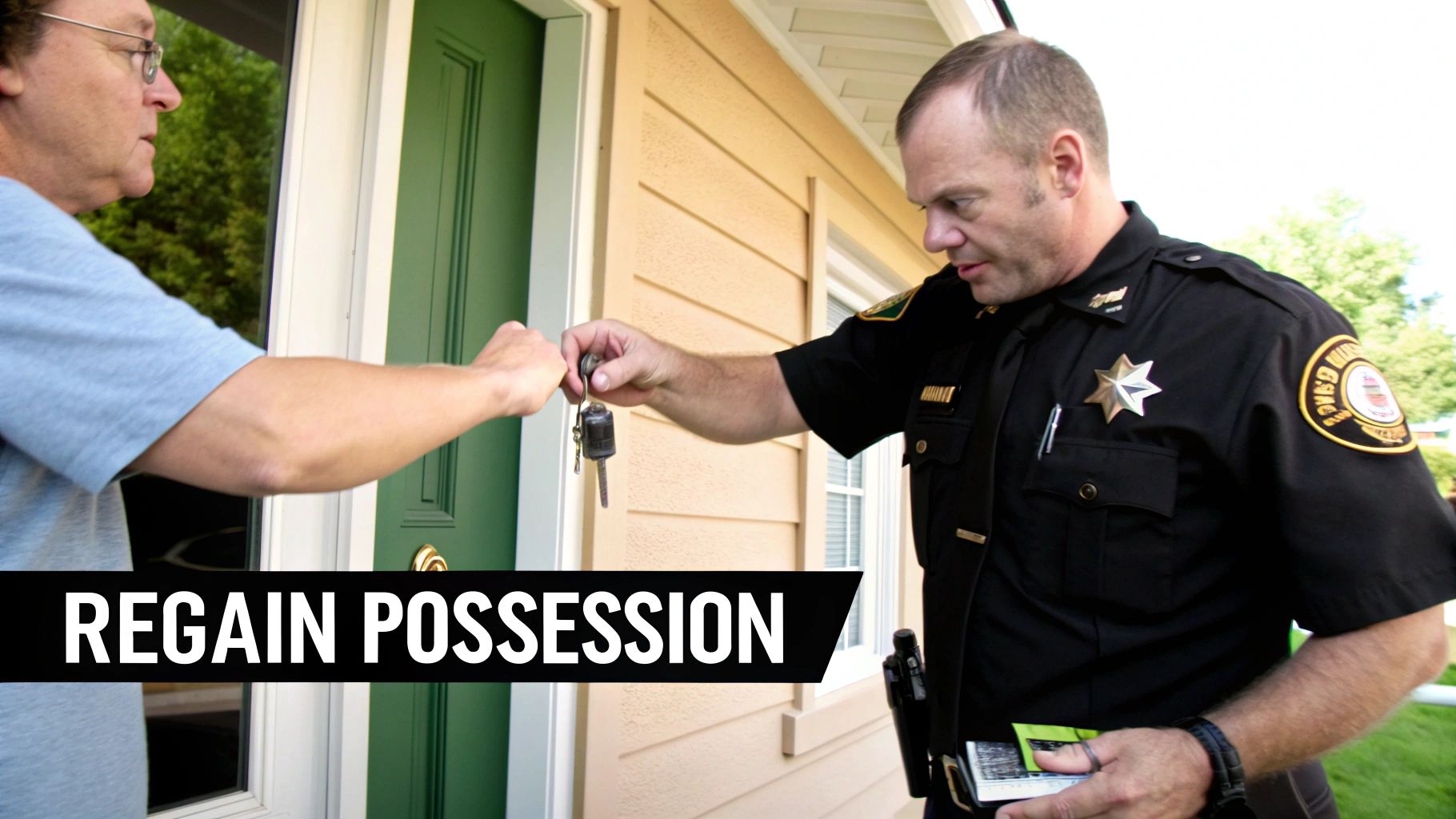
From Judgment to Writ of Possession
The first thing you need to do after you win is get a Writ of Possession of Real Property. This is the official court document that tells the sheriff they have the authority to evict the tenant. You'll file the request forms with the court clerk, who will issue the stamped and signed Writ.
Think of it this way: the judgment is the permission slip, but the Writ is the official order that gets things moving. You can't go any further without it.
Once you have that Writ in hand, you take it straight to the sheriff’s department for the county your property is in. You'll have to pay a fee for their services, usually a few hundred dollars, but it's a non-negotiable cost to make sure the final eviction is handled by the book.
The Sheriff's Role in the Final Lockout
After you’ve delivered the Writ and paid the fee, the sheriff's office takes the lead. They will schedule a time to go to your property and post a 5-Day Notice to Vacate on the tenant's door.
This notice is the final, official warning. It lets the tenant know they have five calendar days to move out on their own. If they’re still there when that time is up, the sheriff will be back to physically remove them.
That five-day period is absolute. Here’s how it usually plays out:
- A deputy posts the notice, which starts the clock.
- The sheriff’s office coordinates the exact date and time for the final lockout with you, which happens after the five days expire.
- On lockout day, you or your property manager absolutely must meet the sheriff at the property. The sheriff will escort anyone remaining off the premises, and you can have a locksmith change the locks on the spot.
Being on time and ready for the lockout is critical. I always tell my clients to have the locksmith scheduled and waiting nearby. The second the sheriff gives you the go-ahead, you need to secure that property to prevent the former tenant from getting back inside.
Dealing With Abandoned Personal Property
So what happens if the tenant leaves a couch, clothes, and boxes behind? California law is extremely specific here—you can’t just haul it all to the dump. If you do, you could get sued for the value of everything you threw away.
You have to follow a strict procedure. If you genuinely believe the leftover items are worth less than $700, you can typically dispose of them. But if the property looks like it's worth $700 or more, you must:
- Store the belongings in a safe place.
- Mail a formal "Notice of Belief of Abandonment" to the tenant’s last known address.
- Give the tenant at least 15 days to claim their property (or 18 days if you mailed the notice).
If the tenant comes back for their things, they are required to pay for reasonable storage costs. If they don't claim the property in time, you can sell it at a public auction. After you’ve deducted the costs of the auction and storage, any money left over must be turned over to the county. Handling this last step of the tenant eviction process in California correctly is essential to avoiding any new legal headaches.
Anticipating Common Tenant Defenses
Winning in eviction court isn't just about showing up and telling your side of the story. It's about chess, not checkers. You have to think a few moves ahead, anticipating what your tenant will argue and having the evidence ready to dismantle their claims before a judge even gives them a second thought.
A smart landlord doesn't just react; they build a defense-proof case from the day the lease is signed. Tenants have every right to contest an eviction, and from my experience, they usually lean on a handful of common legal defenses. Knowing what they are—and how solid property management practices can shut them down—is your most powerful tool.
The Habitability Defense: Your Responsibility on Trial
One of the most powerful arguments a tenant can make is the breach of the warranty of habitability. This isn't just legal jargon; it's a fundamental promise that your property is safe and livable.
If a tenant can credibly claim they shouldn't have to pay rent because the heater was broken all winter, a plumbing leak went ignored, or they were dealing with a pest infestation, they get the judge's attention. This defense strikes at the heart of the rental agreement.
Your absolute best shield here is meticulous record-keeping. Every single repair request, no matter how small, needs to be logged. Document your response, the timeline, and the resolution.
- Keep a Log of Everything: Note the dates and times of phone calls, save copies of every email, and screenshot text message exchanges.
- Document the Fix: Keep all invoices and receipts from your handyman or contractors. Before-and-after photos are worth their weight in gold.
- Respond Immediately: Even if you can't fix it that day, a prompt reply acknowledging the request shows you're engaged and responsible.
This paper trail is your proof. It demonstrates that you're a proactive landlord who takes care of your property, making it incredibly difficult for a tenant to paint you as negligent. The first step is truly understanding what repairs are landlords responsible for so you can build that bulletproof record.
Procedural Errors Can Kill Your Case
I've seen it happen: a judge dismisses an entire eviction case because of a tiny technicality. Tenants and their attorneys are experts at combing through the tenant eviction process in California looking for any mistake, no matter how small.
The notice is their first target. Was the rent amount on the 3-Day Notice off by a single dollar? Did you serve it by posting and mailing, but dropped the copy in the mail a day late? These seemingly minor slip-ups can invalidate everything, sending you right back to square one.
The court doesn't care about your intentions; it cares about the letter of the law. Following the notice requirements perfectly isn't just a suggestion—it's the ticket you need to even get your case heard.
Double and triple-check every single detail on your forms before you serve them.
Retaliation and Discrimination Claims
This is where things can get serious. A tenant might claim you're not evicting them for unpaid rent, but as an act of retaliatory eviction because they reported a code violation or asked for a necessary repair.
Another defense, though less common, is a claim of discrimination. The tenant could argue the eviction is based on their race, family status, or another protected class under the Fair Housing Act. If proven, this isn't just a lost case—it's a massive legal and financial liability.
The only way to defeat these claims is with consistency and documentation.
- Treat Everyone the Same: Apply your rules, rent collection policies, and enforcement actions identically for every single tenant. No exceptions.
- Keep it Professional: All your communication should be strictly business, focused on the lease terms.
- Document the Real Reason: Your detailed records—the ledger showing unpaid rent, the photos of lease violations—become your irrefutable evidence. They prove the eviction is based on legitimate business reasons, not a personal vendetta.
Answering Your Top California Eviction Questions
Even when you follow the steps, the eviction process can throw a few curveballs. Every landlord runs into "what if" scenarios, so let's tackle some of the most common questions I hear from property owners.
How Long Does The Entire Eviction Process Take In California?
This is the million-dollar question, and the honest answer is: it depends. The timeline can swing wildly based on how your tenant responds.
If you're lucky, you'll have an uncontested eviction. This is where the tenant gets the notice, doesn't put up a fight, and leaves after you file the lawsuit. In this best-case scenario, you could be looking at a relatively quick 3 to 6 weeks from serving the first notice to having the sheriff perform the final lockout.
But the moment a tenant decides to fight back by filing an Answer with the court, the clock slows way down. A contested eviction can easily stretch out to 60 or 90 days, sometimes even longer. Several things can throw a wrench in the works:
- Court Congestion: Busy courthouses often mean your trial date gets pushed further and further back.
- Simple Mistakes: One small error on a notice or a misstep in your court filing can be enough to get your case thrown out, forcing you to start all over again.
- Tenant Delay Tactics: A savvy tenant or their attorney can file various motions or demand a jury trial, adding weeks or even months to the process.
Can I Evict a Tenant Without a Written Lease Agreement?
Absolutely. In California, a verbal agreement is still a legal agreement. It usually creates a default month-to-month tenancy, and the lack of a written lease doesn't leave you powerless.
You just have to follow the correct notice procedures for that tenancy type.
To end a month-to-month tenancy without cause, you must serve a written notice. If the tenant has lived in your property for less than a year, a 30-Day Notice to Quit is what you'll need. If they've been a resident for a year or more, the law requires you to give them a 60-Day Notice to Quit.
And if you're evicting for a specific reason—like they haven't paid rent—you'd use the standard notice for that violation, such as a 3-Day Notice to Pay Rent or Quit. The bottom line is that while verbal leases are valid, all of your termination and eviction notices must be in writing. No exceptions.
What If a Tenant Files for Bankruptcy During an Eviction?
This is a serious roadblock. When a tenant files for bankruptcy, it triggers something called an "automatic stay" under federal law. This immediately freezes your state-level eviction lawsuit in its tracks.
The second you're notified of a bankruptcy filing, you must halt all eviction activities. Pushing forward with notices, court filings, or a lockout can result in harsh federal penalties.
To get your eviction back on track, your attorney has to go to the federal bankruptcy court and file a motion asking the judge to "lift the stay." You can only resume the Unlawful Detainer case after the bankruptcy judge grants that request. This is not a DIY situation; you need professional legal help to navigate this.
When Should I Hire a Professional for an Eviction?
While you're legally allowed to handle your own eviction (in pro per), the process is a minefield of potential mistakes. One slip-up can derail your entire case.
You should seriously consider bringing in an experienced eviction attorney or a professional property manager if:
- This is your first eviction.
- The tenant has already hired their own lawyer.
- Your property is in a city with its own strict rent control laws.
- The tenant has filed for bankruptcy or is bringing up complex legal defenses.
If you’re thinking about getting help, it’s crucial to know the official California paralegal requirements to make sure anyone you hire is qualified. A single mistake can cost you months in lost rent and legal fees—often far more than what you would have paid an expert from the start.
Navigating the tenant eviction process in California demands precision, patience, and expertise. If you're facing a difficult tenant situation or simply want to ensure your properties are managed correctly to avoid these issues, Edinhart Realty and Property Management can help. Our team provides professional, reliable services to protect your investment and give you peace of mind. Learn more about our comprehensive property management solutions at https://edinhart.com.


