

Furnished rentals typically command a 20–50% rent premium in most U.S. markets, but that premium doesn't automatically produce higher net income after furniture, turnover, vacancy, and tenant-fit risk. If your property doesn't serve a strong furnished-rental audience, unfurnished is usually the safer choice.
Should you rent your house furnished or unfurnished? The conventional answer focuses on the rent check. That's the wrong starting point. A furnished home can earn more gross revenue and still leave you with less cash, more work, and a larger replacement bill.
A Central California owner needs to judge the property, not the national headline. A home near a hospital, university, employer cluster, or relocation corridor may justify furniture. A family house in a stable neighborhood may perform better with an ordinary long-term lease and no inventory to maintain.
| Decision factor | Furnished rental | Unfurnished rental |
|---|---|---|
| Rent position | Often higher, with furnished premiums commonly ranging from 20–50% in U.S. markets (market benchmark) | Usually aligned with comparable local rentals |
| Best tenant fit | Relocations, business travelers, traveling healthcare workers, and other mid-term renters | Families, local workforce tenants, and long-term households |
| Owner investment | Furniture, household goods, inventory, and replacement reserves | Minimal setup beyond the home and included appliances |
| Management intensity | Higher, especially at move-in, move-out, and replacement time | Lower, with fewer owner-supplied items |
| Main risk | Premium compression, damage, vacancy between specialized tenants, and depreciation | Lower revenue ceiling and less flexibility for temporary renters |
| My default recommendation | Use only when demand and operations support it | Choose this when simplicity and stable occupancy matter most |
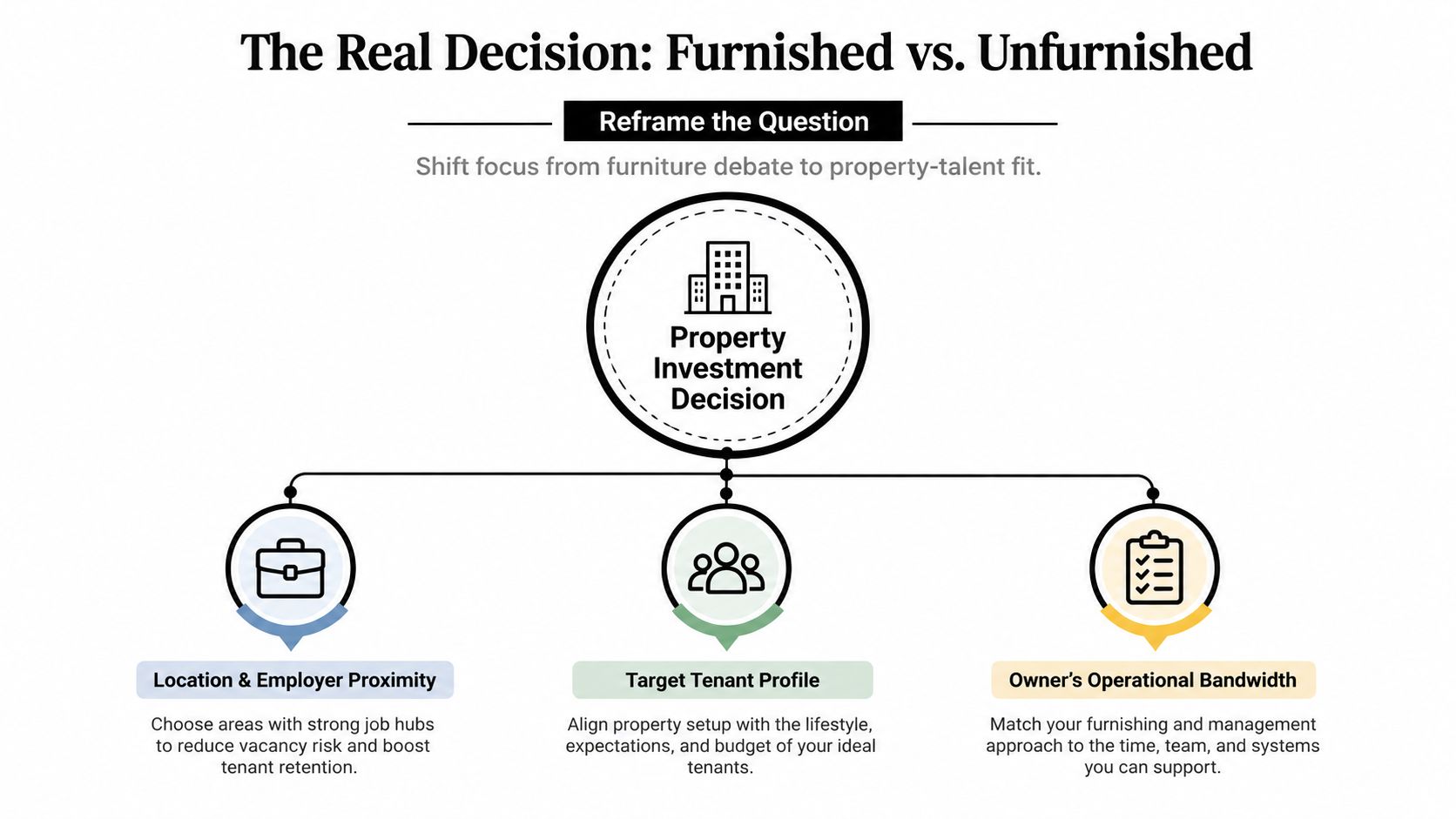
The right answer comes from testing four filters: tenant segment, owner capacity, property layout, and lease horizon. A 1,500-square-foot single-family house in Clovis won't attract the same audience as a compact mid-century rental near Fresno City College. The address, floor plan, parking, storage, and nearby demand drivers matter more than a generic furnished-rental rule.
The Real Decision Behind Furnished vs Unfurnished
The decision isn't whether your furniture looks good. It's whether you want to operate a higher-rent, higher-touch property or a lower-rent, lower-touch property.
Start with the tenant segment. Furnished housing works when renters value speed and convenience enough to pay for a ready-to-live-in home. That can include corporate relocation households, medical professionals on assignments, students, consultants, and people waiting for a permanent home or insurance repairs. Unfurnished housing attracts renters who already own furniture and expect to stay long enough to make the move worthwhile.
Next, assess your operating tolerance. Furnished owners buy, deliver, assemble, photograph, inventory, repair, clean, store, and replace household items. You'll need a process for distinguishing ordinary wear from damage and for making the home ready between leases. If you want rent collection and repair coordination to remain simple, furniture adds exactly the kind of work you're trying to avoid.
Apply the property-fit test
The floor plan has to support the intended renter. A furnished house needs usable sleeping arrangements, comfortable seating, dining space, work surfaces, storage, and durable circulation paths. If adding furniture makes a small living room feel crowded, the premium may not compensate for a poor tenant experience. Owners working with compact rooms can review space-saving living room layouts before buying anything.
Location is the second part of fit. A Clovis home near medical employment and major commuting routes has a stronger argument for furnished positioning than a remote property with no obvious reason for a temporary renter to choose it. Proximity doesn't guarantee demand, but it gives your marketing a specific audience instead of a vague “move-in ready” label.
Decide how much flexibility you actually want
Lease horizon changes the economics. An owner seeking a stable household and a long renewal cycle should usually choose unfurnished. An owner willing to manage more frequent placements may choose furnished if the property clearly serves a mid-term audience.
Before making the decision, review the broader responsibilities of rental ownership in this guide to the pros and cons of renting out your house. Then write down the tenant you want, the lease duration you can handle, and the maximum furnishing budget you can fund without using emergency reserves.
Practical rule: If you can't name the likely furnished tenant and the reason they'll choose your address, don't furnish the house.
What Furnished and Unfurnished Cost You
Will the furnished rent cover the furniture, turnover, and vacancy it creates? That is the decision to test. A rent premium is revenue, not profit, so compare gross rent with every cost caused by furnishing the property.
Broad U.S. comparisons place furnished rentals about 20–50% above comparable unfurnished homes. Examples range from 28% in a Midwest average to 50% in Austin, while slower markets can compress the premium to 15–25% (furnished-rental market comparison). Use those figures to frame the question, not to set a Fresno rent. Pull local furnished and unfurnished comparables before buying anything.
A separate Washington, D.C. example shows how large the gross gap can appear. The unfurnished one-bedroom rents for $2,175 per month, compared with $3,498 furnished, a difference of $1,323 per month, or about 60.8% (rental cost comparison). That difference does not represent your return. Furniture, included utilities, make-ready work, damage, storage, and vacancy can consume it.
Price the entire operating stack
Build the furnished budget around these costs:
- Initial setup: Beds, sofas, dining furniture, desks, lamps, cookware, linens, and window coverings require cash before the first lease starts.
- Replacement exposure: Mattresses, upholstered seating, electronics, and smaller household goods wear out or disappear. Set a replacement reserve instead of treating the initial purchase as a one-time expense.
- Turnover work: Each furnished move-out calls for inventory checks, photographs, cleaning, damage assessment, and restocking. Unfurnished turnover is often simpler because the tenant removes the contents.
- Vacancy risk: Furnished housing serves a narrower renter pool. If the right tenant is unavailable, the property may sit while you wait for a suitable placement.
- Storage: Furniture removed between occupants needs a destination. Storage, transport, and handling become direct expenses during a vacancy.
An unfurnished rental gives up the convenience premium, but it also removes owner-funded furniture and reduces the items that can fail, disappear, or trigger a dispute. For many Central California owners, that predictable model beats a larger advertised rent.
Use a net-income worksheet, not a rent comparison
The table below shows how to structure the decision. It uses a hypothetical comparison, not a Fresno market forecast. Enter your actual local vacancy, furnishing, insurance, utilities, and turnover costs before choosing a strategy.
| Line Item | Furnished | Unfurnished |
|---|---|---|
| Advertised monthly rent | $3,100 | $2,400 |
| Gross scheduled rent for 12 months | $37,200 | $28,800 |
| Furniture and household setup | Subtract actual cost and replacement reserve | None or minimal |
| Turnover and inventory work | Higher | Lower |
| Vacancy between tenants | Model separately | Model separately |
| Utilities, internet, and supplied items | Subtract if owner-paid | Usually lower owner exposure |
| Insurance and contents coverage | Confirm with carrier | Standard rental coverage may be simpler |
| Net annual income | Calculate after all furnished costs | Calculate after all unfurnished costs |
For the maintenance side of the calculation, use a written rental property maintenance cost framework and add a separate furniture-replacement line. If the premium disappears after those entries, choose unfurnished. A higher asking rent is not a better investment when turnover work and depreciation absorb the difference.
Tenant Type, Lease Length, and Screening Reality
Furnished and unfurnished listings don't just attract different décor preferences. They attract different life situations.
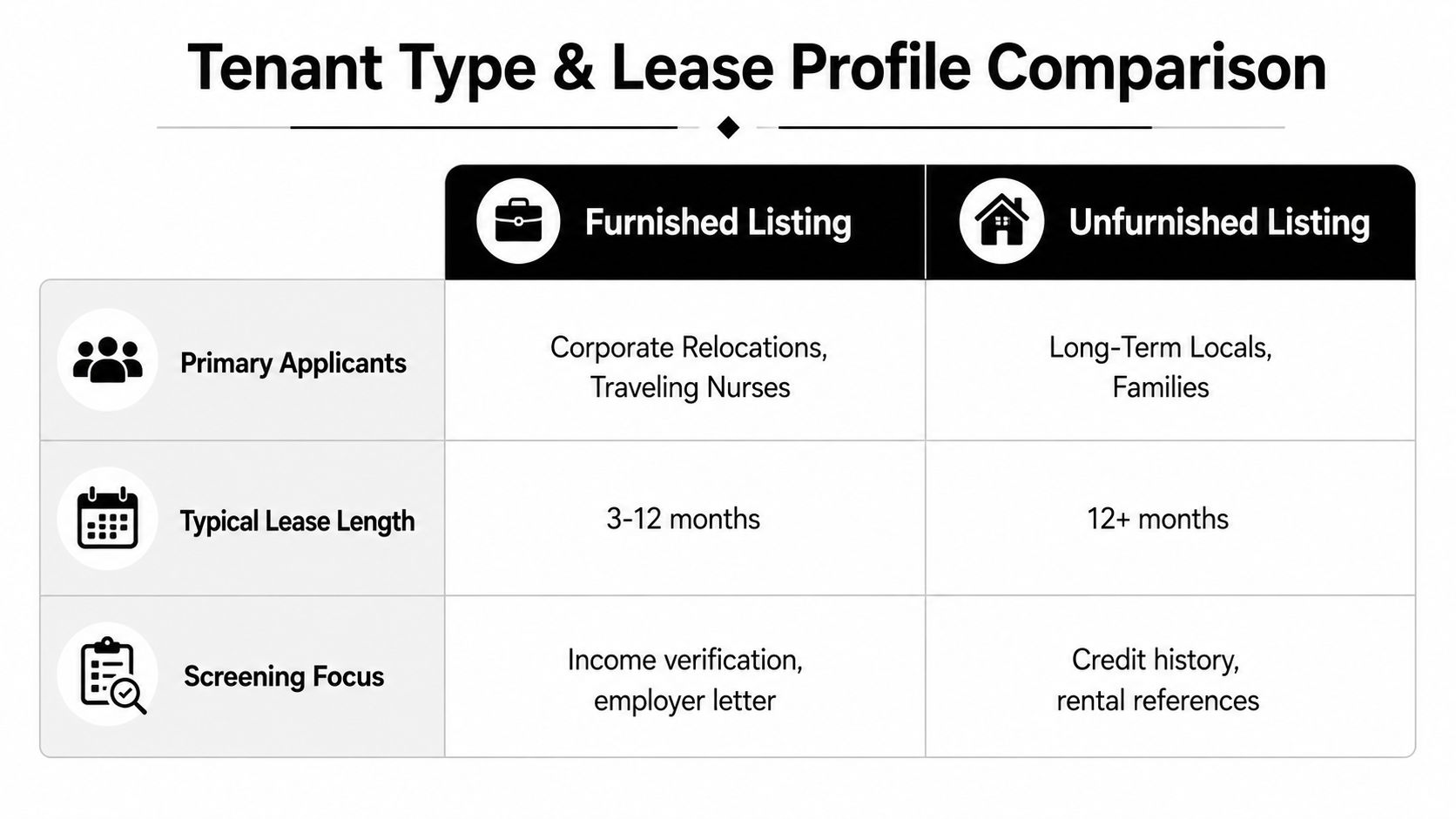
A furnished Fresno-area home may appeal to corporate relocation households, traveling healthcare workers connected to medical campuses, graduate students, and tenants displaced by divorce, repairs, or insurance claims. An unfurnished home usually speaks more directly to families and local workforce tenants who already have household goods and want a stable residence.
The furnished audience can be valuable, but it's narrower. Monthly-rental demand has shifted toward longer stays, with 28-plus-day stays increasing 136%, from 20 million nights in 2019 to 46 million in 2025, according to the cited 2025 market report (monthly-rental market report). The same source reports a 130% increase in relocation-driven stays and an average group size rising to 2.6 people, which matters for owners deciding between a studio, one-bedroom, or multi-bedroom property.
Screen the source of payment
Furnished screening isn't automatically weaker. It's different.
For a local long-term applicant, you'll usually examine income, employment, credit, rental history, references, and the application itself. For a relocation applicant, you may also need an employer letter, assignment dates, relocation-company paperwork, or confirmation of who will pay the rent. An insurance-displacement tenant may involve carrier authorization, a claims contact, and a defined housing period.
Use consistent written criteria across every applicant. The paperwork can change by tenant segment, but your standards for identity, ability to pay, lawful occupancy, and lease compliance shouldn't.
Match the lease to the management model
Unfurnished leases often support a longer operating cycle. Furnished leases can be shorter or more flexible, which creates more placement opportunities but also more inspections and administrative work. Don't assume a tenant's professional title replaces screening. A traveling nurse, relocating executive, or graduate student still needs documented ability to meet the lease terms.
Landlords without a process often miss the details. They accept an employer email without verifying the assignment, skip a complete inventory, fail to document who is responsible for utilities, or approve an extension without updating the lease. Use a defined tenant screening process and keep the same decision standards for every applicant.
Furnished housing wins when the tenant source is real and active. If your marketing plan consists only of listing the house and hoping someone pays the premium, unfurnished is the more disciplined choice.
Insurance, Tax, and Legal Wraps Around Furniture
Furniture changes the owner's exposure even when the lease looks similar. The building remains the building, but you've added personal property, replacement decisions, inventory disputes, and potential liability involving items you supplied.
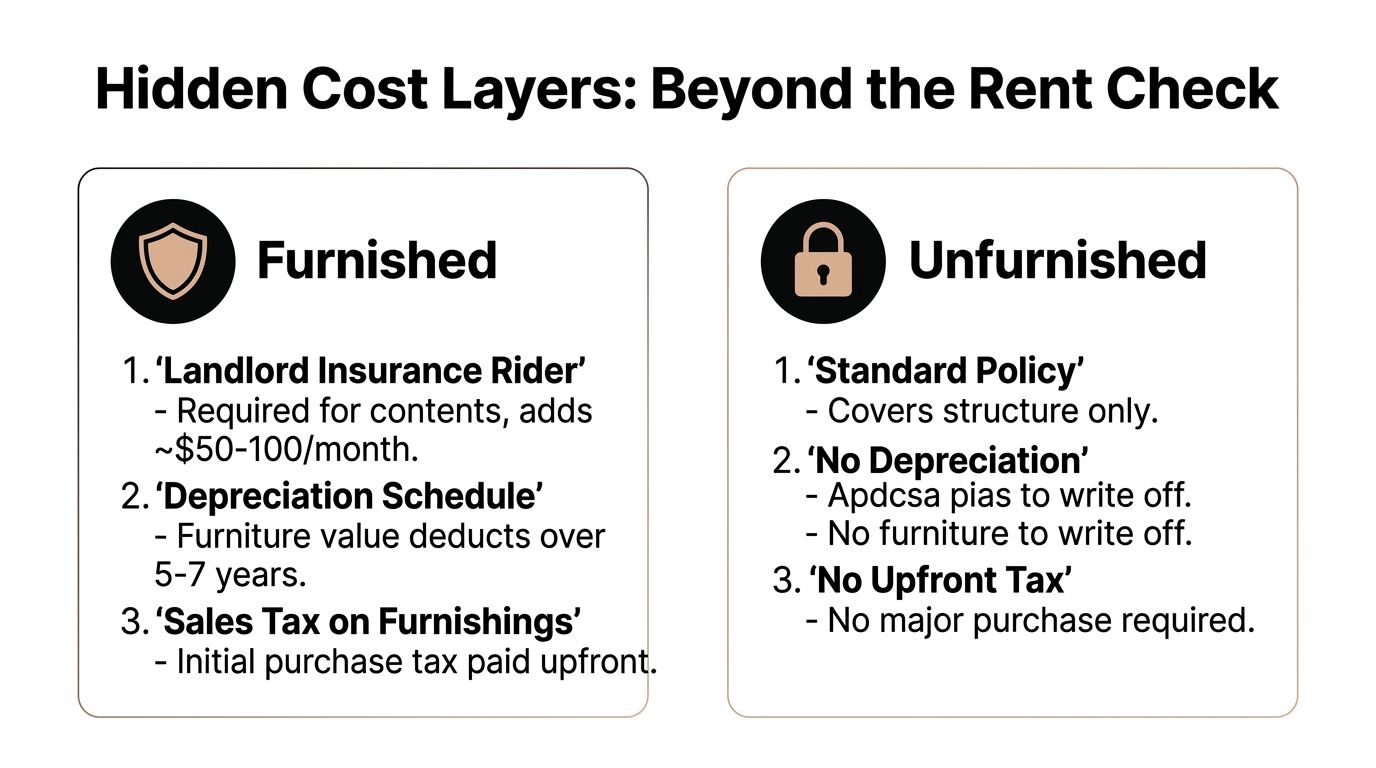
Ask your insurance carrier whether the policy covers landlord-owned contents and whether you need a specific rider. Don't assume a standard rental policy protects every sofa, television, bed, appliance, or kitchen item. Get the answer in writing, including exclusions, deductibles, liability limits, and replacement-cost treatment.
Tax treatment also requires documentation. Furniture isn't the same category as the real estate itself, so owners should review how property type affects taxes with a qualified tax professional. Keep receipts, delivery records, installation costs, photographs, and an itemized inventory. Your tax advisor, not a rental listing, should determine the appropriate depreciation treatment.
Put the contents in the lease
A furnished lease needs more than the phrase “fully furnished.” Attach an inventory that identifies each major item and records its condition. Photograph the home before occupancy, have the tenant acknowledge the condition, and repeat the inspection at move-out.
Include clear language covering:
- Wear and tear: Define ordinary aging separately from misuse and damage.
- Tenant responsibility: State how the tenant is responsible for damage beyond ordinary wear, subject to applicable California law.
- Ownership: Identify the supplied furniture as landlord-owned personal property.
- Removal and storage: Prohibit removal, disposal, or relocation of furnishings without written consent.
- Utilities and services: Spell out every included service and any usage limits or responsibilities.
That paperwork protects both parties. It also gives you a defensible record when a tenant disputes a missing item or damaged surface.
Don't ignore a softer premium
The furnished premium has weakened in some markets. A 2025 Canada rental market report recorded a significantly larger year-over-year price decline for furnished units, while unfurnished one-bedroom rent was $1,939, up only 0.99% year over year after a larger prior increase (Canada rental market report). That isn't a Fresno rent figure, but it's a warning against using static premium assumptions.
Inland Central California owners should stress-test the premium against depreciation, vacancy, storage, and turnover. If the margin only works during a strong furnished-demand cycle, unfurnished is the responsible default.
Three Fresno-Area Scenarios Worth Comparing
The same owner can receive three different answers by changing only the property and tenant profile. These are representative decision scenarios, not verified case studies or market forecasts.
A Clovis bungalow near a hospital corridor has a credible furnished argument. A relocation household or traveling healthcare professional may value a ready-to-live-in home, especially if the property offers parking, a practical kitchen, comfortable bedrooms, and a work area. The owner should still verify the tenant source before buying furniture, because nearby medical employment creates an opportunity, not guaranteed occupancy.
A Fig Garden four-bedroom home points the other direction. If the property's strongest appeal is its neighborhood, space, and suitability for a household that wants stability, unfurnished is usually the better operating model. The owner avoids furnishing a large home for a narrow tenant segment and can focus on durable maintenance, school-area marketing, and renewal quality.
A Tower District workforce rental sits in the middle. Its recommendation depends on layout, transit access, furniture quality, and proximity to employment or university demand. A clean, functional furnished setup may work for mid-length renters, but poor furniture or limited storage can make the same unit less attractive than an unfurnished home where tenants bring their own belongings.
| Scenario | Property Type | Furnished Rent Premium | Furniture Capex | Avg. Vacancy Days/Year | Net Income 24 Months |
|---|---|---|---|---|---|
| Clovis medical-corridor bungalow | Relocation-oriented single-family home | Verify against current comparable listings | Build an itemized property budget | Measure from local furnished comps | Compare after vacancy, supplies, insurance, and replacement reserve |
| Fig Garden family rental | Larger home serving stable households | Likely less important than tenant stability | Avoided under the unfurnished model | Measure traditional lease vacancy | Compare lower management cost against furnished gross rent |
| Tower District workforce rental | Compact home or apartment near employment and education | Depends on layout and tenant demand | Keep setup practical and durable | Test both leasing models locally | Compare the premium against added turnover and storage |
The owner should also budget the building itself before changing the rental format. A pre-listing inspection can catch worn exterior components, and resources on inspecting used doors and siding may help frame repair or replacement questions before furniture absorbs the available cash.
A strong location can justify furnished positioning. It can't rescue a weak floor plan, poor condition, or unsupported rent.
Over a 24-month decision window, the furnished model survives only if the premium arrives consistently enough to pay for the setup and extra turns. The Fig Garden model usually favors predictable occupancy. The Clovis model can favor furnished when the demand source is verified. The Tower District model requires an actual comp and tenant audit, not a guess.
A Quick Decision Matrix for Your Property
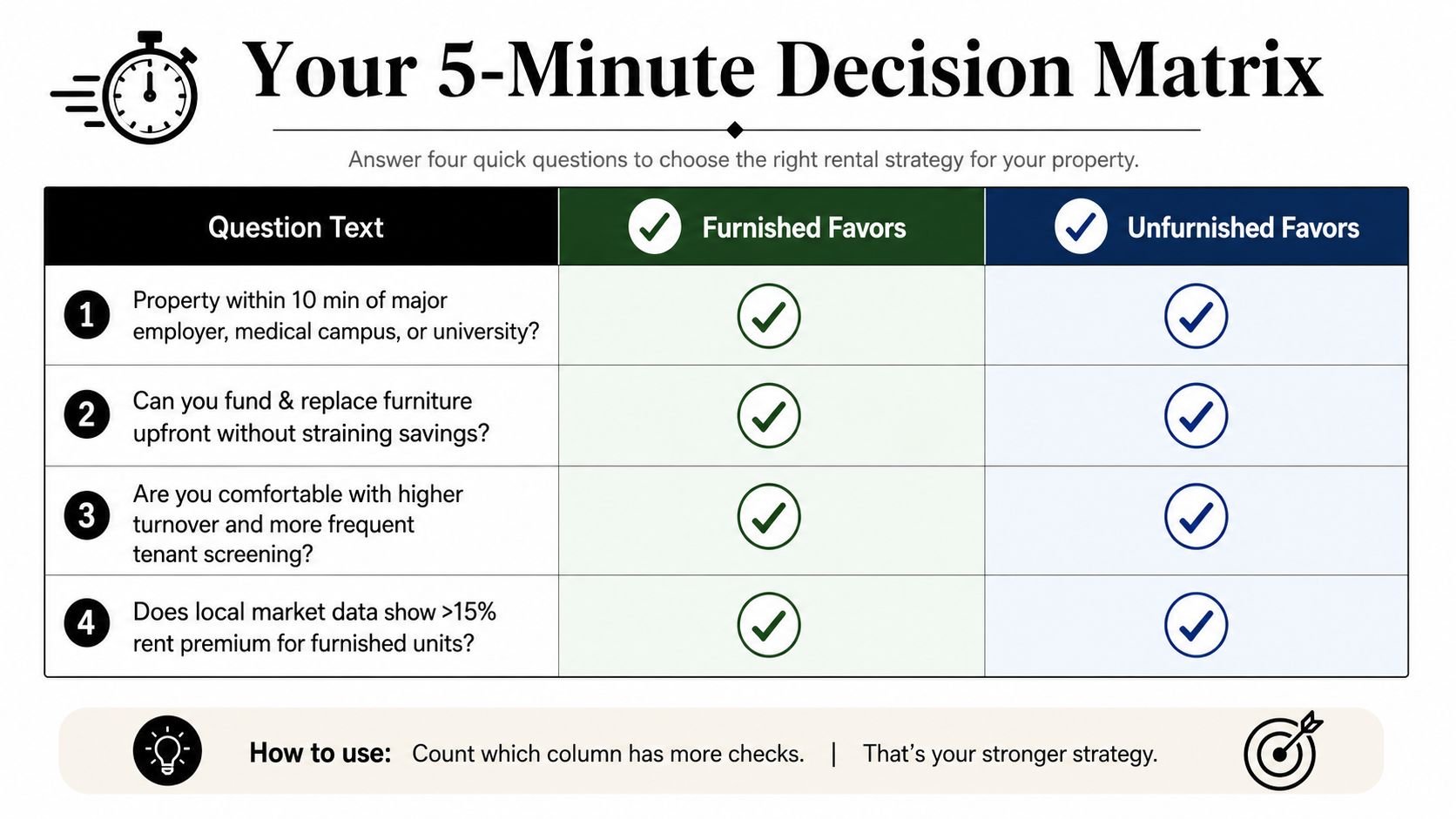
Use four questions before you spend on furniture. Answer them from evidence, not optimism.
First, is the property close to a major employer, medical campus, or university? A location near a reliable demand source supports furnished marketing. A property with no clear temporary-housing audience should start unfurnished.
Second, can you fund the setup and replacement cycle without straining your reserves? Furniture is an operating asset, not a decorative bonus. If buying it forces you to defer roof, HVAC, plumbing, or safety work, stop.
Third, can you handle higher turnover and more involved screening? Furnished leasing demands inventories, condition reports, specialized documentation, and faster decisions when a tenant's assignment changes.
Fourth, do current local comps show a meaningful premium? The relevant number is not a national average. It's the rent difference between similar homes in your submarket, adjusted for size, location, utilities, condition, parking, and lease length.
Score the operating reality
Use a 100-point worksheet. Give each category 25 points when the property and owner strongly support furnished leasing, 12 points when the answer is mixed, and zero when the answer favors unfurnished.
| Category | 25 points | 12 points | 0 points |
|---|---|---|---|
| Local demand | Verified furnished tenant source nearby | Some plausible demand, limited proof | No clear furnished audience |
| Rent premium | Local comps support a strong premium | Premium exists but is inconsistent | No meaningful premium |
| Capital capacity | Setup and replacements are comfortably funded | Funding is possible but tight | Furniture would strain reserves |
| Management bandwidth | Owner or manager can handle frequent turns | Limited capacity with a backup plan | Owner wants a low-touch lease |
A score above 70 favors furnished. A score below 40 favors unfurnished. Scores in the middle require a manager's local leasing evidence and a conservative financial model.
The score isn't a substitute for underwriting. It forces you to account for demand, capital, and labor at the same time. If the property earns points only because you like the idea of higher rent, the model is already biased.
Read the result without talking yourself into it
A high score means furnished is worth testing, not that you should buy the most expensive furniture available. Start with durable essentials, document the condition, and price against current comparable homes.
A low score is a clear answer. List the property unfurnished, target stable households, and preserve your cash for repairs and vacancy. The simplest model often produces the best risk-adjusted result for a homeowner who doesn't want another business to operate.
Next Steps Before You Lock In a Decision
Don't make the decision from a vacant-room impression. Use a short verification process.
Run a 14-day market check
For two weeks, track comparable furnished and unfurnished listings in the same submarket. Record asking rent, included utilities, furniture quality, bedroom count, parking, lease term, date listed, and whether the listing remains active. Separate true competitors from properties that only appear comparable because they share a ZIP code.
Look for evidence of tenant fit. A furnished home near a medical campus should be marketed where that audience searches, not only on a general rental site. An unfurnished family home needs a different message, different photos, and a different lease expectation.
Build the recovery worksheet
List every furnishing purchase before you buy it. Include delivery, assembly, kitchen goods, linens, window treatments, internet equipment, storage, cleaning, and replacement reserves. Then compare the expected furnished rent with the unfurnished rent after all owner-paid expenses.
Prepare these documents for a property-management consultation:
- Property facts: Floor plan, bedroom and bathroom count, parking, storage, current condition, and current rent.
- Financial records: The last 12 months of operating statements, repair invoices, utilities, insurance, and vacancy history.
- Market evidence: Current furnished and unfurnished comparable listings, including lease terms and included services.
- Inventory list: Furniture and household items already in the home, with photographs and condition notes.
Ask a manager questions that force real answers
Don't ask whether furnished rentals are “popular.” Ask:
- How many comparable furnished homes leased recently in this submarket?
- What rent did those homes achieve?
- How long did they remain vacant?
- Which tenant sources produced the applications?
- What furniture replacement reserve do you recommend?
- What insurance rider or contents coverage does the carrier require?
- What happens to the furnishings during a gap between tenants?
- How will you document condition and charge for damage lawfully?
A manager should be able to separate asking-rent opinions from completed leasing evidence. If the answer relies only on a national premium, keep the property unfurnished until you have better information.
Complete the 48-hour verification
Before signing a lease, confirm three items in writing. Verify that the target tenant segment is active in your specific submarket. Confirm furniture depreciation assumptions with your tax advisor. Confirm insurance coverage, exclusions, and contents protection with your carrier.
If those checks support the furnished model, furnish for the tenant rather than for your personal taste. If they don't, list the home unfurnished and protect your cash flow with a simpler lease.
Edinhart Realty and Property Management can help compare local furnished and unfurnished positioning, market the vacancy, screen applicants, draft the lease, and coordinate move-in and move-out details. Visit Edinhart Realty and Property Management with your rent history, property details, and furnishing plan so you can make the decision from local leasing evidence instead of guesswork.


