

When you're getting ready to sell your home in California, the final sale price is just one piece of the puzzle. The other, often overlooked, piece is your closing costs. These fees can have a real impact on your bottom line.
As a rule of thumb, sellers in California can expect to pay around 1-3% of the home's sale price in various closing fees. That's before you even factor in real estate agent commissions, which usually add another 5-6% to the total. A good seller closing costs calculator for California can really help you see the full picture.
Understanding California Seller Closing Costs
So, what exactly are closing costs? Think of them as the service fees paid to all the different professionals and agencies who make your home sale happen. They aren't just random charges; they cover crucial legal and administrative work needed to safely and legally transfer the property from your name to the buyer's.
It’s like the final bill for your home sale. The buyer’s money goes into a neutral escrow account. Before you get your proceeds, the escrow officer pays out all the agreed-upon expenses. This system makes sure everyone involved, from your agent to the county recorder, gets paid correctly.
Who's Getting Paid and Why?
It helps to know who's working behind the scenes to get your sale across the finish line. Their services are what make up the bulk of your closing fees.
- Real Estate Agents: Your listing agent and the buyer's agent are paid for all their work—marketing your home, negotiating offers, and guiding you through the whole process.
- Escrow Officer: This is a neutral third party who manages the transaction, holding onto all the funds and documents until every condition of the sale has been met.
- Title Company: They're responsible for doing a title search to make sure there are no outstanding liens or claims against your property. They also issue an insurance policy to protect the new owner.
- County Recorder: This is the government office that officially documents the change of ownership in public records, making it official.
A Quick Glance at the Numbers
To give you a better sense of what this all adds up to, here's a quick summary table of the typical costs you can expect to see.
Typical California Seller Closing Costs at a Glance
| Cost Category | Typical Percentage of Sale Price | Brief Description |
|---|---|---|
| Realtor Commissions | 5% – 6% | Split between the seller's and buyer's agents for their services. |
| Escrow & Title Fees | ~1% | Covers the cost of the escrow officer and title insurance/search. |
| Transfer Taxes | Varies by County/City | Taxes levied by state, county, and sometimes city governments. |
| Miscellaneous Fees | <1% | Includes recording fees, HOA fees, prorations, and other smaller charges. |
This table provides a high-level view, but remember that the exact percentages can shift based on your location and the specifics of your sale.
What's the Real-World Financial Impact?
So, what does this look like in dollars and cents? Recent data shows that in California, the average seller closing costs are about 2.72% of the home's purchase price. On top of that, realtor commissions add another 5.03% on average. For a median-priced home in our area, this can easily mean tens of thousands of dollars coming out of your net profit.
When you close, you'll receive a final settlement statement (often called a Closing Disclosure) that itemizes every single one of these costs. Our goal with this guide is to demystify that statement long before you see it, so you can forecast your profit with confidence.
Trying to figure all this out can feel a bit overwhelming, especially when you're also planning your next move. The good news is you don’t have to guess. While there are plenty of useful real estate calculators online to get a ballpark idea, this guide will go deeper and break down each specific fee you'll likely see right here in Central California.
A Line-By-Line Breakdown of Seller Fees
To really get a grip on where your money is going, we have to look past the general percentages and dig into the individual line items on your seller's net sheet. Every single fee serves a purpose in getting your home sold.
Using a seller closing costs calculator for California is a great first step, but truly understanding what’s behind each number is what gives you real control. Let’s pull back the curtain on the most common expenses you’ll see when selling your home in the Golden State.
Real Estate Agent Commissions
This is almost always the biggest piece of the pie. The total commission is a percentage of your home's final sale price, typically landing somewhere between 5% to 6% in California.
It's important to know this amount isn't just for one person. It gets split between your agent (the listing agent) and the agent who brings the buyer.
So, for a $450,000 home sale here in Fresno, a 5.5% commission works out to $24,750. That fee is then divided between the two real estate brokerages involved. It covers a ton of work, from professional photography and marketing your home to hosting open houses, skillfully negotiating offers, and managing the mountain of complex paperwork from the contract all the way to closing day.
Commission rates aren't set in stone; they can be a point of negotiation. For a much deeper dive into how these fees are structured, check out our detailed guide on real estate agent commission rates.
Escrow and Title Fees
These two are often lumped together, but they’re actually distinct services that are absolutely critical for a secure sale. Combined, they usually add up to about 1% of the sale price.
- Escrow Fees: Think of the escrow company as the neutral referee. They securely hold all the money and documents until every last condition in the purchase agreement has been met. Their fee covers all the admin work of managing the transaction and making sure the transfer goes off without a hitch. In Central California, it's pretty standard for the seller and buyer to split this cost 50/50.
- Title Insurance: Before you can sell your home, a title search is done to prove you have the legal right to sell it and that there are no hidden liens or claims. The seller typically pays for the Owner's Title Insurance Policy, which is a crucial protection for the new buyer against any old title issues that might pop up down the road. It’s a one-time premium you pay at closing.
I like to tell my clients to think of the escrow officer as the transaction's project manager and the title company as its legal historian. You need both to protect everyone and ensure the ownership transfer is clean and legally sound.
Government Fees and Taxes
Of course, the government gets its cut, too. These fees are non-negotiable and change depending on where your home is located.
County and City Transfer Taxes
This is simply a tax charged on the transfer of property from you to the new owner. California has a statewide documentary transfer tax of $1.10 per $1,000 of the sale price.
But watch out—many cities and counties tack on their own transfer tax right on top of the state's. While Fresno County sticks to the state rate, some cities in the Bay Area have much, much higher rates. This is why it’s so important to use a calculator that lets you input your specific city for an accurate estimate.
Recording Fees
This one is a small but mandatory fee paid to the county. It’s the cost to officially record the new deed in the public record, which is what makes the sale legally official. It’s usually a flat fee and often less than a couple hundred bucks.
Other Common Seller Costs
Beyond the "big three" of commissions, escrow/title, and taxes, you'll see a few other smaller fees show up on your settlement statement.
- Natural Hazard Disclosure (NHD) Report: California law requires sellers to disclose if their property is in a high-risk zone for things like floods, fires, or earthquakes. This report costs around $100 – $150 and is given to the buyer.
- Homeowner's Association (HOA) Fees: If you're in an HOA, you’ll have to pay for the prep of the HOA document package for the buyer, which includes bylaws, financials, etc. You’ll also be on the hook for any prorated HOA dues up to the day of closing.
- Pest Inspection and Repairs: In many parts of California, a pest (or "termite") inspection is a must, especially for buyers using VA or FHA loans. The seller often covers the initial inspection (around $75 – $150) and then negotiates with the buyer over any needed repairs.
- Home Warranty Plan: This is a popular strategy to make a home more attractive. Many sellers offer to pay for a one-year home warranty for the buyer, which provides peace of mind by covering potential breakdowns of major systems and appliances. These plans usually run between $400 and $600.
- Prorated Property Taxes: You’re responsible for property taxes for every day you owned the home during the tax year. Escrow will calculate the exact amount you owe up to the closing date, and it will be taken out of your proceeds. On the flip side, if you've already paid your taxes for the period, you might actually get a credit back.
Breaking It Down: A Real-World Fresno Example
Theory and percentages are great, but let's be honest—seeing the actual numbers is what really matters. To give you a clear picture of how closing costs affect your bottom line, we’ll walk through a realistic home sale right here in Fresno, California.
We'll use a final sale price of $450,000, a pretty common figure for our market in the Central Valley. By subtracting each cost one by one, you'll see exactly how we get from the sale price to your final net proceeds. This is the same process that happens in every real transaction.
Setting the Stage for Our Fresno Home Sale
Let's imagine a typical single-family home in Fresno County selling for $450,000. The sellers still owe $250,000 on their mortgage, which will be the first major expense paid off from the sale. We'll also assume a standard 5.5% total real estate commission, which is a competitive rate in our area.
Think of this breakdown as a manual run-through of a seller closing costs calculator for California. Understanding how these numbers work together is the key to selling your home with confidence and no surprises.
This flowchart gives a great visual of the main fee categories you'll encounter.
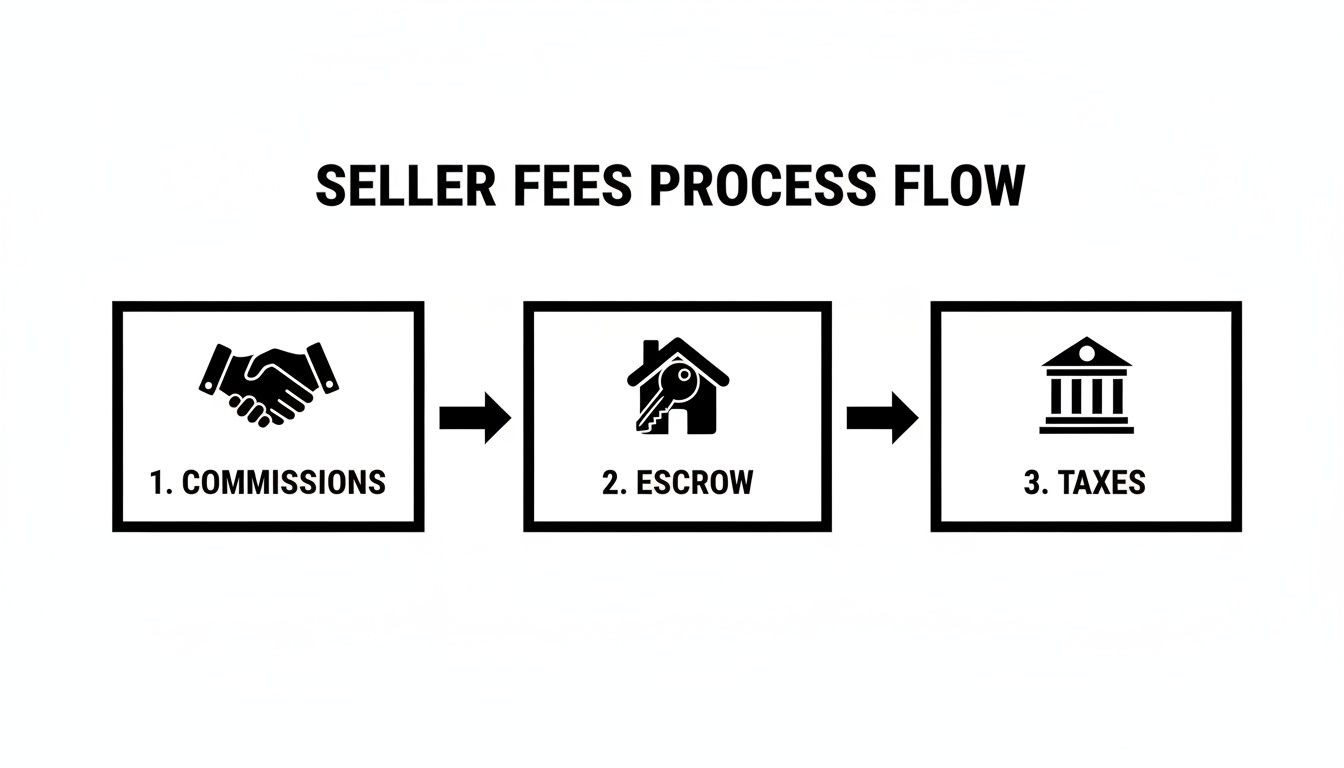
As you can see, the biggest chunks are professional commissions, escrow fees for handling the funds securely, and the government taxes that are part of every sale.
Calculating Your Net Proceeds, Line by Line
So, let's start with that $450,000 sale price and begin deducting the costs. The table below will keep a running total, showing you exactly how your take-home amount changes with each expense. This is the kind of detail you need for accurate financial planning.
The housing market is always changing, and knowing these costs helps you position your home effectively. To learn more about what's happening locally, check out these 7 housing trends in Fresno, CA that could impact your sale.
Now, let's get into the nitty-gritty with a sample net sheet.
This table breaks down the estimated costs for a typical Fresno home sale, giving you a transparent look at where the money goes.
Sample Net Sheet Calculation for a $450,000 Fresno Home Sale
| Item | Cost Calculation | Amount | Remaining Proceeds |
|---|---|---|---|
| Starting Sale Price | — | $450,000.00 | $450,000.00 |
| Real Estate Commissions | 5.5% of $450,000 | -$24,750.00 | $425,250.00 |
| Remaining Mortgage Payoff | Principal Balance | -$250,000.00 | $175,250.00 |
| Seller's Escrow Fee | 50% of estimated $1,800 total fee | -$900.00 | $174,350.00 |
| Owner's Title Insurance | Approx. 0.25% of Sale Price | -$1,125.00 | $173,225.00 |
| County Transfer Tax | $1.10 per $1,000 of value | -$495.00 | $172,730.00 |
| Natural Hazard Disclosure | Flat Fee | -$125.00 | $172,605.00 |
| Seller-Paid Home Warranty | Flat Fee for Buyer | -$550.00 | $172,055.00 |
| Prorated Property Taxes | Estimated 2 months owed | -$750.00 | $171,305.00 |
| Recording Fees & Misc. | Estimated Flat Fees | -$250.00 | $171,055.00 |
| Estimated Net Proceeds | — | $171,055.00 | $171,055.00 |
As the numbers show, the costs definitely add up. After starting with a $450,000 sale price, the seller is projected to walk away with about $171,055. It's a perfect example of why you have to look beyond the sticker price.
What We Can Learn From This Example
This breakdown really shines a light on a few key points for anyone thinking of selling in Central California. Unsurprisingly, the agent commissions and the mortgage payoff are the two biggest deductions by a long shot.
The final net proceeds are what truly matters. This figure represents the actual cash you receive after every party has been paid. Always request a detailed Seller's Net Sheet from your agent before you list to avoid any financial surprises at closing.
And while those smaller fees for things like the NHD report or recording documents might seem minor, they add up and collectively chip away at your final profit. Every single one is a necessary part of a legal and secure transaction. This Fresno-based scenario gives you a solid financial snapshot, but just remember—your own situation, especially with negotiated repairs or credits, will create a unique bottom line. Think of this as your starting point for what to expect.
Practical Ways to Reduce Your Seller Closing Costs
While a lot of closing costs are set in stone, a savvy seller has more control over the final bill than you might think. Getting strategic about a few key areas can lead to some serious savings, giving your net profit a healthy boost. It all starts with knowing where you have some wiggle room and where you don't.
Most people immediately fixate on the biggest line item: real estate commissions. These fees are how your agent gets paid for their marketing muscle and tough negotiation skills, but they aren’t always carved in granite.
Everything in real estate is negotiable, and that can include the commission percentage. You might find more flexibility here with a high-value home or if you're selling in a red-hot market where properties are flying off the shelf.
But, be careful what you wish for. A lower commission can sometimes mean less marketing firepower or a less experienced agent. A top-tier agent who commands a standard commission might just land you a much higher sale price that more than makes up for their fee. It's a delicate balance.
Navigate Negotiations on Repairs and Concessions
The home inspection report is a make-or-break moment. This is where buyers will often come back with a list of requested repairs, and how you handle it can save—or cost—you thousands. You’ve really got three choices: agree to make the repairs yourself, offer a credit, or just say no.
Offering a repair credit is usually the path of least resistance. It gets you out of the business of coordinating contractors before you close and lets the buyers pick who they want to do the work. This approach can save you a ton of time, stress, and even money, since what it costs you to fix something might be more than a buyer’s quote.
Your power in this negotiation really depends on the market. If it's a seller's market with buyers lining up, you can probably stand your ground. In a slower buyer's market, being flexible with a credit can be the one thing that keeps your deal from falling apart.
Of course, another great strategy is to get ahead of the problem. By tackling potential issues before you even list the house, you can cut down on nasty surprises during the inspection phase. For a full rundown, check out our guide on preparing to sell your home.
Shop for Your Service Providers
While some fees are non-negotiable, you absolutely have the right to choose your own providers for certain services. This is especially true for title insurance and escrow services.
Don't just automatically accept the first company that's suggested. Take a few minutes to call a couple of different local title and escrow companies and ask about their fee structures. The savings on an individual line item might only be a few hundred bucks, but every single dollar adds up and lands back in your pocket. Ask your agent for a few recommendations, but then do your own homework.
Strategic Timing and Tax Considerations
Believe it or not, when you sell can directly impact your closing costs, particularly when it comes to prorated property taxes. If you close right after you've made a big property tax payment, you'll actually get a credit back from the buyer for the days they'll own the home in that pre-paid period.
On the flip side, closing just before a tax payment is due means you’ll owe less at the closing table. This doesn't change your total tax bill for the year, but it can make a difference in how much cash is deducted from your proceeds at closing.
Lastly, while it isn't technically a closing cost, getting a handle on the tax implications is critical to maximizing what you walk away with. As you look for ways to reduce your expenses, understanding home sale capital gains tax and how to use your exemptions is a must. Chatting with a tax pro early in the game can help you plan ahead and save you from any ugly surprises next April.
Get the Real Numbers with Edinhart Realty And Property Management

Navigating the web of California's seller closing costs is tricky. A generic online calculator can give you a rough idea, but it can’t give you the whole story. You need precision, local insight, and a partner who’s committed to protecting your equity.
That's where we come in. Here at Edinhart Realty & Property Management, we skip the basic estimates and get straight to a clear, accurate financial picture from day one.
Our process starts with a personalized consultation where we build out a detailed Seller's Net Sheet just for your property. This isn't some ballpark figure. It's a line-by-line breakdown based on your home's value, location, and specific situation. We believe in total transparency, making sure you understand every single fee before your home even hits the market.
Central California Is Our Backyard
Our deep roots in Fresno, Clovis, and the wider Central California area give our clients a serious advantage. Local market trends don't just affect your final sale price; they play a huge role in projecting your costs and, maybe more importantly, in navigating negotiations.
We know the difference between typical escrow fees in Fresno County and those in Madera County. We know how to structure offers and counteroffers around common repair requests for homes in this area. This local expertise means your net sheet is built on real-world data, not fuzzy statewide averages that can throw you off.
Your home is probably your biggest asset. Our mission is to treat it that way. We provide a precise financial roadmap so there are absolutely no surprises when you get to the closing table.
Your Next Step to a Clear Financial Outcome
An online seller closing costs calculator for California is a great place to start, but getting a personalized analysis is the critical next step. It’s what turns abstract percentages into actual dollars and cents, empowering you to make smart decisions about your sale.
So, what does this look like for you?
- A Custom Net Sheet: We'll prepare a comprehensive estimate of your net proceeds based on a strategic, market-driven sale price for your specific home.
- Strategic Advice: You'll get our best guidance on positioning your home, handling potential buyer requests, and keeping negotiable costs to a minimum.
- Confident Planning: When you have an accurate forecast of your final payout, you can plan your next move with financial certainty. No guessing games.
Ready to see the real numbers for your home sale? Contact Edinhart Realty & Property Management today. Let's build a plan together that maximizes your profit and makes your selling journey a smooth one.
Still Have Questions About California Closing Costs?
Even after you’ve run the numbers, a few questions always seem to pop up about the closing process. It's totally normal. From who’s on the hook for what to the tax implications, getting straight answers is the key to a smooth, stress-free sale.
We get these questions all the time from sellers, so let's tackle the most common ones we hear. Our goal is to have you walking into your closing day feeling confident and knowing exactly what’s coming.
Who Pays for What? The Buyer or the Seller?
This is easily one of the biggest points of confusion. In California, closing costs are split between the buyer and seller, but it’s important to remember that most of these are negotiable.
As a general rule, sellers almost always cover the real estate agent commissions, the owner's title insurance policy, and any government transfer taxes. Escrow fees are typically split right down the middle, 50/50.
Buyers, on the other hand, usually take care of costs tied to their mortgage. Think loan origination fees, appraisal costs, and their own lender's title insurance policy. But the market can throw a curveball here—in a hot seller's market, it's not uncommon for a motivated buyer to offer to cover one of the seller's fees just to make their offer more attractive.
Do I Need to Bring a Check to Closing?
Thankfully, no. As the seller, you won't be writing a check to cover these expenses at the closing table. Everything is managed neatly through the escrow process.
The escrow company is your neutral third party. They take the full purchase price from the buyer, pay off your outstanding mortgage, deduct all of your closing costs from the remaining balance, and then wire the final net proceeds directly into your bank account. It's a seamless transaction, which is why a good seller closing costs calculator for California is so helpful—it gives you a solid preview of that final deposit.
Your final settlement statement, often called a Closing Disclosure or HUD-1, lays it all out in black and white. It's a complete ledger showing every dollar coming in from the buyer and every single deduction, so you see exactly how your final net profit is calculated.
Can I Write Off Seller Closing Costs on My Taxes?
This is a critical financial question, and the answer isn't as simple as a standard deduction. You can't "deduct" most closing costs the same way you’d deduct mortgage interest on your yearly tax return.
Instead, these costs work to lower your potential capital gains tax. Here’s how it works: you add most of your closing expenses—like agent commissions, title insurance, and transfer taxes—to the original price you paid for your home. This increases your property's "cost basis."
By increasing your cost basis, you shrink the gap between what you paid for the home and what you sold it for. A smaller calculated profit means a smaller taxable capital gain. It’s a powerful strategy for keeping more of your money, but it's absolutely essential to talk it over with a qualified tax professional to make sure you're applying the rules correctly for your unique situation.
Ready to move past the estimates and get a crystal-clear financial breakdown for your property? The team at Edinhart Realty and Property Management can create a detailed Seller's Net Sheet, giving you an accurate picture of what you'll walk away with. Visit us online at edinhart.com to get started with confidence.


