

It’s a tale as old as time in real estate: good schools and high property values go hand in hand. This isn’t just a myth—it's one of the most reliable forces driving the market, shaping where people buy and how much they’re willing to pay.
Why Good Schools Build Great Property Value
Think about a young family starting their home search. Before they even look at listings on Zillow, what’s the first thing they do? They pull up school district maps. They’re drawing lines, ruling out entire zip codes, and building their search around a handful of top-rated schools.
This happens in every city, every single day. The connection isn't just a perk for families, either. It’s a powerful economic engine that creates stable, desirable communities. The intense demand from parents wanting the best for their kids puts a high floor under property values, making the entire neighborhood a safer bet.
The Power of Parental Demand
Parents will often pay a serious premium to get their kids into a top-rated school district. This creates a hyper-competitive market where homes are always in demand, sell faster, and often spark bidding wars.
You can think of a great school district as a powerful brand name that automatically adds value to every single home within its boundaries.
A strong school system acts as an anchor for a neighborhood. It attracts committed residents, fosters community involvement, and promotes long-term stability—all of which are ingredients for healthy real estate appreciation.
Because of this constant demand, homes in these areas aren't just a place to live; they become solid financial investments. The effect is so strong that it creates a "school premium"—a clear price gap between two nearly identical homes that just happen to be on opposite sides of a district line.
Protecting Your Investment
Here’s something savvy buyers and investors know: the value added by great schools acts as a buffer during market downturns.
When the broader real estate market starts to cool off, homes in sought-after school districts tend to hold their value much better. Why? Because the buyer pool—parents—is highly motivated and less swayed by fluctuating economic news. This resilience makes these properties a much safer investment over the long haul.
This isn’t just a hunch. Research shows that homes zoned for top-rated school districts can sell for a premium of 10% to 30% over similar homes in less-regarded areas. A study from the National Association of Realtors found that over five years, homes near high-performing public schools appreciated roughly 15% faster than those in other areas. You can find more global real estate insights and research on how these trends play out worldwide.
Even buyers without kids get in on this. They understand the dynamic and target these neighborhoods specifically for their superior resale potential and rock-solid investment security.
We've put together a table to quickly break down how these market drivers work.
Key Factors Linking School Quality to Property Value
This table gives you a clear overview of why better schools almost always translate to higher home prices.
| Factor | Impact on Real Estate | Primary Beneficiary |
|---|---|---|
| High Parental Demand | Creates a competitive market, leading to faster sales and higher offer prices. | Home Sellers & Investors |
| Investment Security | Properties tend to hold their value better during economic downturns. | Homeowners & Investors |
| Community Stability | Attracts long-term residents who are invested in the neighborhood. | The Entire Community |
| Higher Resale Value | Homes consistently command a "school premium" over comparable properties. | Homeowners & Investors |
| Strong Renter Pool | Families who can't afford to buy will pay premium rents to be in the zone. | Landlords & Investors |
As you can see, the ripple effects of a great school system go far beyond the classroom, creating a foundation for a strong and stable real estate market for everyone involved.
How to Decode School Ratings and Reports
When you first start looking at homes, you're hit with a wall of numbers—especially when it comes to schools. Sites like GreatSchools and Niche are great, but they can feel a bit overwhelming, boiling an entire school down to a single score, like a 7/10 or an A-.
Those top-level ratings are a decent starting point, for sure. But relying on them alone is like buying a car just because you like the color. To make a truly smart real estate decision, you’ve got to pop the hood and see what’s really going on.
A school with a high overall score might be hiding some underlying issues. On the flip side, a C+ school could be on a serious upswing—a hidden gem for a buyer who knows what to look for. The trick is to move past the simple grade and dig into what makes it up.
Looking Beyond the Overall Score
Think of a school report like a company's financial statement. The final profit number is what everyone looks at, but the real story is in the line items. For schools, those "line items" are the individual metrics that show you what’s really happening inside the classroom.
So, let's break down the categories that most rating platforms use. They all vary a little, but they tend to focus on the same core areas that paint a much clearer picture.
These are the metrics that really matter:
- Academic Proficiency: This is the classic one—how well are students doing on state tests in subjects like math and reading? It’s a baseline for performance.
- Student Growth Data: This is a big one. It measures how much students are improving year-over-year, no matter where they started from.
- College and Career Readiness: For high schools, this looks at graduation rates, how many kids are taking AP or IB classes, and what their SAT/ACT scores look like.
- Equity and Subgroup Performance: This metric is crucial. It shows how well a school is serving students from all backgrounds, highlighting any achievement gaps that need attention.
By looking at these pieces individually, you get a much better feel for a school’s real strengths and weaknesses. It helps you see past a number that might not be telling you the whole truth.
Student Growth: The Secret Indicator
Out of all these numbers, student growth is easily the most powerful, yet it's the one most people skip over. Proficiency scores are just a snapshot in time, showing how many kids cleared a certain bar. Growth data, on the other hand, tells you if the school is actually making a difference.
A school with so-so proficiency scores but high student growth is a place where kids are learning and improving. It means the teachers are connecting, the curriculum is working, and the school is adding real value. This can be a major clue that good things are happening, which often leads to rising property values down the road.
Spotting a school with high student growth but an average overall rating is like finding an undervalued stock before the rest of the market catches on. It signals that positive change is happening, presenting a unique opportunity for homebuyers and investors.
Conversely, a school with high test scores but low growth might just be coasting. The students may come from privileged backgrounds, but the school itself isn't doing much to push them forward. That could be a red flag that performance is flat or even heading in the wrong direction.
How to Identify Trends and Opportunities
The real goal isn't just finding a school that’s good right now, but one that's trending in the right direction. An improving school can lift an entire neighborhood's real estate market over time.
Here's how to spot those positive trends:
- Look at Multi-Year Data: Don't just check this year's report card. Pull up the data from the last 3-5 years. Are test scores and growth numbers consistently climbing? Are they closing achievement gaps? Look for a pattern.
- Read Parent and Student Reviews: Numbers are important, but people tell the story behind them. Check out reviews on sites like Niche and look for consistent themes. Are parents raving about engaged teachers? Is there a strong sense of community?
- Check Local News and School Board Minutes: Is the district getting new funding? Did they just hire a superstar principal? This kind of on-the-ground intelligence can signal improvements long before they show up in the official ratings.
When you combine the hard data with this kind of local insight, you get the complete picture. It's what allows you to confidently figure out how a school will impact your home's value—not just today, but for years to come.
Understanding School District Boundaries
Ever seen two nearly identical houses on the same street, but one consistently sells for 20% more? It's not a fluke. Often, the culprit is an invisible line running right down the middle of the road—a school district boundary.
These lines on a map are one of the most powerful, yet frequently overlooked, forces in real estate. They dictate which public school a child is eligible to attend, and in doing so, they carve out sharp, generational divides in property values. If you're buying a home or investing, figuring out how these zones work is absolutely essential.
This map gives you a great visual of how these boundaries slice and dice a typical neighborhood.
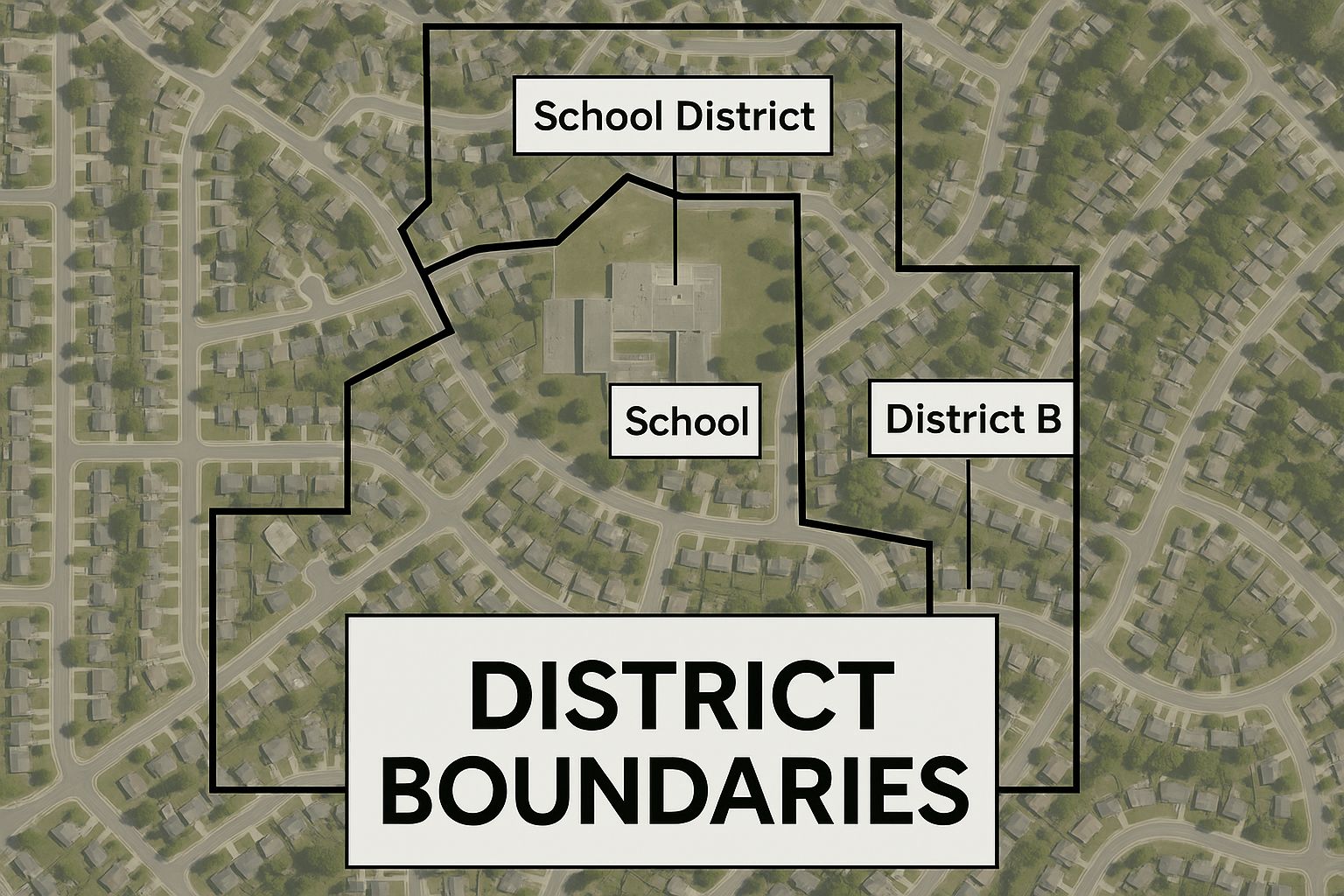
As you can see, a simple street or creek can serve as a hard border, instantly placing two adjacent homes into completely different educational and real estate worlds.
The School Quality Sorting Effect
Over time, a funny thing starts to happen inside these boundaries. Entire communities begin to organize themselves based on how well the local schools perform. Experts call this the "school quality sorting effect."
Think of it like a powerful magnet. A highly-rated school district naturally pulls in families who put a premium on education. These families are often willing and able to pay more for a home in that zone, which in turn lifts property values for everyone inside the boundary.
This is nothing new. Researchers have tracked how housing markets have shifted based on school districting policies since the 1950s and 60s. They found that higher-income families tend to cluster in areas with better schools, a trend that can unfortunately reinforce both economic and racial segregation. You can get more insights on how these policies shape real estate markets and their long-term impact.
How To Verify School Zoning For A Property
Never, ever assume a house is zoned for the school that's just a block away. Boundary lines can zig-zag in the most unexpected ways, and the information on a real estate listing can easily be wrong or outdated. You have to check it yourself before you even think about making an offer.
Relying on a real estate listing's school information without independent verification is a risky gamble. A mistake can have significant financial consequences, directly impacting your home's future value and appeal.
Here’s your game plan for confirming a property’s designated schools:
- Official District Website: This should be your first stop. Most school districts have an online lookup tool where you can plug in an address and see the assigned elementary, middle, and high schools. It's your most reliable source.
- Call the District Office: Can't find the online tool or just want to be 100% certain? Pick up the phone. A quick call to the district's administrative office can give you a definitive answer.
- Review County Maps: Your county's tax assessor or appraisal office usually has detailed parcel maps that layer in school district information.
Doing this homework is a non-negotiable step in the buying process.
The Risk Of Redistricting
Here’s the catch: school district boundaries aren't permanent. As populations grow and shrink, districts sometimes redraw the lines. This process is called redistricting, and it often happens when a new school is built to handle overcrowding or when older schools are closed and consolidated.
For a homeowner, this is a massive risk. Imagine your home is right on the edge of a top-tier district. A boundary change could suddenly rezone you into a lower-performing district, and your property value could take an immediate nosedive.
Before you buy, look for these warning signs:
- Check for Overcrowding: Are the schools in the district packed to the gills? This is the number one reason districts redraw their maps.
- Review School Board Minutes: Dig through recent meeting agendas from the local school board. Any talk of capacity problems, new construction plans, or "boundary studies" are huge red flags.
- Consider Local Development: Are massive new housing developments popping up nearby? A flood of new students can easily force a district's hand.
Beyond Traditional Boundaries
While zoning is the big one, it isn't the only game in town. Some areas have alternatives that give families more flexibility and can influence real estate decisions.
- Charter Schools: These schools get public funding but operate outside the traditional district rules. They often have special programs and use a lottery system for admission, so your home address doesn't matter.
- Open Enrollment Policies: Some school districts allow students from outside their boundaries to apply for a spot if there's room. This can be a lifeline for families stuck in a less-desirable zone.
But here's the thing: while these options are great for families, they don't carry the same weight in real estate. The guaranteed access that comes from living inside a top-rated district's boundary is still the gold standard for protecting and growing your property's value.
Investment Strategies for School-Centric Markets
For any sharp real estate investor, the link between good schools and property values isn't just a talking point—it's a core principle for building a portfolio that can weather any storm. A homebuyer is trying to find their one perfect fit, but an investor uses school data to spot trends, forecast growth, and lock in solid returns across multiple properties.
It's a strategy that lets you play both offense and defense. On the offensive side, you can zero in on areas on the brink of a boom. For defense, you can acquire properties in established, top-tier districts that offer incredible stability and a constant stream of high-quality tenants. This isn't just about buying houses; it’s about making smart acquisitions based on one of the most reliable indicators of future value.
The logic is simple. The places where families want to live are the places where rental demand is always high, and property values are better protected from market swings. Let’s break down two powerful ways to turn this knowledge into profit.
The Up-and-Coming District Strategy
This strategy is all about having a little foresight. The goal is to identify a school district that's good now but showing all the signs of becoming great tomorrow. You're essentially getting in just ahead of the curve, before the rest of the market catches on and prices jump. It takes a bit more digging, but the payoff can be huge.
Here’s what to look for:
- Improving School Metrics: Search for districts where student growth scores are climbing, even if the overall test scores aren't at the top yet. This is a tell-tale sign of effective teaching and a district on the rise.
- New Leadership or Funding: Has a highly respected new superintendent been hired? Did a school bond just pass to upgrade facilities? These events can act as powerful catalysts for rapid improvement.
- Gentrification and Redevelopment: Are you seeing more young professionals and families moving in? Are new coffee shops and boutiques popping up? These are often the first signals that school performance and perception are about to follow.
By buying property here, you get in at a lower cost and set yourself up to ride a wave of appreciation as the district’s reputation improves. It’s the classic "buy low, sell high" philosophy, perfectly applied to the schools and real estate market.
The Top-Tier Rental Strategy
While the first approach is about growth, this one is all about stability and reliable cash flow. Here, the plan is to buy rental properties inside the boundaries of the absolute best, most sought-after school districts. In these zones, demand is a constant, giving you a deep pool of well-qualified tenants to choose from.
Many families who can't afford to buy in these expensive areas will gladly pay a premium in rent just to get their kids into those top-rated schools. This creates some serious advantages for an investor.
Investing in top-tier school districts provides a defensive moat around your assets. You get lower vacancy rates, higher-quality tenants who are more likely to care for the property, and the ability to consistently increase rents year after year.
This strategy is less about hitting a home run on appreciation and more about generating dependable, long-term income. It’s no wonder institutional investors are increasingly making school quality a key part of their real estate strategy. A recent JLL report even confirmed that areas with strong schools see healthier multi-family housing demand and higher occupancy rates.
For investors looking to apply these strategies, a side-by-side comparison can help clarify which path aligns best with your goals.
Investor Strategy Comparison for School-Centric Markets
| Investment Strategy | Description | Risk Level | Potential ROI |
|---|---|---|---|
| The Up-and-Coming District | Buying in areas where school ratings are improving but haven't peaked yet. Capitalizes on future appreciation. | Medium to High | High |
| The Top-Tier Rental | Acquiring properties in established, highly-rated districts. Focuses on stable cash flow and low vacancy. | Low | Moderate to High |
| Short-Term Flip | Purchasing a fixer-upper in a great school district to quickly renovate and sell to a family buyer. | Medium | High (Short-Term) |
| Long-Term Buy and Hold | A patient approach in either an up-and-coming or top-tier district, relying on market appreciation and rent growth over decades. | Low to Medium | Very High (Long-Term) |
Each strategy has its place, depending on your tolerance for risk and your long-term financial objectives.
For more deep dives and ongoing market analysis, consider exploring the insights and market analysis on real estate trends. And whether you're a seasoned pro or just getting started, our complete guide to buying investment homes offers more valuable perspectives for building your portfolio. By understanding these dynamics, you can make informed decisions that leverage school quality as the cornerstone of your success.
The Real Estate Impact of Universities and Colleges
The powerful link between education and property value isn't just about K-12 schools. For many communities, a local university or college is the single largest economic and cultural engine, creating a unique and surprisingly resilient real estate market—what many call a "university town."
Think about it. These areas see a constant, predictable wave of people. Every single year, a new class of students shows up needing a place to live, while a steady stream of professors, researchers, and staff members are looking for homes to either buy or rent. This creates a perpetual demand that helps insulate the local market from the dramatic booms and busts you might see elsewhere.
This dynamic makes university towns an absolute magnet for real estate investors. The never-ending demand for off-campus housing provides a reliable stream of rental income, and the university's sheer stability helps protect property values over the long haul.
The University Town Ecosystem
A university's influence spreads far beyond the campus grounds. These institutions are massive employers—often the largest in their region—providing thousands of stable, well-paying jobs. That economic foundation supports a vibrant local economy packed with restaurants, shops, and services catering to students, faculty, and the entire community.
It creates a fantastic positive feedback loop. The university attracts top talent, which drives commercial growth, which in turn makes the town an even better place to live. The result is a thriving, self-sustaining ecosystem where property values are anchored by something far more permanent than fleeting market trends.
In a university town, real estate isn't just supported by the local economy—it's supported by a global institution. The university's brand, research funding, and international student body provide a level of economic insulation that is difficult to replicate.
This stability is a huge reason why the relationship between these specific schools and real estate is so powerful for both homeowners and investors looking for dependable growth.
Investment Opportunities and Benefits
For investors, university towns offer a clear and compelling list of advantages. The constant need for student rentals is the most obvious perk, but the opportunities are much more diverse than just dorm-style housing.
- Consistent Rental Demand: The annual cycle of students guarantees a deep and predictable tenant pool, keeping vacancy rates low.
- Faculty and Staff Housing: Beyond students, there's a strong market for faculty and staff who want quality homes close to where they work.
- Recession Resistance: University enrollment often actually increases during economic downturns as people head back to school to pick up new skills. This can make these rental markets counter-cyclical and exceptionally stable.
These factors create a perfect environment for long-term buy-and-hold strategies. For investors looking to defer capital gains from one sale to the next, understanding the benefits of a 1031 exchange can be a powerful tool for growing a portfolio in these stable markets.
Homeowners also reap some serious rewards. They get to enjoy the cultural amenities the university brings—like theaters, museums, and sporting events—while having the peace of mind that comes from living in a community with a rock-solid economic base. This blend of lifestyle and financial security makes homes near universities a consistently smart investment.
Future Trends Shaping Schools and Real Estate
For generations, the link between schools and real estate has been a golden rule. Good schools meant high property values, period. But major shifts in how we work and learn are starting to shake up that old playbook.
The ground is shifting, and homebuyers and investors who pay attention to these new trends will be the ones who come out ahead.
One of the biggest game-changers? The explosion of remote work. For decades, a family’s search for a home was tethered to a reasonable commute. Now, a huge number of professionals can live pretty much anywhere, completely severing the tie between their home and their office. This newfound freedom means some families can put other priorities—like affordability or lifestyle—ahead of squeezing into a top-rated school district.
That doesn't mean school quality is suddenly irrelevant. Far from it. Its role is just getting a lot more nuanced.
The Rise of Educational Choice
At the same time, what we consider a "good education" is no longer just about the local public school. A whole new world of alternative learning models is giving parents more options than ever before, which could seriously loosen the grip that traditional school zones have on home prices.
Think about all the emerging options:
- Specialized Charter Schools: These schools are publicly funded but run independently, often with a laser focus on things like STEM, the arts, or project-based learning. Getting in is usually about winning a lottery, not having the right address.
- Advanced Online Academies: High-quality virtual schools now offer tough, personalized learning that you can access from any home with a solid internet connection.
- Homeschooling and "Microschools": Small, tight-knit learning groups are popping up everywhere, letting families customize an education that fits their kids perfectly.
As these alternatives become more common, a home's value might start to depend less on its one assigned school and more on the entire educational ecosystem of the area. A city with a bunch of great charter and private school options, for instance, might not see such massive price gaps between its public school zones. You can see these patterns evolving in the housing trends in Fresno, CA, where a wider variety of choices is clearly influencing what buyers decide to do.
The future of the school-property value connection lies not just in district ratings, but in a community's overall portfolio of educational opportunities. A region that offers diverse, high-quality choices will attract and retain families, supporting broad and stable real estate markets.
While the how of education is changing, the fundamental desire for quality learning is still a massive driver. Policies that champion "school choice," like voucher programs or open enrollment, will only continue to blur the hard lines of school zoning.
For savvy buyers and investors, this means the old strategy of just looking up a school rating is no longer enough. You now have to assess a community's entire educational landscape to really understand its long-term real estate potential.
Have Questions? We Have Answers.
When it comes to the intersection of real estate and education, a lot of the same questions pop up for buyers, sellers, and investors. Let's tackle some of the most common ones head-on, so you can move forward with total confidence.
How Much More Will I Really Pay for a Home in a Top School District?
The "school premium" is no myth—it's a very real factor in home pricing. On average, you should be prepared to pay anywhere from 10% to 30% more for a similar home in a top-rated district compared to one in a neighboring, less-regarded zone. In really hot markets, that number can climb even higher.
But don't just think of it as an extra cost. It's a strategic investment. You're buying into a high-demand feature that will always attract a deep pool of future buyers. This helps protect your home's resale value and keeps it stable in the market for years.
Think of the school premium as an insurance policy on your home's value. It provides a buffer against market downturns and ensures your property remains desirable to the widest possible audience when it's time to sell.
This added investment buys you more than just a house; it buys you access to a stable community and a powerful driver of long-term appreciation.
Can School District Lines Actually Change and Hurt My Property Value?
Yes, they absolutely can. This is a genuine risk every homebuyer needs to think about, especially if you're looking at a home near a district boundary line.
School boards redraw these boundaries through a process called redistricting. It usually happens to manage changing student numbers or to account for new schools being built. If your home gets rezoned from a top-tier school to a lower-rated one, the hit to your property value can be swift and significant. The premium you paid for that school access can essentially disappear overnight.
Here’s how you can protect yourself before you buy:
- Verify current zoning. Go directly to the school district's official website or call their administrative office. Don't rely on third-party info.
- Check recent school board meeting minutes. Look online for any chatter about overcrowding or potential boundary studies.
- Ask your real estate agent. A good local agent should be aware of any known redistricting plans in the works.
A little bit of homework here can save you a world of financial pain later.
I Don't Have Kids. Should I Still Care About Schools?
Without a doubt. Even if you don't have children and never plan to, buying a home in a great school district is one of the smartest financial moves you can make. This decision has a far greater impact on your investment than it does on your personal lifestyle.
Why? Because properties in top-rated districts attract a much larger pool of potential buyers. This makes your home more liquid and much easier to sell quickly when you're ready to move. This constant demand also acts as a shield, protecting your investment from the worst effects of an economic downturn.
Beyond the financials, these neighborhoods often have more engaged residents, better public parks and amenities, and lower crime rates—all things that improve the quality of life for everyone, kids or no kids.
Navigating the complexities of the Fresno real estate market requires local expertise. Whether you're buying, selling, or looking for world-class property management, Edinhart Realty and Property Management has the experience to maximize your investment. Learn more about our services at https://edinhart.com.


