

Before a single photo is taken or a listing is written, the real work of renting out your condo begins. You're not just offering a space anymore; you're creating a premium product that has to compete in a crowded market. The goal is to make such a strong first impression that top-tier tenants are immediately drawn in, which means less time vacant and a better justification for your asking price.
This isn't about a quick tidy-up. It's a strategic move to maximize your investment from day one.
Getting Your Condo Rent-Ready
Tenants today have sky-high expectations, and a polished, well-maintained condo tells them you're a professional landlord who cares. Putting in the effort upfront saves you from a world of future complaints and sets a clear standard for how the property should be treated.
Prioritize High-Impact Repairs
Nothing screams "neglect" like a collection of small, annoying issues. A drippy faucet, a squeaky door, or a loose cabinet handle might seem trivial on their own, but together they paint a picture of a property that isn't cared for. Fixing these is non-negotiable.
Grab a notepad and walk through every single room. Be meticulous.
- Plumbing: Check under every sink for the slightest hint of a leak. Make sure toilets flush with gusto and the water pressure is solid.
- Electrical: Flip every switch and test every outlet. Replace those dim, burnt-out bulbs with bright, energy-efficient LEDs to make the space feel alive.
- Hardware: Jiggle every doorknob, pull on every cabinet handle, and check every towel rack. All windows and doors should open, close, and lock without a fight.
To be truly systematic, use a detailed guide like our rental property inspection checklist. It ensures you won’t overlook a single thing and helps minimize those late-night emergency calls down the road.
The Power of a Fresh Coat of Paint
I can't overstate this: never, ever underestimate what a fresh coat of paint can do. It’s easily one of the most cost-effective upgrades you can make, instantly transforming a space to feel cleaner, brighter, and much larger.
Stick with neutral colors. Think agreeable gray, a warm beige, or a classic off-white. These shades act as a blank canvas, making it easy for potential tenants to imagine their own belongings in the space. A consistent, modern color scheme makes the entire unit feel cohesive and well-managed. Before you list, it's smart to learn how to increase your home's appeal before renting; many of the same principles apply to attracting the best tenants.
Key Takeaway: A professional-looking paint job isn't just about covering up scuffs. It communicates quality and care, directly impacting a renter’s first impression and their willingness to meet your price.
Focus on Kitchens and Bathrooms
These are the two rooms that can make or break a deal. A renter's decision is heavily influenced by the kitchen and bathrooms, but you don't need to shell out for a full-gut renovation. Small, smart upgrades can have a massive impact.
Here are a few simple but effective updates:
- Update Fixtures: Swap out that dated, builder-grade faucet and showerhead for modern options in brushed nickel or matte black. It’s a small change with a big visual payoff.
- Refresh Cabinetry: If the cabinets are structurally sound, a new coat of paint and some new hardware can make them look brand new for a fraction of the cost.
- Regrout and Recaulk: Dingy grout and peeling caulk make a bathroom feel old and grimy. A fresh application makes the whole space look sparkling clean and helps prevent future water damage.
Prospective tenants will scrutinize these areas more than any other. A clean, updated kitchen and bath can easily be the deciding factor that makes them choose your condo.
The rental market is always in flux. While national average rents have dipped slightly, a flood of new rental inventory is hitting the market. That means more competition. Renters are getting pickier, and certain features are now in high demand. For instance, over 40% of renters are specifically looking for pet-friendly units, and energy efficiency is a growing priority. Making a few strategic upgrades to meet these demands can give you a serious competitive edge.
How To Price Your Condo Rental
Nailing the right rental price is both an art and a science. If you price it too high, your perfectly prepped condo will sit empty, bleeding money every single day. Price it too low, and you're leaving cash on the table that should be in your pocket. The mission is to hit that sweet spot: attract high-quality tenants fast and get the best possible return on your investment.
This all starts with a practical, data-first approach called a comparative market analysis (CMA). It sounds complex, but it's really just a smart way of figuring out your condo's worth by seeing what similar properties have recently rented for.
Start With Hyper-Local Comparisons
Your best and most accurate comparisons—or "comps"—are right inside your own building. Why? Because these units share the exact same location, HOA perks, and overall building vibe, making them the ultimate benchmark.
Kick off your research on popular rental sites. Look for units that are either available now or, even better, were just marked as "rented."
- Same Building, Same Layout: First, find a unit with the same number of bedrooms, bathrooms, and similar square footage. This is your ground zero.
- Neighboring Buildings: Next, expand your search to include condos in adjacent buildings that offer similar amenities, like a pool, gym, or doorman.
- Finishes and Features: Now, zoom in on the details. Does the comp have a slick, renovated kitchen with stainless steel appliances while yours has the original white ones? That difference has a real dollar value you need to account for.
Factor In Your Condo's Unique Value
Once you’ve got a baseline from your comps, it's time to adjust for what makes your unit stand out. Even in the same building, no two condos are truly identical.
Does your unit have something special? Put a number on it. For instance, a corner unit with a killer panoramic city view could easily command an extra $100-$200 per month over an identical one staring at a brick wall. A simple in-unit washer and dryer could add another $50-$75 in perceived value when compared to units that have to use a communal laundry room.
A huge mistake I see new landlords make is pricing their condo based on what they need to cover their mortgage. Tenants couldn't care less about your personal costs; they only care about market value. Your price has to be based on what the market will actually support.
Use Online Estimators As A Starting Point Only
Those online rent estimators can give you a quick ballpark figure, but they should never be the final word. These tools run on algorithms that often miss the subtle but critical details that sway the price—things like the quality of your recent renovation, which floor your unit is on, or the overall condition of the building.
Use them to get a general feel, then sharpen that number with your own detailed, on-the-ground research. If you want to get really granular, our guide on how to determine rental price breaks down the methodology even further.
To get a clearer picture of everything involved, this visual flow shows how preparing your condo is the first step toward justifying your price.
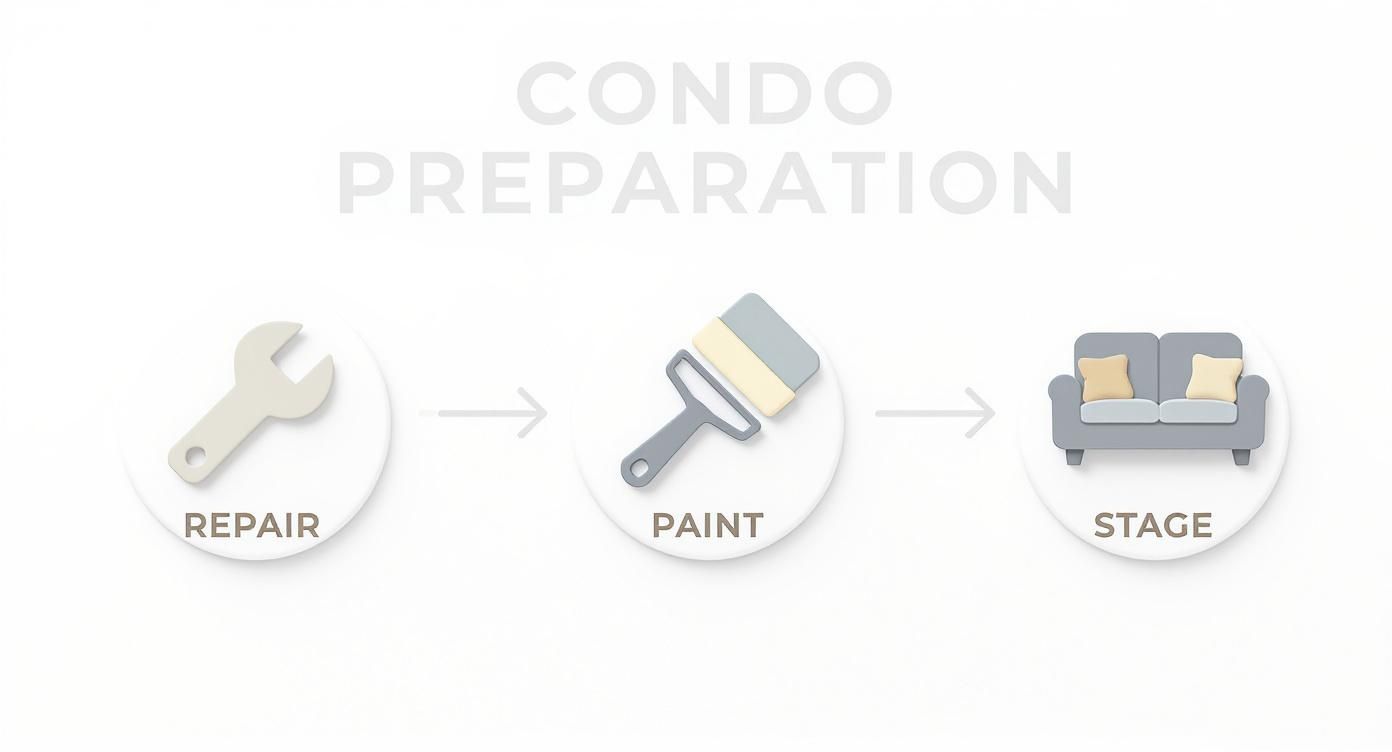
As the infographic shows, a methodical prep process—handling repairs, adding fresh paint, and staging—builds the foundation you need to command a competitive rent.
To make this even more practical, let's break down how you can calculate your price point. This worksheet helps you see all your costs in one place so you can set a rent that not only covers everything but also ensures you're profitable.
Condo Rental Price Calculation Worksheet
| Expense/Factor | Monthly Cost/Value | Notes |
|---|---|---|
| Mortgage (PITI) | Principal, Interest, Taxes, Insurance | |
| HOA Dues | Include all monthly or special assessments | |
| Utilities (if any included) | E.g., water, trash, internet | |
| Vacancy (5-10% of rent) | Set aside funds for when the unit is empty | |
| Repairs & Maintenance | Budget for routine and unexpected fixes | |
| Property Management Fee | If applicable (usually 8-10% of rent) | |
| Premium Features Value | Add value for views, upgrades, etc. | |
| Total Expenses | Sum of all costs above | |
| Desired Profit Margin | Your target monthly profit | |
| Target Rent | Total Expenses + Desired Profit |
This table isn't just about covering bills; it's a strategic tool. By laying everything out, you can confidently set a price that aligns with the market while still hitting your financial goals.
Remember, your pricing strategy is part of a much bigger picture. The global real estate rental market is massive and growing, projected to climb from $2.91 trillion to $3.87 trillion by 2029. This boom is fueled by online platforms that give landlords like you more data than ever to make smart decisions. Condos in city centers are especially well-positioned, as urban rentals are outpacing growth in rural areas.
By blending hard data from local comps with a clear-eyed assessment of your condo’s unique appeal, you'll be able to set a competitive price that keeps your vacancy rate low and your income high.
Creating a Rental Listing That Attracts Tenants
You’ve got the condo looking perfect and a competitive price nailed down. Now, it’s time for the marketing. A generic listing is just going to get swallowed up in a sea of identical-looking options. Your real goal here is to craft an ad that stops people mid-scroll and makes them want to see the place now.
This isn't just about rattling off features; it's about selling a lifestyle—the one your ideal tenant is dreaming of.

Photography That Sells
Let me be blunt: your photos are the single most important part of your listing. That's it. Dark, blurry, or cluttered pictures will absolutely kill a potential renter's interest before they even read a single word of your description. You don't necessarily need to hire a pro, but you do need to think like one.
Wait for a bright, sunny day and throw open every blind and curtain. Natural light is your best friend, period. Flip on every light in the unit, too—you want the space to feel as warm and inviting as possible. And please, tidy up like you’ve never tidied before. Clear all the countertops, hide the personal stuff, and make sure every surface is spotless.
A great trick is to shoot from the corners of rooms; it makes them look bigger and more open. Be sure to get a wide variety of shots, covering every room, any unique features like a great balcony view, and don't forget the building's amenities like the gym or pool. It's a fact that listings with high-quality photos can get up to 95% more views.
Crafting a Compelling Listing Description
The photos grab their attention, but your words are what will keep it. Steer clear of a dry, boring list of features. Your job is to paint a picture of what it’s actually like to live there.
Start with a powerful headline that immediately highlights the best thing about your condo. Instead of a snooze-fest like "2 Bed, 2 Bath Condo for Rent," try something punchy: "Stunning Corner Unit with Sweeping City Views & Modern Upgrades." See the difference? It immediately sets your property apart.
In the description itself, weave a bit of a story.
- Evoke a feeling: "Imagine sipping your morning coffee on the private balcony as you watch the sunrise over the city skyline."
- Highlight the benefits: "The dedicated home office nook is the perfect quiet space for remote work, while the building's rooftop pool is an ideal urban oasis for weekend relaxation."
- Be specific: Mention brand names for new appliances (e.g., "brand new Bosch dishwasher") or specific materials ("gleaming quartz countertops").
This kind of detail helps people connect with the space on an emotional level, making it much easier for them to picture themselves calling it home.
Pro Tip: Don't forget to clearly lay out the logistics. State the rent, security deposit, lease term, pet policy, and what utilities are included. This kind of transparency pre-qualifies applicants and saves a ton of back-and-forth for everyone.
Choosing the Right Rental Platforms
To get the most eyeballs on your listing, you need to be where the tenants are looking. Spreading your listing across multiple high-traffic platforms is the key to getting your condo rented quickly.
Each of the major players has its own strengths:
- Zillow Rental Manager: This is the undisputed powerhouse. You create one listing, and it gets pushed out across Zillow, Trulia, and HotPads, giving you incredible reach. It’s also super user-friendly, making it a go-to for independent landlords.
- Apartments.com: This platform is known for attracting serious, long-term renters. It's a great place to find tenants who are really deep into their apartment hunt and know what they want.
- Facebook Marketplace: Never underestimate the power of social media. Marketplace gives you a more informal, direct line to local renters and is fantastic for generating a high volume of initial inquiries very quickly.
The condo rental market is incredibly active, especially when you look at vacation rentals. The global vacation rental sector is projected to hit $105.7 billion in revenue by 2025. And in the United States, roughly 85% of vacation stays are booked on platforms like Airbnb, which just goes to show how vital these digital marketplaces are. You can find more insights on the growth of the vacation rental market.
When you combine amazing photography with a story-driven description and smart placement on the top rental sites, you create a marketing machine that does the heavy lifting for you. This approach ensures your listing doesn't just get seen—it gets results.
Finding and Screening the Right Tenants
Your condo is prepped, priced, and ready to show. Now for what is easily the most important step in this entire process: choosing the right person to live there.
A great tenant is more than just someone who pays the rent; they're an asset who respects your investment. On the flip side, a bad tenant can turn your promising property into a nightmare of missed payments, unexpected damage, and costly legal battles.
This is exactly why having a systematic, legally sound screening process isn't just a good idea—it's absolutely essential. It's your single best defense against future problems.

Establish Clear and Fair Rental Criteria
Before you even think about accepting that first application, you need to define your tenant selection criteria. These are the objective, non-discriminatory standards you'll apply to every single applicant to ensure you’re compliant with the Fair Housing Act.
Get these written down and apply them consistently.
- Income Requirement: A solid, common standard is requiring a gross monthly income of at least three times the monthly rent. This is a good indicator that they can comfortably afford the unit without financial strain.
- Credit Score: Set a reasonable minimum score you're willing to accept, like 650 or higher. This gives you a quick snapshot of their financial responsibility.
- Rental History: You're looking for a clean rental history. This means no prior evictions and, ideally, positive references from their previous landlords.
Having these standards in place from the get-go protects you from accusations of discrimination. Your decisions are based on business logic, not personal feelings.
The Application and Initial Review
The rental application is your first real set of data on a prospective tenant. Make sure it's thorough. It needs to capture all the essential information for you to start verifying, including employment history, stated income, previous addresses, and references.
Once those applications start coming in, your job is to verify everything. Never just take their word for it. Call the employer listed to confirm their position and income. A five-minute phone call can save you from a tenant who fudged the details on their application.
One of the biggest mistakes a landlord can make is trusting a "good feeling." Your screening process has to be driven by data and consistent criteria. A friendly personality doesn't pay the rent or fix a damaged wall.
Conducting Thorough Background and Credit Checks
This is where you move beyond what the applicant has told you and get the full, unbiased picture. A professional background check is a non-negotiable part of renting out a property today.
Several online services make it simple for landlords to run these checks, and it's standard practice to have the applicant cover the fee.
- Credit Report: This will show you their debt, payment history, and any red flags like collections or bankruptcies. You're looking for a pattern of irresponsibility.
- Criminal Background Check: A national criminal search reveals relevant convictions. Just be sure to follow all local and state laws regarding how you can use this information in your decision-making process.
- Eviction History: For most landlords, this is a deal-breaker. An eviction search will show if they've ever been legally removed from a property for lease violations or not paying rent.
For a much deeper dive into the nuts and bolts of this process, you can learn more about how to screen tenants effectively in our detailed guide.
The All-Important Landlord Reference Check
Calling an applicant's previous landlord might just be the most insightful step of all. This is your chance to find out how they behave as a tenant in the real world.
Don't just ask a generic question like, "Were they a good tenant?" You need to dig deeper with specific questions to get the real story.
To make sure you cover all your bases, a simple checklist can be a huge help.
Tenant Screening Checklist
Following a consistent checklist ensures you evaluate every applicant fairly and thoroughly, leaving no stone unturned.
| Screening Step | Key Action | Legal Consideration |
|---|---|---|
| Set Criteria | Define income, credit, and rental history standards before marketing. | Ensures compliance with Fair Housing Act by applying standards equally. |
| Application Review | Collect a complete application from every adult applicant. | Verify all information provided; inconsistencies are a red flag. |
| Income Verification | Request pay stubs or an offer letter. Call the employer to confirm. | Confirm the income meets your minimum requirement (e.g., 3x rent). |
| Credit & Background Check | Use a reputable service to run credit, criminal, and eviction reports. | Get applicant's written consent. Follow FCRA and state-specific laws. |
| Landlord References | Call the two most recent landlords with a list of specific questions. | Document your conversation. Be wary of references from family members. |
| Final Decision | Approve or deny based only on your pre-set, written criteria. | Send an adverse action notice if denying based on credit/background report. |
This structured approach not only helps you find the best tenant but also provides a clear, documented process to protect you legally.
When you call the previous landlord, try asking these questions:
- Did they pay their rent on time every single month?
- Did they keep the property in good condition and report maintenance issues?
- Were there ever any complaints from neighbors?
- Did they provide proper notice before they moved out?
- And the most important one: Would you rent to them again?
The answer—or even the hesitation before the answer—to that last question can tell you everything you need to know. By combining a meticulous application review, data-driven checks, and insightful reference calls, you build a complete profile that helps you choose a reliable tenant who will treat your condo with care.
Crafting an Ironclad Lease Agreement
You’ve found the perfect tenant. Great! Now comes the most critical piece of the puzzle: the lease agreement. This isn't just some formality to rush through. This document is the legal backbone of your relationship with your tenant, and a well-written lease sets clear, unambiguous expectations from day one.
Think of it as the official rulebook for the tenancy. It lays out everyone's rights and responsibilities, creating the single source of truth for resolving any disputes down the road. Without a strong lease, you're just inviting misunderstandings and potentially costly legal headaches.
Beyond Rent and Dates: The Core Clauses
Every lease covers the basics—rent amount, due date, and the length of the term. But an ironclad agreement goes much deeper. It anticipates common problems before they ever happen. This is what separates an amateur landlord from a pro.
Here are the non-negotiable clauses you absolutely must include:
- Maintenance and Repairs: Get specific. Who's responsible for what? A good lease will state that the tenant handles minor things like changing light bulbs and air filters, while you, the landlord, take care of major appliance repairs or plumbing issues. This simple clarification prevents countless arguments.
- Pet Policy Addendum: If you're allowing pets, you need a separate addendum. Period. Specify the allowed type, breed, and size of the animal. Require proof of vaccinations and clearly state that the tenant is on the hook for any pet-related damage. Don't forget to collect a separate pet deposit if your local laws allow it.
- Guest Policy: You need to define the line between a guest and an unauthorized occupant. A common approach is limiting guest stays to 14 consecutive days or 30 total days within a six-month period. This clause is your protection against a tenant's friend or partner moving in without being screened and added to the lease.
- Rules and Regulations: This is where you cover the day-to-day stuff. Think noise policies, smoking rules, and how trash should be disposed of properly.
The Critical Condo HOA Addendum
Renting a condo adds a unique layer of rules from your Homeowners Association (HOA). The HOA has its own book of Covenants, Conditions, and Restrictions (CC&Rs) that dictate everything from parking to what can be stored on a balcony. Your tenant is legally required to follow these rules, and your lease has to make that crystal clear.
Your lease must have a specific HOA addendum. This document should require the tenant to acknowledge they've received the HOA rules and agree to follow them. It also needs to state that any fines they incur for breaking HOA rules are their financial responsibility. This keeps you from getting caught in the middle.
Crucial Insight: Don't take this lightly. If your tenant violates an HOA rule, the HOA can fine you, the owner. A strong lease clause transfers this liability directly to the person who broke the rule—your tenant.
Templates vs. Legal Counsel: A Smart Decision
It's tempting for new landlords to just grab a generic lease template online. While they can be a starting point, these one-size-fits-all documents often miss the mark. They might not be specific to your state or city's laws, which can vary dramatically.
A solid lease agreement has to comply with local regulations. For example, if your property is in California, you need to be deeply familiar with California landlord-tenant laws, as the rules around security deposits, late fees, and evictions are incredibly specific.
Just look at the difference:
| Lease Source | Pros | Cons |
|---|---|---|
| Online Template | Inexpensive or free, easy to find | May not be state-specific, often outdated, might lack crucial clauses for condos |
| Lawyer-Drafted | Tailored to your property and local laws, offers maximum legal protection | Higher upfront cost |
Spending a few hundred dollars to have a lawyer draft or review your lease is one of the smartest investments you can make. That initial cost is nothing compared to the thousands you could burn through in a single legal dispute that stems from a weak or unenforceable lease. It buys you peace of mind and puts your rental business on a solid legal foundation.
Common Questions About Renting Out a Condo
Jumping into the world of being a landlord, especially for the first time, naturally brings up a ton of "what if" scenarios. Even the most prepared person has questions. Getting a handle on these common issues from the start is what separates a confident, successful landlord from one who's constantly stressed out.
Think of this as your quick-reference FAQ for navigating the real-world, practical side of your new venture.
Do I Need Special Landlord Insurance for My Condo?
Yes, and this is completely non-negotiable. Your standard homeowner's insurance policy is built for you living in your own home. The second a tenant moves in, that policy is essentially void for any rental-related issues. Your risk profile changes overnight, and your insurance has to reflect that.
You’ll need to get a specific landlord insurance policy. It’s a different beast entirely and covers two critical areas:
- Liability Coverage: This is what protects your finances if a tenant or their guest gets hurt on your property and you're found to be at fault.
- Property Damage Coverage: This covers the physical structure of your condo itself from things like a fire, a major storm, or other disasters.
It's also just smart business to write a clause into your lease requiring tenants to have their own renter's insurance. Their policy covers their personal belongings—your landlord policy won't. This one simple step can save you massive headaches and potential disputes if, say, a pipe bursts and ruins their expensive couch and TV.
How Do I Handle Maintenance Requests and Repairs?
The absolute key here is to have a professional system from day one. Don't fall into the trap of managing repairs through random text messages or voicemails. Give your tenant a clear, written way to submit requests, whether it's a dedicated email address or an online portal.
Promptness is everything. You have to respond to every request quickly, even if it’s just to say, "Got it, I'm looking into it and will have an update by tomorrow." For the big stuff—a major water leak, the furnace dying in winter, a fridge that stops cooling—you need to act immediately.
Landlord Tip: Before you even list your condo, create a go-to list of trusted contractors. Having a great plumber, a reliable electrician, and a solid handyman in your contacts means you can send help fast in an emergency instead of frantically searching for someone reputable.
What Are My Legal Responsibilities Regarding the Security Deposit?
This is one area where you really need to follow the letter of the law. A security deposit is not your money. It belongs to the tenant, and you're just holding it in trust during their tenancy. State and local laws are incredibly strict about this.
You have to dig into the specific laws for your city and state. They will dictate:
- Maximum Amount: There's usually a cap on how much you can collect, often one or two months' rent.
- Storage Requirements: Many states require you to keep the deposit in a separate, interest-bearing escrow account. You absolutely cannot mix it with your personal funds.
- Return Deadline: The law specifies exactly how long you have to return the deposit after a tenant moves out, often 21 or 30 days.
You can only make deductions for legitimate, documented reasons like unpaid rent or damage beyond normal wear and tear. If you withhold any amount, you must provide the tenant with a detailed, itemized list explaining every single charge.
Can the Condo Association Prevent Me from Renting My Unit?
Absolutely, they can. This is a massive roadblock that trips up so many new landlords. Before you spend a dime on paint or post a single listing, you must get your hands on the HOA's governing documents—the bylaws and the CC&Rs (Covenants, Conditions, and Restrictions)—and read them cover to cover.
Many condo associations have tight rules on rentals. Some have a "rental cap," limiting the percentage of units that can be rented at any given time. If that cap is full, you might be put on a waiting list for years. Others might ban short-term rentals or even require the board to personally approve your chosen tenant.
Ignoring these rules is a recipe for disaster. It can lead to hefty fines, legal trouble, and even a lien against your property. Making sure you're in full compliance with your HOA is the true first step of this entire process.
Navigating these complexities is what separates a successful landlord from a stressed one. At Edinhart Realty and Property Management, we handle these details every day, ensuring our clients' investments are protected and profitable. If you're looking for expert guidance and peace of mind, explore our comprehensive property management services at https://edinhart.com.


