

Susanville stands out for one reason that surprises almost every new owner and renter who looks at it closely. Median rent is $1,300 per month as of April 2026, which is 33% lower than the national average, according to Zumper’s Susanville rent data. In California, that immediately changes the conversation.
Affordable doesn’t mean easy. Rentals in Susanville CA sit in a market where price and availability pull in opposite directions. Renters can find rates that look manageable on paper, but they often run into limited supply, sparse listing detail, and fast decision windows. Owners see the other side of that same reality. Pricing mistakes, weak marketing, and loose screening cost more when there aren’t many comparable listings to hide behind.
That’s why this market rewards preparation. Tenants need to move like serious applicants, not casual browsers. Landlords need to treat even modest properties like income assets, with clear pricing, polished presentation, and tight lease execution. California rules also matter, and anyone renting or managing property here should understand the basics of California landlord-tenant law.
Your Introduction to the Susanville Rental Scene
Susanville doesn’t behave like a typical California rental market. It’s cheaper than most investors expect, but it’s also tighter and less transparent than many renters expect. That combination creates opportunity for owners and friction for tenants.
For landlords, the main appeal is straightforward. Entry costs are lower than in larger California metros, and rent levels can still support workable cash flow if the property is bought and managed correctly. For tenants, the appeal is also obvious. The market is comparatively affordable, which matters if you’re relocating for work, downsizing, or trying to control monthly housing costs without leaving the state.
Why this market feels different
The challenge is that Susanville isn’t a high-volume listing market where dozens of near-identical units refresh every week. People looking for rentals in Susanville CA often find a short list of options, uneven listing quality, and not much clarity on total monthly cost until they start calling around.
Practical rule: In Susanville, the advertised rent is only the starting point. The real decision usually comes down to availability, lease terms, utility responsibility, and how quickly you can act.
Owners who do well here usually get the basics right. They price close to local reality, they present the property cleanly, and they screen hard. Owners who struggle often assume low competition means they can skip the details. That’s usually where avoidable vacancy, bad fit tenants, or repeated turnover start.
Who needs a different strategy
This market asks different things from each side.
- Tenants need speed: Have documents ready before you start touring.
- Owners need discipline: A cheaper market doesn’t excuse weak systems.
- Investors need flexibility: Long-term and short-term rental strategies can lead to very different outcomes depending on the asset.
Susanville can work well for both sides. But it usually works best for people who understand that affordable and easy are not the same thing.
The Susanville Rental Market Snapshot for 2026
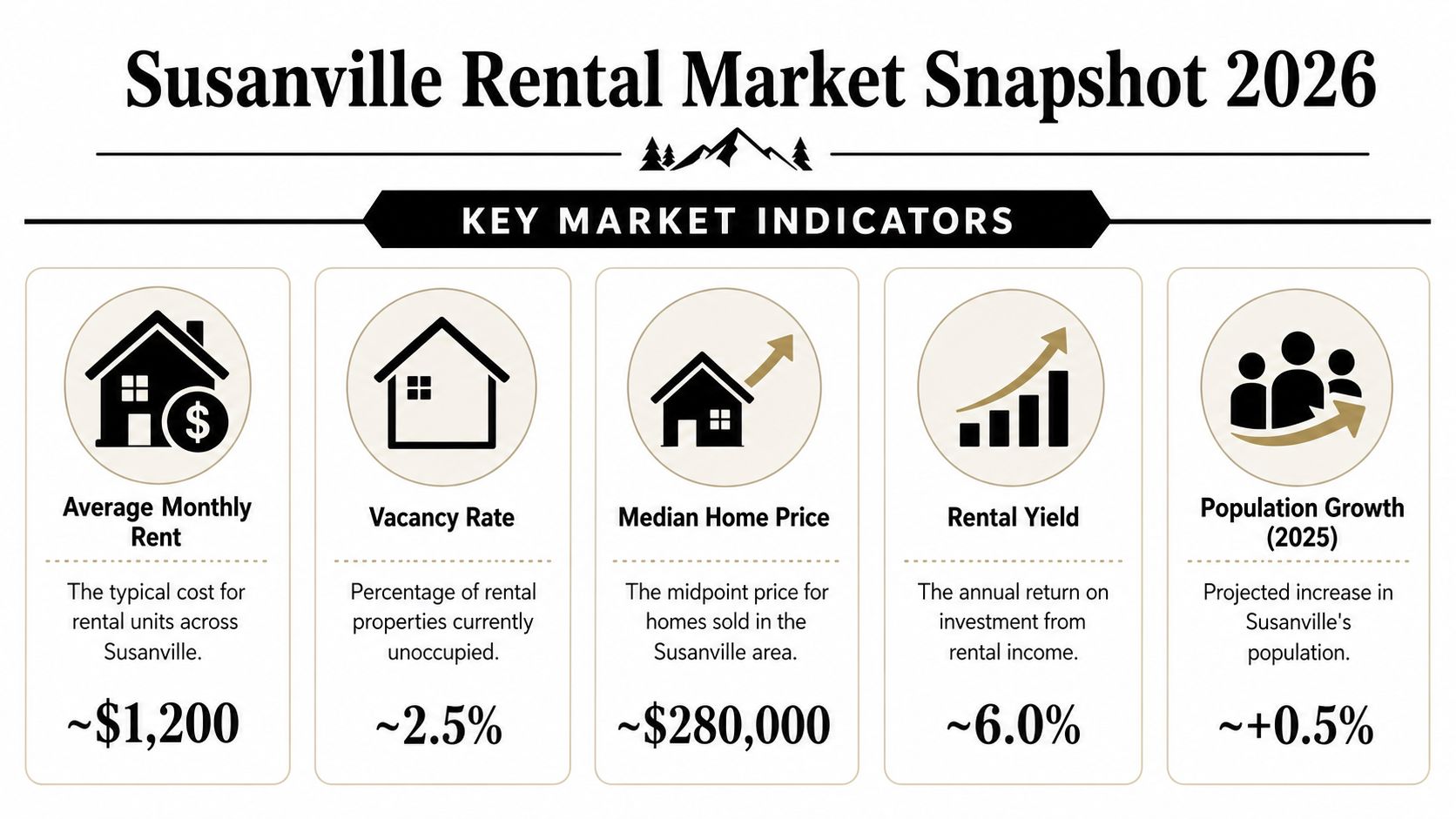
Susanville rents sit well below broader California norms, but available rentals have tightened sharply. That combination defines the market in 2026. Lower asking rents bring attention from budget-conscious tenants, while limited inventory gives owners less room for operational mistakes.
The median advertised rent in Susanville is $1,300 per month across property types, as noted earlier from the Zumper data already referenced in this article. The same market summary also pointed to a major year-over-year drop in active rental listings through third-party reporting. For both sides of the lease, that matters more than the headline price.
What the rent range actually means
Median rent is a starting point, not a pricing rule.
In Susanville, a lower-end unit, an updated apartment, and a detached house with yard space are serving different renter pools. The earlier Zumper summary showed listings ranging from $425 to $1,800, which is a wide spread for a small city. That spread usually reflects condition, size, utility responsibility, and how scarce that unit type is at the moment.
For tenants, that means a listing at the market median may still be a poor value if the unit is dated or shifts too many costs into utilities. For owners, it means overpricing based on hope instead of comparable units can leave a property sitting longer than expected, even in a supply-constrained market.
What tight inventory changes for tenants
Low supply reduces choice first. Price pressure follows.
A renter searching in Susanville often cannot wait for the "perfect" unit to appear next week, because next week may bring very few new options. That changes the search process in practical ways:
- Comparison gets harder. There may only be a handful of active listings that fit your budget and bedroom count.
- Decision speed matters. Well-priced units can draw interest quickly, especially if they are clean and clearly advertised.
- Total housing cost matters more than face rent. A cheaper unit can become expensive fast if the tenant covers power, trash, lawn care, or longer commuting costs.
Out-of-area renters should also screen for area fit early. Reviewing local Susanville crime information before applying can help narrow options before spending time on tours and application fees.
What the same market conditions mean for owners
Owners have an advantage, but only if they run the property well.
Tight inventory supports occupancy. It does not protect a landlord from poor photos, slow follow-up, weak screening, or deferred maintenance. In smaller markets, reputation and response time carry more weight because applicants usually call several owners in a short window and compare who looks organized.
Three patterns show up again and again:
- Clean presentation gets better applicants. Tenants in a thin market still sort hard by condition.
- Fast communication protects leasing momentum. Delayed replies push qualified renters to the next available unit.
- Accurate pricing protects ROI. A unit that sits vacant for weeks often underperforms a slightly lower-priced unit leased quickly to a stable tenant.
The Underlying Susanville Pattern
Susanville works best for people who treat the market as constrained, not simple. Renters need to act with documents, budget limits, and neighborhood priorities already set. Landlords and investors need systems that protect occupancy without giving away rent through sloppy execution.
That is the practical read on 2026. Susanville remains relatively affordable on paper, but limited supply keeps pressure on both sides to make good decisions quickly.
Exploring Susanville Neighborhoods for Rentals
Neighborhood choice in Susanville usually comes down to lifestyle fit, commute pattern, and housing type. Most renters don’t need a polished neighborhood pitch. They need to know whether an area feels more convenient, quieter, older, or better suited to a house versus an apartment search.
Because public rental data at the neighborhood level is limited, the better approach is to sort Susanville by how people use the city. Some renters want easier access to shopping and services. Others want a little more breathing room, a house layout, or a simpler drive to work.
How renters should evaluate area fit
Start with the daily routine, not the map. Ask where you’ll buy groceries, where you’ll park, whether you need outdoor space, and how much driving you can tolerate. In a small market, “close enough” can still be the right answer, but only if the unit itself solves the bigger need.
Safety research also matters, especially for out-of-area tenants who don’t know the city well. Before signing, check available local crime information for Susanville-area decision making and compare it with your commute, parking, and access priorities.
Susanville Neighborhood Rental Guide
| Neighborhood Area | Typical Rentals | Average Rent Range (Est.) | Best For |
|---|---|---|---|
| Downtown and central areas | Older apartments, smaller homes, mixed-use units | Varies by condition and lease terms | Renters who want proximity to services and a more walkable feel |
| Residential streets near schools and parks | Single-family homes, duplexes, some small multifamily | Typically higher than older apartment stock | House seekers, families, tenants prioritizing yard space |
| Outer residential edges | Detached homes, quieter blocks, fewer apartment choices | Depends heavily on size and upgrades | Tenants who want less traffic and a more suburban feel |
| Highway-accessible corridors | Mixed inventory, practical rather than polished | Wide spread based on property type | Commuters and renters focused on access over neighborhood character |
The “average rent range” column is intentionally qualitative. In Susanville, condition and property type move pricing enough that broad neighborhood estimates can mislead more than they help.
What owners should notice by area
Landlords often focus on citywide rent and ignore micro-positioning. That’s a mistake. A plain unit in a convenient location can outperform a slightly nicer unit in a less practical pocket if the target renter values access and simplicity. The opposite is also true for families or longer-term tenants who care more about space and residential feel.
A Susanville rental doesn’t need to impress everyone. It needs to fit a clear renter profile better than the alternatives.
Owners should ask a few basic questions before marketing:
- Who is the likely tenant for this block? Single worker, couple, family, or temporary resident.
- What feature closes the deal here? Parking, fenced yard, storage, or easier access to services.
- What would lose the tenant fast? Deferred maintenance, poor heating or cooling, unclear utility setup, or weak exterior condition.
What works better than chasing the “best” area
There usually isn’t one universal “best neighborhood” in Susanville. There’s the best fit for a renter’s routine and the best fit for an owner’s asset. A downtown-adjacent apartment and a more residential single-family home can both perform well if they’re marketed to the right tenant with realistic expectations.
That’s the better lens for rentals in Susanville CA. Match the property to the use case. Don’t force a suburban-family pitch onto a compact in-town unit, and don’t market a house like it’s just another generic rental.
A Renter's Playbook for Finding a Home in Susanville
Susanville rewards prepared renters. If you wait until you find the perfect listing to gather documents, ask about utilities, or check your budget, you’re already behind applicants who came ready.
The first move is simple. Treat your search like an application process, not a browsing process. That means you should know your budget ceiling, your move-in timing, your must-haves, and your deal breakers before you schedule a tour.

Build a rental packet before you tour
In a small, supply-constrained market, complete applications stand out. Landlords don’t want a pile of partial information and follow-up emails. They want to know whether you’re qualified and ready.
Bring these pieces together early:
- Proof of income: Recent pay stubs or equivalent income documentation.
- Photo ID: Make sure it’s current and easy to submit.
- Rental history: Prior addresses, landlord contacts, and accurate dates.
- References: Only include people who will answer.
- Funds plan: Be clear on what you can pay at signing.
If you have pets, add vaccination records and a short, honest pet profile. If you’ve had a prior issue on credit or rental history, explain it directly and briefly. A clean explanation works better than letting the owner discover it mid-screening.
Ask smarter questions than “Is it available?”
The fastest way to waste time is to ask broad questions and get broad answers. When you contact a listing, ask what affects your real monthly cost and decision timeline.
Focus on these:
- Which utilities are included, if any?
- What utility providers serve the property?
- What lease term is being offered?
- Are there property-specific rules on pets, parking, or yard care?
- What documents are needed to apply?
Don’t underestimate utility costs
This is one of the most overlooked issues in Susanville. Only a handful of listings advertise included utilities, and that lack of transparency matters because rural California utility rates can add 20% to 30% to base rent, according to Apartments.com’s utilities-included Susanville listings page.
That means a unit that looks cheaper at first glance may end up costing more month to month than a slightly higher-rent unit with some bundled expenses.
Ask for average past utility bills if the owner has them. If they don’t, ask what the last tenant was responsible for and which systems in the home drive the bill.
What helps you get approved
Landlords in Susanville aren’t only screening for income. They’re screening for follow-through. A renter who replies late, submits incomplete documents, or changes their story mid-process looks risky even if their income is fine.
A stronger approach looks like this:
- Reply quickly: Delays signal uncertainty.
- Be consistent: Your application, ID, and income docs should match.
- Be realistic: Don’t apply for a place that already strains your monthly budget.
- Read the lease: Clarify maintenance responsibilities, utility terms, and renewal rules before signing.
What usually doesn’t work
Many renters lose good opportunities by over-negotiating too early, showing up unprepared, or assuming a verbal “sounds good” means the place is theirs. In a market with limited stock, the applicant who is organized often beats the applicant who is still thinking about it.
The practical takeaway is simple. If you want better results with rentals in Susanville CA, compete on readiness. In this market, that’s often what separates signed leases from missed chances.
An Investor's Guide to Owning Susanville Rentals
Susanville is the kind of market where strategy matters more than scale. You don’t need a huge portfolio to make a rental work here. You need a property that fits the local renter pool, a pricing method grounded in reality, and a management plan that protects occupancy and income.
For long-term landlords, the appeal starts with affordability and constrained supply. The market’s broad rent spread means property type, condition, and presentation drive results. A clean house with practical features usually competes differently than a basic apartment, and owners should build their plan around that distinction.

Long-term rentals reward clean execution
The mistake I see most often in smaller markets is lazy pricing. Owners either anchor to what they hope the property should earn or copy a weak comp without adjusting for condition, layout, or utility setup. That usually leads to one of two outcomes. The unit sits, or it leases to the wrong tenant because the owner panics and loosens screening.
A better process is to compare active alternatives, look hard at property-specific advantages, and price for qualified demand. If you want a solid framework, this guide on how to price a rental property is useful because it forces owners to think beyond simple guesswork.
Three things usually improve leasing results in Susanville:
- Professional photography: Especially important when listings are limited and each one gets scrutinized.
- Tight screening: A smaller pool doesn’t justify weaker standards.
- Property readiness: Clean turns, working systems, and simple curb appeal changes matter.
Single-family homes often make the stronger rental case
Susanville’s local data points to a meaningful premium for houses over apartments in the long-term market. Verified market notes indicate houses command higher average rents than apartments in town, which supports a familiar small-market pattern. Detached homes often attract longer-stay tenants who care about space, parking, privacy, and outdoor use.
That doesn’t mean apartments are bad investments. It means owners should be honest about where each product type wins. Apartments can work when they’re efficient, well-kept, and easy to lease. Houses tend to offer more room to differentiate and justify stronger rent.
Owner move: Before remodeling, ask whether the upgrade improves leasing speed, tenant quality, or rent durability. Cosmetic spending without a clear leasing benefit is easy to overdo.
The short-term rental niche is the sharper play for some assets
The Susanville market becomes more engaging, as the city’s short-term rental market shows average annual revenue of $27,937 per listing, a $195 average daily rate, and revenue that can exceed $2,300 per month, which is 78% above the $1,300 long-term average, according to AirROI’s Susanville Airbnb data. In a market with extreme short-term rental scarcity, that’s not a minor side note. It’s a serious alternative strategy.
Not every property should become a short-term rental. The homes that fit best usually have a layout, location, parking setup, and furnishing path that support guest turnover without constant friction. But if an owner has the right asset, the revenue gap is large enough to justify a close look.
The practical trade-offs are different from long-term rentals:
- Higher gross revenue potential: The headline upside is stronger.
- More operational work: Turnovers, booking management, and guest communication matter.
- More sensitivity to presentation: Photos, staging, and furnishing quality directly affect booking performance.
Management choices affect returns more than owners think
A lot of Susanville investors don’t need a massive management stack. They need a few things done consistently well. Marketing needs to be sharp. Screening needs to be strict. Lease paperwork needs to be current. Maintenance response needs to be organized.
For owners who want support without full day-to-day involvement, firms such as Edinhart Realty and Property Management offer both full-service management and placement-only models, which is useful when an investor wants professional marketing and screening but may prefer to keep operational control.
What doesn’t work in this market
Susanville isn’t forgiving of vague strategy. Owners underperform when they do any of the following:
- Buy a property without deciding whether the better use is long-term or short-term.
- Over-improve a unit beyond what the likely tenant or guest will pay for.
- Assume low inventory removes the need for strong marketing.
- Accept weak applicants to avoid short vacancy.
The best Susanville rentals are rarely accidental. They’re usually the result of clear positioning, disciplined pricing, and a management style that matches the asset.
Is Professional Property Management Right for You
A Susanville rental can look simple from the outside. It’s a smaller market, the rent seems straightforward, and there may not be many competing listings. But the work isn’t simple when you account for screening, documentation, pricing, maintenance coordination, renewals, and the judgment calls that happen when something goes off track.
That’s where owners need to be honest with themselves. If you live nearby, know California leasing practices, answer quickly, and screen consistently, self-management can work. If you live out of area, own multiple properties, or don’t want lease compliance and tenant communication sitting on your calendar every week, management support starts to make more sense.
Owners who usually benefit from outside help
Professional management is often the better fit when any of these apply:
- You’re an out-of-town investor: Distance makes showings, inspections, and vendor coordination harder.
- You want strict screening: Consistency matters more than instinct.
- You own more than one unit: Repetition creates process demands.
- You want cleaner records: Statements, collections, and lease files need structure.
It’s not just about collecting rent
Good management protects time, but its ultimate benefit is protecting decision quality. The value is in reducing avoidable mistakes. That includes pricing errors, lease language problems, slow repair handling, and poor applicant selection.
Owners of multifamily or secured buildings may also need to think beyond traditional lock-and-key workflows. For access planning, especially where controlled entry is part of operations, tools like advanced building access control systems can be worth reviewing alongside your broader management setup.
The tipping point is simple. If your rental income depends on systems you don’t have time to run well, you don’t have a passive investment. You have an unmanaged job.
The decision comes down to your role
Some owners want to be landlords. Others want to be investors. Those are not the same job.
If you like leasing, maintenance coordination, and tenant communication, keeping control may suit you. If your main goal is stable income with less operational drag, handing off part or all of the workload is often the cleaner choice. In Susanville, where supply is tight and mistakes show up quickly, that choice can affect both your return and your stress level.
If you own a rental or are thinking about investing in Susanville, Edinhart Realty and Property Management is one resource to consider for leasing support, tenant screening, property marketing, and ongoing management options.


