

Before you can slap a price tag on a potential rental property, you need a solid way to figure out what it's really worth. A rental property value estimator isn't just one magic tool; it's a combination of proven methods investors use to get a clear picture of a property's market value. The smartest investors I know never rely on just one. They blend several approaches—like comparative market analysis, the income approach, and the cost approach—to get the most accurate number.
What Really Drives Rental Property Value

Before you even think about plugging numbers into a calculator, you have to understand what makes one property a goldmine and another a dud. A property's true financial fingerprint is a mix of its physical state and what's happening in the market around it. Getting a handle on these core drivers is your first step.
The most obvious factor? Location, location, location. It’s a cliché for a reason. A duplex in a buzzing city center where everyone wants to live will always be worth more than the exact same building in a town with a shrinking job market. Being close to good schools, parks, and transit doesn't just bump up the rent you can charge; it fuels long-term appreciation.
The Impact of Condition and Demand
A property’s condition is a huge piece of the puzzle. A building that's been well-maintained with modern touches means you won't have to sink a bunch of cash into it right away. It also attracts better tenants who are willing to pay a premium.
Making smart improvements is key. You can significantly boost what your property is worth with the right projects. For some great ideas, it's worth checking out these upgrades that can boost your home renovation return on investment.
Finally, market demand ties it all together. The global real estate rental market is massive—it was valued at USD 2.91 trillion in 2025, an 8.2% jump from the year before. Part of that is because rising home prices are forcing more people to rent.
As an investor, your job is to look past the listing price. You need to see how location, condition, and market demand all intersect to give a property its real financial identity.
Foundational Valuation Methods
To put a number on all these factors, investors lean on three fundamental methods. Any good rental property value estimate will likely pull from all three to give you a well-rounded view.
To help you get started, here's a quick rundown of the main valuation methods you'll encounter. Each one looks at the property from a different angle.
Key Valuation Methods at a Glance
| Valuation Method | Core Principle | Best For |
|---|---|---|
| Comparative Approach | Compares your property to similar, recently sold properties nearby. | Valuing single-family homes and small multi-family properties. |
| Income Approach | Focuses on the property's ability to generate income (using GRM, Cap Rate). | Commercial properties and larger residential rental buildings. |
| Cost Approach | Calculates value by estimating the cost to replace the property from scratch, minus depreciation. | New construction, unique properties, or insurance valuations. |
By familiarizing yourself with these three pillars of valuation, you’ll be much better equipped to analyze deals and make smarter investment decisions.
Finding Accurate Comps for Your Property

When it comes to putting a value on a residential property, nothing beats the classic Sales Comparison Approach. You’ll hear experienced investors and real estate agents just call it "finding comps," and for good reason. It’s the most trusted and common method out there.
While it sounds straightforward—just look at what similar houses nearby sold for—there’s a real art to getting it right. The entire point is to find a true apples-to-apples comparison. This isn't about a quick glance at Zillow; it's about digging in to find a defensible value for your specific property. A good rental property value estimator tool is built on this very foundation.
How to Select Strong Comparables
The accuracy of your final number hangs completely on the quality of the comps you choose. You can’t just grab the first three sales you see in the neighborhood. To do this like a pro, you need to be methodical and laser-focused on a few key criteria.
When you're hunting for solid comps, here’s what you need to zero in on:
- Proximity: Stay close. Really close. Stick to properties within a one-mile radius, but if you can stay within the same subdivision or even on the same few streets, that's even better. Sometimes, a single road can be the dividing line between two totally different market values.
- Time of Sale: Market conditions change fast. Only look at properties that have sold in the last six months. In a hot market, I'd even tighten that to the last three months. A sale from a year ago is ancient history and won't reflect what a buyer would pay today.
- Property Type and Size: This one’s a no-brainer, but it’s crucial. Single-family homes should only be compared to other single-family homes. Pay close attention to the square footage, making sure your comps are within 10-15% of your property’s size. A cozy 1,500 sq. ft. bungalow is not a good comp for a sprawling 3,000 sq. ft. two-story.
- Age and Condition: A charming 1950s ranch has a completely different appeal and potential maintenance profile than a brand-new build, even if they have the same bed and bath count. Try to match the home’s general condition, too—a fully renovated property isn't a fair comparison to one with an original kitchen from the 70s.
Pro Tip: Don't be afraid to go straight to the source. Dive into your county's public records or property tax websites. You'll often find more detailed, accurate data on sale dates, property specs, and tax assessments than you'll see on the big real estate portals.
Adjusting for Differences
Here's where the "art" really comes into play. It's almost impossible to find two properties that are identical. So, once you have your top three comps, you need to "adjust" their sale prices to account for the differences. Think of it like handicapping a horse race to level the playing field.
For example, let's say your property has a two-car garage, but a great comp that just sold only has a one-car garage. You'd need to add the approximate value of that extra garage space to the comp's sale price. On the flip side, if a comp has a stunning, brand-new kitchen and yours is a bit dated, you'd subtract the value of that high-end renovation from its sale price.
Some of the most common adjustments you'll make are for:
- Differences in square footage
- Number of bedrooms and bathrooms
- Garage size (or lack thereof)
- Lot size and special features like a pool or a view
- Major recent upgrades like a new roof, kitchen, or bathrooms
Making these small tweaks normalizes the data, giving you a much sharper, more realistic picture of what your property is actually worth right now. And remember, a property's value as an investment also depends on local regulations. For example, our guide on landlord-tenant law in California is a must-read for anyone investing in that state, as it directly impacts your bottom line.
Using the Gross Rent Multiplier for Quick Estimates
When you're out in the field sizing up potential deals, you need a quick way to get a read on a property's value. That's where the Gross Rent Multiplier (GRM) comes in. Think of it as the real estate investor's back-of-the-napkin calculation. It's a simple, fast way to use a property's income to get a rough idea of what it’s worth.
The math is pretty simple: Sale Price / Gross Annual Rent = Gross Rent Multiplier. To flip it around and estimate a property’s value, you just need the typical GRM for the neighborhood and the property’s potential annual rent. Multiply those two numbers, and you've got a ballpark figure.
Finding and Applying a Local GRM
Here's the catch: the GRM is only as good as the local data you use. A GRM of 8 might be the norm in one part of town, while just a few miles away, the average is closer to 12. To get a reliable number, you have to dig into recent sales of comparable rental properties right there in that specific area. Look at what similar places sold for and what their annual rents were when they sold.
Let’s walk through a real-world example. Say you’re looking at a duplex that you figure can bring in $40,000 a year in gross rent. You pull some comps and see that similar duplexes in the same neighborhood have been selling at a GRM between 9 and 10.
- With a GRM of 9, the estimated value comes out to $360,000 ($40,000 x 9).
- With a GRM of 10, the estimated value is $400,000 ($40,000 x 10).
Just like that, you have a solid price range to work with. It tells you immediately if the seller's asking price is in the realm of reality or way off base. This quick analysis is a fundamental first step.
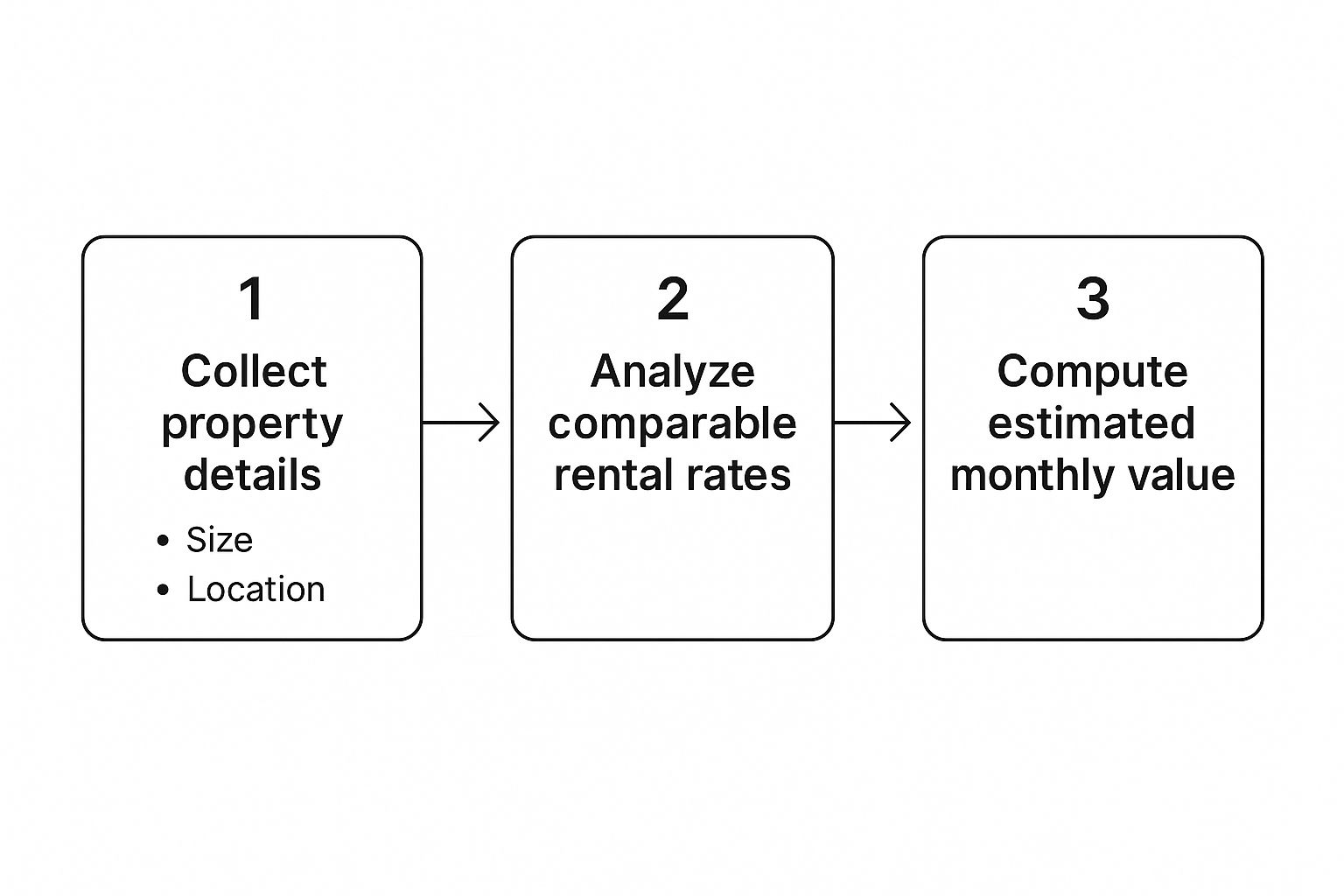
As you can see, the process flows from understanding the property to analyzing the market's rent potential, all leading to a rough valuation. It all hinges on having good data.
The Major Limitation of GRM
Now for the reality check. While the GRM is a fantastic tool for a first look, it has one massive blind spot: it completely ignores operating expenses. We’re talking about property taxes, insurance, maintenance costs, and vacancy loss. Two properties might pull in the exact same gross rent, but if one has sky-high taxes and needs a new roof, it's a far worse investment.
The GRM is a starting point, not a finish line. It’s a tool for quickly filtering out obviously overpriced deals, but it should never be your sole method for a serious investment analysis.
Even with market fluctuations, the real estate sector has proven to be incredibly resilient. A recent global real estate outlook from UBS.com notes that capital values in key markets have held strong, keeping total returns positive. This just underscores why it's so important to use sound valuation methods to find those strong opportunities.
Always follow up your GRM check with a more detailed analysis, like the Cap Rate, which we’ll get into next.
Calculating True Profitability With Cap Rate
While the Gross Rent Multiplier gives you a quick, back-of-the-napkin estimate, serious investors need a sharper tool to see a property's real financial health. This is where the Capitalization Rate, or Cap Rate, comes in. It's an indispensable metric that cuts through the noise.
Instead of just looking at gross income, the Cap Rate forces you to account for the operating expenses that actually eat into your profits. This reveals a property's true potential return.
Pinpointing Your Net Operating Income
Before you can find the Cap Rate, you need to calculate its foundation: the Net Operating Income (NOI). Think of NOI as your total rental income minus all the costs of keeping the lights on and the property running.
You’ll start with your Gross Scheduled Income (GSI), which is the total annual rent you'd collect if the property were 100% occupied all year. From there, you subtract every single operating expense.
Be honest and thorough here. These aren’t one-off capital improvements like a new roof; they are the recurring costs you’ll face year after year.
Here are the common expenses you can’t forget:
- Property Taxes: A significant and unavoidable annual cost.
- Insurance: Standard homeowner's insurance won't cut it. You need specific landlord coverage. Our guide to landlord insurance comparison can walk you through finding the right policy.
- Utilities: Even if your tenants cover their own bills, you might be on the hook for electricity in common areas or water during vacancies.
- Maintenance & Repairs: A good rule of thumb is to budget 1% of the property’s value each year for upkeep. Stuff breaks.
- Property Management Fees: If you hire a pro, expect to pay 8-12% of the monthly rent.
- Vacancy Loss: No property stays filled 100% of the time. It’s smart to budget for a 5-10% vacancy loss from your GSI.
Meticulously calculating your NOI isn't just about plugging a number into a formula. It’s about building a realistic financial model for your investment. This is the bedrock of making a smart decision.
From NOI To Property Value
Once you have a solid NOI, you can use the Cap Rate to estimate what the property is actually worth.
The formula itself is simple: Net Operating Income / Current Market Value = Cap Rate.
To flip this around and find the property's value, the formula becomes: Net Operating Income / Market Cap Rate = Property Value.
So, what’s a "good" Cap Rate? It completely depends on the market. In a hot, stable area, you might see Cap Rates around 4-6%. In a smaller or riskier market, investors will demand a higher return, looking for 8% or more. The only way to know the right Cap Rate is to see what similar income properties have recently sold for in that specific area.
Let's walk through an example. Say you've researched your target neighborhood and found that similar properties are trading at an average Cap Rate of 6%. Your subject property has an NOI of $24,000.
- $24,000 (NOI) / 0.06 (Cap Rate) = $400,000 (Estimated Property Value)
This tells you that to an investor, based on its actual profitability, the property is worth about $400,000. That's a far more reliable number than one based on gross rent alone.
GRM vs Cap Rate: When To Use Each Method
Choosing between GRM and Cap Rate isn't about which one is "better," but which one is right for the task at hand. GRM is for quick, high-level screening, while Cap Rate is for deep, serious analysis when you're ready to make an offer.
| Factor | Gross Rent Multiplier (GRM) | Capitalization Rate (Cap Rate) |
|---|---|---|
| Calculation | Property Price / Gross Annual Rent | Net Operating Income / Property Price |
| Best For | Quickly comparing similar properties in the same market. Good for a first-pass analysis. | In-depth analysis when you're seriously considering a property. |
| Complexity | Very simple. Requires only price and gross rent. | More complex. Requires detailed expense information to find NOI. |
| Accuracy | Less accurate. Ignores operating expenses, which can vary wildly. | Highly accurate. Reflects the property’s true profitability. |
| Use Case | Screening a long list of potential properties to see which are worth a closer look. | Making an informed offer and conducting due diligence. |
Ultimately, both metrics have their place. Start with GRM to filter your options, then dive deep with Cap Rate on your top contenders.
For a more comprehensive look at evaluating deals, a guide on Analyzing Real Estate Investment Deals is a great next step. This kind of detailed analysis is crucial, especially as global trends shift. For instance, European all-property rents saw a 4.1% annual increase in late 2024 due to low supply, which directly impacts NOI and, therefore, valuations across the board.
Choosing the Right Valuation Tools and Resources
While it's crucial to get your hands dirty with manual calculations like GRM and Cap Rate to build your investor instincts, let's be real—modern tools can be a massive time-saver. They flood you with data points you wouldn't find otherwise. The trick is knowing which ones to trust and how to use them smartly.
Think of these tools as a starting point, not the finish line. A solid rental property value estimator scrapes public data to spit out a quick snapshot of value, which is great for an initial screen. But it has no idea you just dropped a grand on new quartz countertops or that the local elementary school just got a 10/10 rating. That's where your own due diligence comes in.
Vetting Online Rental Estimators
Not all online tools are built the same. Before you anchor your decisions to an automated number, you've got to vet the source. A few minutes of checking can save you from a world of hurt based on bad or old information.
Here’s a quick mental checklist I run through when looking at a new online estimator:
- Data Freshness: How current is this information? Real estate can turn on a dime. A tool using sales data from six months ago is practically a history lesson, not a market analysis. You want tools that pull directly from the MLS, ideally in near real-time.
- Data Sources: Where are they getting this stuff? The best platforms are transparent, pulling from multiple reliable streams like public records, MLS listings, and even user data. If a tool is cagey about its sources, I get cagey about its results.
- Customization: Does it let me tweak the details? A generic estimate is one thing, but a tool that lets you plug in your specific upgrades, the property's condition, or unique features will always give you a much sharper, more useful number.
When you're managing a whole portfolio, you start looking at tools more critically. You might even find useful parallels by checking out articles comparing different portfolio tracking solutions for other assets, as they can highlight features that are invaluable for managing property investments too.
Popular Free Valuation Tools
You don't always have to pay for a good first look. Many of the big real estate websites offer free tools that are perfect for that initial phase when you're just trying to sift through potential deals.
Platforms like Zillow have become go-to spots for a quick reality check. You can pop in an address and get an instant rent estimate based on what's happening in that specific market.
The screenshot above gives you a perfect example of Zillow's "Rent Zestimate." It doesn't just give you one number; it provides a rent range, a median estimate, and a map of nearby comps. This is gold for quickly seeing if a seller's projected rent is realistic or just wishful thinking.
For those of us investing here in Central California, combining these powerful online resources with on-the-ground expertise is the key. Partnering with a specialized Fresno property management team, for instance, can help you verify those numbers and get a complete, accurate picture you can actually bank on.
A quick pro tip: Don't just rely on one tool. Pull estimates from two or three different platforms. If they're all pointing to a similar number, you can feel much more confident as you dig deeper into your own analysis.
Common Questions from Investors
It’s completely normal to have a ton of questions when you’re trying to nail down a property’s value. The real estate world is filled with nuances, and honestly, even seasoned pros find themselves double-checking their work. Let's walk through some of the most frequent questions we hear when people are using a rental property value estimator.
Think of this as your guide to moving forward with more confidence. The goal is to make sure you're not just throwing darts at a board, but making smart, informed decisions backed by solid logic and real data. Getting these basics right is what really separates a successful investment from a very costly mistake.
How Accurate Is an Online Rental Property Value Estimator?
This is the big one, isn't it? An online estimator is a fantastic starting point. It gives you a quick, ballpark figure right away, which is great for initial screening. But its accuracy can be a real mixed bag.
These tools pull from public data and algorithms, and they often miss the critical, on-the-ground details. An automated tool has no idea you just sank money into a high-end kitchen remodel, nor does it understand the subtle shifts happening in a specific neighborhood block. It gives you a valuable first look, but that’s exactly what it should be—just a first look.
Treat an automated valuation as one piece of the puzzle, not the whole picture. Always back it up with your own comps analysis and a detailed Cap Rate calculation to get a true feel for the property's potential.
What Is a Good Cap Rate for a Rental Property?
I wish there were a magic number for a "good" Cap Rate, but there isn't. The right number depends entirely on the market, the property type, and your own comfort level with risk. A lower Cap Rate isn't automatically a bad thing; it often points to a safer, more stable investment.
Here’s a practical way to think about it:
- High-Demand Urban Areas: In hot markets like San Francisco or New York, you might see Cap Rates of 4-6%. These are stable, lower-risk markets where appreciation is a huge part of your long-term return.
- Smaller or Growing Markets: In up-and-coming areas or less predictable locations, investors need a higher return to justify taking on more risk. Here, you’d be looking for Cap Rates in the 8-10% range, or sometimes even higher.
The right Cap Rate is simply the one that matches the risk profile of the area and aligns with your personal investment goals.
How Do I Make Adjustments in a Comps Analysis?
Adjusting comps is where the real work—and the real insight—happens. It’s the most hands-on part of valuation, and it's where you can truly sharpen your estimate. The whole point is to make each comparable property look as much like your target property as possible.
You start with your property as the baseline. For every comparable you find, you have to assign a dollar value to any major differences.
For example, if a comp has a brand-new roof and yours doesn't, you subtract the value of that upgrade from the comp's sale price. On the flip side, if your property has a finished basement or an extra bathroom that the comp is missing, you add the value of that feature to the comp's sale price. This process standardizes the data, giving you a defensible and much more realistic value estimate.
Navigating valuations in Fresno, Clovis, and the wider Central Valley requires a smart blend of hard data and local insight. For a truly accurate picture of what your property is worth, you need experts who know the area inside and out. Trust the team at Edinhart Realty and Property Management. We combine professional analysis with boots-on-the-ground knowledge to help you maximize your investment. Contact us today for a professional valuation you can build on.


