

When you own a rental property, mastering the tax code is one of the smartest ways to boost your bottom line. Benefits like writing off your expenses or claiming depreciation can slash your taxable income, leaving more of your rental profit right where it belongs—in your pocket.
Your Tax Strategy Is a Core Pillar of Your Investment
For a lot of landlords, tax time feels like a punch to the gut. You can have a fantastic year with great tenants and solid cash flow, only to watch a huge chunk of it disappear when you file your return. It’s a common story, but it absolutely doesn't have to be yours.
The U.S. tax code isn't just a rulebook; it’s loaded with incentives designed to encourage real estate ownership. When you stop seeing taxes as a burden and start seeing them as a roadmap, you unlock a powerful set of tools for building serious wealth. It’s all about learning how to make the rules work for you.
Turning a Tax Burden Into a Wealth-Building Tool
The secret is to think about taxes all year round, not just in April. Every decision you make, from a minor repair to a major renovation, has a tax consequence. Successful investors get this. They know these benefits aren't shady loopholes—they're put there on purpose to encourage people like you to provide housing.
The real magic happens with benefits like depreciation. This allows you to claim a "paper loss" that shrinks your taxable income, even while your property is putting cash in your bank account. It's this unique advantage that makes real estate such a powerful engine for long-term wealth.
This guide will walk you through all the major tax advantages available to landlords. We'll start with the basics that everyone can use and then move on to the more advanced strategies that the pros use to supercharge their returns. By the end, you'll see exactly how to make the tax code your greatest ally.
Before we dive in, let's take a quick look at the key benefits we'll be covering. Think of this as your cheat sheet for all the good stuff ahead.
Key Tax Benefits for Landlords at a Glance
| Tax Benefit | What It Is | Primary Impact |
|---|---|---|
| Expense Deductions | Writing off the costs of owning and managing your property. | Lowers your taxable rental income. |
| Depreciation | A deduction for the wear and tear on your building over time. | Creates a non-cash expense that reduces your tax bill. |
| 1031 Exchange | A rule allowing you to defer capital gains tax on a sale. | Helps you grow your portfolio without a tax penalty. |
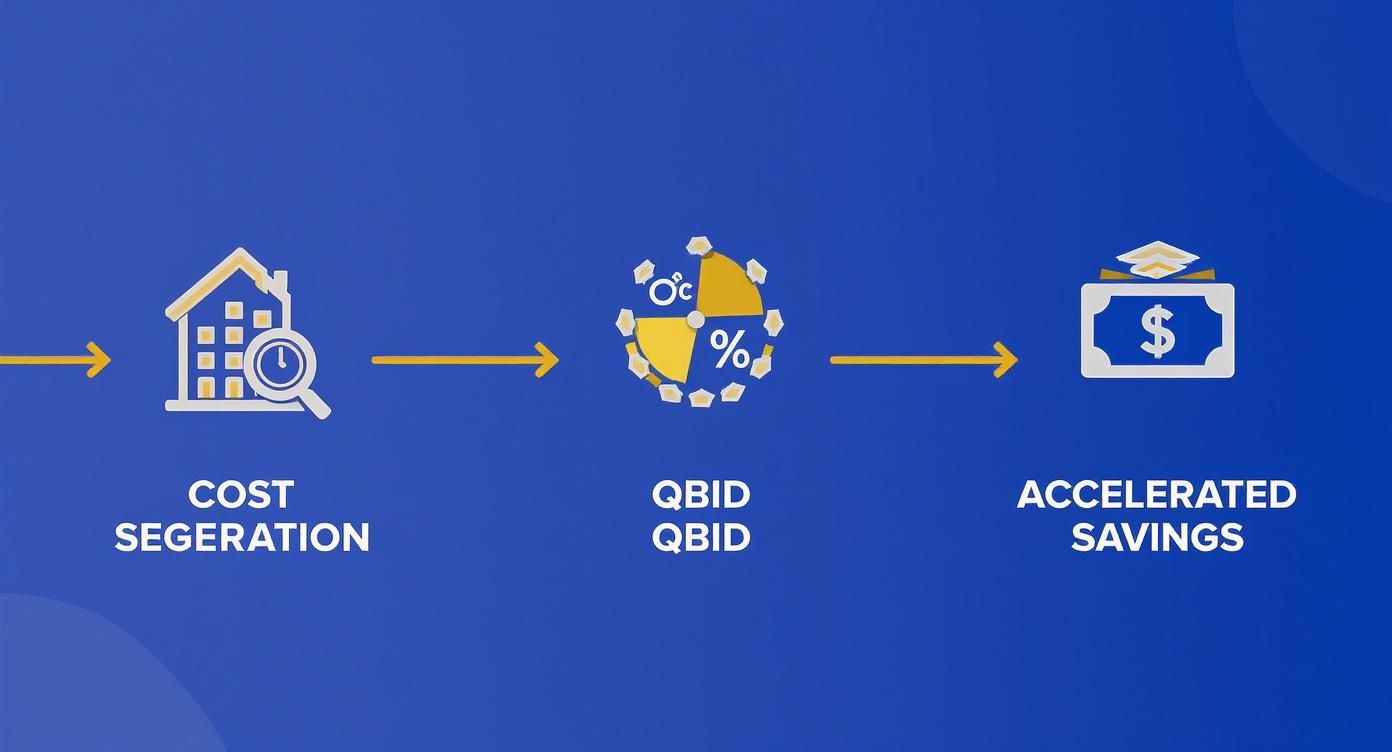
| Advanced Strategies | Methods like cost segregation and the QBID. | Significantly accelerate savings and reduce tax liability. |
Now that you've seen the big picture, let's get into the details of how each of these powerful tools can work for you.
Essential Tax Deductions Every Landlord Can Claim
Beyond the big-picture benefits like depreciation, your biggest weapon for improving yearly cash flow is mastering your day-to-day expense deductions. The secret is to start thinking of your rental property exactly like a small business. Every single dollar you put into operating and maintaining that business is a potential tax deduction that trims down your taxable income, leaving real money in your pocket.
These aren't some hidden, complicated loopholes; they're just standard business practices the IRS fully recognizes. The trick is knowing what qualifies and then tracking every last expense. When you nail this process, you guarantee you're only paying taxes on your actual profit, not your gross rental income.
Breaking Down Your Property Expenses
Your largest and most predictable deductions will almost always come from the basic costs of just owning the property. These are the big-ticket items that are usually easy to track but absolutely critical to get right.
- Mortgage Interest: That big chunk of your mortgage payment that goes to interest? It’s 100% deductible. Your lender makes this easy by sending you a Form 1098 each year that spells out exactly how much you paid.
- Property Taxes: The local and state property taxes you pay are a major expense, and thankfully, they are completely deductible for your rental.
- Insurance Premiums: The cost for your landlord insurance policy—including coverage for liability, fire, flood, and theft—is a necessary business expense and fully deductible.
These three expenses alone often make up the biggest slice of your annual write-offs. They're the foundation of a solid deduction strategy.
Accounting for Operating Costs
Next up are the everyday costs of keeping your property safe, running smoothly, and rented out. These are the expenses that keep your tenants happy and protect the value of your investment.
One of the most common mix-ups for landlords is the difference between a repair and an improvement. A repair (like fixing a leaky faucet) is a current expense you can deduct in full this year. An improvement (like putting on a whole new roof) adds significant value and has to be capitalized and depreciated over its useful life.
Here are a few examples of common operating costs you can deduct right away:
- Repairs and Maintenance: This bucket covers everything from fixing a running toilet and patching drywall to paying for landscaping services and routine pest control.
- Utilities: If your rental agreement has you paying for utilities like water, gas, electricity, or trash service, those costs are deductible.
- Advertising: Any cash you spend to find new tenants—like fees for online rental listings or even a "For Rent" sign—can be written off.
- Cleaning and turnover costs: The money you spend cleaning a unit between tenants, hauling away junk, or putting on a fresh coat of paint is considered maintenance and is deductible.
This is where meticulous record-keeping becomes your best friend. Every small repair adds up, and without good tracking, you could easily leave hundreds or even thousands of dollars on the table come tax time.
Don't Forget Your Business Overheads
Finally, never forget that you are running a business, and many of the administrative costs that go along with it are also deductible. These are often the most overlooked expenses.
- Professional and Legal Fees: The money you pay to property managers, accountants, bookkeepers, and lawyers for services related to your rental is a deductible business expense.
- Travel Expenses: If you have to drive to your rental property to collect rent, handle a repair, or show the unit, you can deduct your mileage. For 2024, the standard IRS rate is a generous 67 cents per mile.
- Supplies: The cost of office supplies, printing rental applications, or any other materials you need to manage your property can also be deducted.
To make sure you catch every last penny, it's worth exploring systems for effective invoice management for real estate. Having a solid process for tracking these smaller, varied expenses is the key to maximizing your deductions and keeping your records organized and audit-proof. Every receipt, invoice, and mileage log is a crucial part of your tax-saving game plan.
Understanding Depreciation: The Silent Wealth Builder
Of all the tax breaks available to rental property owners, depreciation might just be the most powerful. It's often called a "phantom deduction" for a good reason—it lets you write off a major expense on your tax return without actually spending a dime that year, cutting straight into your taxable income.
Think of it like this: the IRS gets that your rental building, a physical asset, will wear out over time. To account for this slow decline, they allow you to deduct a piece of the building's value from your rental income every single year. It’s a scheduled write-off for this theoretical loss, even while your property’s actual market value is hopefully climbing.
This is how you create a powerful "paper loss" that can drastically shrink, or even completely erase, your tax bill on the real cash profits your property is putting in your pocket.
The Simple Math Behind Residential Depreciation
For any residential rental property in the U.S., the IRS sets a "useful life" of 27.5 years. This just means you get to deduct the value of the building, spread out evenly over that entire period. The formula is surprisingly straightforward and is a critical piece of your tax planning puzzle.
First thing you need to do is figure out your cost basis—basically, the total amount you’ve sunk into acquiring the property.
- Purchase Price: This is your starting point, the number on the sales contract.
- Closing Costs: Certain purchase-related costs, like legal fees, recording fees, and title insurance, get added to your basis.
- Major Improvements: If you did any big upgrades before you started renting it out, like putting on a new roof or installing a new HVAC system, you add that cost in too.
Once you have your total cost basis, there’s one critical step you can't forget: you have to subtract the value of the land.
Why Land Can't Be Depreciated
The IRS views land as an asset that never gets "used up" or wears out. Since it has an indefinite life, you can only depreciate the structures sitting on it—never the land itself. You can usually find the land's value on your property tax assessment, or you can have an appraiser figure it out for you.
A Practical Depreciation Example
Let's walk through a quick scenario to see how this powerful deduction really works in the wild.
- Calculate the Cost Basis: You buy a single-family rental for $350,000. You also pay $10,000 in closing costs. That brings your total cost basis to $360,000.
- Separate Land Value: You check your property tax assessment, and it shows the land is valued at $85,000. You have to pull this amount out.
- Determine Your Depreciable Basis: $360,000 (Total Basis) – $85,000 (Land Value) = $275,000. This is the number you get to work with.
- Calculate Your Annual Deduction: Now, you just divide that depreciable basis by the standard 27.5-year lifespan for residential property.
- $275,000 / 27.5 years = $10,000 per year
That's it. You can now deduct a full $10,000 from your taxable rental income, every year, for the next 27.5 years. So if your property brought in a net operating income of $12,000 this year, that depreciation deduction knocks your taxable income all the way down to just $2,000. It's a huge benefit that boosts your real-world cash flow without costing you anything out-of-pocket.
To get a better handle on the mechanics, you can learn more about what rental property depreciation is and see how it can shape your entire investment strategy.
Advanced Strategies to Accelerate Your Tax Savings
Once you've got the hang of standard deductions and depreciation, it's time to explore the more powerful strategies the pros use to really amplify their tax benefits. These advanced tools go way beyond the basics, offering ways to seriously accelerate your tax savings and beef up your immediate cash flow. They take a bit more planning, sure, but the financial payoff can be huge.
By strategically reclassifying parts of your property or getting your rental activities to qualify as a business, you can unlock deductions that fundamentally change your tax bill for the better. These aren't shady loopholes; they're just sophisticated ways of using the tax code, designed for investors who know their stuff.
Unleash Accelerated Depreciation with Cost Segregation
Standard depreciation is a great perk, but it’s slow. It treats your entire building as one single asset that you write off over 27.5 years. A cost segregation study flips that idea on its head. Think of your rental not as one big block, but as a collection of different pieces, each with its own, much shorter lifespan.
An engineering-based cost segregation study meticulously combs through your property to identify and reclassify these components. Things like carpeting, appliances, cabinetry, and even specific electrical systems and landscaping can be pulled out from the building's main structure.
This reclassification is a total game-changer for your tax strategy. Instead of lumping everything into that long 27.5-year schedule, you can depreciate these specific assets much faster—usually over 5, 7, or 15 years.
The Impact of Accelerated Depreciation
By front-loading your depreciation deductions into the first few years you own the property, you generate massive "paper losses" right away. This can slash your taxable income in the short term, freeing up a ton of cash that you can then pour back into your portfolio.
This is a powerful move that has saved property owners a fortune. A study by the National Association of Realtors found that cost segregation studies boosted the average annual depreciation deduction by a whopping 300% in the first year alone. On a $1 million rental, an investor might reclassify $200,000 in assets, generating huge upfront write-offs and potentially saving tens of thousands in taxes in just the first few years. You can find more insights on this rental property tax strategy on wcginc.com.
Claiming the Qualified Business Income Deduction
Another massive tax benefit some landlords can tap into is the Qualified Business Income (QBID) deduction, often called the Section 199A deduction. This rule lets owners of pass-through businesses—which can include rental property enterprises—deduct up to 20% of their net rental income right off their taxable income.
This isn't just another write-off against your rental income; it's a deduction that lowers your overall adjusted gross income (AGI). So, if your rental property brings in $50,000 in qualified net income, you could potentially deduct $10,000. Depending on your tax bracket, that could mean thousands back in your pocket.
But hold on—not every landlord automatically gets this powerful benefit. The IRS needs your rental activities to be treated as a legitimate "trade or business."
To meet that standard, you generally need to check a few key boxes:
- Maintain Separate Books: You have to keep completely separate books and records for your rental business.
- Meet the Hours Test: You (or your team) must put in at least 250 hours of rental services per year.
- Keep Contemporaneous Records: You must keep detailed, real-time logs and records that prove the hours you worked and what you did.
"Rental services" covers a lot of ground, from advertising and screening tenants to collecting rent, arranging repairs, and managing the books. Keeping meticulous records is absolutely non-negotiable if you want to claim this deduction. For many landlords, using one of the best accounting software for rental properties is the only way to effectively track both the hours and the finances needed to qualify for QBID and prove it if the IRS comes knocking.
When you start combining strategies like cost segregation with the QBID, you create a multi-layered approach that can maximize your tax benefits far beyond what basic deductions could ever achieve.
Using a 1031 Exchange to Defer Taxes and Grow Your Portfolio
When you sell a rental property that’s gone up in value, you can be sure the IRS is waiting for its share. That bill comes in the form of capital gains taxes, and it can take a serious chunk out of your profits, putting the brakes on your portfolio growth. But what if you could legally hit the pause button on that tax event?
Enter the 1031 exchange, one of the most powerful tools in an investor's belt. Named after the section of the tax code that created it, a 1031 exchange isn't really a sale—it's more like a swap. You're trading one investment property for another, letting you roll 100% of your proceeds into a new deal without cashing out and triggering a tax bill. It’s the ultimate strategy for letting your investment compound and grow, tax-deferred.
The Critical Rules of the Exchange
Now, this isn’t a free-for-all. To pull off a successful 1031 exchange, you have to follow a set of very strict, non-negotiable rules. One wrong move can blow up the whole deal, leaving you with an immediate and often painful tax liability. Understanding the timelines is everything.
A 1031 exchange is a strategy for deferring taxes, not avoiding them. You're effectively kicking the tax can down the road, allowing your equity to grow unhindered by capital gains taxes until a future sale where you don't perform another exchange.
The two deadlines you absolutely cannot miss are:
- 45-Day Identification Period: The clock starts the moment you close on your original property. From that day, you have exactly 45 days to officially identify potential replacement properties in writing.
- 180-Day Closing Period: You must buy and close on one or more of the properties you identified within 180 days of selling your original one. That 180-day window starts on the very same day as the 45-day clock.
A 1031 Exchange in Action
Let’s see how this plays out in the real world. Imagine an investor named Sarah who bought a duplex ten years ago for $200,000. Today, it’s worth $500,000. If she just sold it, she’d be looking at a hefty capital gains tax on her $300,000 profit. Instead, she decides to use a 1031 exchange.
She sells the duplex, and the $500,000 in proceeds go directly to a qualified intermediary—a neutral third party required for the exchange. Within 45 days, she identifies a small apartment building she wants to buy. She then closes on that new property within the 180-day deadline, using the full proceeds from her duplex sale.
The result? Sarah pays zero capital gains tax. She successfully kicked the tax can down the road and leveraged her equity to trade up from a duplex to a larger apartment building. Just like that, she’s boosted her potential rental income and net worth without losing a dime to taxes. For a deeper dive, our comprehensive guide walks you through how to navigate a successful 1031 exchange.
While the 1031 exchange is a fantastic tool for deferral, it’s just one piece of the puzzle. It’s smart to also understand the other methods to reduce capital gains tax as part of your overall investment plan. By mastering these rules, you can turn a taxable event into a powerful strategic move for building your real estate empire.
When you look at the tax benefits for U.S. real estate, putting them in a global context really makes them stand out. The American tax system isn't random; it's intentionally built with a powerful mix of deductions and deferral strategies designed to get people investing in property. It’s no wonder the U.S. is such a hot market for investors from all over the world.
Some countries have an even simpler approach. Take the United Arab Emirates, for example—rental income there is completely free from personal income tax. Investors get to keep 100% of what they earn. On the flip side, you have high-tax countries like Sweden and Denmark, where tax rates can eat up more than 40% of your rental profits. The U.S. lands somewhere in the middle, offering a smart framework of incentives that can dramatically lower what you actually end up paying in taxes.
Why International Investors Choose the US Market
This unique blend of tax breaks is a massive magnet for foreign capital. While the average effective tax rate on U.S. rental income hovers around 22%, that number doesn't even begin to tell the whole story. It doesn't factor in game-changers like depreciation. This favorable setup is a big reason why over 60% of foreign real estate investors here come from countries with much higher tax burdens back home.
This global appeal really drives home the power of the tools you have available as a U.S. investor. Foreign investors pour an estimated $120 billion into U.S. real estate, and a huge part of that is driven by a desire to make the American tax system work for them.
Of course, other countries have their own compelling tax systems for property owners, drawing in investors looking to slash their tax liability. You can discover more insights about these global tax havens on globalcitizensolutions.com. Getting that worldwide perspective helps you fully appreciate the value of mastering the strategies available right here in your own backyard.
Let's face it, digging into rental property taxes can stir up a lot of questions. Getting the right answers is key to staying on the IRS's good side while making the most of every tax break you’ve earned.
Here are a few of the most common questions we hear from landlords, answered in plain English.
Can I Deduct My Home Office?
You bet, but you have to play by the IRS’s rules, and they are strict. The most important rule is that your home office space must be used regularly and exclusively for your rental business. That means the corner of the dining room table where the kids do their homework won't cut it.
When it comes to calculating the deduction, you’ve got two choices:
- The Simplified Method: This is the easy route. You can deduct $5 per square foot for up to 300 square feet. That gives you a straightforward deduction of up to $1,500 a year.
- The Actual Expense Method: This one requires more math. You’ll figure out the percentage of your home that your office occupies and then deduct that same percentage of your actual home expenses—things like mortgage interest, insurance, and utilities.
No matter which path you take, keep impeccable records. You’ll need them to prove your claim if the IRS ever comes knocking.
Passive Investor vs. Real Estate Professional
Understanding this distinction is one of the most powerful things you can do for your tax strategy. For most people, rental income is a passive activity. If your rentals end up losing money for the year, you can generally only use those losses to cancel out other passive income, not your day job salary.
Qualifying as a Real Estate Professional is a game-changer. It lets you treat rental losses as non-passive, meaning you can deduct them against your ordinary income. For the right person, this can unlock massive tax savings.
To get this coveted status, you have to pass two tests:
- You have to prove that more than half of all the work you do in a year is in real estate trades or businesses.
- You must put in more than 750 hours during the tax year working in real estate trades or businesses.
How Should I Handle Security Deposits?
This is a classic point of confusion, and getting it wrong can cause reporting headaches. Here’s the simple truth: a security deposit is not taxable income when you receive it. Why? Because it’s not your money yet. You’re just holding onto it with the legal obligation to give it back.
The only time a security deposit becomes income is if you end up keeping some or all of it. This usually happens when a tenant leaves owing rent or you have to use the deposit to repair damages they caused. The moment you rightfully keep that cash, it becomes taxable income for that year.
Navigating the maze of property taxes and day-to-day management can feel overwhelming. Edinhart Realty and Property Management provides expert guidance to help you maximize your returns and keep everything compliant. Discover our professional property management services and see how we can help.


