

A Fresno landlord gets two proposals on the same afternoon. One manager offers full-service oversight, including rent collection, maintenance coordination, tenant communication, and accounting. Another offers tenant placement only, then hands the property back once the lease is signed. The monthly price looks attractive until the landlord notices renewal charges, software fees, repair markups, and a clause allowing compensation if the home sells.
That's where a rental property management agreement earns its keep. It isn't a courtesy letter or a pricing sheet. It's a written agency contract that defines the owner-manager relationship, the manager's authority, compensation, responsibilities, records, and exit rights. Once both parties sign, it's legally binding. New Mexico's property-management rules also illustrate the compliance burden these agreements can create, including record-retention requirements during and after the relationship.
In 2026, a weak agreement creates more than a fee dispute. The manager may control the owner portal, resident data, online rent collection, and maintenance history. If the software changes, the property sells, or the owner switches firms mid-lease, vague language can turn a simple transition into an expensive argument.
Why a Rental Property Management Agreement Matters in 2026
A Central California owner with a rental in Fresno may think the choice is simple: pay for full-service management or save money with placement-only service. The decision is broader. The agreement determines who answers the tenant, who authorizes repairs, who holds records, who controls the software, and who gets paid when the lease renews or the property changes hands.
A management agreement is the operating document for that relationship. It identifies the property, appoints the manager as the owner's agent, defines permitted actions, establishes payment terms, and explains how either party can end the arrangement. A short document isn't automatically safer. Missing language leaves more room for the manager's interpretation, default legal rules, or a later dispute.
The modern contract carries more than management duties
Many managers now combine traditional services with online rent collection, owner dashboards, resident analytics, digital reporting, and maintenance workflows. That creates a single point of dependency. If the contract says only that the manager may use “third-party software,” it may not tell you who owns the tenant ledger, how quickly you'll receive records, or what happens when the manager replaces the platform.
The same problem appears in fee language. A headline management percentage can sit beside placement charges, setup costs, renewal commissions, inspection fees, vendor markups, and sale-related compensation. Industry guidance on management agreements recommends separating included services from extra-fee services and defining payment schedules and authority boundaries clearly.
Practical rule: If a charge, record, approval right, or exit consequence matters to you, put it in the signed agreement. A sales conversation won't protect you later.
A weak contract usually hurts owners in three places. First, a discontinued platform can leave you without immediate access to tenant, rent, and repair records. Second, a renewal clause can trigger compensation after you thought the original placement work was finished. Third, a sale can be delayed if the manager controls records or claims a continuing commission.
Treat the agreement like the property's operating system. Read the fee schedule, exhibits, technology language, and termination provisions together. The cheapest proposal is often the one that leaves the most important decisions undefined.
The Core Building Blocks Every Agreement Must Contain
Start with six building blocks. If one is missing, stop treating the document as complete and ask the manager to add it before you sign.
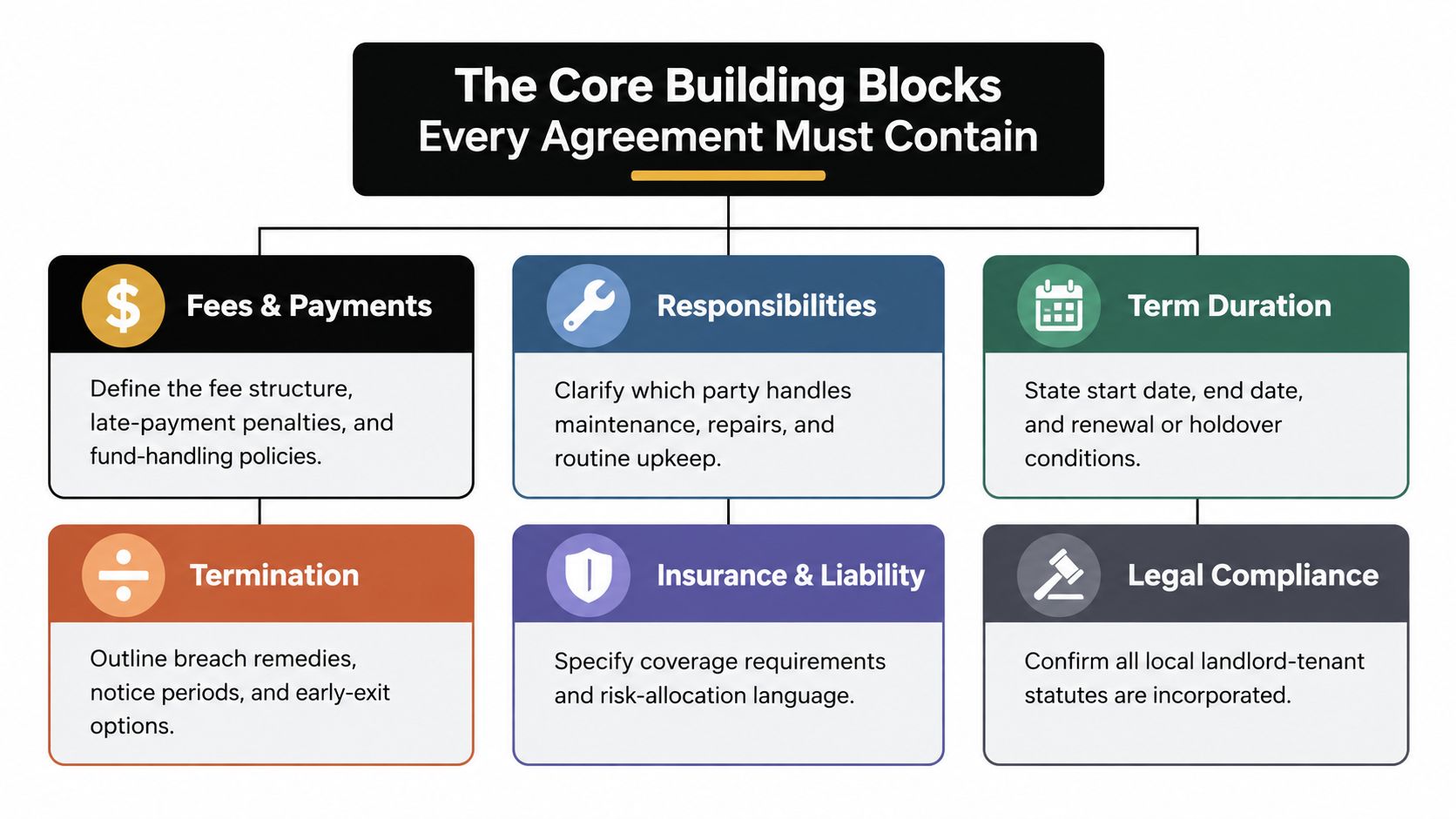
Term and renewal
Term states when management begins and ends. Renewal explains whether the agreement renews automatically, how much notice either party must provide, and whether the manager keeps earning fees during a holdover period. Delete automatic renewal language that extends the relationship without a clear reminder or owner approval.
Fees and payments
The fee block must list recurring management compensation, placement charges, setup or onboarding costs, renewal commissions, maintenance charges, inspection fees, collection costs, and any hourly services. Require the manager to state whether percentages apply to collected rent, scheduled rent, late fees, deposits, or other receipts. A single percentage without a complete schedule is not transparent pricing.
Responsibilities
Write down who handles marketing, screening, lease preparation, rent collection, maintenance coordination, complaints, inspections, notices, accounting, and emergencies. “Manager will manage the property” is not a scope of work. Separate included services from excluded services so the manager can't reclassify ordinary work as billable later.
Authority and spending
The manager needs practical authority, but not unlimited discretion. Set approval requirements for major repairs, projects, settlements, legal work, and vendor relationships. Require written notice when the manager acts under an emergency exception.
Insurance and liability
Identify required owner policies, the manager's coverage, certificates of insurance, indemnification, and exclusions for negligence or misconduct. The agreement should allocate risk rather than hide it inside a broad hold-harmless clause.
Legal compliance and records
Address fair housing, licensing, trust-account handling, security deposits, notices, local rules, and record delivery. Oregon's official guidance lists property identification, duties, authority, term, termination, fees, accounting statements, record transfer, signatures, and retention among the items an agreement should address. Owners who need to connect property records with broader real estate systems can also review a unified real estate data API before choosing how information will move between tools.
Owner warning: When the contract omits a core block, the missing term doesn't disappear. It becomes a dispute, a default position, or an expensive negotiation after the problem has already occurred.
How Management Fees Add Up in 2026
A Fresno rental listed at $2,400 per month can carry a far higher management bill than the headline percentage suggests. The recurring fee is only one line item. Review the property management fee benchmarks before comparing proposals.
A 2026 industry compilation reports an average monthly management fee of 8.49% of collected rent, compared with a California average of 7.44%, or a reported flat average of $111.61. It also reports tenant placement averaging 70.6% of one month's rent and setup fees averaging $185.24. On the Fresno example, the national average equals $203.76 per month, or $2,445.12 across twelve months, before placement, renewal, setup, maintenance, inspection, or legal charges. The same figures show why first-year costs can reach 18% to 20% of gross rental income after placement, setup, and renewal fees. These figures come from Baselane's 2026 fee compilation.
| Fee Type | National Average | California Average | Typical Range |
|---|---|---|---|
| Monthly management | 8.49% of collected rent | 7.44% of collected rent or $111.61 flat average | Depends on scope and pricing model |
| Tenant placement | 70.6% of one month's rent | Not separately reported in the cited benchmark | Depends on service and property |
| Setup or onboarding | $185.24 | Not separately reported in the cited benchmark | Depends on provider |
| First-year combined cost | 18% to 20% of gross rental income | Not separately reported in the cited benchmark | Depends on included charges |
Line items landlords miss
Read every clause covering maintenance markups, vendor coordination, renewals, inspections, eviction coordination, account setup, and vacant-property charges. Require the agreement to disclose vendor rebates, referral compensation, and related-party work. For third-party repairs, require an actual invoice and state whether the manager adds a markup.
Convert each percentage into a dollar amount for your property. Then get written answers about vacancy, nonpayment, lease extensions, repair emergencies, and a sale or manager change. A proposal is comparable only when the service scope, collection basis, and every extra charge are visible. Ask who owns resident data, how online rent records transfer, and whether a software discontinuation can interrupt collection or reporting. Those terms can matter as much as the management percentage.
Full-Service Versus Placement-Only Service Compared
Full-service management buys distance from daily operations. Placement-only service buys a completed lease and leaves the owner responsible for everything afterward. Neither model is automatically superior. The right choice depends on your location, availability, operating experience, and tolerance for tenant calls.
| Factor | Full-Service Management | Placement-Only Service |
|---|---|---|
| Scope of duties | Rent collection, tenant communication, maintenance coordination, accounting, inspections, and lease administration as defined in the agreement | Marketing, applicant screening, lease preparation, and move-in support as defined in the agreement |
| Cost structure | Recurring management fee plus any listed placement, renewal, setup, maintenance, or special-service charges | Usually a placement charge, followed by owner-managed operating costs |
| Owner involvement | Limited day-to-day involvement, though approvals and funding remain important | High involvement after lease signing, including rent, repairs, notices, and tenant communication |
| Best fit | Out-of-state owners, owners with multiple properties, and landlords who want an operating buffer | Hands-on landlords who live nearby and can manage the tenancy themselves |
Choose full service for operational distance
Full service makes sense when you can't respond quickly, don't want to coordinate vendors, or own enough property that tenant administration consumes your week. It also gives you a defined accounting and communication process, provided the agreement promises those deliverables.
Choose placement only for control
Placement-only works when you're comfortable handling the tenancy after lease-up. Before signing, confirm exactly where the service ends. Require delivery of the application file, screening records, signed lease, move-in documentation, deposit information, and any required notices.
Don't compare these models by headline price alone. Compare the work you'll perform yourself, the risk you'll carry, and every fee that applies after the tenant moves in.
A Sample Rental Property Management Agreement Template
Use the following clause order as a working outline. Have California counsel review the final document, especially where local ordinances, agency authority, deposits, or indemnification are involved.
1. Parties and property identification
Name the owner, management company, designated broker, and authorized contacts. List the complete property address and identify attached units, parking, storage, and included appliances.
2. Term and renewal
State the start date, end date, renewal process, and holdover treatment. Remove automatic renewal unless the manager must give written notice and the owner has a practical opportunity to decline.
3. Management scope
List marketing, screening, leasing, rent collection, tenant communication, maintenance coordination, inspections, accounting, and complaints. Mark each service as included, excluded, or separately charged.
4. Fee schedule
Create a complete fee exhibit. It should identify recurring fees, placement, setup, renewal, maintenance, inspections, legal coordination, sale-related compensation, and any minimum charge.
5. Owner obligations
State the owner's duties for funding repairs, maintaining insurance, providing disclosures, approving major work, and complying with lawful instructions. Don't accept an obligation to approve every routine decision if you're paying for full service.
6. Manager obligations
Require timely accounting, lawful leasing practices, tenant communication, record maintenance, and compliance with the agreed service scope. Add delivery standards for statements, notices, invoices, and owner updates.
7. Trust-account handling
Explain where rent and deposits go, how funds are reconciled, what deductions are permitted, and when owner funds are disbursed. Require statements that identify receipts, payments, reserves, and ending balances.
8. Maintenance authority
Set approval thresholds and emergency exceptions. Require competitive pricing or owner approval for affiliated vendors, substantial work, and any repair that exceeds the stated authority.
9. Insurance and indemnification
Specify policies, certificates, additional-insured status, defense obligations, and liability exclusions. Protect the owner from language that excuses the manager's negligence, willful misconduct, or unauthorized acts.
10. Fair housing and legal compliance
Require compliance with federal, California, and applicable local landlord-tenant rules. Identify who handles notices, accommodations, inspections, licensing issues, and regulatory requests.
11. Termination
Separate ordinary termination, termination for breach, and termination after an uncured failure. State notice, cure periods, final fees, rent handling, tenant communication, and record delivery.
12. Sale of property
Add a specific sale-triggered termination right. State that a sale doesn't create a placement, renewal, commission, transition, or record-release fee unless the owner expressly agreed to that charge.
13. Records and data
Define ownership, access, retention, export format, delivery timing, and deletion. Include tenant files, ledgers, invoices, communications, inspection reports, photos, applications, and software-generated records.
14. Governing law and disputes
Name the governing state law and dispute process. Check for venue, attorney-fee, arbitration, mediation, and notice provisions that could make enforcement costly.
15. Signatures and exhibits
Require signatures, dates, broker identification where applicable, and attachments for fees, property condition, insurance, and service scope. A missing exhibit can undermine an otherwise careful agreement.
Technology and Data Clauses Most Contracts Leave Vague
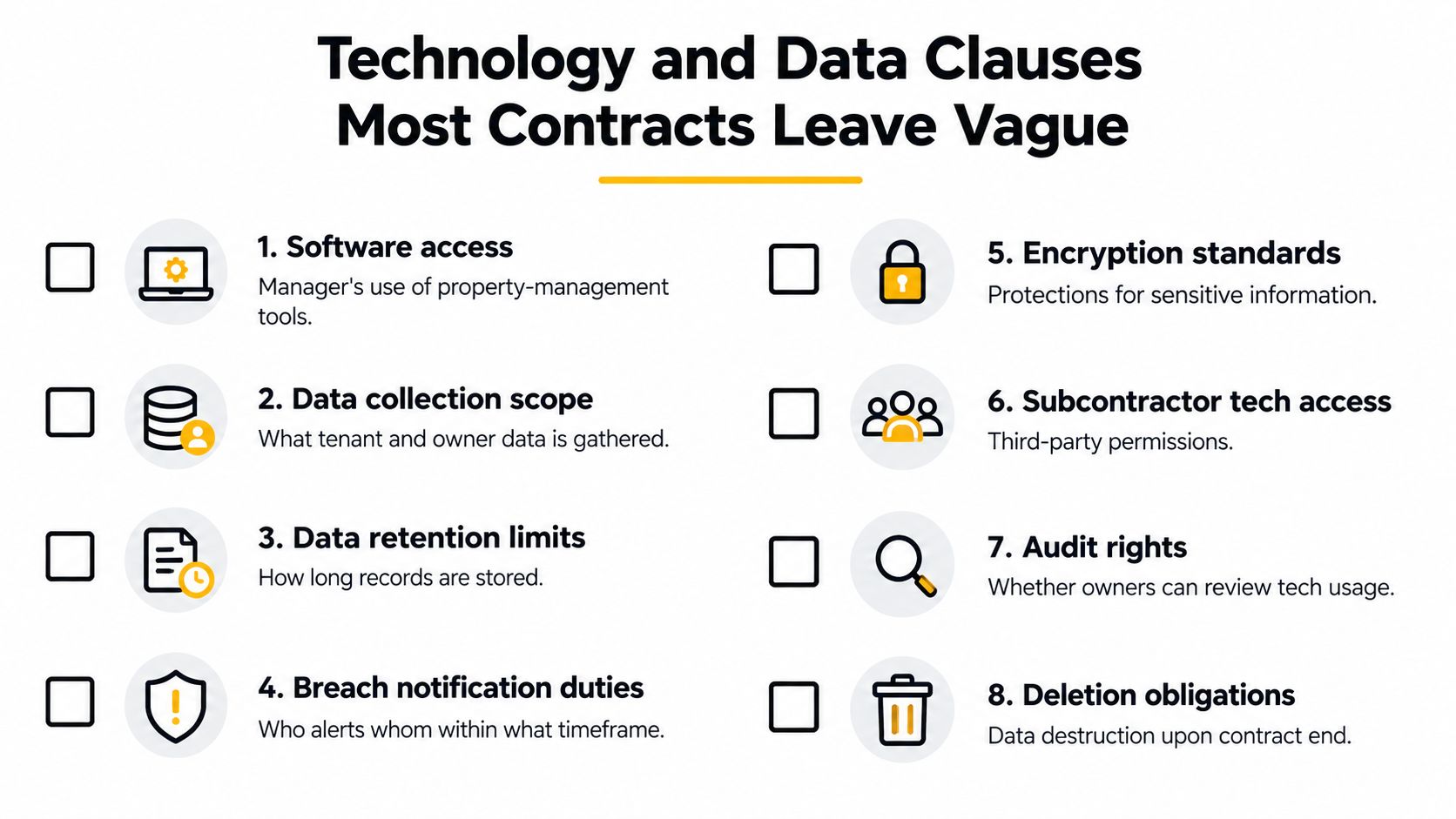
A sentence allowing the manager to use software isn't a technology policy. It doesn't answer who owns the rent ledger, who can export resident communications, or how quickly the owner receives records after termination.
The risk is practical. A manager may change its property-management platform, discontinue an owner portal, or move resident analytics to another vendor. Without a transition clause, you may have access only while you remain a client. A current 2026 property management software guide can help owners understand the systems managers may bundle into the relationship, while this property management software comparison helps frame questions about integrations and reporting.
Four sentences worth demanding
Add language covering these points in plain English:
- Data ownership and portability: “The owner owns property, financial, maintenance, tenant-communication, and lease records created or maintained for the property, and the manager must provide an export in a commonly usable format upon request.”
- Software discontinuation: “If the manager discontinues, replaces, or loses access to a platform, the manager must preserve and deliver the owner's records without interruption to lawful management operations.”
- Online rent collection costs: “The manager must identify all payment-processing, portal, convenience, and transfer charges, state who pays each charge, and obtain owner approval before adding a new fee.”
- Technology performance: “The manager must provide the reporting, payment status, maintenance history, and communication access described in this agreement and must promptly disclose any material outage or service reduction.”
Also address data retention, breach notification, encryption, subcontractor access, audit rights, and deletion after the relationship ends. Don't let “industry-standard security” stand alone. The contract should identify the process the manager follows when systems fail or sensitive information is exposed.
Termination Scenarios and the Sale-Related Exit Trap
Termination is not one event. Draft three separate paths because notice, fees, records, tenants, and active leases change under each one.
| Scenario | Typical Notice | Maximum Fee Exposure | Record Transfer |
|---|---|---|---|
| Ordinary end-of-term exit | Often 30, 60, or 90 days, as written in the contract | Remaining management fees, renewal charges, or stated termination fees if allowed | By a defined deadline after final reconciliation |
| Breach-based termination | Notice and cure period stated in the agreement | Waived when the manager fails to cure its breach | Begins immediately after termination |
| Sale-related termination | Separately negotiated, not buried in ordinary termination | Commission, renewal, transition, or sale-related claims unless waived | Delivered without a fee as part of the sale transition |
Ordinary termination
State exactly when notice begins. It may run from delivery, the next calendar month, or the end of the contract term. The agreement must also explain the final month's prorated management charge and whether the manager can claim a renewal fee after receiving notice.
Breach-based removal
Define material breaches, including missing accounting, unauthorized charges, missed legal duties, and failure to perform agreed services. Give the manager a reasonable cure period where appropriate. Permit immediate termination for serious misconduct, unlawful conduct, or conduct that threatens residents or property.
The sale trap
Selling the property can trigger claims that the regular fee schedule never made clear. A manager may claim a renewal commission when the tenant signs again, a transition charge for exporting records, or management fees while the existing lease remains active. Technology clauses can worsen the problem if the contract does not require prompt delivery of online payment records, resident communications, maintenance history, and the owner ledger.
Using the 2026 fee compilation, a manager continuing to collect fees while a sale takes three months could draw roughly $611 in management compensation, before a renewal claim or other charges. The sale clause should expressly end that exposure at closing or at the agreed transfer date.
Demand sale-specific language that permits termination with 10 days' notice, waives record-transfer fees, and excludes renewal compensation when the tenant rolls over after the sale. The clause should identify who handles rent, notices, repairs, the active lease, the security deposit, and the final owner statement during the handoff.
Require a fixed deadline for delivering exportable records and a written accounting of every fee deducted during the transition. If the manager sells software access or data services as part of management, the contract should not let those systems delay the transfer or create a new exit charge.
Pre-Signing Landlord Checklist for Legal and Insurance Compliance
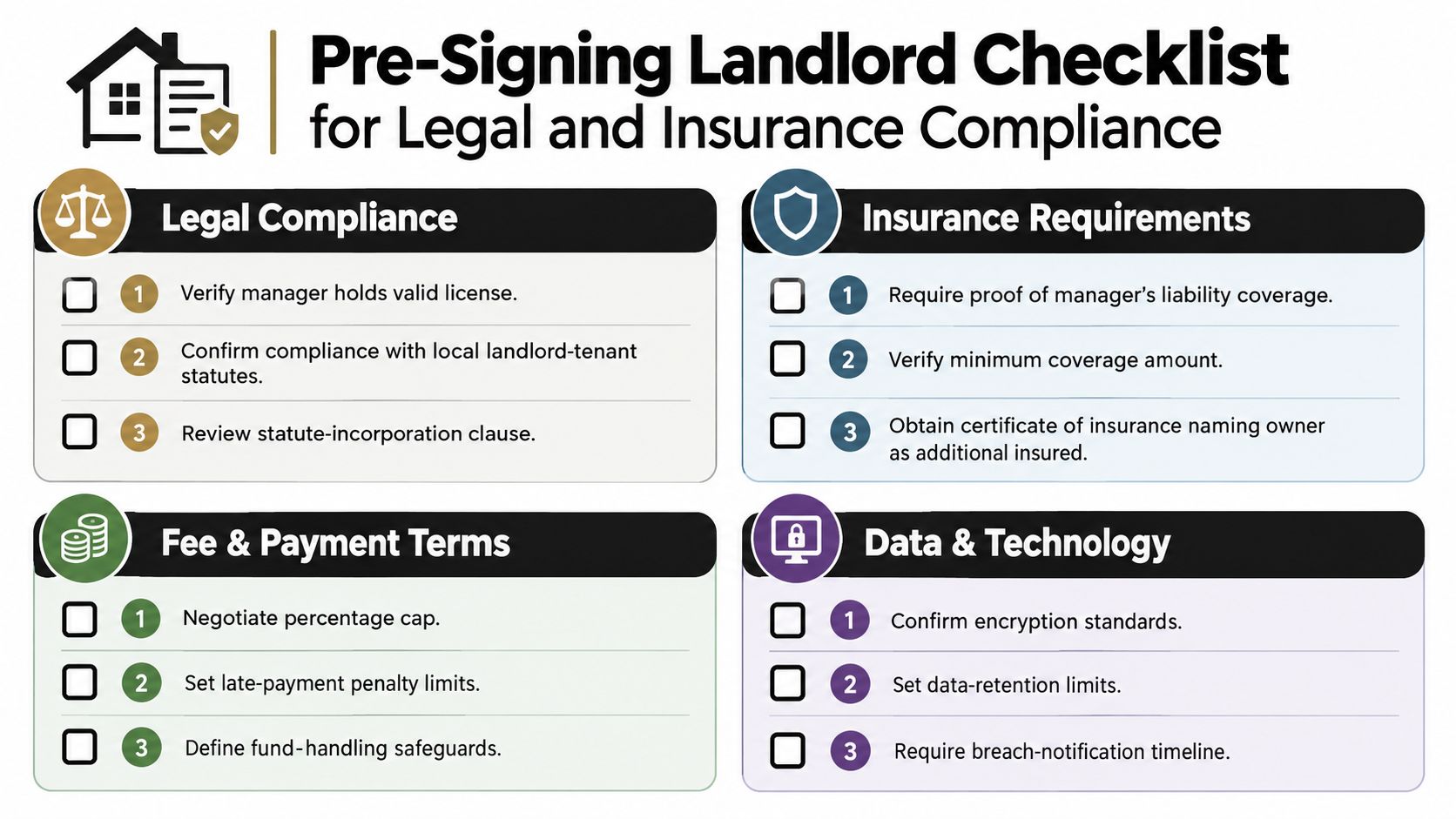
Before signing, verify the document in four passes. Don't rely on a manager's verbal explanation of a clause that remains unchanged in the final agreement.
Legal compliance
- Verify licensing: Confirm the manager and designated broker hold the required California credentials for the services they'll perform.
- Check local rules: Review the city's landlord-tenant requirements, including any rent, notice, registration, inspection, or disclosure provisions.
- Confirm agency authority: Make sure the agreement authorizes lease signing, notices, collection, and vendor coordination without granting unlimited power.
- Review records: Confirm the contract's retention, accounting, and transfer requirements. Use this compliance documentation resource to organize the records you'll need to review.
Insurance
Require proof of the manager's liability and errors-and-omissions coverage. Ask your insurer whether the manager should be added as an additional insured, and make sure the indemnification clause doesn't shift every management error back to you. Owners comparing coverage options can review ISU Insurance Services commercial policies as part of that conversation.
Fees
Confirm the monthly percentage, calculation base, minimums, vacancy treatment, placement charge, setup fee, renewal fee, maintenance charges, inspection fees, and legal-service costs. Require prior approval for new or open-ended charges and ask for vendor invoices when a markup applies.
Exit mechanics
Locate the ordinary termination, breach, sale, record-release, data-export, and renewal-exclusion clauses. If you can't find the sale right or record deadline in the signed document, assume you don't have it.
How to Negotiate the Clauses That Matter Most
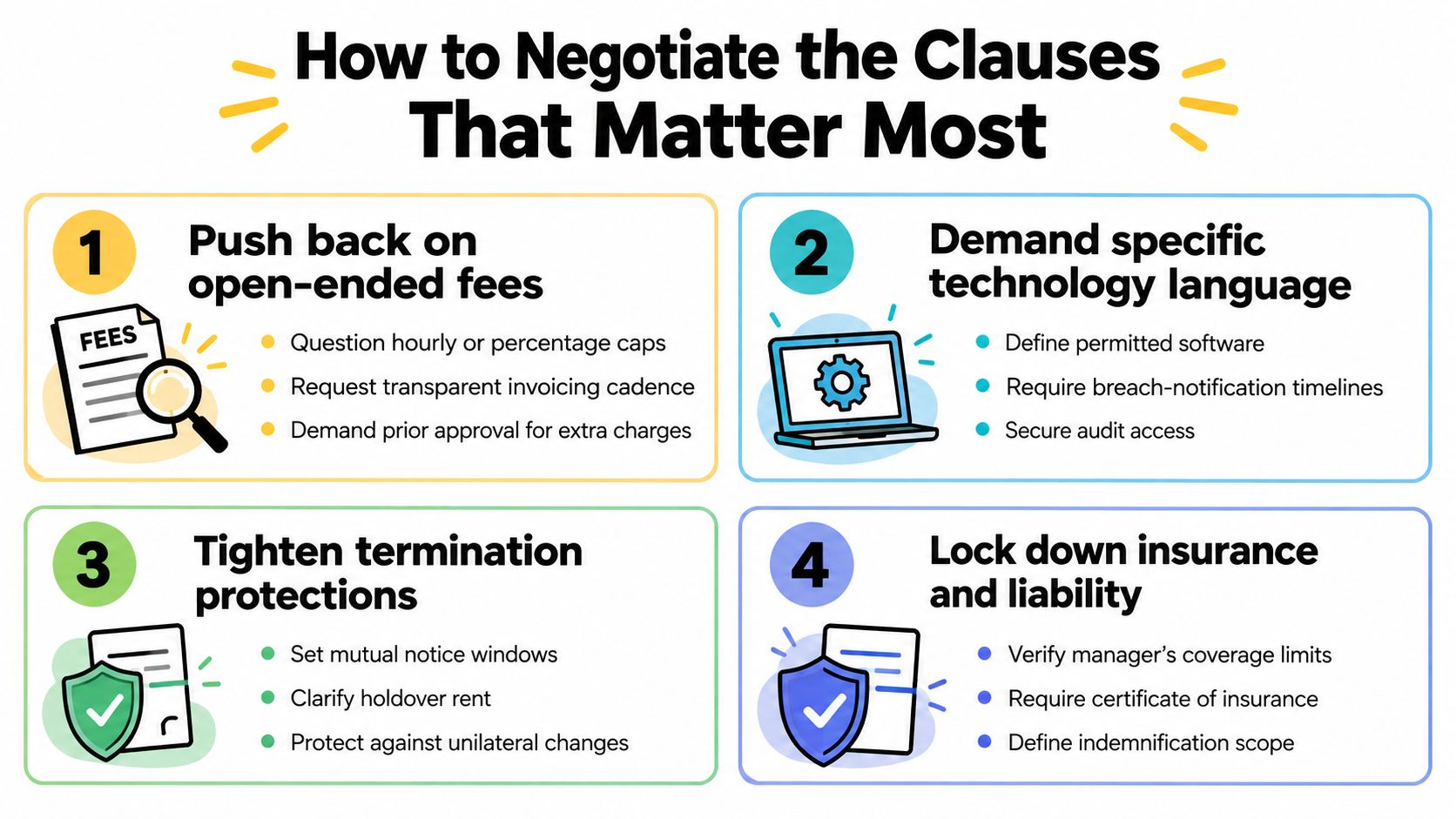
Treat the management agreement as a starting offer, not a finished document. A manager will negotiate leases, repairs, and vendor terms for you. The contract deserves the same scrutiny because it controls every operating decision after occupancy.
Put these four concessions on the call agenda:
- Cap the monthly management percentage. Require a written ceiling of 9%, with the calculation base, minimums, and vacancy treatment stated clearly.
- Shorten termination notice. Request 30 days instead of 90 days, with separate rules for breach, sale, and manager nonperformance.
- Carve out a sale exit. Require sale-triggered termination, no record-transfer fee, and no renewal commission after the sale.
- Exclude software-discontinuation liability. The manager must preserve and export owner records when it changes platforms, retires software, or loses access to a resident analytics system.
Require rent deposits within 5 business days of collection, a written quarterly inspection schedule, and a 48-hour emergency repair-response standard. Put each service level in the agreement, not in an email from a leasing agent.
Anchor the fee discussion to the California average cited earlier rather than the national figure, and bring the printed benchmark from the Baselane fee compilation to the call. Require an itemized schedule showing every charge and the duty each fee covers. If the proposed percentage exceeds that benchmark, ask which concession the manager will include at no charge: a capped rate, 30-day exit, sale carve-out, or data-export guarantee. Trade the premium for a specific obligation.
Quick-Reference Index of Clauses and Cross-References
Use this table in the negotiation call. A blank answer is a revision point, not a minor drafting issue. Pay particular attention to technology, record access, and the cost of leaving a manager before the contract term ends.
| Clause | Fee Impact | Primary Risk | See Section |
|---|---|---|---|
| Term and renewal | Continuing management or renewal charges | Automatic extension | The Core Building Blocks |
| Management percentage | Recurring charge against the stated rent base | Paying on amounts never collected | How Management Fees Add Up |
| Tenant placement | One-time leasing compensation | Fee triggered again after a tenant rollover | Fee section, line items |
| Setup or onboarding | One-time account charge | Paying for undefined administrative work | Fee section, line items |
| Maintenance markup | Added cost on vendor work | Conflicts over vendor pricing | Fee section, vendor charges |
| Termination notice | Possible continuing fees | Being locked in during poor performance | Termination Scenarios and the Sale-Related Exit Trap |
| Sale-related exit | Commission, renewal, or transition claims | Delayed sale and withheld records | Termination Scenarios and the Sale-Related Exit Trap |
| Data ownership | Usually indirect, through transition costs | Losing access to ledgers and tenant files | Technology and Data Clauses Most Contracts Leave Vague |
| Software discontinuation | Export or conversion costs | Platform changes interrupting visibility | Technology and Data Clauses Most Contracts Leave Vague |
| Insurance certificates | Premium and risk-allocation implications | Uninsured management errors | Pre-Signing Landlord Checklist for Legal and Insurance Compliance |
| Legal compliance | Possible legal and administrative charges | Liability for unlawful management | Pre-Signing Landlord Checklist for Legal and Insurance Compliance |
Read the fee rows together. A percentage may look acceptable until placement, onboarding, maintenance, renewal, or sale-related charges are added. The agreement should state the rent base, collection condition, billing trigger, and whether each charge applies after termination.
The exit rows deserve equal scrutiny. A manager may claim compensation after a sale or tenant renewal unless the contract limits those claims. Require a clear end date, defined record-transfer duties, and an itemized list of charges that survive termination. For software changes, specify the file formats, delivery deadline, and access period for owner and resident records.
Frequently Asked Questions on Rental Property Management Agreements
How long must a manager retain tenant records?
The answer depends on the governing state and the type of record. Some state rules require written records to be retained for six years during and after a management agreement, as illustrated by New Mexico's administrative rule. Your agreement should state the longer applicable period when laws differ, identify the records covered, and require delivery of copies before the manager deletes anything.
Can an out-of-state owner let a California manager sign leases?
A manager may need clearly documented agency authority to negotiate or sign on the owner's behalf. The agreement should identify the permitted acts, approved lease forms, notice authority, and any power-of-attorney language required by the transaction or governing law. Don't assume a general management appointment authorizes every signature.
What happens when I switch managers during an active lease?
The lease generally continues, but management duties, rent instructions, tenant communications, accounting, and deposit custody must transfer cleanly. Require the outgoing manager to deliver the signed lease, ledger, notices, inspection records, maintenance history, tenant contact information, and deposit accounting by a stated deadline. The incoming manager should confirm in writing who holds and transfers the security deposit.
Does a 2026 agreement need a cybersecurity clause?
Yes. Add written terms for software access, data ownership, retention, encryption, subcontractor access, breach notifications, audit rights, and deletion. A generic permission to use software doesn't protect your access to resident analytics, online rent records, or digital reports when the management relationship ends.
Edinhart Realty and Property Management offers both full-service monthly management and placement-only service for Central California owners, with defined options for rent collection, repair coordination, tenant communication, leasing, renewals, and accounting. Review your rental property management agreement with Edinhart Realty and Property Management before signing, and ask for a written fee schedule, technology plan, and sale-transition clause.


