

You're standing in front of a Fresno house that looks ready to rent tomorrow. The paint looks decent, the yard's tidy, and the listing price seems workable. Then the critical questions emerge. How much income will it produce, what will it cost to own, and is the rental property investment return strong enough to justify tying up your money in Central California?
That is where many new investors slow down. A property can look like a good deal on paper and still fall short once vacancy, repairs, and management enter the picture. In Fresno and the surrounding Central California market, the gap between a property that seems promising and one that performs usually comes down to how carefully you measure return, then how consistently you manage the home after closing.
The good news is that rental return becomes much easier to judge once you break it into the right pieces. When you know the key metrics, you can compare houses with more confidence, avoid emotional decisions, and see whether a deal has real income potential. A useful outside reference point is a commercial real estate valuation guide, because valuation and income analysis need to support each other whenever you are weighing a purchase.
For buyers searching for homes in this market, the process often starts before the math. A good property hunt begins with inventory, neighborhood fit, and rent potential, which is why many local investors also use how to find investment properties before they ever plug numbers into a spreadsheet. For a broader market reference, a Global Property Guide overview can help you see how local returns compare with other areas, though Fresno still needs to be judged on Fresno-style numbers.
Professional property management also changes the equation. Small differences in screening, maintenance timing, lease renewals, and expense control can shift the final return in ways that a spreadsheet alone will not show. For investors who want a practical comparison of short-term and long-term performance, these insights on Airbnb profitability for owners help frame how management style affects income, especially when you compare a traditional rental with other approaches.
Is This Fresno Property a Good Investment
A Fresno investor often starts with the same question. The house may look solid, the street may feel familiar, and the numbers can still tell a different story. Paint, layout, and curb appeal matter, but they do not answer the true test, which is whether the property can keep producing income after vacancies, repairs, and day-to-day management costs are paid.
Start with income, then test the costs
The first screen is straightforward. Compare expected rent with the purchase price, then subtract operating expenses, vacancy, and management. In Fresno, that order matters because a property can lease quickly and still miss the mark if repairs are frequent, turnover is high, or the monthly carrying costs are too heavy.
Practical rule: if you cannot explain the return in plain language, you do not know the deal well enough yet.
A market benchmark can help you orient yourself, but it should not decide the purchase for you. U.S. gross rental yields averaged 6.56% in Q4 2025, and analysts at Global Property Guide show that returns vary meaningfully from one area to another. That spread highlights why a Fresno property's potential should be judged using local data.
Why the answer changes from property to property
Two homes with the same purchase price can produce very different results once rent, repairs, and management enter the picture. A property with steady tenant demand and controlled expenses can outperform a nicer-looking listing that costs more to hold and maintain. A broader valuation framework can help you stay grounded here, especially if you want to separate price from performance. A practical commercial real estate valuation guide can also help you see how investors compare income, costs, and asset value in a disciplined way.
A property is a good investment when the income still works after the expenses do their job.
If you are still searching, start with neighborhoods, tenant profile, and likely maintenance needs, not just the asking price. Investors who use a local property hunt process, such as the approach outlined in how to find investment properties, usually make faster decisions when a promising house comes along because they already know what strong numbers look like in this market.
The Five Key Metrics of Rental Returns
A Fresno investor can look at one property and see five different numbers that all seem to say something important. Each one is answering a different question. One shows how much income the property generates, another shows how efficiently your cash is working, and another helps you compare two homes without getting distracted by cosmetic updates or curb appeal.
What each metric is really doing
Net Operating Income, or NOI, is the property's income after operating expenses but before mortgage payments. It works like the property's working profit, the amount left after the day-to-day costs of keeping the home rentable are paid.
Capitalization rate, or cap rate, compares NOI to purchase price. It gives you a quick read on the income engine of a deal, which is useful when you are comparing similar properties in the same Fresno or Central California submarket. Current market data shows that single-family rentals reached about 7.3% cap rates in Q4 2025 and multifamily cap rates averaged about 5.6% in 2025 (Walnut Invest).
Cash-on-cash return measures annual pre-tax cash flow against the cash you put into the purchase. This matters when financing is part of the deal, because it shows how hard your invested cash is working.
Gross Rent Multiplier, or GRM, compares property price to gross rent. It is a fast screening tool, but it leaves out expenses, so it can make a property look better than it really is if repairs, taxes, or management costs are heavy.
Internal Rate of Return, or IRR, tries to capture the full return path over time, including the holding period and the eventual sale. It gives you a longer view of performance, but it depends heavily on assumptions, so it should not stand on its own.
| Rental Return Metrics at a Glance | |||
|---|---|---|---|
| Metric | What It Measures | Best For | Limitation |
| NOI | Operating profit before debt | Judging property income quality | Leaves out financing |
| Cap Rate | NOI relative to price | Comparing similar assets | Does not show the impact of financing |
| Cash-on-Cash Return | Cash earned on cash invested | Deals using financing | Does not capture appreciation fully |
| GRM | Price relative to gross rent | Fast screening | Ignores expenses |
| IRR | Time-weighted total return | Long-term planning | Depends on assumptions |
Why professionals never stop at one number
Each metric answers a different question, and no single one tells the whole story. A Fresno house might look acceptable on GRM, yet still disappoint once expenses and financing are added. Another property may seem expensive at first glance, but produce stronger actual return because its operating costs are tighter and its rent collection is steadier.
For a fuller look at how analysts compare properties, the real estate investment property analysis guide is a useful companion to your own spreadsheet. If you are comparing long-term rentals with short-term stays, the insights on Airbnb profitability for owners help show why the holding strategy changes the numbers so much.
Calculating Your Potential Return Step by Step
A Fresno investor can make this math real with a simple example. Say you're evaluating a $400,000 three-bedroom house. You're not trying to guess the future. You're trying to measure whether the current rent and expense structure support the purchase.
Build the calculation from the ground up
Start with annual rent, then subtract the costs that show up whether the property is occupied or not. For a practical underwriting pass, many investors begin with estimated rent, then layer in operating expenses, a vacancy allowance, and ongoing maintenance. That process matters because a property that looks attractive on rent alone can weaken fast once the actual carrying costs are included.
Practical rule: if the deal only works when every month is full and every repair is minor, the deal is fragile.
The infographic below maps the sequence clearly.
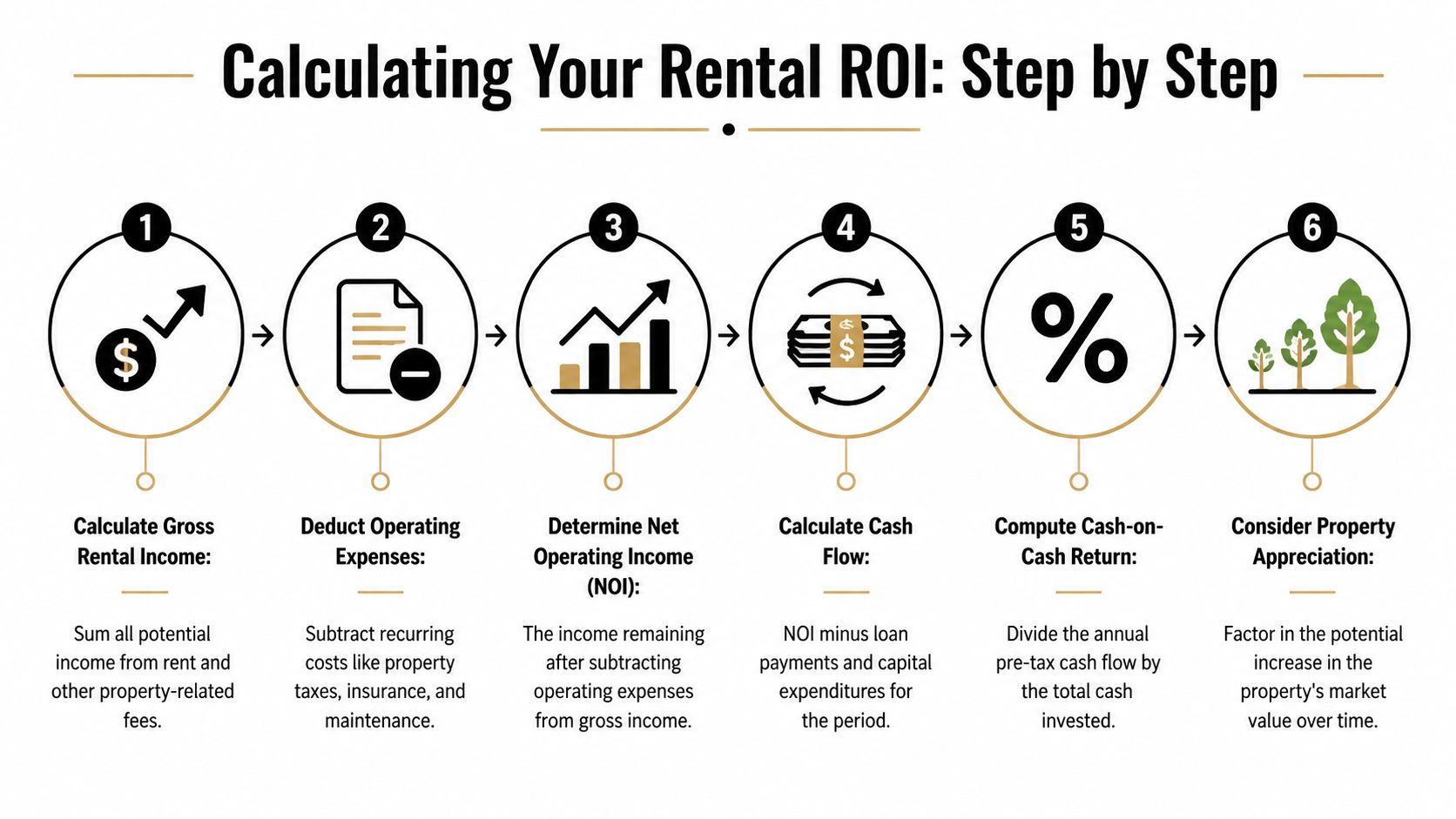
Here's how a local investor would approach the worksheet in practice:
- Gross rental income. List the full rent the house should collect over a year.
- Operating expenses. Subtract recurring costs like taxes, insurance, maintenance, and management.
- NOI. What remains is the income the property produces before debt.
- Cash flow. Subtract loan payments and major capital spending if you're checking performance financed with debt.
- Cash-on-cash return. Divide annual pre-tax cash flow by total cash invested.
- Appreciation. Consider whether long-term value growth strengthens the total return.
The exact formulas matter less than the discipline. A property with healthy rent can still underperform if vacancy or repairs are ignored. That's why local underwriting in Fresno should always treat the first pass as a stress test, not a victory lap.
How the math changes when debt enters the picture
Financing can make a property look stronger on a cash basis, but it also adds monthly pressure. That's where cash-on-cash return becomes useful, because it shows how the property treats the money you put down. Investors who understand this distinction stop confusing paper appreciation with cash in the bank.
The key is to make the math honest. Use realistic rents, realistic expenses, and realistic vacancy, then see whether the Fresno house still clears your threshold.
How Local Markets and Management Impact Your Numbers
A Fresno property's return isn't fixed when you buy it. It changes with tenant demand, repairs, turnover, screening quality, and how tightly someone manages the file. That's why two owners can buy similar houses and end up with very different outcomes.
Central California changes the inputs
Local neighborhoods affect rent potential, but they also affect turnover risk and maintenance patterns. A house with strong tenant demand and predictable upkeep can stay stable for years, while a property that attracts weak applicants can generate avoidable damage and missed payments. In Central California, the manager's job is to protect the income line before it turns into a problem.
Utilities, landscaping, and routine service calls also matter more than many first-time investors expect. When those tasks are handled loosely, the expenses creep up in ways that don't show up in the listing photos. Good management tightens that gap by keeping the property cleaner, turning units faster, and catching issues before they become larger repairs.
Management turns theory into realized return
Professional property management changes the actual numbers in the formula. It does that through screening, rent collection, vendor coordination, and lease enforcement. A service model like is property management worth it is relevant here because the fundamental question isn't whether management costs money, it's whether the owner is getting disciplined execution in return.
Edinhart Realty and Property Management offers a practical example of how that shows up on the ground. Its full-service model includes rent collection, repair coordination, tenant communication, lease renewals, and financial reporting, while its placement-only option focuses on marketing, screening, and lease drafting. That kind of structure affects return because each of those tasks influences occupancy, collections, and operating discipline.
Manager's reality: a strong rent number means little if the tenant file is weak and the turn process is sloppy.
Investors often underestimate how much consistency matters. One missed follow-up, one delayed repair, or one poorly screened tenant can erase a lot of margin. A good operator doesn't just preserve the property, it protects the math behind the property.
Strategies to Maximize Your Rental Investment Return
The best returns usually come from improving the deal after the purchase, not just hunting for a perfect one. That means using better pricing discipline, smarter upgrades, and tighter operations. In a market where debt-financed property ROI benchmarks are being quoted in a wider range, roughly 7% to 12% depending on market and strategy, the margin for sloppy underwriting is thin (Baselane).
Spend where the rent response is strongest
Not every upgrade pays back the same way. A kitchen refresh may do more for tenant appeal than a cosmetic improvement that photographs well but doesn't change monthly rent much. In Fresno, value-add work should be chosen for durability, tenant appeal, and ease of maintenance, not for novelty.
Small changes can also help when they reduce turnover headaches. Durable flooring, clean fixtures, and low-maintenance finishes usually support a steadier operating profile than fragile design choices. The right upgrades don't need to be flashy, they need to make the unit easier to rent and easier to keep rented.
Control the levers you can actually control
Rent pricing should be reviewed with local comps, not gut feeling. Vacancy should be treated as a performance issue, not bad luck. And maintenance should be scheduled and documented before small issues turn into emergency calls.
- Price with discipline: Set rent based on actual market fit, not what you hope the market will pay.
- Reduce dead time: Get make-ready work and marketing moving before the current tenant leaves.
- Watch recurring costs: Revisit vendors, service schedules, and recurring line items regularly.
- Use financing carefully: If refinancing improves cash flow without creating new risk, it can strengthen the return profile.
- Keep screening strict: Better tenants usually mean steadier collections and fewer avoidable repairs.
Professional oversight matters here because return is partly operational, not just financial. The more consistent the system, the easier it is to hold the property near its target performance over time.
Common Pitfalls and Critical Considerations
Many investors overrate the gross number because it's easy to calculate and flattering to read. That's a mistake. Gross rent tells you what the property might collect, but it doesn't tell you what you get to keep after operating costs and capital needs show up.
Gross numbers can hide weak deals
A technically defensible ROI calculation uses net income relative to total invested capital, not just rent divided by price (Investopedia). That distinction matters because a property can boast a decent-looking rent line and still deliver a weak outcome once expenses, vacancy, and financing are included. A stronger return picture also includes appreciation over time, but that still doesn't replace the need to evaluate the income side accurately.
The easiest way to get burned is to ignore the costs that don't feel urgent during escrow. Roof reserves, HVAC surprises, lease-up time, and management fees all reduce what reaches your pocket. If you leave those out, your spreadsheet becomes a sales pitch instead of an analysis.
Tax treatment changes the real result
Taxes matter because they alter what's left after operations. Mortgage interest, operating expenses, and depreciation all affect the owner's actual return picture in ways that a simple rent calculation can't capture. That's another reason experienced investors treat the headline yield as a starting point, not the final word.
Real estate looks simple until the costs start arriving in separate lines.
The right response isn't fear, it's discipline. Build conservative assumptions, keep reserves, and compare net outcomes instead of chasing the prettiest gross number. When the Fresno market gives you a deal that still works after those checks, you're looking at something worth serious attention.
Your Next Steps to Smart Investing
A strong rental property decision starts with the numbers, but it doesn't end there. You need to know the difference between gross yield, NOI, cap rate, and cash-on-cash return, then you need to test the property under realistic operating conditions. In Central California, that means looking past the listing photos and asking whether the income can survive real management, real maintenance, and real vacancy.
The investors who do this well don't rely on one metric. They compare several, stress-test them, and then decide whether the property fits their goals. That approach builds confidence because it turns a guess into a process.
If you're buying in Fresno or trying to improve an existing rental, the next smart move is to pair your numbers with local property management judgment. A team that handles marketing, screening, rent collection, lease renewals, repair coordination, and reporting can help keep the return closer to the plan instead of drifting away from it.
If you want help turning a Fresno rental into a clearer, more dependable asset, Edinhart Realty and Property Management can help with property management, tenant placement, and leasing support across Central California. Visit Edinhart Realty and Property Management to review services, compare management options, and take the next step toward a stronger rental property investment return.


