

Before we get into the nitty-gritty of the formulas, let's get one thing straight: cash flow is the lifeblood of your rental property. It’s the raw, honest truth about whether an investment is actually making you money or slowly bleeding your bank account dry.
Simply put, cash flow analysis is the process of adding up all your income and subtracting all your expenses. If you have money left over at the end of the month, that's positive cash flow. That's the goal.
Why Positive Cash Flow Is Non-Negotiable
It’s easy to get caught up in the excitement of a potential deal, but you can't just look at the rent and the mortgage payment. True rental property cash flow analysis forces you to account for every single dollar, giving you a brutally honest look at a property's financial health.
Think of it this way: a positive cash flow property funds your lifestyle, while a negative one becomes a stressful part-time job you have to pay for. An investment that requires you to dip into your own pocket every month is a liability, not an asset.
The Foundation of a Strong Investment
Positive cash flow is what makes real estate such a powerful tool for building wealth. It’s the money you use to handle that surprise A/C repair, cover a vacancy when a tenant moves out, and build up a solid financial cushion. This monthly profit is your reward for taking the risk, and it’s the engine that lets you grow your portfolio.
A proper analysis keeps you from buying a property based on emotion or wishful thinking. It grounds your decisions in hard data. For a deeper dive into the mechanics, it's worth checking out this complete guide to understanding cash flow statements, which are crucial for evaluating any asset's financial performance.
A property might go up in value over time, but appreciation is just speculation. Cash flow is the real, predictable return you can take to the bank today. It pays the bills while you wait for that long-term growth to happen.
Understanding the Market Dynamics
In today's market, focusing on cash flow is more important than ever. The global real estate rental market was valued at a massive $2.7 trillion in 2024 and is expected to grow by over 7% in the next year alone.
What’s driving this? A serious housing undersupply and the rising cost of homeownership are pushing more people into renting. For smart investors, this creates a fantastic opportunity to generate steady, reliable income.
To get your analysis right, you have to track a few key components. To make it easier, here's a quick breakdown of the essential income and expense categories you absolutely need to have on your radar.
Key Components of a Cash Flow Analysis
| Component Type | Examples | Impact on Cash Flow |
|---|---|---|
| Gross Income | Monthly rent, pet fees, laundry income, parking fees | Increases cash flow (the "money in" side) |
| Operating Expenses | Property taxes, insurance, maintenance, repairs, property management fees, utilities | Decreases cash flow (the "money out" side) |
| Financing Costs | Mortgage principal and interest payments (P&I) | Decreases cash flow (a major expense item) |
| Capital Expenditures | Roof replacement, new HVAC system, major renovations | Decreases cash flow (large, infrequent costs) |
Tracking these items gives you the complete financial picture, not just a rosy snapshot. With this information, you can calculate the two most important metrics for any rental property investor: Net Operating Income (NOI) and, ultimately, your final cash flow.
How to Calculate Your Net Operating Income
Before we can even talk about final cash flow, we have to get a handle on a foundational metric for any rental property cash flow analysis: Net Operating Income, or NOI.
Think of NOI as your property's pure, unfiltered profitability. It tells you exactly how much money the asset generates from its core operations, completely stripping out any financing costs like your mortgage.
This is a critical distinction. NOI lets you judge a property's performance on its own merits, separate from how you decide to finance it. It answers one simple question: "Is this a good business?" That makes it the perfect tool for comparing different investment opportunities on an apples-to-apples basis.
The calculation itself is pretty straightforward: just take your total income and subtract all the operating expenses.
Tallying Your Gross Rental Income
First things first, you need to pin down your Gross Rental Income (GRI). This is the absolute total income your property could generate if it was 100% occupied for the entire year.
For a single-family home pulling in $2,000 a month in rent, the math is simple: $2,000 x 12 months = $24,000 annually.
But income isn't always just the rent check. You have to account for any other revenue streams the property kicks off. This could be anything from:
- Parking fees
- Pet fees
- Late rent penalties
- Income from on-site laundry facilities
- Storage unit rentals
Adding these other income sources gives you the full picture of the property's earning potential. It’s a key step that new investors often miss when they get tunnel vision on the monthly rent.
This flow chart gives a great visual of the simple but powerful formula for figuring out your property's Net Operating Income.
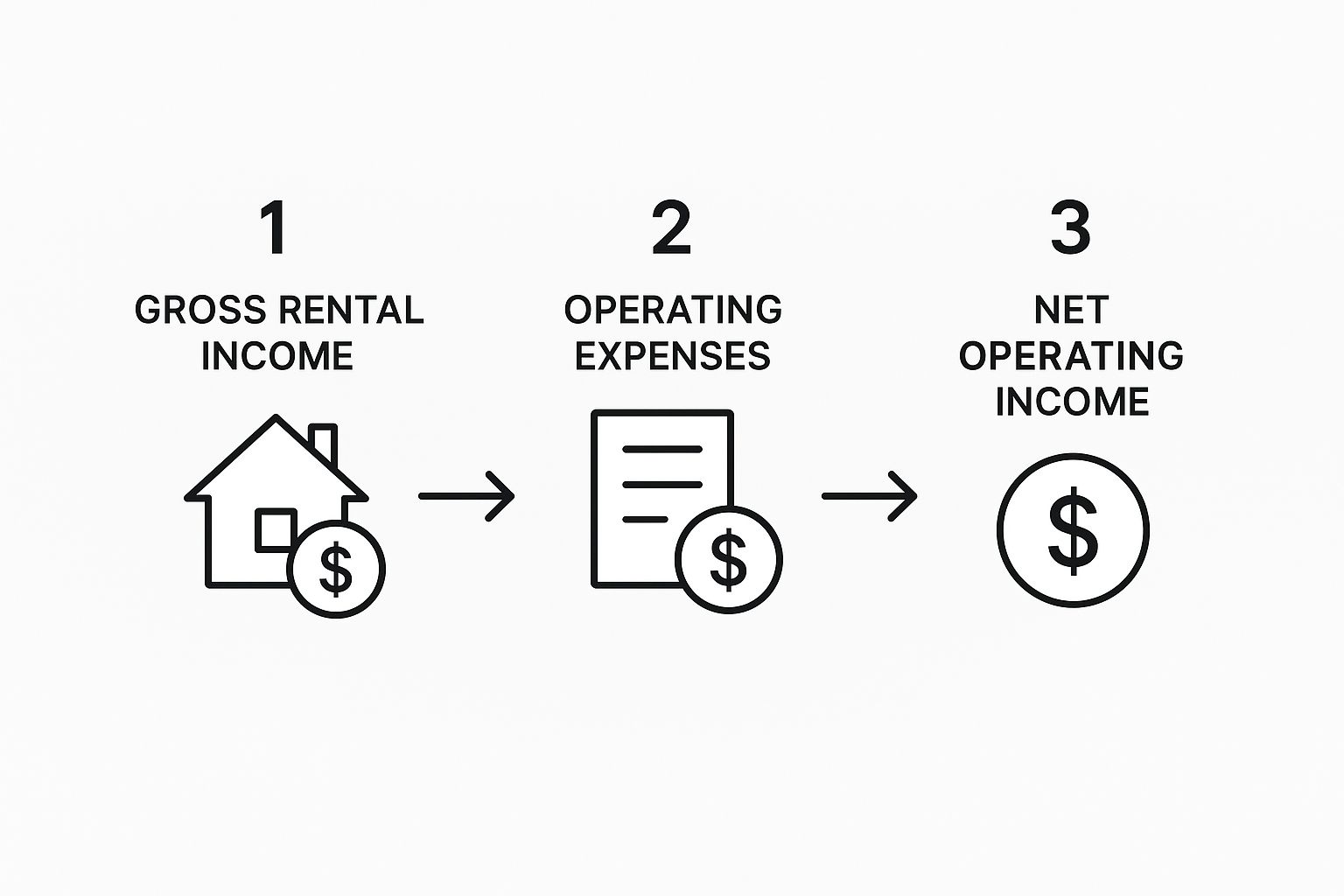
As you can see, the path to finding NOI is a clear-cut process of subtracting your operational costs from total income. What's left reveals the property's core profitability.
Identifying and Subtracting Operating Expenses
Once your Gross Rental Income is tallied up, it's time to subtract the Operating Expenses (OpEx). These are all the costs required to keep the property running and generating that income—and remember, this excludes your mortgage payment.
A classic mistake is underestimating these costs. Here’s a rundown of the expenses you absolutely have to account for:
- Property Taxes: A significant and unavoidable cost.
- Property Insurance: Protects your asset from damage and liability.
- Property Management Fees: Usually 8-12% of collected rent. Even if you self-manage, you should bake this cost into your analysis.
- Utilities: Any utilities you, the owner, are on the hook for (like water, sewer, or garbage).
- Maintenance and Repairs: This covers everything from a leaky faucet to patching drywall. Budgeting 5-10% of the gross rent is a solid rule of thumb.
- Vacancy: No property stays occupied 100% of the time. A conservative estimate is to set aside 5-10% of your GRI to cover those empty periods between tenants.
- Landscaping and Snow Removal: Any costs to maintain the exterior.
- Pest Control: Regular treatments to keep the property pest-free.
- HOA Fees: If your property is part of a homeowners' association.
It's essential to be realistic, even a little pessimistic, when estimating your expenses. Overlooking just one or two of these categories can quickly turn what looks like a great deal on paper into a money pit. The numbers have to reflect real-world possibilities.
Putting It All Together: A Real-World Example
Let's circle back to our example single-family rental with a GRI of $24,000 and calculate its NOI.
| Expense Category | Annual Cost |
|---|---|
| Property Taxes | $3,000 |
| Insurance | $1,200 |
| Vacancy (5% of GRI) | $1,200 |
| Repairs & Maintenance (5%) | $1,200 |
| Property Management (8%) | $1,920 |
| Total Operating Expenses | $8,520 |
Now, we just plug those numbers into the NOI formula:
NOI = Gross Rental Income – Total Operating Expenses
NOI = $24,000 – $8,520 = $15,480
So, this property generates $15,480 in Net Operating Income each year. For a deeper dive into this vital metric, you can learn more about what Net Operating Income is and how it really impacts your investment strategy. With this number in hand, you’re one step closer to finding your true cash flow.
Finding Your True Cash Flow After Financing

So you've nailed down your Net Operating Income (NOI). That number is powerful—it shows you the property's raw earning potential before any loans get involved. But let's be real, most of us aren't buying properties with a briefcase full of cash. That's why NOI doesn't tell the whole story.
To get a true picture of your investment, you have to account for the single biggest expense for nearly every investor: the mortgage.
Financing is what makes real estate investing accessible, but it comes with a cost. By subtracting your debt service—that's just the principal and interest part of your loan payment—from the NOI, you finally see your pre-tax cash flow. This is the number that really matters. It's the cash that actually hits your bank account every month.
Subtracting Your Debt Service
Let’s stick with our single-family rental example. We already figured out it has an annual NOI of $15,480, which breaks down to $1,290 per month.
Now, let's say you landed a mortgage with a monthly principal and interest (P&I) payment of $950.
The math from here is pretty simple:
Monthly Cash Flow = Monthly NOI – Monthly Debt Service (P&I)
$240 = $1,290 – $950
After the bank gets its cut, this property leaves you with $240 in your pocket each month. That comes out to $2,880 a year. This is your pre-tax cash flow, and it’s the figure that directly impacts your personal finances. If you're looking to get a handle on the different ways to fund a deal, digging into how to finance an investment property will give you a major leg up.
Quick Tip: Be careful not to subtract your entire mortgage payment (PITI). Remember, property taxes and insurance were already counted in your operating expenses to find NOI. Only subtract the principal and interest (P&I) here to avoid counting those costs twice.
This is the moment of truth. Does the property pay for itself and still pay you? Or will you be feeding it money every month? But hold on, we’re not quite done. There’s one more crucial cost that new investors almost always forget.
The Hidden Cost of Capital Expenditures
Stopping after pre-tax cash flow is a massive—and common—mistake. Why? Because it ignores Capital Expenditures (CapEx). These are the big, infrequent, but absolutely inevitable expenses needed to keep a property from falling apart.
We’re not talking about fixing a leaky faucet. CapEx refers to major system replacements and significant upgrades.
Think about the big-ticket items that have a limited lifespan:
- Roof Replacement: A new roof can easily run $10,000 or more and needs to be done every 20-30 years.
- HVAC System: That furnace or AC unit won't last forever. Expect to replace it every 15-20 years.
- Water Heater: These typically give out after about 10-12 years.
- Major Appliances: Fridges, stoves, and dishwashers all need to be replaced eventually.
- Exterior Painting: This isn't just for curb appeal; it protects the building from the elements.
Forgetting to budget for CapEx is like thinking your car will run forever without ever needing new tires or a transmission. Sooner or later, these bills will come due, and a single one can wipe out years of your hard-earned cash flow if you're not prepared.
How to Budget for CapEx
Since CapEx bills don't show up every month, you need a plan. The smart move is to set up a "CapEx reserve"—a separate savings account you contribute to monthly. That way, the money is waiting when you need it.
Here are a couple of popular ways to estimate your monthly savings:
- Percentage of Gross Rent: A solid rule of thumb is to set aside 5% to 10% of the gross monthly rent. For our example property bringing in $2,000/month, that means saving $100 to $200 every single month for future CapEx.
- Fixed Amount Per Unit: Other investors prefer a flat-rate method, like budgeting $200 to $300 per unit each month. This is straightforward and works especially well if you own multifamily properties.
By systematically setting this money aside, you turn your analysis from a short-term guess into a realistic, long-term financial strategy. It’s the final step that makes your investment bulletproof, ensuring a surprise roof leak doesn't turn into a personal financial disaster.
Finding Markets with Strong Cash Flow Potential
You’ve heard the old real estate mantra a thousand times: "location, location, location." It’s a cliché for a reason—it’s the absolute bedrock of a smart rental property investment. A killer property in a dying market is a losing bet every time. The real secret to success is finding markets with solid economic fundamentals before you even start scrolling through listings.
Getting a feel for a market means going deeper than the listing photos. You have to dig into the data that tells the real story of its financial health. Two of the most powerful numbers you'll look at are the capitalization rate (cap rate) and the gross rental yield. A higher cap rate generally points to a better return on your cash, while a healthy rental yield shows that rents are strong relative to property prices. These aren't just numbers; they're clues to a market's supply, demand, and overall profitability.
To really get good at this, you need to turn raw market data into a clear financial picture for any potential investment. Mastering that forecasting skill is a game-changer. You can get a great breakdown of that process in Your Guide to Cash Flow Projection.
Choosing Between Cash Flow and Appreciation
One of the first big decisions you'll face is whether you're hunting for immediate cash flow or betting on long-term appreciation. This choice is often dictated by geography. Big, expensive coastal cities in places like California or New York might see huge jumps in property value over a decade, but their sky-high prices make positive cash flow nearly impossible from the get-go.
On the other hand, a lot of secondary and tertiary markets, especially in the Midwest and South, offer a totally different deal. Property prices are much more reasonable, but rental demand is still solid. That’s the perfect recipe for generating steady, predictable income month after month. You might not see the wild price swings of a coastal hub, but that reliable cash flow gives you stability and the capital to buy your next property.
Neither strategy is "better"—it all comes down to what you're trying to achieve. Are you playing the long game to build massive equity, or do you need income now to fund your life and grow your portfolio?
The trade-off is simple: high-appreciation markets often mean you’re breaking even or even losing a little money each month, banking on a big payday when you sell. High cash flow markets pay you to own the property from day one, giving you a financial cushion against recessions and surprise repairs.
Cash Flow vs Appreciation Markets: A Comparison
To really see the difference, it helps to put these two market types side-by-side. The right choice for you depends entirely on your personal financial goals, risk tolerance, and timeline.
| Characteristic | High Cash Flow Markets (e.g., Midwest) | High Appreciation Markets (e.g., Coastal Cities) |
|---|---|---|
| Property Prices | Lower | Higher |
| Immediate Cash Flow | Strong and positive | Often negative or neutral |
| Long-Term Appreciation | Moderate | High potential |
| Barrier to Entry | Lower | Higher |
| Economic Volatility | More resilient | More sensitive to downturns |
| Investment Strategy | Income-focused, buy-and-hold | Growth-focused, equity building |
Ultimately, this comparison highlights the fundamental choice between generating immediate income and building long-term wealth through property value.
Uncovering Cash Flow Hotspots
The hunt for yield is leading smart investors away from the obvious gateway cities. The real opportunity for strong cash flow today is often in secondary markets where that property-cost-to-rent ratio is tipped heavily in your favor.
Recent data points to cities like Birmingham, Memphis, and Cleveland as prime examples of cash flow markets for 2025. These areas have lower entry costs and a steady stream of tenants, letting investors lock in returns that beat the national average. For context, while the average U.S. gross rental yield was around 6.51% in late 2025, you can often find deals in these cities that perform much better.
A thorough rental property cash flow analysis always starts at the market level. Once you find a geographic area that matches your strategy, you’ve already won half the battle before you even make an offer.
Take Control: Actionable Ways to Boost Your Rental Cash Flow

Once you've run the numbers and closed on a property, the real work begins. Getting a handle on your investment isn't a one-and-done deal. The smartest investors I know are always tweaking, always looking for an edge to turn a decent investment into a cash-flow machine.
This isn't about sitting back and waiting for the market to go up. It's about grabbing the reins and actively managing your asset's performance. When it comes to boosting cash flow, you’ve got two levers to pull: crank up the income or clamp down on the expenses. The real magic happens when you do both at the same time.
Smart Ways to Increase Your Rental Income
The first thought is always "raise the rent," but that's a blunt instrument. Sometimes it's not possible, and it's not always the smartest move. The better approach is to add real value that tenants are genuinely happy to pay more for.
Think about small, strategic upgrades that make a big impact:
- In-Unit Laundry: A washer and dryer is probably the single most requested amenity out there. It can easily justify a $50-$100 bump in monthly rent and makes your unit fly off the market.
- Smart Home Tech: You don't have to go crazy. A smart thermostat, a keyless entry lock, or a video doorbell adds a layer of convenience and security that modern renters absolutely love. The cost is minimal, but the perceived value is huge.
- Pet-Friendly Policies: By saying "yes" to pets, you open your doors to a much larger pool of qualified applicants. You can then charge a non-refundable pet deposit and a monthly "pet rent" of $25-$50 per animal, which creates a whole new income stream.
Look beyond the four walls of the unit, too. Is there a garage space or a small shed you could rent out separately? Another great move is implementing a utility bill-back system (often called RUBS), where tenants cover a portion of the water, sewer, and trash. This moves an expense off your books and directly into your bottom line.
Proactive Strategies for Cutting Expenses
While more income is great, controlling your costs is where many landlords find the easiest wins. Every single dollar you save on your operating expenses is a dollar of pure, unadulterated cash flow in your pocket.
The key is to be proactive, not reactive. Don't wait for the call that the A/C is dead.
A proactive maintenance schedule for your big-ticket items—HVAC, plumbing, the roof—is non-negotiable. That $150 annual HVAC tune-up might feel like an expense, but it can prevent a $5,000 emergency replacement during a summer heatwave. That saves you a fortune and keeps your tenants from melting.
Beyond routine maintenance, put your recurring costs under the microscope:
- Shop Your Insurance Annually: Premiums have a nasty habit of creeping up every year. Make a habit of getting fresh quotes annually to ensure you aren't overpaying.
- Appeal Your Property Taxes: The county's assessment of your property value isn't always gospel. If you think they have it valued too high, filing an appeal could save you hundreds, if not thousands, a year.
- Refinance Your Mortgage: This is a big one. If interest rates have dropped since you first bought the place, refinancing can slash your monthly mortgage payment and give you an instant, significant cash flow boost.
Don't forget that keeping good tenants is one of the biggest cost-savers of all. Every time a tenant moves out, you're bleeding money on lost rent, cleaning, repairs, and marketing. Focusing on great service is one of the most effective ways to slash those vacancy costs. Our guide on proven tenant retention strategies has some fantastic, practical tips for this.
Real-World Case Study: Boosting Cash Flow by $325
Let’s put this into practice. An investor I know bought a duplex with each unit renting for $1,200. After running their initial numbers, they were clearing a modest $200 a month in cash flow.
They got to work and made a few strategic moves:
- Added a coin-operated washer and dryer in the basement (+$100/month).
- Rented out a previously empty garage spot for $50/month (+$50/month).
- Instituted a $25/month pet fee for a new tenant's cat (+$25/month).
- Refinanced their mortgage, which cut their payment by $150/month.
With just those four small adjustments, their monthly cash flow shot up from $200 to $525. That's an extra $325 every month, or $3,900 a year, from a series of small, intentional actions. It proves how powerful these little optimizations can be.
Answering Your Top Cash Flow Questions
Even after you've got the formulas down, a few questions always seem to pop up when you're analyzing a potential rental property. These are the practical, real-world questions that come up when the numbers on a spreadsheet need to translate into a real-life decision.
Let’s tackle them head-on so you can move from theory to action and analyze your next deal with total confidence.
How Much Cash Flow Is Actually "Good"?
This is the million-dollar question, isn't it? The honest answer is that there’s no single magic number. What’s “good” cash flow really depends on your personal goals, the market you’re investing in, and the specific property.
That said, a well-known benchmark in the real estate community is the $100 per door rule.
What this means is that after you’ve paid every single expense—mortgage, taxes, insurance, and set aside cash for future vacancies and big-ticket repairs (CapEx)—you should have at least $100 left in your pocket each month for every unit.
For a single-family rental, that's $100 a month. For a duplex, you'd be looking for $200 a month. This is widely seen as a healthy minimum that gives you a bit of a cushion and makes the whole venture worth your time and risk.
Plenty of seasoned investors won't even look at a deal unless it produces $200-$300 or more per door, especially on less expensive properties. The key is to match your target to the effort required. A property that needs more hands-on management should absolutely be generating more cash to compensate you for the headache.
Should I Focus on Cash Flow or Appreciation?
This is the classic debate: cash in your pocket today (cash flow) or the hope of a big payday down the road (appreciation)? The best strategy, of course, is to find a property that gives you both.
Ideally, you'll land a property that generates positive cash flow from day one and is also located in a market with strong fundamentals pointing toward long-term growth. But if you have to choose, most experienced investors will tell you to put cash flow first.
Why? Because appreciation is a bet. It’s speculative. You’re counting on future market trends, and those are never guaranteed. Cash flow, on the other hand, is real and predictable. It’s the money that pays your mortgage, covers that surprise A/C repair, and gives you the financial stability to hold onto the asset long enough for appreciation to actually happen.
Think of it this way:
- Cash flow is your salary for being a landlord.
- Appreciation is your retirement bonus.
You need that salary to live on and keep the business running month after month. The bonus is fantastic when it finally hits, but you can't build a sustainable investment strategy by just hoping for it.
What Is the 1 Percent Rule?
The 1% Rule is a quick, back-of-the-napkin test investors use to see if a property is even worth analyzing further. It's not a substitute for a full, detailed cash flow analysis, but it's brilliant for quickly filtering out the duds.
The rule is simple: a property's gross monthly rent should be at least 1% of its total purchase price.
Here’s a quick example:
- Purchase Price: $200,000
- 1% of Purchase Price: $2,000
- Target Monthly Rent: At least $2,000
If that $200,000 house only rents for $1,500 a month (0.75%), it fails the 1% Rule. It almost certainly won't cash flow once you subtract all the real-world expenses. But if it rents for $2,200 (1.1%), it passes the initial sniff test and is worth digging into with a proper spreadsheet.
In many of today's more expensive markets, hitting the 1% Rule is tough. Because of this, some investors have loosened their standards to a 0.8% Rule. The principle is the same—it’s just a simple filter to save you from wasting hours analyzing deals that have no chance of making you money from the start.
Ready to stop guessing and start making data-driven decisions for your rental properties? The team at Edinhart Realty and Property Management specializes in maximizing rental income and ensuring your investments perform at their peak. Whether you need full-service management or expert help placing the perfect tenant, we have the local market knowledge to boost your cash flow. Visit us online to learn how our professional services can help you achieve your real estate goals.


