

A Fresno landlord checks Zillow before breakfast, sees three nearby homes priced above his target, and raises the rent on a vacant property before listing it. A week later, the listing has views but few inquiries. The next week brings more silence, then a price cut that still doesn't address the lost time, missed showings, or growing vacancy.
That pattern is common in Fresno, Clovis, and surrounding Central California neighborhoods. Owners compare asking rents, split the difference, and treat the result as a decision. A stronger rental pricing strategy treats price as a live operating variable. The right rent depends on property type, location, timing, inquiry response, vacancy exposure, and the value tenants can see immediately.
Why Most Landlords Get Rental Pricing Wrong
A Clovis landlord sees a nearby rental listed above target and raises the rent on a vacant home. The listing receives views but few inquiries. After several days with no activity, the owner cuts the price, yet the lost rent, missed showings, and carrying costs remain. Matching a competitor can look disciplined while turning a small pricing error into a vacancy problem.
The three-Zillow-comp method feels objective because it produces a number quickly. That number usually reflects what other landlords are asking, not what tenants will accept today. A newer detached home near Clovis schools competes differently from an older apartment near central Fresno, even with the same bedroom count.
A nearby listing also may be vacant, poorly marketed, or offering features that justify its price. Asking rent is not realized rent. Until a qualified tenant signs and moves in, the number is a hypothesis.
The hidden cost of matching comps
Reactive comp-matching creates two risks. Pricing below actual demand gives away income. Copying an optimistic competitor extends vacancy, which is often more expensive because the empty home still carries mortgage, insurance, utilities, maintenance, and management obligations.
Price sensitivity explains why a small rent change can produce a much larger change in inquiries. Tenants may accept a modest difference when few suitable homes are available. With several comparable options and tight budgets, a higher headline rent can send them elsewhere. Research on residential price discrimination examines how landlords may charge higher rents to tenants with less elastic demand, while practical pricing guidance recommends watching the first 72 hours after a change and using a 5 to 7 day window to judge inquiry response. The cited residential pricing research
Use those windows as operating checkpoints, not automatic instructions to cut rent. A well-presented Fresno home with no inquiries may have a pricing problem, a marketing problem, or both. Tours without applications point to a different issue, such as condition, screening requirements, or weak value perception.
Why broad averages miss local demand
Central California demand is segmented. Detached single-family rentals and attached apartments do not always move at the same pace. 2025 market data reported faster midyear growth for detached single-family rents than attached units, followed by 1.4% year over year by August 2025 for single-family rents and 0.6% year over year in December 2025 for apartments. Cotality's rental market update
A Clovis single-family home priced from an apartment average may be underpriced. An older Fresno apartment priced against a newer suburban home may sit vacant. Set a defensible starting rent, watch response, compare signed results with nearby supply, and make small adjustments before vacancy becomes the largest cost.
Reading the Market Signals That Actually Matter
A reliable pricing decision starts with three signals, comparable rents, vacancy conditions, and seasonal demand. None works alone. A high asking rent means little if similar homes are sitting empty, and a low vacancy environment doesn't justify a premium for a property that photographs poorly or needs visible repairs.
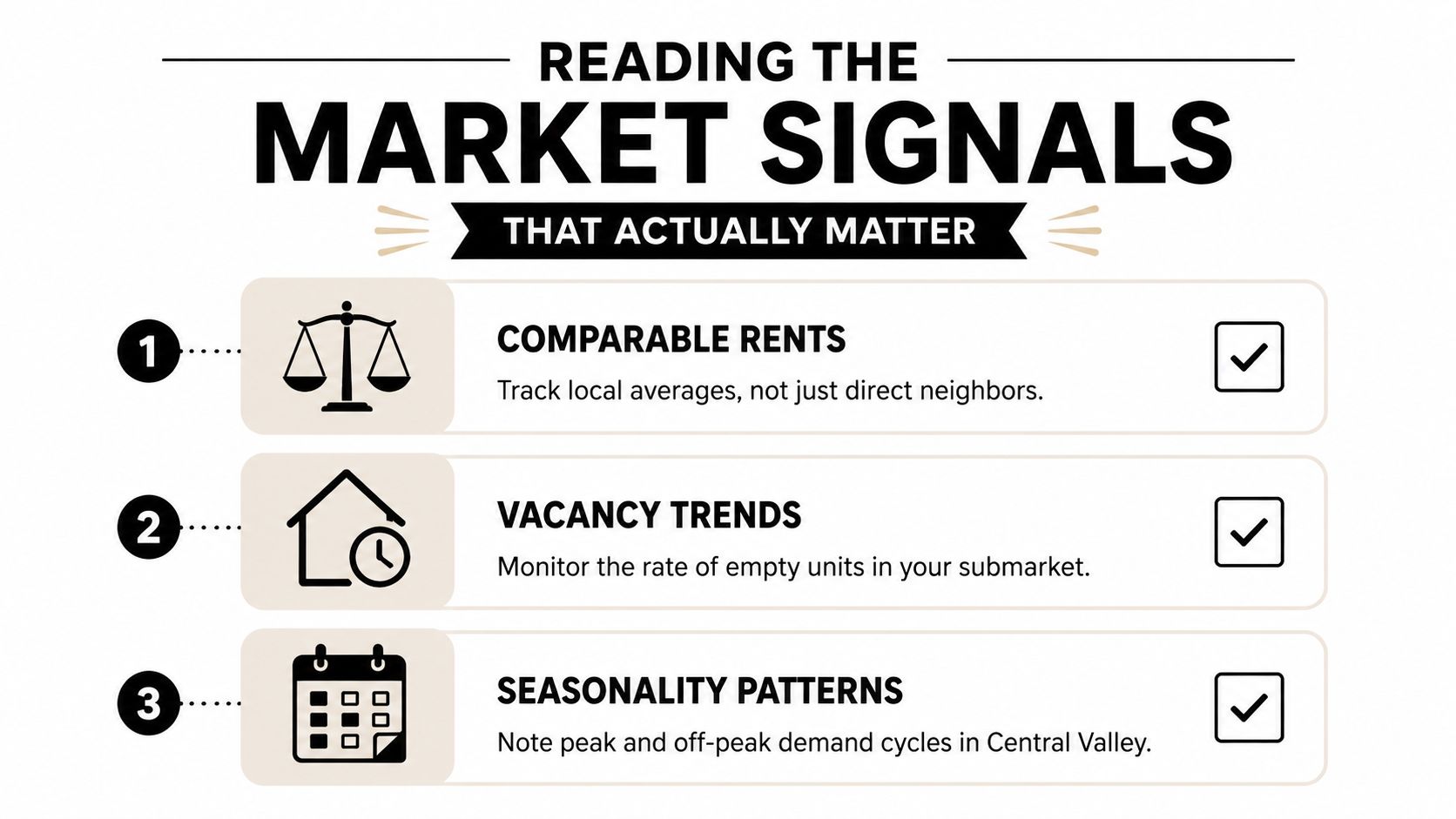
Comparable rents
Start with a tight geographic radius, preferably around the property's immediate competitive pocket rather than a citywide average. In Fresno, a home near Woodward Park, a rental near Tower District, and a property close to Fresno State can attract different tenant groups. In Clovis, school boundaries, commute routes, lot size, and neighborhood condition can matter more than a broad Clovis median.
Separate your list into direct competitors and reference properties. Direct competitors should match the property's type, bedroom count, parking, condition, pet policy, laundry setup, and approximate location. Reference properties can help identify the upper and lower edges of the market, but they shouldn't determine the final price by themselves.
A useful monthly snapshot records:
- Active asking rents: Track comparable homes that a tenant can lease today.
- Time on market: Note which listings remain available while lower-priced alternatives disappear.
- Feature differences: Record garages, yards, renovations, appliances, utilities, and pet terms.
- Inquiry response: Count calls, messages, showing requests, applications, and signed leases.
- Realized outcomes: Replace assumptions with the rent and concession accepted when available.
For broader research, landlords can review market information related to residential rentals from Axis Meter Solutions, then narrow the practical decision to the property's immediate submarket. A local real estate market analysis tool can also help organize comparable properties and property-specific adjustments.
Vacancy trends
Vacancy tells you how much negotiating power landlords have. When tenants have many acceptable alternatives, a premium can delay leasing. When suitable inventory is scarce, a well-maintained property may support firmer pricing.
An academic study of rental rate stickiness found that housing vacancy rates stayed above 7% and reported a 0.011 correlation between rents and vacancy rates, indicating that rent movement can't be separated entirely from market tightness. The rental rate stickiness research
The correlation isn't a pricing formula. It is a reminder to monitor the condition of the local rental pool. If comparable homes accumulate online, reduce the amount of premium you're assuming. If quality inventory disappears quickly and your property produces strong inquiry, holding price may be wiser than offering a concession.
Seasonal demand
Central Valley demand changes with household calendars and employment patterns. Back-to-school searches can affect family-oriented areas, while harvest-related movement can alter timing for some renters. The exact effect varies by neighborhood and property type, so track your own inquiry history instead of relying on a generic seasonal assumption.
A monthly snapshot should answer three questions: Are comparable homes leasing faster or slower, are inquiries rising or falling, and are tenants responding more strongly to price or to features? Those answers give you better direction than a single average.
Calculating Your True Costs and Target ROI
Market rent sets the ceiling tenants may accept, but your cost structure sets the floor below which the investment stops making sense. Cost-based pricing can't force tenants to pay an unsupported rent. It can show you when the property, financing, or renovation plan needs to change.
Build a spreadsheet before you publish the listing. Use monthly figures for mortgage principal and interest, property tax, insurance, routine maintenance, capital reserves, utilities paid by the owner, management fees, landscaping, pest service, licensing costs where applicable, and an allowance for vacancy. Keep one-time turns and major replacements separate from recurring operating costs so the model doesn't hide future expenses.
A workable Fresno example
Use actual figures from your property rather than copying an internet estimate. For illustration, the structure below shows how to organize the analysis without pretending that one Fresno home has universal costs.
| Cost Category | Monthly Amount | Notes |
|---|---|---|
| Mortgage payment | Actual loan payment | Separate principal and interest if you track equity |
| Property tax | Annual tax divided monthly | Use the property's current assessment and payment schedule |
| Insurance | Annual premium divided monthly | Include landlord coverage and any required endorsements |
| Maintenance reserve | Owner-selected reserve | Set aside funds for routine repairs and replacement cycles |
| Property management | Contracted monthly fee | Confirm whether leasing, inspections, and renewals are separate |
| Owner-paid utilities | Property-specific amount | Include water, sewer, trash, or other services you cover |
| Vacancy allowance | Modelled monthly amount | Reflect expected empty time and turnover exposure |
| Minimum viable rent | Sum of operating costs | This is a floor for the investment model, not proof of market rent |
| Target return | Owner-selected amount | Add the return objective after costs, not before them |
The minimum viable rent is the amount needed to cover the selected expense stack under your assumptions. It isn't automatically the advertised rent. If that floor sits above nearby market support, raising the listing price may only extend vacancy. You may need to reduce costs, improve the property, change the financing, or reconsider the investment.
Testing cash flow and improvements
Calculate expected annual collected rent, subtract operating expenses and vacancy, then compare the result with the cash invested. Keep cash-on-cash return separate from appreciation and loan principal reduction. A home can build equity while producing weak monthly cash flow, and those are different investment outcomes.
For a deeper worksheet approach, use a rental property cash flow analysis that separates income, operating costs, financing, and owner assumptions. Then test three rent scenarios, conservative, market-aligned, and optimistic. The optimistic case should never be the only case supporting a purchase or remodel.
Remodeling deserves the same discipline. Fresh paint, durable flooring, clean lighting, working appliances, attractive landscaping, and professional photography often improve the tenant's first impression. Expensive finishes may help a home compete at the top of its segment, but they don't automatically create a rent premium in a price-sensitive pocket. Compare the expected rent difference with the renovation cost, downtime, maintenance burden, and replacement risk before approving the work.
Practical rule: Improve the features tenants notice during a showing before paying for finishes they won't value enough to cover their cost.
Choosing the Right Pricing Model for Your Property
A rental pricing model should match the property and the owner's operating style. A stable, desirable Clovis home may not need constant changes, while a vacant unit competing with a large supply of similar apartments benefits from closer monitoring. The choice isn't between complex and simple. It's between models that fit different levels of demand uncertainty.
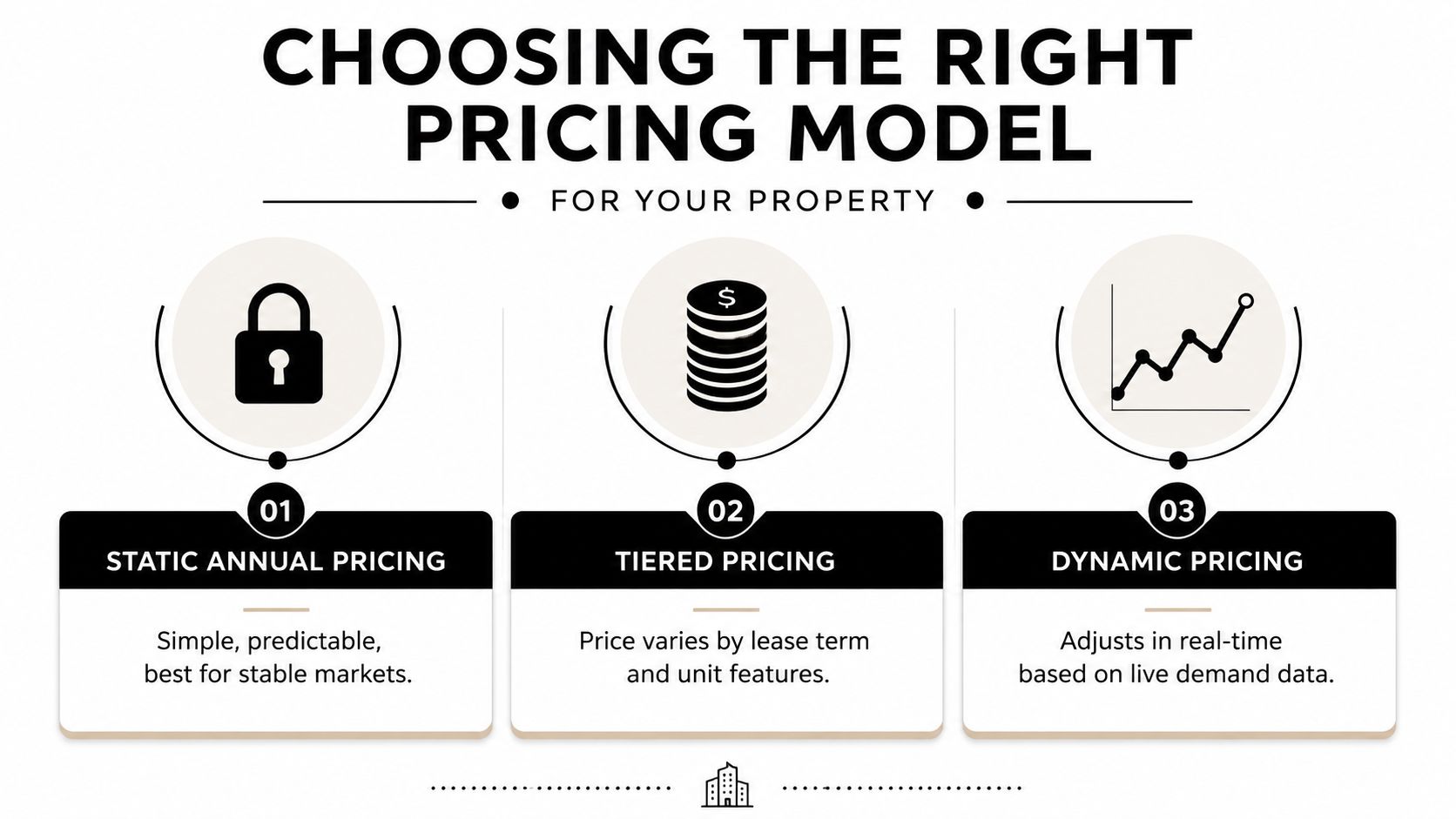
| Pricing Model | Advantages | Drawbacks | Best Fit |
|---|---|---|---|
| Static annual pricing | Predictable, easy to administer, simple for owners and tenants | Can miss market shifts and delay a necessary response | Low-vacancy properties with stable demand |
| Tiered pricing | Reflects lease length, features, and included services | Requires clear rules and careful tenant communication | Homes with meaningful feature or term differences |
| Dynamic market-responsive pricing | Responds to demand, vacancy, and performance signals | Requires monitoring, clean data, and disciplined adjustments | Properties exposed to changing competition |
Static pricing
Static annual pricing works when the market is dependable and the owner values simplicity. A well-positioned home in a strong Clovis school district may lease reliably at a carefully researched figure, especially when the property has a yard, garage, appealing condition, and professional presentation. Even then, review the rent before renewal rather than assuming last year's price remains appropriate.
The weakness is delayed response. If the market softens, a static rent can leave the property above competing homes for too long. If demand strengthens, the owner may renew below support without realizing it.
Tiered pricing
Tiered pricing creates different prices for different value packages. Examples include a premium for a longer lease with fewer turnover risks, a distinction between furnished and unfurnished terms, or a clear adjustment for included services. The structure must be transparent. Tenants should understand what changes the rent and what they receive in return.
Avoid arbitrary tiers that merely disguise a higher price. A lease-length difference should reflect risk, turnover, and operating costs. A feature premium should connect to something tenants can inspect and value.
Dynamic pricing
Dynamic pricing works best as a market-responsive control loop, not a static annual rent sheet. Research on algorithmic pricing in multifamily rentals found that adopters lowered rents more rapidly than non-adopters during economic downturns, which points to faster downside response as a practical benefit. The multifamily algorithmic pricing research
For a Central California owner, dynamic doesn't have to mean hourly software changes. It can mean a quarterly portfolio review, a rent-to-market ratio, and a vacancy dashboard that considers days to lease, renewal rate, and realized vacancy. The key is to avoid a vacant unit carrying a premium just because the owner dislikes lowering the asking rent.
Testing Prices and Using Concessions Strategically
A listing price is a market test, but the result is useful only when the property is ready to show. Before changing rent, confirm that the home is clean, the photos match its condition, the description answers practical questions, and applicants can move through the process without unnecessary friction. A weak listing can make a correctly priced Fresno or Clovis rental look overpriced.
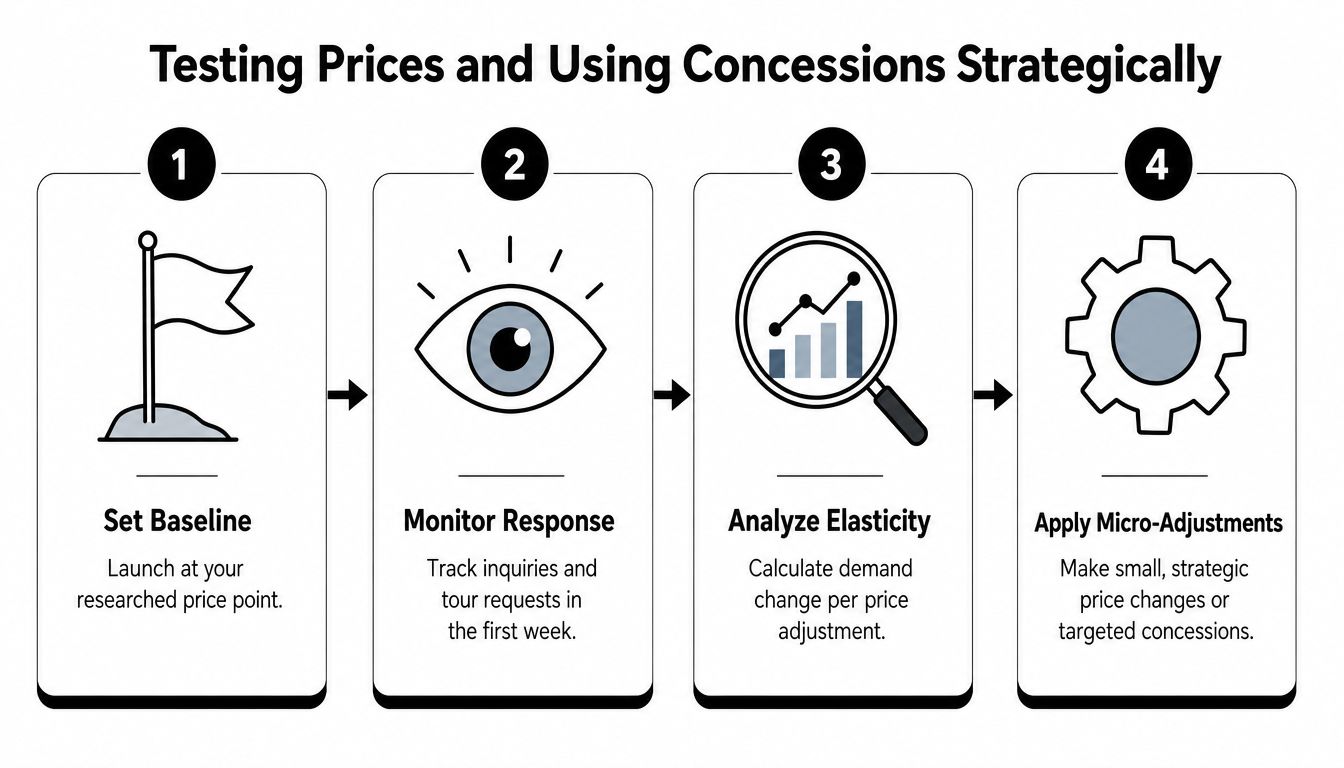
The micro-adjustment playbook
Use a measured sequence instead of matching every competing listing or reacting to each message. In a softening market, reactive comp-matching creates a hidden cost. Repeated cuts can anchor prospects to a lower future price, reduce revenue before demand has been tested, and obscure whether the underlying problem is presentation, timing, or property fit.
- Set the baseline: Choose rent from direct comps, condition, features, expected operating costs, and the target return. Record the launch date and the assumptions behind the figure. For Central California single-family homes, compare against similar houses in the same neighborhood rather than relying on apartment pricing. A Clovis home with a yard and garage may draw a different renter segment from a nearby apartment community.
- Watch the opening response: Review inquiries and showing activity during the first 72 hours, then assess the broader response over a 5 to 7 day window. Separate online views from qualified inquiries, completed tours, and applications. Those steps reveal more than raw listing traffic.
- Adjust in small increments: If the property is properly marketed and response remains weak, consider a 1% to 3% weekly micro-adjustment rather than a large immediate cut. Keep the change small enough to preserve options, but large enough for the market to notice.
- Record what changed: Track rent, inquiries, tours, applications, concessions, and the reason for each adjustment. Also record whether competing single-family homes or apartments entered or left the market. Without that record, owners confuse coincidence with cause.
A small adjustment lets you move toward market support without signaling that another reduction is imminent.
Choosing a cut or concession
Reduce recurring rent when the asking price is clearly above comparable homes and demand stays weak. Offer a concession when the headline rent is defensible but a temporary incentive can address a move-in timing barrier. A limited move-in credit or waived pet fee may work, but write the terms clearly and calculate effective rent before approving it.
| Observed response | Likely issue | Practical response |
|---|---|---|
| Few inquiries and few tours | Price, presentation, or visibility problem | Verify marketing first, then test a modest adjustment |
| Inquiries but no tours | Scheduling, qualification, or listing clarity problem | Improve communication and remove avoidable friction |
| Tours but no applications | Value, condition, or tenant-fit concern | Ask for feedback and address visible objections |
| Applications but weak quality | Price may be attracting the wrong segment | Recheck screening standards and the value signal |
| Strong response immediately | Price may be conservative | Hold briefly, then review whether the market supports more |
Professional photography, accurate floor plans, clean curb appeal, and prompt showing communication make the test easier to interpret. They do not replace defensible rent. They help distinguish price resistance from poor presentation, so a landlord does not pay twice through vacancy and reduced revenue.
Aligning Lease Terms and Legal Compliance With Your Price
A sound rental pricing strategy must survive the lease, renewal, and tenant communication process. California landlords can't treat a market adjustment as permission to ignore applicable rent limits, notice requirements, protected tenant rights, or local rules. Before changing rent, verify whether the property and tenancy fall under state or local restrictions, including the requirements associated with AB 1482.
Lease language should explain the initial rent, included services, renewal process, and any lawful adjustment mechanism. A multi-year agreement may include clearly drafted escalation terms, but the clause must comply with applicable law and shouldn't promise an increase the landlord cannot legally enforce. Use current California Association of Realtors forms or qualified legal guidance rather than copying language from an old lease.
The California landlord-tenant law resource can help owners identify issues that deserve closer review, including security deposits, notices, renewals, and compliance responsibilities. Legal requirements change, and a form that worked for a prior tenancy may not fit a new situation.
Make pricing understandable to tenants
Tenants respond better when the rent and terms are clear. State whether utilities, landscaping, parking, pet charges, or other services are included. Present concessions in writing, show when they apply, and avoid advertising a temporary effective rent without making the regular obligation obvious.
Financial reporting matters after the lease is signed. Owners should be able to see collected rent, management charges, repairs, owner-paid expenses, concessions, and vacancy impact in a way that supports the next pricing decision. Transparent records also reduce disputes when a renewal conversation involves a market adjustment.
Placement-only owners still need a compliant process after the tenant moves in. Professional marketing and screening can establish the tenancy, but the owner remains responsible for day-to-day notices, repairs, records, renewals, and lawful rent handling unless a management agreement assigns those tasks to someone else.
Edinhart Realty and Property Management offers full-service management for rent collection, repairs, tenant communication, renewals, move-in and move-out coordination, and accounting, along with placement-only marketing, screening, and lease drafting for owners who prefer to manage operations themselves. Visit Edinhart Realty and Property Management to discuss a Central California pricing review and choose the management model that fits your property.


