

You're getting your Fresno or Clovis home ready to rent, but the websites don't agree on the price. One number looks too low for your updated kitchen. Another looks appealing until you notice that similar homes are still sitting online. Meanwhile, you're paying the mortgage and trying to decide whether to finish repairs, schedule photos, or wait for a better tenant.
A useful rent price estimate should give you more than a listing price. It should tell you what to ask, what you're likely to collect after concessions, and what makes sense for a reliable tenant who already lives there. Then it needs to survive the practical test: whether holding out for more money is worth another empty month.
Fresno Bedroom Rents to Start From
Fresno rent benchmarks by bedroom
The HUD FY2026 Fair Market Rent schedule supplies the gross-rent program benchmarks below, while HUD's Fresno housing market analysis supplies the May 2025 single-family averages and their year-over-year changes. These columns describe different measures, not competing appraisals of your home.
| Bedroom | HUD FY2026 fair market rent | May 2025 single-family average | Year-over-year change |
|---|---|---|---|
| Studio | $1,347 | Not published | Not published |
| One-bedroom | $1,355 | $1,561 | 5% |
| Two-bedroom | $1,664 | $1,922 | 8% |
| Three-bedroom | $2,314 | $2,402 | 7% |
| Four-bedroom | $2,660 | $2,913 | 8% |
Circle your bedroom row as a sanity check, not a valuation. HUD's Fair Market Rent measure is a standardized housing-program benchmark with tenant-paid utility assumptions built into gross rent. It isn't automatically the legally permitted rent, and it isn't a promise that a tenant will sign at that price.
The single-family column is more directly relevant to a detached rental home, but it still combines properties with different locations, layouts, finishes, and upkeep. Neither column tells you whether your particular garage, yard, kitchen, or utility arrangement deserves an adjustment.
What the bedroom row leaves out
A bedroom count doesn't describe how a home lives. A comfortable floor plan with usable storage and a functional garage competes differently from a home with awkward rooms and limited parking. A recently renovated detached house may justify pricing above these broad benchmarks, while deferred maintenance can require a discount against better-maintained competitors.
Condition needs a candid assessment. Fresh paint does not make worn cabinetry, damaged flooring, or an unreliable appliance disappear. Before adding a renovation premium, identify what a prospective tenant will notice during the showing.
- Location: Compare nearby alternatives with similar school access, commute routes, and surroundings.
- Space: Separate useful interior space from a floor plan that merely looks large on paper.
- Responsibility: Record who pays utilities and handles recurring services.
- Readiness: Distinguish cosmetic updates from repairs the home needs before occupancy.
For broader local context, our guide to average rent in Fresno helps frame the citywide conversation. Your property still needs its own competitive set, especially when comparing a Clovis detached home with rentals elsewhere in the Fresno area.
Use the benchmark to ask better questions
If your proposed price sits well above the relevant bedroom benchmark, write down the reasons. A documented renovation, enclosed garage, or private outdoor space can support a difference. Your mortgage payment and remodeling receipts can't establish what tenants will pay.
Practical rule: Use the bedroom row to identify questions, then use comparable rentals to answer them.
Don't force your home to match a regional number just because that number is easy to find. The defensible price is the one supported by properties a tenant would reasonably consider instead.
Price Rent from Local Comps and Avoid Costly Errors
Build a spreadsheet before choosing a price. Give every comparable its own row, with columns for location, property type, bedrooms, size, condition, utilities, concessions, listing status, and evidence date. Leave unknown terms marked as unknown rather than filling them with optimistic assumptions.
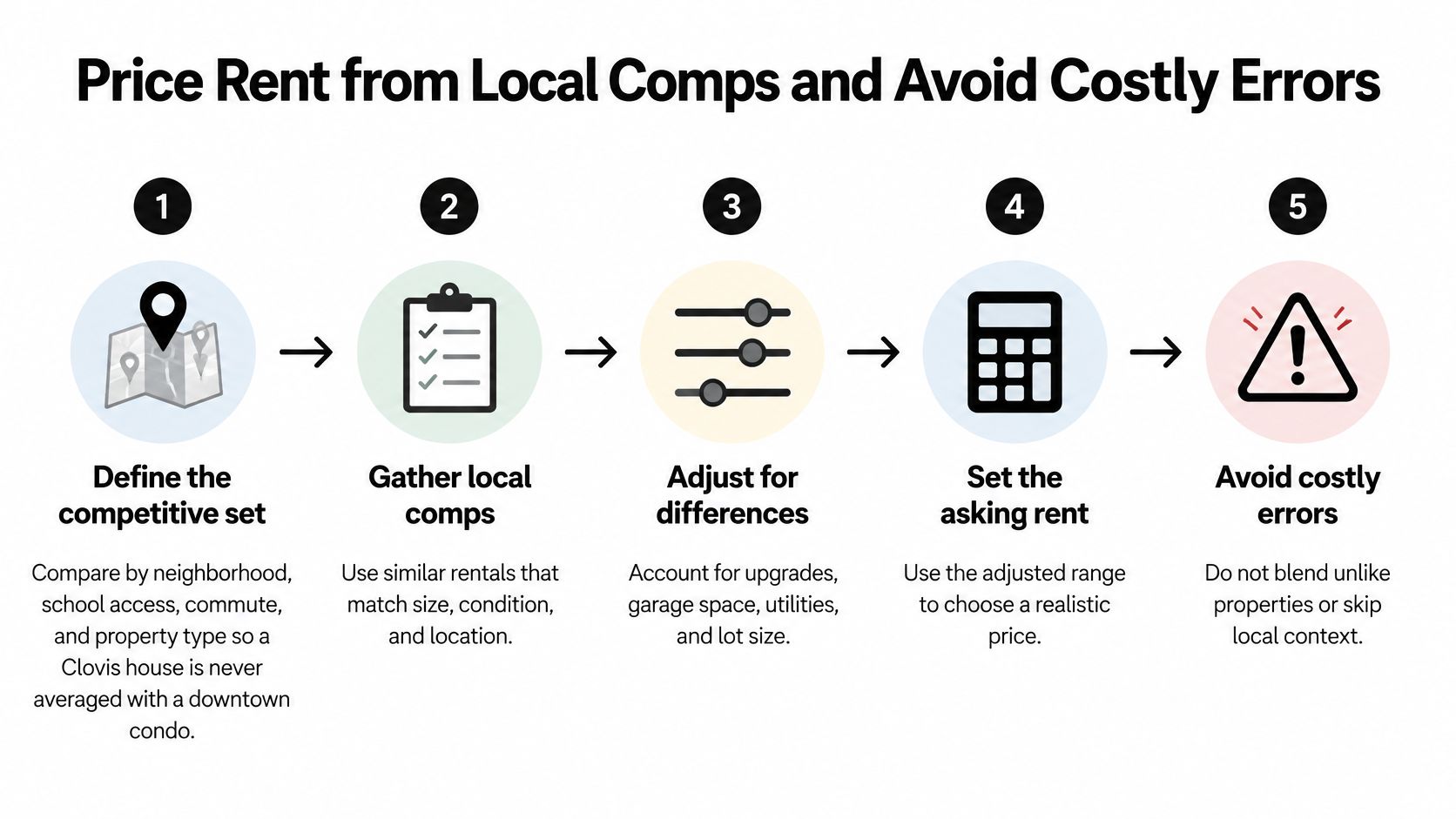
Keep this workflow beside the spreadsheet while you gather evidence.
Build a competitive set you can defend
Define where the tenant would also look. Start with neighborhood, school access, commute, and property type. A detached Clovis house shouldn't be averaged with a downtown apartment because both have the same bedroom count. This prevents location and building-type differences from masquerading as a pricing opportunity.
Gather comparable rental outcomes. Favor recently leased homes when you can verify the terms, and use active listings to understand current competition. Match bedroom count, approximate floor area, parking, outdoor space, and condition. Save the listing details because an address and headline rent won't explain your decision later.
Normalize the lease terms. Note concessions, furnishing, pet policies, utility responsibility, and recurring owner-paid services. Convert concessions into effective monthly rent over the proposed lease term. A listing with free rent may compete below your price even when its advertised rent looks higher.
Choose a representative center. Use a median or a trimmed mean after excluding unsuitable properties. Don't remove a low-priced comparable merely because you dislike the result; remove it only when its differences make it a poor substitute. Keep unusually upgraded homes and stale advertisements out of the core calculation unless you can make a defensible adjustment.
Check current exposure and document the range. Review whether competing homes are leasing, reducing prices, or staying available. Record an asking range and an expected lease-up rent, along with the date, assumptions, and missing information. This prevents a reasonable estimate from becoming an unsupported fixed target.
The federal Fair Market Rent methodology uses statistically screened evidence to develop a market-wide benchmark for standard-quality housing. That's useful context, but your rental worksheet has a different job: identifying what a qualified applicant is likely to choose among comparable homes.
Separate a trend from a lease result
Zillow's repeat-rent methodology tracks changes for the same rental units and weights the observations to reduce distortion from the mix of available properties. The practical lesson is straightforward: a changing average can reflect different homes being advertised, not a genuine change in what your home can earn.
Keep asking prices and signed rents in separate columns. If a listing disappears, don't assume the owner received the advertised amount. Unless you can verify the executed terms, treat that result as incomplete.
For more on organizing comparable evidence, use our comparable market analysis guide. Our initial evaluation includes walking through the home when it's accessible and determining a recommended listing price based on comparable properties that recently sold. For a rental decision, keep that sale-based context distinct from the leased-property evidence used to support rent.
This video provides another resource to review alongside your property worksheet.
Finish with a short explanation of why each retained comparable belongs. If you can't explain the comparison without leaning on the bedroom count alone, find a better match.
Adjust Features and the Per-Square-Foot Rate
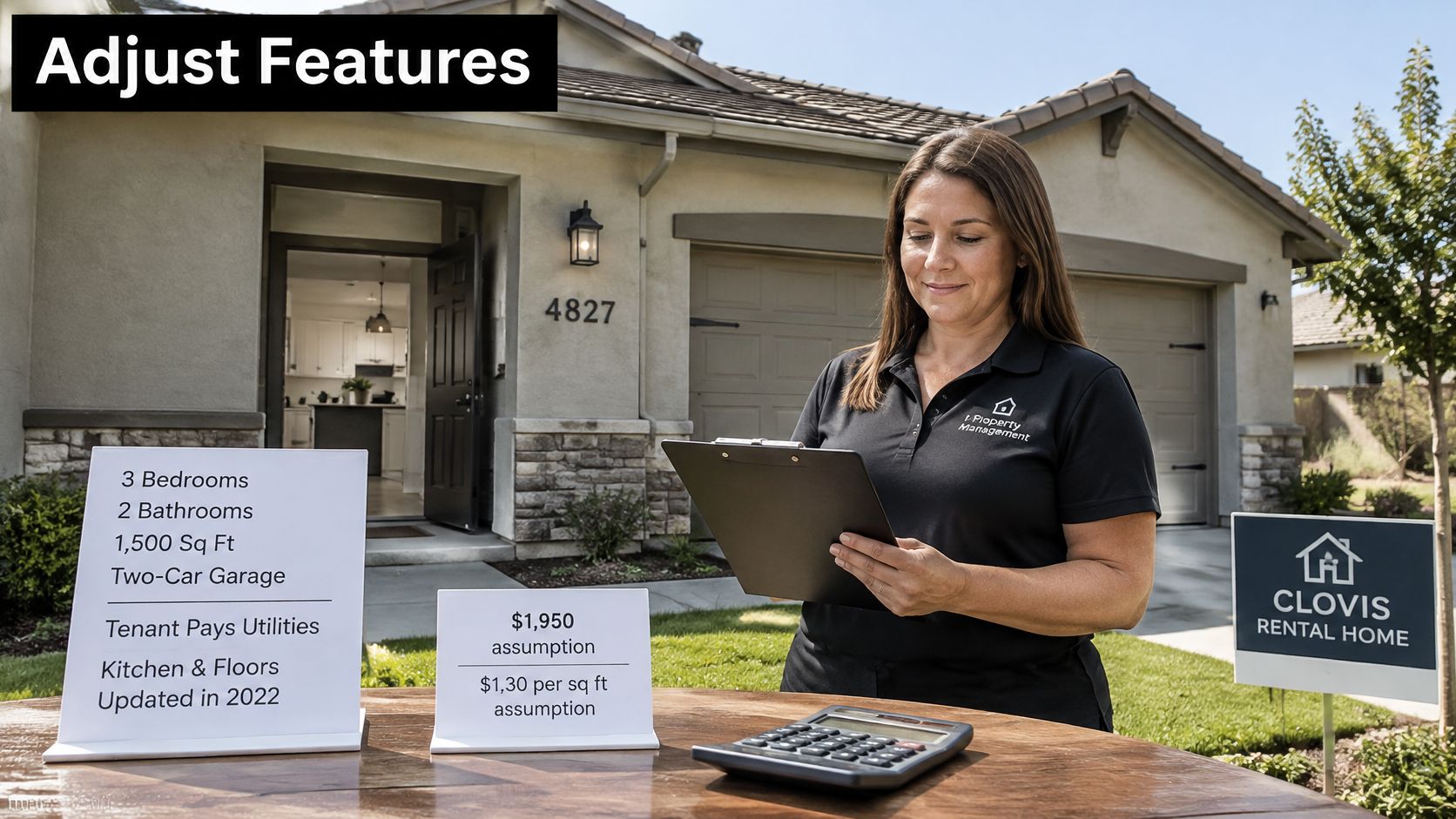
Consider a hypothetical Clovis rental, not a report of actual leased homes. Assume the subject has three bedrooms, 1,500 square feet, a two-car garage, updated kitchen and flooring, and tenant-paid utilities. Every price, lease term, and feature adjustment in this example is an assumption used to demonstrate the calculation.
A walkthrough helps verify whether the features on the worksheet match what an applicant will see.
Worked comp example for a Clovis three-bedroom
| Comp | Size and terms | Effective rent | Rate per sq ft |
|---|---|---|---|
| Comp A | Assumed 1,480 sq ft; leased at $2,450; trash included | $2,450 | About $1.66 |
| Comp B | Assumed 1,620 sq ft; advertised at $2,650; one month free over a twelve-month lease | About $2,429 | About $1.50 |
| Comp C | Assumed 1,450 sq ft; dated condition; leased at $2,300 | $2,300 | About $1.59 |
| Subject | Assumed 1,500 sq ft; updated finishes; tenant-paid utilities | About $2,420 asking before concessions | About $1.61 asking |
Convert the terms before comparing the space
Start with Comp B because its advertised price hides the concession. Under the assumed terms, the tenant pays $2,650 for eleven months, producing $29,150 across a twelve-month lease. Dividing that total by twelve gives approximately $2,429 in effective monthly rent.
Then divide each comparable's effective monthly rent by its square footage. The rounded rates are approximately $1.66, $1.50, and $1.59 per square foot. Their median is $1.59, using the rounded worksheet figures.
Apply that median to the subject's assumed area:
$1.59 × 1,500 square feet = $2,385 base monthly rent.
This is a sizing calculation, not the final recommendation. It works only because the homes were selected for similarity before doing the arithmetic. A polished formula won't fix a poor comparable set.
Make narrow feature adjustments
For this scenario, assume the evidence supports adding $75 because the subject's kitchen is clearly newer than the dated benchmark. Also assume a $40 deduction to account for trash service included in a competing home but paid by the subject's tenant.
The demonstration becomes:
$2,385 + $75 − $40 = $2,420 proposed asking rent.
Those adjustments are not Clovis pricing rules. In an actual worksheet, each needs support from the closest available rental comparisons and the specific service arrangement. If the evidence is weak, widen the estimated range instead of pretending the adjustment is precise.
- Avoid double counting: Don't add a garage premium when the selected comparables already have equivalent garages.
- Check the condition baseline: If the comparable set already consists of renovated homes, another broad renovation premium may be unjustified.
- Use lot size carefully: A larger yard may provide useful space, but it can also create additional tenant maintenance.
- Keep location adjustments specific: Explain the actual difference in access or surroundings rather than assigning a blanket premium to a city name.
A feature deserves an adjustment only when it changes the comparison. Its installation cost doesn't establish its rental value.
Professional photography can show those differences clearly, but it doesn't create a new kitchen or repair a tired bathroom. Fix visible deficiencies first, then photograph the home accurately. The estimate should reflect the property you'll deliver, not the version you hope applicants imagine.
Cross-Check Online Estimates Before Trusting Them
An online estimate is useful when it challenges your assumptions. It's less useful when you accept it because it happens to be the highest number. Keep the property worksheet open while checking portals so you can identify the reason for a disagreement.
Check what the tool actually measures
Record the inputs and output. Save the address, bedroom filter, property type, estimate, and displayed range. Determine whether the figure describes advertised rents, a modeled property estimate, or verified lease outcomes. If the tool doesn't explain the measure, don't treat it as signed rent.
Compare like-for-like rates. Calculate the implied rent per square foot and compare it with your adjusted comparable set. In the hypothetical Clovis example, a substantially higher tool result should prompt a review of the properties behind it. Newer buildings or a different property mix may explain the gap.
Inspect what's included. Check utilities, parking, furnishing, and services. A tool may not distinguish an owner-paid utility package from a home where the tenant pays those bills separately. That difference belongs in your worksheet even when the portal has no field for it.
Review the history and timing. For a technical historical cross-check, RealtyAPI.io provides historical Zillow rental estimates. Use historical readings to investigate how the estimate has changed, not as proof that a tenant signed at any particular amount. Log the date of your current reading, too.
Require an explanation for a large gap. Compare the result with the bedroom benchmark and the subject's property type. A premium should have a documented property-level reason. If you can't find one, rerun the comparable search before choosing either figure.
Resolve disagreements in the worksheet
The Zillow housing data methodology describes a stock-representative repeat-rent measure designed to track typical observed market rent. That kind of index helps evaluate market movement, but it doesn't guarantee a particular home's achievable price.
Don't average conflicting tool outputs to make the disagreement disappear. Identify whether the mismatch comes from location, property type, lease terms, condition, or stale evidence. If the portal doesn't disclose enough to make that determination, give the transparent local comparisons more weight.
Keep the decision anchored to the calculation you can explain:
Worksheet check: Effective monthly rent divided by comparable square feet, multiplied by subject square feet, then adjusted for documented feature differences.
The strongest estimate isn't necessarily the most complicated one. It's the one whose inputs you can verify and whose adjustments you can defend.
Asking Rent Versus What You Actually Collect
Three rents and a vacancy test
The amounts below continue the hypothetical Clovis scenario. They're planning assumptions, not current market quotes.
| Figure | What it measures | Example |
|---|---|---|
| Achievable asking rent | Price on a new listing before concessions | About $2,420 |
| Expected signed rent | Rent after a concession a tenant may require | About $2,320 effective with half a month free over a twelve-month lease |
| Renewal rent | Rent from a qualified tenant already in place | Often below new asking; a small increase can beat turnover |
| Vacancy trade-off | Extra rent versus one more empty month | A $100 monthly premium produces $1,200 annually; an extra empty month at $2,420 costs more than that annual premium |
These are separate decisions. Asking rent determines how you position the listing. Expected signed rent describes the economics of the deal you anticipate accepting, while renewal rent requires attention to the existing lease, applicable rules, and the value of avoiding turnover.
Zillow's affordability methodology distinguishes the asking rent of a rental entering the market from rent paid under an ongoing lease. That distinction matters when you're deciding whether a portal estimate supports a new listing or an increase for someone already living in the home.
Put the concession into the income forecast
In the assumed example, half a month of free rent equals $1,210. Spread over the assumed twelve-month lease, that reduces effective monthly rent by approximately $101, putting the economic result near $2,320.
The lease might still state the full monthly rent with a separate concession agreement. Your income forecast should recognize the concession rather than treating the headline amount as money collected every month. Have the lease documents reflect the actual agreement clearly.
For renewal planning, start with the incumbent's current rent and the lawful options for that property. Review our guide to rent control in California before treating a market estimate as permission to raise an existing tenant's rent. A pricing worksheet doesn't replace a property-specific compliance review.
Test the premium against an empty home
Assume you hold out for $100 more per month. That adds $1,200 over a full year, but an additional vacant month at the scenario's $2,420 asking rent consumes roughly two years of that premium. Cleaning, repairs, and other turnover expenses would be separate.
Owner decision: Compare expected collected income over the same period, not just the monthly rent printed on competing listings.
This doesn't mean you should accept every low offer. It means the premium needs a realistic path to collection. Qualified inquiries, completed showings, and applications provide more useful feedback than the number of people who viewed the advertisement.
We don't charge a monthly property management fee while a home isn't receiving rental income, including between tenants while placement is being processed. That removes a management charge during that period, but it doesn't replace the rent you lose. The owner still needs a clear limit on how long to test the higher price.
Confirm the Rent Before You List
Lock the decision before the photos and advertisements go out. The listing price, acceptable deal, and vacancy limit should agree with the same financial plan. Otherwise, it's easy to keep defending an ambitious asking rent while abandoning the income target.
Write down the decision boundaries
For the hypothetical Clovis home, the owner's instruction could be:
- Asking rent: Start near the scenario's $2,420, supported by the adjusted comparisons.
- Acceptable signed outcome: Budget around $2,320 effective if the assumed concession is needed.
- Vacancy limit: Tolerate no more than one empty month under this particular plan.
Those are scenario choices, not universal recommendations. Refresh the comparable evidence immediately before marketing and set a review point in advance. If showing activity is thin after the opening weekend, check exposure, photo quality, availability for tours, and price rather than automatically waiting out the vacancy limit.
Choose the level of help you need
Our Placement-Only Service includes professional photography, professional mass marketing, online applications, screening, presentation of the most qualified applicants with recommendations, and drafting the final lease on the owner's behalf. It fits owners who want help securing a tenant but prefer managing the property themselves.
Full-Service Monthly Property Management is the alternative for owners who don't want day-to-day involvement. It includes rent collection, repair coordination, tenant communication, move-in and move-out coordination, lease renewals, and accounting statements.
Homeowners often receive approximately $200 more per month than they received with previous management companies on the same home. That isn't a promised increase for every property; your recommendation still needs support from the home's condition, local competition, and lease-up economics.
Bring the comp sheet, feature adjustments, utility responsibilities, and vacancy test to a free consultation. When the home is accessible, a walkthrough can help resolve condition questions before you commit to the advertised rent.
Edinhart Realty and Property Management offers a free consultation to help you evaluate your rental price and choose between placement-only help and ongoing management. Visit Edinhart Realty and Property Management to discuss your Fresno or Clovis home, arrange a walkthrough when it's accessible, and confirm your asking rent, acceptable signed rent, and vacancy limit before listing.


