

It's the 5th, you manage 40 units, and six checks still haven't arrived. Two will bounce, one was never mailed, and three residents swear they sent payment last week. You're not short on tenants who can pay. You're short on a system that makes paying easy, traceable, and hard to forget.
That's what your choice of rent payment options really controls. It affects how often rent lands late, how many hours your staff spends matching deposits to ledgers, and when owners see usable cash. A cheap method that creates returned payments and manual follow-up isn't cheap. A convenient method with a high processing fee can also fail if nobody explained the cost in advance.
Demand for choice is real, but habits haven't disappeared overnight. In a January 2025 survey, AppFolio's 2025 renter preferences research found 86% of 2,002 U.S. renters called online rent payment a valuable financial service, while 39% still paid by cash or check. The eight options below are judged by real cost to collect, meaning fees, reconciliation work, speed, security, and late-payment risk, not by popularity alone.
1. ACH Bank Transfer (Electronic Funds Transfer)
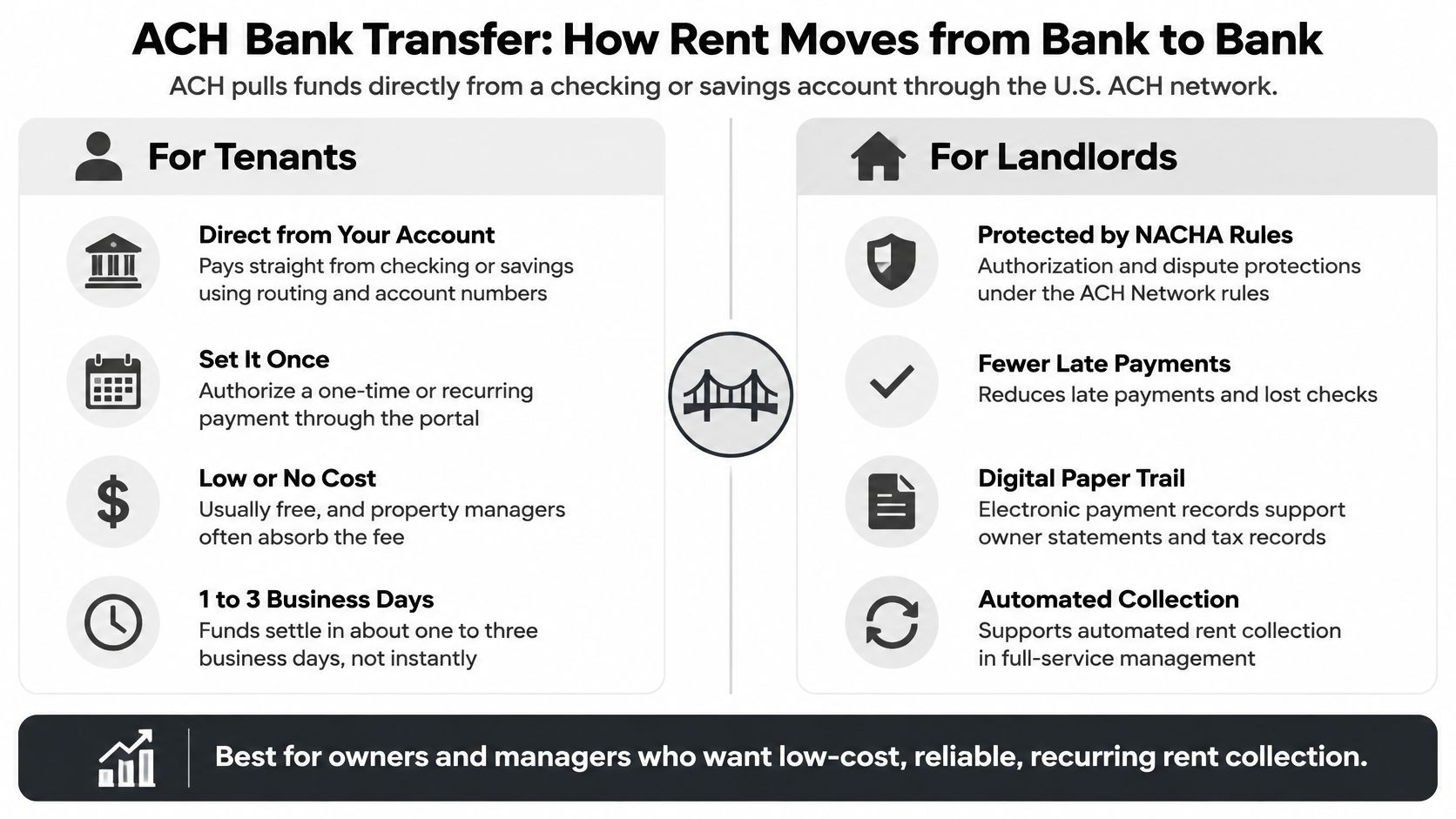
ACH moves rent directly from a tenant's checking or savings account to your operating account through the Automated Clearing House network. The tenant authorizes the debit in a portal, you get a transaction record tied to the unit, and funds normally settle in 1 to 3 business days. For most portfolios, it's the lowest-cost electronic rail and the best default.
That default status reflects a long shift. An analysis covering about 1.2 million renters found online payments rose from 4% in 2014 to 51% in 2025, while checks and cash fell from 96% to 49%. ACH fits that shift because it handles recurring rent without card-level processing costs.
Where ACH Works and Where It Trips
Platforms such as AppFolio, Buildium, and Yardi typically make ACH the standard portal option. Small landlords use the same setup through lighter portals, and the operational gain is identical. You stop guessing which unlabeled deposit belongs to which tenant.
The weakness is timing and returns. A tenant can submit on the due date and still settle after your grace period ends, or the debit can return for insufficient funds days later. Set a clear cutoff time, explain when payment is credited, and don't mark rent collected until the return window has passed in your internal process.
- Promote the low-cost path: Put ACH first in the lease packet and move-in instructions.
- Keep authorizations on file: You'll need them if a tenant disputes a debit.
- Reconcile monthly: Match every deposit to the rent roll and chase returns the day they post.
Owners who want that discipline built in often compare portal setup with rent collection services for landlords before adding more software.
2. Automatic Recurring Rent Payments (Autopay)
Autopay isn't a payment rail. It's a schedule layered on top of ACH or a card, with the tenant authorizing rent to charge automatically on the due date. That distinction matters because autopay inherits the cost and settlement speed of whatever sits underneath it.
It's also the feature most likely to reduce "I forgot" lates. A survey cited in AppFolio's guide to paying rent online found 60% of tenants wanted automatic payments, 64% preferred reminders by text or email, and 53% wanted mobile-app notifications. Put those together and you get a practical sequence. Remind, charge, confirm, then flag failures fast.
Make Enrollment the Default Conversation
Full-service managers usually raise autopay at lease signing, not after the first late fee. That's when the tenant is already adding bank details and reading due-date rules. Multifamily operators pair enrollment with a reminder 3 to 5 days before each charge, so an expired card or changed bank account surfaces before rent fails.
Practical rule: Autopay reduces forgetfulness. It doesn't fix insufficient funds, so your failed-payment notice still needs to go out the same day.
Write the failure process into the lease, including returned-payment charges, late-fee timing, and whether you'll retry the debit. Review the failed-payment report every month instead of discovering a pattern at renewal. For the follow-through after a miss, pair this setup with a clear process for handling late rent payments so staff respond consistently. Don't offer an autopay discount you can't sustain, but do make the lowest-cost ACH version the easiest one to choose.
3. Credit and Debit Card Payments
Cards solve a different problem than ACH. A tenant who's short on liquidity until payday, chasing rewards, or missing a checking account can still pay through a portal or app. You get fast authorization and a clean record. You also get the highest processing cost in this list, plus chargeback exposure ACH doesn't carry in the same way.
Tenants notice when this option is missing. In the American Express and Forbes Insights tenant survey, 81% of 638 tenants said offering their preferred method was important, 41% were frustrated when credit-card payment wasn't available, and 22% would consider another home if they couldn't pay their preferred way. That doesn't mean cards should be your default. It means removing them entirely creates friction you should choose deliberately.

Fee Disclosure Is the Whole Game
Most managers who accept cards pass through a convenience fee and keep ACH available as the no-fee or low-fee alternative. That structure is defensible only if the tenant sees the fee in the lease and again before checkout, not after submission. Confirm current California rules on rent-related fees before setting any surcharge, because a portal default isn't legal advice.
Track chargebacks separately from ordinary late payments and keep the signed authorization, timestamp, and receipt for each transaction. A tenant who pays by card to earn Bilt points or other rewards may be perfectly reliable. A tenant who disputes a charge after moving out is a documentation problem you'll either win quickly or lose slowly.
4. Paper Checks
A check can reach the office after the rent deadline, carry the wrong amount, omit the unit number, or bounce after staff have entered it in the ledger. Each error creates follow-up work. Checks have no processor fee, but staff time and late-payment risk still count toward the cost of collecting rent.
Some residents keep using checks because the method is familiar and gives them a paper record. That preference can be accommodated without making checks the default. Keep them as a fallback, and make the delivery and processing rules clear before the first payment is due. The Federal Reserve Bank of Boston payment choice research provides historical context for check use, but its figures are not needed to assess today's collection trade-offs.
Keep Checks Controlled if You Keep Them
Small landlords may accept checks as a primary method; larger management operations often retain them as a secondary option. Either way, specify the payee name, mailing or lockbox address, and mailing deadline in the lease. Ask tenants to write the unit number and rent month on the memo line.
- Deposit promptly: Use remote deposit capture to avoid holding checks for a bank visit.
- Credit carefully: Record when a check arrives separately from when funds clear.
- Set a return-payment process: If the lease and local rules allow it, require certified funds after a bounced check.
Set aside time for scanning, deposit processing, correcting misapplied payments, and sending late notices when comparing checks with electronic options. A check avoids a processor charge, but it can shift collection costs into staff workload and delayed funds. Keep the option available where it serves tenants, while directing routine payments through a method that is easier to track.
5. Money Orders and Cashier's Checks
When a tenant has already bounced a check, "please try again" is bad policy. Money orders and cashier's checks are prepaid or bank-guaranteed instruments, so the funds question is largely settled before the tenant hands payment over. That certainty is their value. Their friction is why they shouldn't be your everyday system.
Tenants buy money orders at banks, credit unions, retail counters, and the U.S. Postal Service. For a resident without a bank account, a USPS money order may be the most accessible documented option. For a manager, that beats loose cash because there's a purchased instrument, a payee line, and a receipt the tenant can keep if the envelope goes missing.
Best Use as a Fallback Rule
Specify acceptable forms in the lease before you need them. State that after a returned payment, rent must arrive as a cashier's check or money order for a defined period, made payable exactly to the legal payee name. Scrambling to invent that rule during a dispute helps nobody.
A guaranteed instrument solves the funds problem. It does not solve the delivery problem, so give tenants a deadline that accounts for buying and mailing it.
Keep copies or scans of each instrument and advise tenants to retain purchase receipts. Watch for altered payee names and incomplete fields at intake, not at reconciliation. Used narrowly, these instruments protect cash flow after a failure. Required from everyone, they'll slow collections and push reliable tenants to ask why paying you feels like a trip to the post office every month.
6. Cash Payments
Cash is immediate, and that's almost the only operational advantage. There's no processor fee and no settlement delay, but there's also no built-in proof of who paid, how much, or when. If a tenant says they handed over full rent and your envelope is short, you're left arguing memory against memory.
That's why professional managers usually limit or eliminate cash. It creates theft risk, invites ledger errors, and forces staff to carry funds to the bank. Some small landlords still accept it at a set office hour and issue receipts on the spot. That can work at very small scale, but only with discipline most informal setups don't maintain.
Non-Negotiable Controls if Cash Is Allowed
In California, landlords who accept cash should issue a written receipt. Treat that as the floor, not the ceiling, and review current California and local requirements before you take the first payment.
- Number every receipt: Give the tenant a signed copy and keep the duplicate with the ledger entry.
- Restrict intake: Name the location, hours, and staff members authorized to accept cash.
- Deposit the same day: Reconcile cash against receipts before it leaves the office.
Don't let tenants slide cash under a door, leave it with maintenance, or pay a partial amount without a written record of what was accepted and what remains due. Cash also complicates partial-payment disputes, since there's no processor timestamp to settle timing. If a resident relies on cash because they're unbanked, steer them toward a money order or another documented fallback. You'll preserve access without building your rent roll on untraceable envelopes.
7. Zelle (Bank-to-Bank Instant Transfers)
Zelle feels perfect until something goes wrong. The tenant sends money from a mobile banking app using your email or phone number, and it often lands within minutes at no direct cost to either side. For a landlord with a handful of units, that speed is hard to ignore.
The problem is everything around the transfer. Zelle was built for person-to-person payments, not full rent accounting. There's no built-in rent roll, late-fee logic, reminder sequence, or unit-level reconciliation. If ten tenants with similar names pay on the same day, you're rebuilding the record from bank notifications and screenshots.

Use It Only With Business Controls
Smaller landlords who accept Zelle should route it to a dedicated rental bank account, never a personal account mixed with household spending. Confirm enrollment properly and have the tenant verify the recipient name on a small first transaction if your bank workflow allows it. Log every transfer in your accounting software the day it arrives, with unit, month, and sender noted.
Fraud risk deserves blunt language in your payment instructions. Tell tenants you'll never change payment details by a surprise text or email, and require a phone call to a known number before they act on any change. Scammers target exactly that moment, when a tenant is rushing to pay before a late fee.
Zelle also offers little room for error once funds are sent to an enrolled recipient. A typo can become a recovery project rather than a simple reversal. It can serve as a backup for a trusted tenant or a tiny portfolio, but it doesn't scale into a controlled collection system.
8. Rewards-Based Rent Payment Platforms (Bilt)
A tenant may want points for paying rent, while the owner needs to know what arrives, when it arrives, and what the platform charges. Bilt lets tenants pay through a third-party platform and earn points, often through a co-branded card. It also promotes lower-cost ACH options. The practical trade-off is that rewards can add another layer between the tenant's payment and your records, so confirm the fee, settlement timing, and support process before recommending it.
Credit reporting is a separate feature, not an automatic result of paying through a portal. CNBC on using rent payments to build credit reports that in 2025, 13% of renters had their rent payments reported to credit bureaus. The same coverage says 57% would be more likely to rent from a manager offering reporting, and nearly 80% said reporting would make them more likely to pay on time. Reporting may support credit-building, but does not guarantee a higher score.
Questions to Ask Before You Recommend One
Ask which bureau or bureaus receive the payment history, who pays any reporting fee, and how returned or disputed payments are handled. Clarify whether reporting is positive-only, meaning the provider reports on-time payments but does not report missed or late payments. For rewards, check the tenant's total cost after card fees and whether enrollment terms have changed since the last lease cycle.
Verify the landlord's enrollment and payment routing before directing tenants to sign up. Request written confirmation from the provider that your property is eligible, then complete a test payment and match its deposit against the platform's transaction record. Compare its workflow with your current portal and the best rent collection apps. Confirm fee disclosure and California rent payment rules as well, since using a third party does not remove your responsibility to communicate payment terms clearly.
How the 8 rent payment options compare on speed, cost, and best use
| Payment Method | Typical Speed | Tenant Cost | Security | Best For |
|---|---|---|---|---|
| ACH Bank Transfer (Electronic Funds Transfer) | 1–3 business days | Usually free or low-cost | NACHA authorization and dispute protections | Low-cost, reliable recurring rent collection |
| Automatic Recurring Rent Payments (Autopay) | Processed automatically on the scheduled date; depends on payment method | Depends on the linked bank account or card | Requires clear written authorization; failed payments may occur | Reducing late rent and administrative work |
| Credit and Debit Card Payments | Usually 1–3 business days; confirmation is immediate | Often a 2–3% convenience fee | Chargebacks may create risk and extra work | Tenants who prefer cards and owners who can offset processing costs |
| Paper Checks | Several business days after deposit | No processing fee | Physical record, but risk of loss, fraud, or bounced checks | Those not yet set up for electronic payments |
| Money Orders and Cashier's Checks | Funds typically available upon purchase; delivery and deposit take additional time | Purchase fees, usually a few dollars | Guaranteed funds; lost instruments can be difficult to replace | Tenants without bank accounts or landlords seeking guaranteed funds |
| Cash Payments | Immediate | No transaction fee | Higher risk of theft, loss, and payment disputes; receipts are important | Tenants without banking access when strict controls are in place |
| Zelle (Bank-to-Bank Instant Transfers) | Usually within minutes | Typically free for personal users | Transfers are generally irreversible; verify recipient details | Fast, low-cost transfers for users comfortable with irreversible payments |
| Rewards-Based Rent Payment Platforms (Bilt) | Depends on the platform and payment method | Varies; card fees may offset rewards, while ACH may be lower-cost | Third-party platform adds complexity; terms and eligibility vary | Tenants seeking rewards and landlords using a compatible platform |
Build a Layered Rent Payment Setup Instead of Picking One
No single method wins on every measure. ACH is the strongest default because it's low cost, traceable, and built for recurring rent. Autopay belongs on top of it because it removes forgetfulness, which is the easiest late-payment cause to fix. Those two pieces should carry the bulk of a healthy rent roll.
Cards belong in the stack as a choice, not as the foundation. Offer them with the fee disclosed in the lease and at checkout, and always keep ACH available as the lower-cost path. That respects tenants who need liquidity or want rewards without forcing every resident to subsidize card processing. It also gives you a documented emergency option when a tenant's bank transfer won't arrive in time.
Traditional methods still have a narrow job. Keep checks available under a clear mailing deadline if your resident base needs them, require money orders or cashier's checks after returned payments, and accept cash only with numbered receipts and same-day reconciliation. Zelle can work for a very small portfolio with a dedicated account, but don't mistake a fast transfer for a collection system. Rewards platforms are an optional layer for tenants who value points or credit reporting, after you've verified fees, bureau reporting, and landlord enrollment.
Audit Before You Switch Anything
Start with last quarter's ledger, not a software demo. Sort late payments, returned payments, and partial payments by method, then note how much staff time each one created. You'll usually see the true cost to collect in that exercise. A method with no processing fee may be producing most of your follow-up calls, while a paid portal rail may be finishing collections with almost no touches.
Then set targets you can review monthly, such as autopay enrollment, digital-payment share, failed-payment rate, and time to resolve a failed payment. Enable reminders before the next billing cycle, move ACH to the front of your move-in packet, and rewrite any payment instructions that don't state cutoff times and returned-payment rules plainly. Announce changes early enough for tenants who rely on checks or money orders to adjust without missing a due date.
For owners who'd rather not build and monitor that stack themselves, Edinhart Realty & Property Management includes automated rent collection in its Full-Service Monthly Management package. That means the portal, payment choices, reminders, and accounting records are handled as part of management instead of becoming another monthly project for the owner. Whether you run it in-house or hand it off, the principle stays the same. Make the right payment the easiest payment, keep a controlled fallback for everyone else, and measure cost by what collection actually takes from your team.
If chasing checks, posting deposits, and following up on failed payments is eating the first week of every month, Edinhart Realty and Property Management can run automated rent collection through a tenant portal with ACH and card options, reminders, and transparent owner reporting as part of full-service management in the Fresno area. Visit Edinhart Realty and Property Management to talk through your current rent payment options and build a layered setup that gets rent in on time with less manual work.


