

A tenant's rent is due on the first, but the fifth arrives with an empty mailbox, no deposit notification, and a landlord who's already checking the bank account twice a day. A few texts follow. The tenant says the check is coming. Another day passes, and the landlord still has to wonder whether the payment was mailed, lost, delayed, or never sent.
That uncertainty is the problem rent collection services are designed to solve. They combine payment methods, tenant reminders, recurring schedules, receipts, account records, and follow-up procedures so rent moves through a consistent process instead of depending on one person remembering what to do every month.
A useful system also needs to handle the exceptions. Some tenants prefer ACH transfers, while others use cards, checks, or cash. A payment can fail, arrive late, be disputed, or require a formal notice. Good rent collection isn't just about replacing checks with a portal. It's about creating a documented workflow for what happens before the due date, on the due date, and after rent becomes late.
What rent collection services really do for landlords
Rent collection services give landlords a repeatable operating process for moving money from a tenant to the property's operating account. That process might include an online portal, scheduled bank debits, card acceptance, automated reminders, payment confirmation, ledger updates, late-fee rules, and escalation when a tenant doesn't pay.
Without that structure, a landlord often performs the same tasks manually. They check the mailbox, search email for payment confirmations, send reminders, record deposits in a spreadsheet, calculate fees, and try to reconcile everything with the bank statement. Each step creates another opportunity for a missed date or inconsistent record.
The workflow before and after the due date
A practical rent collection workflow usually has four stages:
- Before rent is due: The system sends a reminder, confirms the amount due, and gives the tenant a clear payment path.
- On the due date: The tenant pays through an approved method, or an enrolled recurring payment is submitted automatically.
- After payment: The system records the transaction, issues a receipt, and updates the tenant ledger when the payment status changes.
- When rent is late: The landlord receives an alert, the tenant receives the appropriate notice, and the next action follows the lease and local requirements.
That sequence matters because rent collection is closely related to broader accounts receivable management, where consistent invoicing, tracking, reconciliation, and follow-up help keep money moving through an organization. Landlords can use this guide to mastering accounts receivable management for a wider look at the recordkeeping principles behind dependable collections.
The service may be software used by a self-managing owner, a payment platform connected to accounting tools, or a full-service property manager handling communication and enforcement. The label matters less than the controls behind it.
Practical rule: Choose a system that tells you what happened, what is still pending, and what action comes next.
The rest of the system comes down to four landlord questions. How does money reach the bank? What improves when reminders and posting are automated? How should late fees and escalation work? Finally, what does each side of the lease gain or give up?
For a closer look at the service structure itself, this overview of rent collection services for landlords provides useful context on the tasks a collection provider may handle.
How rent collection actually reaches the bank
The payment method affects speed, cost, risk, and reconciliation. A tenant may experience every option as “paying rent,” but the landlord sees different settlement dates and different levels of administrative work.
The four common routes are ACH, cards, checks, and cash. ACH pulls funds from a tenant's bank account and generally settles in 1 to 3 business days, while card transactions tend to add percentage-based processing costs. That makes ACH a sensible default for recurring residential rent, with cards available when convenience matters more than processing cost. The reasoning behind this approach is explained in this breakdown of rent collection methods.
A large dataset covering $21,876,603,069 in rent payments from January 2014 through October 2025 found that online payments rose from 4% in 2014 to 51% in 2025. Offline methods, including checks and cash, fell from 96% to 49%, but they didn't disappear. Rentec Direct's rent payment data also found that tenants paying offline were 23% more likely to pay late than tenants paying online.
That shift supports digital-first collection, but it doesn't justify abandoning tenants who still need offline options. A complete service records a check or cash payment in the same ledger as an ACH payment, rather than forcing the landlord to maintain two disconnected systems.
Rent payment rails at a glance
| Method | Typical settlement | Tenant fee | Best fit |
|---|---|---|---|
| ACH direct debit | Usually 1 to 3 business days | Often lower than card processing, though platform or tenant fees may apply | Recurring rent where predictable cost matters |
| Debit or credit card | Often faster from the tenant's perspective, but timing varies by provider | Percentage-based processing costs are common | Convenience, fallback payments, or tenants who prefer cards |
| Paper check | Depends on delivery, deposit, and bank clearing | Mailing or check-related costs may apply | Tenants who aren't ready to use digital payments |
| Cash | Immediate only after secure receipt and verification | Collection or retail processing fees may apply | Tenants without reliable banking access |
The important distinction is pending versus cleared. An online portal may show that a tenant initiated payment, but the landlord still needs to know whether funds have settled or could be returned. Checks also require a clear policy for when the payment is considered received and when the deposit is considered available.
The strongest setup routes tenants toward the lowest-cost working rail, usually ACH, while preserving cards and offline methods for exceptions. It also keeps every payment tied to the lease, tenant, property, due date, and receipt record.
Manual chasing versus automated rent collection
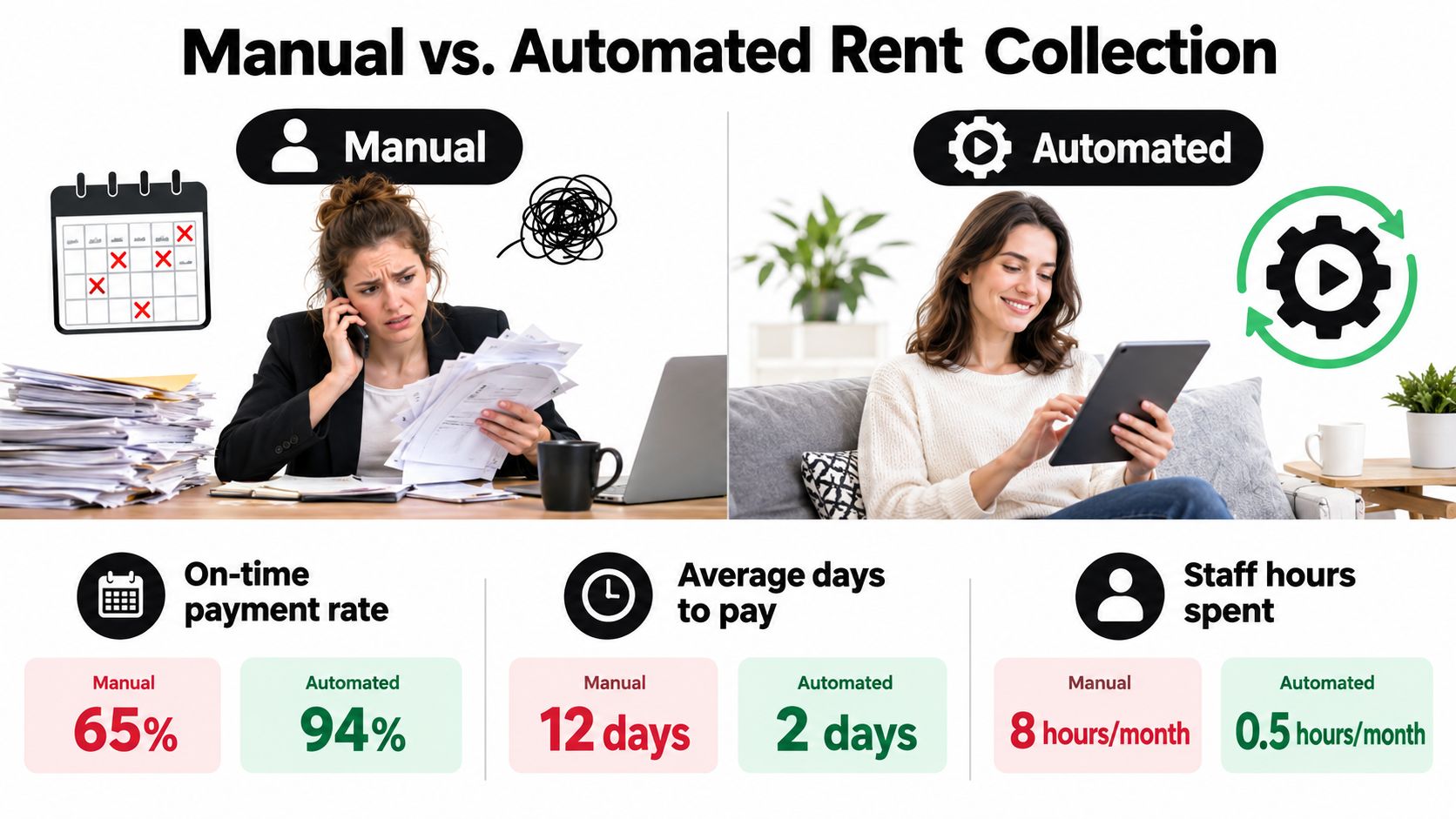
Manual collection can appear inexpensive when a landlord owns only one property. The hidden cost is repetition. Every month, someone has to remember who paid, who promised to pay, which check was deposited, which tenant needs a reminder, and whether a late fee was applied correctly.
Automation changes that rhythm. A recurring payment schedule can handle routine collection, while reminders go out before the due date and alerts identify failed or missing payments. The landlord still makes decisions, but they no longer spend the same amount of time discovering which decisions are needed.
Published benchmark-style data comparing automated and manual property-management firms reported 3% to 5% of units late per month for automated firms, compared with 8% to 14% for manual firms. It also reported that days to payment after the due date fell from 6.2 to 1.8 days, while staff time spent on collections fell from 4.5 hours to 0.8 hours per 100 units. These figures come from US Tech Automations' property-management comparison.
Where the improvement actually comes from
Automation doesn't make every tenant pay on time. It removes common delays between the due date, the reminder, the payment attempt, and the ledger update.
A manual workflow might look like this:
- The landlord checks the account or mailbox.
- The landlord identifies missing payments.
- The landlord sends individual messages.
- The tenant explains the delay.
- The landlord records the eventual payment.
- The landlord calculates whether a fee applies.
An automated workflow performs the routine portions on a schedule. The owner then focuses on a failed debit, a tenant who needs a payment arrangement, a disputed charge, or a legal notice.
The same benchmark reported target operating measures of 95% or higher on-time payment, under 4 days to full collection, 65% or higher autopay enrollment, under 2% day-30 delinquency, and under $1.00 per transaction. Those are management targets, not universal results, so an owner should use them as a dashboard framework rather than a promise.
Automation should remove routine chasing, not remove judgment.
The most useful comparison isn't “software versus people.” It's routine work versus exception work. A landlord who spends less time copying payment information into a ledger has more time to speak with a tenant whose income changed, verify a disputed charge, or inspect a property with a maintenance issue.
Late fees, reminders, and the path to escalation
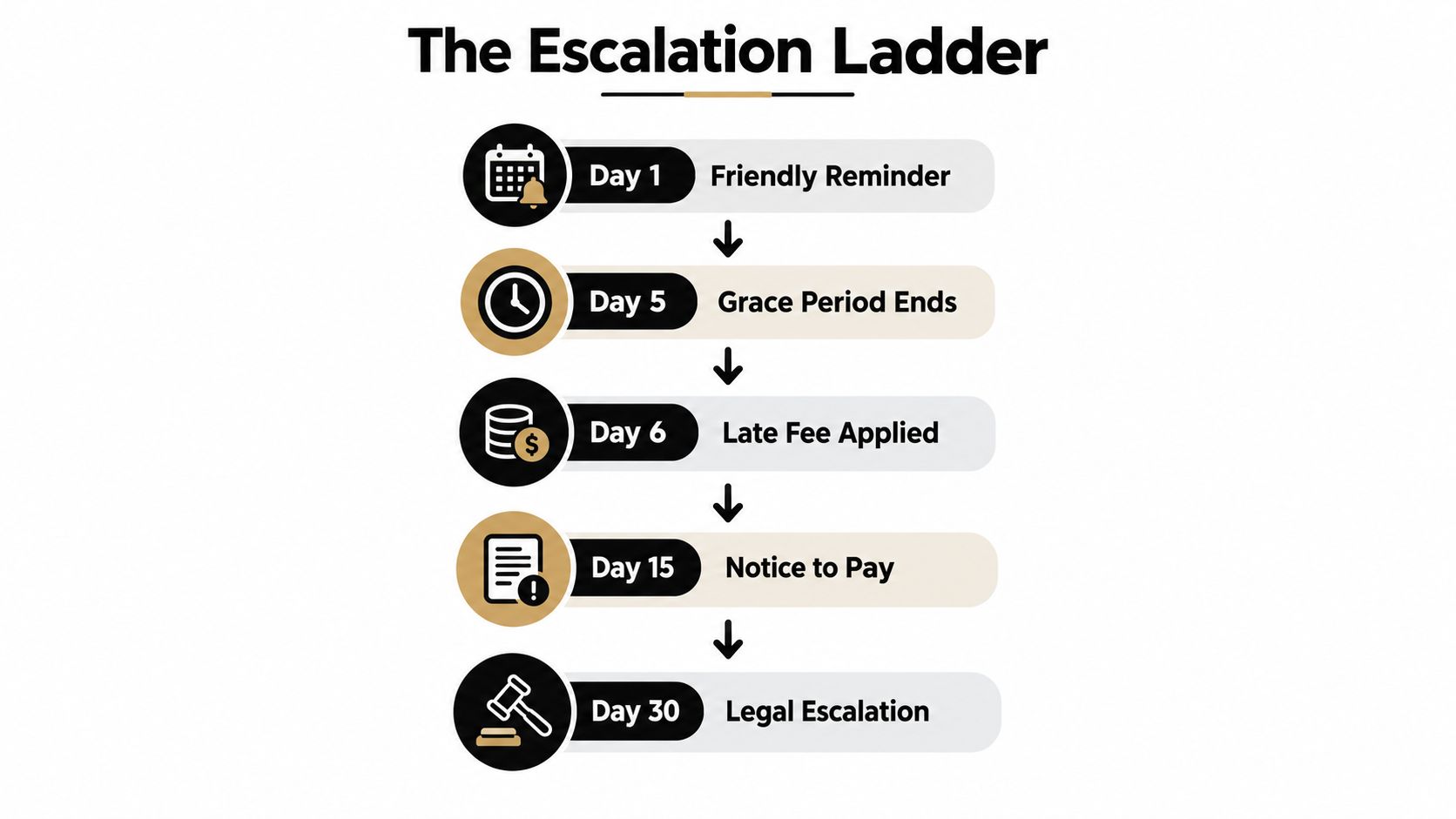
Late rent needs a sequence, not an emotional reaction. The process should begin with a clear reminder and end with a legally appropriate decision, with each step documented in the tenant record.
A sensible ladder often includes:
- Pre-due reminder: Tell the tenant the amount and due date, along with the accepted payment methods.
- Grace window: Apply any lease-defined grace period consistently.
- Late-fee review: If the payment remains outstanding, check whether the lease permits a fee and whether local rules allow it.
- Formal notice: Send the required written notice with the correct amount, deadline, and delivery method.
- Legal escalation: If the tenant still doesn't comply, coordinate with qualified local counsel or follow the applicable court process.
Late fees can support compliance, but they aren't the whole collection strategy. Hemlane's analysis of 1.5 million rent payments found a median late fee of $75. Properties with a late-fee policy collected 91.0% of rent on time, compared with 89.0% where no late-fee policy existed, as reported in this analysis of rent late-fee data.
That difference is meaningful, but modest. A fee won't fix a tenant who never receives a reminder, can't use the payment portal, or faces a failed bank debit. Nor should a landlord treat a fee as a substitute for screening, clear lease language, and timely communication.
Make enforcement predictable
The late-fee clause should state the amount or calculation, the triggering date, any grace period, and the circumstances in which the charge applies. The landlord should use the same process for comparable situations and avoid changing the rule informally from tenant to tenant.
A written policy also helps the tenant understand what happens next. The message should distinguish between a friendly reminder, a fee notice, and a formal demand for payment. Those documents have different purposes and shouldn't be blended into one vague text message.
Percentage-based fees can create disputes when rent amounts differ or when the charge appears punitive. A clearly defined flat fee may be easier to explain and administer, but the enforceability of any fee depends on the lease and the applicable law. Before sending a formal notice, landlords can review this practical guide on how to handle late rent payments, then confirm the required procedure locally.
What landlords and tenants gain and risk
A rent collection service changes the daily experience of both parties. The landlord gets a structured record and fewer routine interruptions. The tenant gets more ways to pay and clearer confirmation, but may also face fees or automated messages at an uncomfortable moment.
For the landlord, the main benefits are operational:
- Predictable cash flow: Scheduled payments make expected income easier to monitor.
- Auditable records: Receipts, ledger entries, and notices can stay connected to the tenancy.
- Less awkward chasing: A reminder can be sent by a consistent system rather than improvised in a personal text.
- Cleaner accounting: Deposits and payment histories are easier to reconcile at tax time.
The risks are just as practical. A landlord may assume the portal is correct without checking a failed debit. An automated late fee may be applied despite a payment being pending. A system may send repeated notices while a tenant is actively trying to resolve a bank problem.
Tenants also receive a mixed result. Multiple payment rails, automatic receipts, and visible balances reduce uncertainty. On the other hand, convenience charges, declined-payment fees, and repeated automated messages can add stress during a short-term cash shortage.
Benefits and risks of rent collection services by audience
| Audience | Main benefits | Main risks |
|---|---|---|
| Landlord | Consistent reminders, centralized records, easier reconciliation, clearer delinquency tracking | Incorrect automation, missed exceptions, payment reversals, overreliance on a portal |
| Tenant | Payment choice, receipts, scheduled payments, visible balance information | Processing fees, failed-payment charges, confusing notices, reduced personal contact |
| Property manager | Standardized procedures across properties, shared records, easier owner reporting | Poor configuration, inconsistent escalation, unclear responsibility for exceptions |
| Both sides | A dated record of payments, notices, and communications | A record can still be incomplete if offline payments or side agreements aren't entered promptly |
The shared benefit is the paper trail. If a tenant disputes a fee or a landlord claims rent was never paid, the parties can review the transaction status, receipt, bank record, notice, and communication history. That doesn't automatically decide the dispute, but it gives everyone a more reliable starting point than memory.
A good service should also preserve human contact. The system can send the reminder, but a landlord or manager still needs to explain a rejected payment, approve a payment arrangement, or respond to a tenant who has a legitimate question.
Inside Edinhart's full-service rent collection model
A full-service model connects collection to the rest of property operations. Instead of asking the owner to choose a payment tool, monitor the ledger, contact the tenant, prepare statements, and coordinate escalation separately, the management company manages those responsibilities as one workflow.
Edinhart Realty and Property Management describes a full-service arrangement that includes a tenant payment portal, automated rent collection, resident communication, repair coordination, lease administration, and accounting statements. The portal gives residents a way to access payment-related workflows and review balances, while an auto-debit program allows enrolled tenants to have rent withdrawn automatically.

The operating logic is straightforward. A tenant receives the amount due, submits or schedules payment through the available system, and receives a record of the transaction. The manager monitors the account, updates the owner's financial records, and investigates exceptions such as a rejected debit or an unpaid balance.
Reporting that owners can actually use
Collection is only useful when the owner can see what happened to the money. A full-service arrangement can connect payment activity with monthly owner statements, year-end tax documentation, and delinquency reporting. That gives the owner a view of income, expenses, unpaid balances, and property-level activity without requiring them to assemble information from separate files.
The same workflow can also distinguish a normally paying tenant from a recurring delinquency. A clean payment history needs no unnecessary intervention. A missed payment can trigger a reminder, a documented notice, and a review of the lease terms before the matter moves further.
The management fee is part of that decision. Survey-based benchmarks in the available materials place average full-service management fees at 8.92% of collected rent, with a flat-fee equivalent of $85.42. Another survey of 722 property management branches across 80 metro areas reported a national average of 8.49% of monthly rent, a range of 3.75% to 14%, and found that 75.3% of companies used percentage-based pricing. These benchmarks are summarized in average property management fee research.
The right comparison isn't only the management percentage. An owner should ask what the fee includes, who communicates with tenants, how failed payments are handled, whether notices are coordinated, and which accounting records are delivered.
For delinquency, a structured manager-led process can move from the first missed payment to notice preparation and eviction coordination. Local legal requirements still control the procedure, and qualified counsel may be needed. The value of the operating model is that the payment record, communication history, lease terms, and next action remain connected.
A full-service workflow should feel quiet when rent arrives normally and become more visible when something goes wrong.
Choosing the right model and quick answers
The best collection model depends on the work you want to keep and the work you want to delegate. Before signing up, review your portfolio size, tenant payment preferences, tolerance for checks and cash, accounting ability, and local rules for notices and eviction.
A small owner with reliable tenants may prefer software and handle communication personally. A growing portfolio may justify a third-party platform that combines payments with screening, leasing, bookkeeping, or maintenance records. An owner who lives away from the property, dislikes collections, or lacks time for compliance work may prefer full-service management.
Choosing a rent collection model
| Model | Best for | Trade-off |
|---|---|---|
| Self-managed software | Owners who want control and can handle tenant communication | Lower delegation, more responsibility for setup, exceptions, and compliance |
| Third-party payment platform | Owners who need payment automation and centralized records | The platform may not handle local notices, tenant conversations, or legal coordination |
| Full-service management | Owners who want collection connected to leasing, maintenance, reporting, and escalation | Management fees reduce gross rent, and the owner gives up some direct control |
| Manual collection | A very small operation with tenants who use simple payment methods | More personal effort, weaker automation, and greater risk of inconsistent records |
Pricing can be based on a percentage of rent, a fee per unit, a transaction charge, or a combination. Each model creates different incentives. A percentage fee may align the manager with collected income, while a flat platform fee may be easier to forecast. Transaction charges can make low-cost ACH preferable to cards, but the tenant-facing price should be disclosed clearly.
Questions landlords still ask
Who can legally collect rent for a landlord?
A landlord can collect personally or authorize a property manager or other service provider to collect on the landlord's behalf. The management agreement should identify who receives funds, who maintains the ledger, who communicates with tenants, and who handles notices. State licensing and trust-account rules may apply, so confirm the arrangement locally.
What records should a landlord keep?
Keep the lease, payment confirmations, bank deposits, receipts, ledger entries, late-fee calculations, notices, delivery evidence, and relevant communications. The exact retention period depends on local law, tax requirements, and the landlord's accountant. A system is useful only if the records can be retrieved when a tenant, auditor, tax professional, or court requires them.
How should security deposits be separated from rent?
Security deposits aren't ordinary rental income. Keep them identified separately in the accounting records and follow the applicable rules for holding, using, and returning them. Don't let a portal's convenience cause you to combine deposit transactions with rent without the correct classification.
What happens when a tenant disputes a charge?
Pause assumptions and review the lease, payment status, receipt, ledger, bank record, and communication history. If the issue involves a card chargeback or a legal dispute, follow the platform's process and obtain professional advice when needed. Don't apply another fee just because the first charge is being questioned.
Can tenants opt out of automated debits?
The answer depends on the lease, the payment authorization, and applicable law. Tenants should understand how to change or cancel an authorization, but cancelling autopay doesn't cancel the obligation to pay rent. Give tenants a clear alternative payment method and document any change.
The right service is the one that fits your actual operating habits. If you need software, choose a platform that records exceptions as carefully as successful payments. If you need delegation, choose a management arrangement that connects collection with communication, accounting, and local compliance.
Edinhart Realty and Property Management offers full-service management with online rent collection, tenant payment workflows, resident communication, repair coordination, and financial reporting, along with placement-only services for owners who want to manage ongoing operations themselves. Visit Edinhart Realty and Property Management to discuss which model fits your properties and how a structured collection process can reduce monthly follow-up.


