

You're managing a day job, a duplex, and a tenant who pays through Venmo four days late every month. At first, it feels manageable. Then a partial deposit arrives, the payment note is vague, the receipt gets buried in a text thread, and you spend part of your weekend checking whether the balance is settled. Add another property, a vacancy, or an out-of-state owner's expectations, and rent collection stops being a minor task.
The right rent collection services for landlords aren't just the apps with the most features. They're the systems that match your portfolio, your available time, your tenants' payment habits, and your tolerance for follow-up. The decision should prevent missed records, inconsistent enforcement, and avoidable cash-flow gaps before those problems spread across multiple units.
Why Rent Collection Quietly Breaks for Busy Landlords
The first problem usually isn't refusal to pay. It's an informal process that works just well enough to avoid immediate change.
A tenant sends money through a peer-to-peer app. You recognize the amount, but the payment doesn't identify the unit or rental period clearly. A few days later, the tenant sends a partial amount and promises the rest after payday. You make a note in your phone, update a spreadsheet when you remember, and send a weekend reminder from your personal number. Nothing looks catastrophic, yet your records no longer provide a clean answer to three basic questions: what was charged, what was received, and what remains outstanding?
That ambiguity creates more work than the original late payment. You reconcile deposits manually, search for receipts, calculate balances, and decide whether a late fee applies. If another tenant follows a different payment pattern, you're now managing several informal systems at once.
Operator's rule: If a payment method depends on your memory, personal messages, or manual spreadsheet updates, it isn't a collection system. It's a recurring administrative risk.
The workload multiplies faster than the unit count
A second property doesn't merely add another rent payment. It adds another lease, ledger, bank deposit, tenant communication history, and set of exceptions. An out-of-state property adds travel constraints, local vendor coordination, and the need for records someone else can understand without calling you.
The COVID-19 period showed how quickly collection performance can deteriorate when tenant income, eviction rules, and payment access change at the same time. A peer-reviewed landlord study found that 88.9% of landlords reported collecting at least 90% of charged annual rent in 2019, but that share fell to just over 60% in 2020. The share collecting only 50% to 89% rose from 8.2% to 28.6% during the same period, as documented in the peer-reviewed study of landlord rent collection during the pandemic.
That history matters even if your tenants currently pay reliably. A structured portal, automated reminders, clear delinquency rules, and a complete ledger give you a repeatable process when circumstances change.
Build around the owner you are today
Before comparing vendors, decide whether you need payment handling, operating support, or full delegation. A DIY owner with one local unit may need a low-cost ACH portal and clean reporting. A remote investor may need multi-property access, owner statements, and maintenance coordination. A full-service manager needs collection embedded in leasing, accounting, notices, and tenant communication.
Landlords who are still balancing property tasks with employment should also address the broader scheduling problem. Practical property management time strategies can help, but rent collection deserves its own workflow because delays affect every other property expense.
The Four Core Models of Rent Collection Explained
Choose the collection model around your portfolio, available time, tenant payment habits, and tolerance for follow-up. A DIY owner with one nearby unit needs control and low overhead. A remote investor needs reliable records and fewer manual checks. A full-service manager needs collection tied to leasing, accounting, notices, and tenant communication.
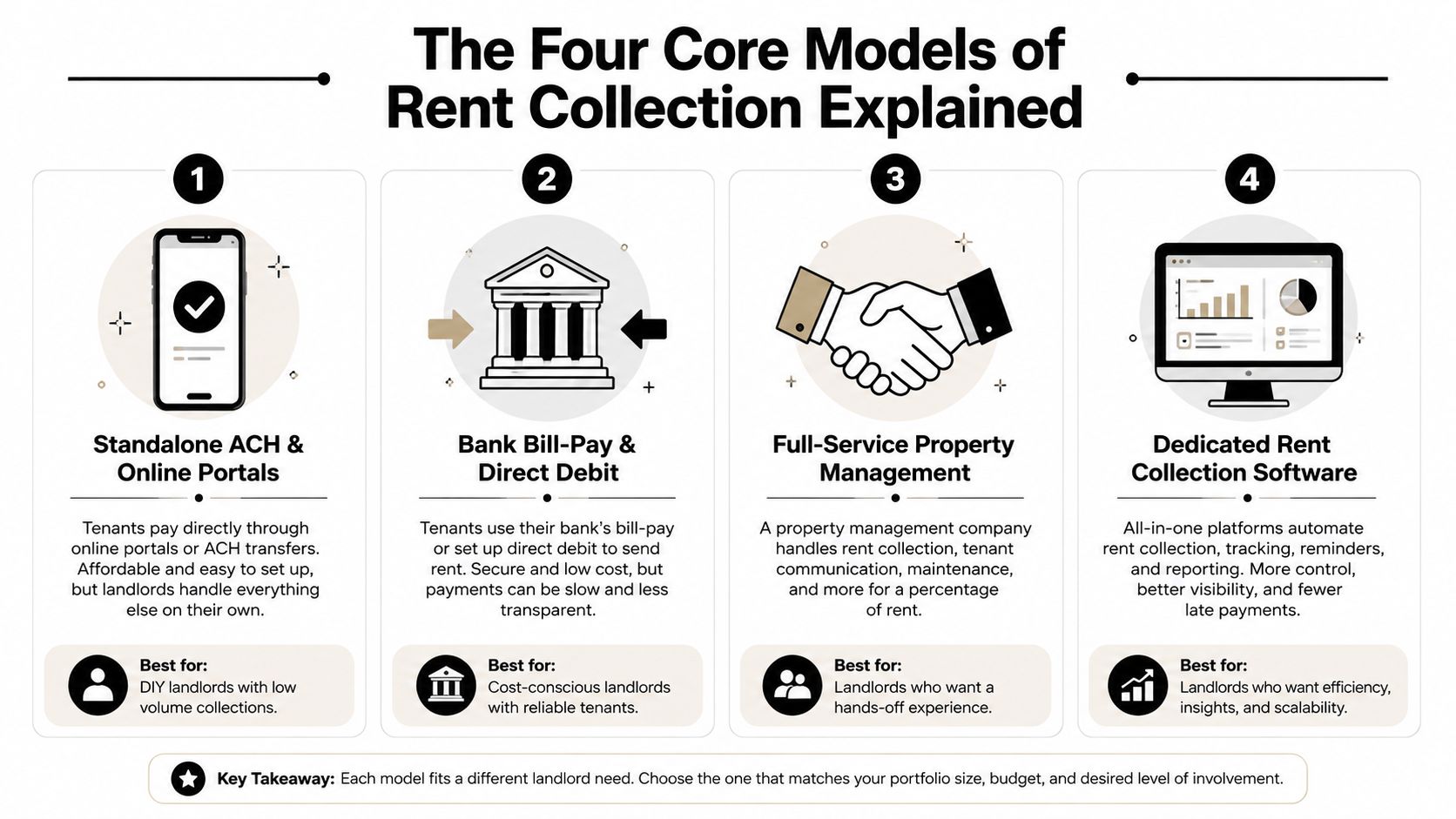
Standalone ACH and online portals
A basic portal lets tenants connect a bank account, schedule recurring payments, receive reminders, and review payment history. Products such as Buildium, AppFolio, RentRedi, and Avail sit in or near this category, although several also include leasing, screening, maintenance, or accounting tools.
This setup fits a DIY owner replacing checks, cash, Venmo, or informal bank transfers without transferring property operations. You retain control of notices and tenant relationships while the platform handles payment initiation and records. Set a clear reminder and follow-up schedule, because automation records a missed payment but does not resolve it.
Bank bill-pay and direct debit tools
A bank bill-pay arrangement or direct debit setup can work when tenants already use online banking. Funds may go directly to your account, but the experience depends on the tenant's bank, payment timing, transaction descriptions, and your ability to match deposits to the correct lease.
It suits a small, stable portfolio with hands-on oversight. It becomes a poor fit when you need lease-linked ledgers, automated late fees, tenant messaging, or consistent records across several properties.
Third-party landlord payment processors
Services such as PayRent and RentPayment focus on landlord payment flows instead of general personal transfers. These processors often support ACH and cards, recurring schedules, tenant accounts, payment reporting, and controls for failed or reversed payments.
They are a practical middle ground for an owner who wants a dedicated collection tool without adopting a complete property management suite. Review who pays processing fees, how quickly funds settle, how reversals are handled, and whether exports fit your accounting process.
Full-service property management
A property management company combines collection with leasing, tenant communication, maintenance coordination, renewals, inspections, notices, and accounting. You pay for labor, oversight, and accountability alongside the payment function.
This model fits remote investors, owners with demanding schedules, and landlords who do not want to handle soft delinquency or vendor issues themselves. The manager should follow up before a missed payment becomes a formal default, document each contact, and escalate consistently under the lease. The trade-off is less day-to-day control and a management fee structure that must be weighed against the work removed from your schedule.
Payment Rails Compared, ACH Versus Cards Versus Portals
The cheapest payment rail and the best collection setup aren't always the same thing. Landlords should compare transaction cost, settlement time, reversal exposure, tenant convenience, and record quality.
ACH is usually the right default for recurring rent. Industry guidance places typical ACH processing around $0.25 to $1.50 per transaction, or roughly under 1%, while credit cards commonly cost about 2% to 3% plus a fixed fee, as explained in this guide to ACH and card processing costs for rent. For a $2,000 rent payment, the cited comparison is roughly $5 for ACH versus about $58 for a card, so landlords absorbing card fees can face an annual processing difference exceeding $600 per unit.
Cards still have a role. They're convenient for a one-time charge, move-in balance, or tenant who needs payment flexibility. They're usually a poor default for recurring rent when the owner absorbs the fee. Tenant-paid convenience fees can protect your margin, but they may discourage adoption, especially if the tenant already has a free bank-transfer option.
A portal adds an important layer beyond the rail itself. It connects the payment to a tenant, property, due date, ledger, reminder sequence, and downloadable report. A raw bank transfer may cost less, but a portal can save enough reconciliation time to justify a modest markup.
| Payment Rail | Typical Tenant Fee | Settlement Time | Best Fit |
|---|---|---|---|
| ACH | Low or no tenant fee, depending on provider | 1 to 3 business days | Recurring rent and cost-sensitive owners |
| Credit or debit card | Percentage-based convenience fee is common | Usually faster than ACH, depending on provider | One-time charges or tenant convenience |
| Portal payment | Varies by the underlying ACH or card rail | Depends on the selected rail | Owners who need reminders and ledgers |
| Bank bill-pay or direct transfer | Often no platform fee | Depends on the bank and transfer method | Small, stable portfolios with hands-on reconciliation |
Before choosing among rent collection apps and landlord payment tools, ask whether the platform gives you a reliable ledger and export. A slightly higher fee is acceptable when it eliminates manual matching, but no price is attractive if failed payments disappear into an inbox.
Features That Actually Improve On-Time Payment
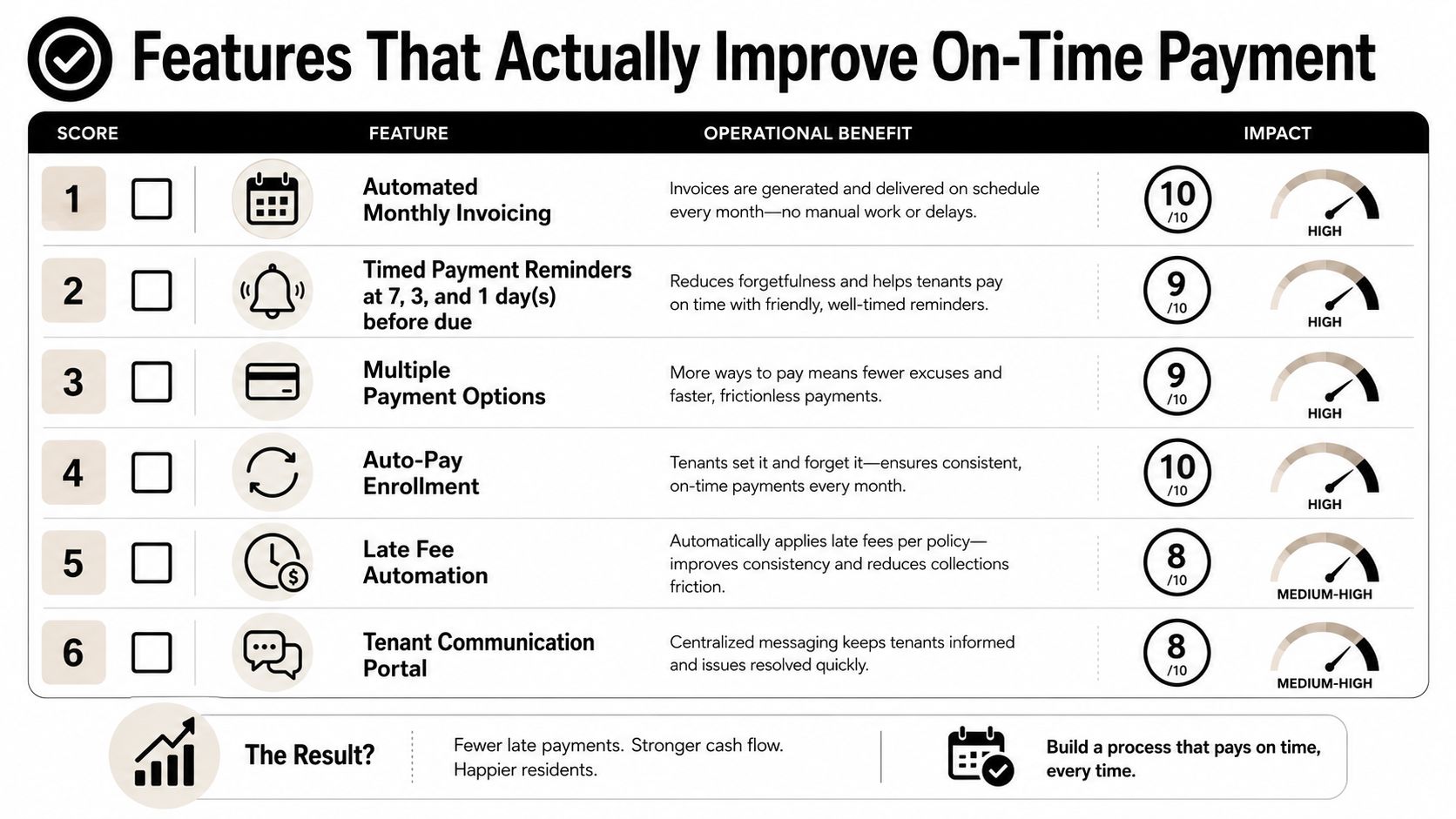
Score every vendor against the workflow, not the marketing page. A payment service earns its place when it reduces decisions you currently make manually.
Tenant-facing controls
Start with the due-date sequence. The platform should create monthly invoices, send reminders at 7, 3, and 1 day before the due date, and show the amount due in a tenant account. The reminders should come from the rental system, not your personal phone, so the tenant sees a consistent business process.
Look for these capabilities:
- Late-fee automation: The system calculates and applies the lease-based charge after the grace period, instead of asking you to remember it.
- Partial-payment handling: Tenants can submit an approved partial amount while the ledger carries the remaining balance forward.
- Multiple payment methods: Tenants can store more than one approved bank or card method, reducing failures when one account changes.
- Prorated charges: Mid-month move-ins and move-outs should produce clear, lease-consistent amounts without a separate spreadsheet calculation.
- Auto-debit scheduling: Tenants should be able to select an authorized withdrawal date that matches their income cycle and your lease terms.
A visible early-pay discount can also outperform a purely punitive approach. Even a $10 incentive may be more persuasive than another late-fee warning, provided the lease and local rules support the arrangement.
Owner-facing visibility
You need an alert when money posts, fails, reverses, or remains partial. You also need a real-time ledger that exports to CSV or QuickBooks, tenant payment history that identifies repeat lateness at renewal, and one login that switches cleanly between properties.
The best rent collection process for tenants is easy for the tenant but accountable for the owner. Test the tenant screen before signing up. If a tenant can't see the balance, payment status, receipt, and next due date without contacting you, the platform hasn't solved the communication problem.
Pricing Structures and What Each One Really Costs
Rent collection pricing usually falls into three structures: flat per-unit fees, percentage-of-rent charges, and tenant-paid pass-through fees. The right choice depends on rent levels, unit count, payment volume, and who absorbs processing costs.
A flat fee is predictable. A service charging between $8 and $15 per unit per month can fit a single-family owner who wants reminders, auto-pay, and a ledger without surrendering a percentage of rent. Percentage pricing, commonly 1% to 4%, can make sense when the platform includes broader management work, but it becomes expensive as collected rent rises. Pass-through pricing protects the landlord's cash flow, yet tenants may resist recurring card or convenience charges.
The supplied comparison illustrates the difference clearly. On a $1,500 monthly single-family rental, a $10 per-unit monthly fee costs $120 per year, while 2% of rent costs $360 per year. On a $3,000 monthly duplex charged at 2%, the gap narrows to $60 between the flat-fee example and the percentage model.
| Pricing Model | Single-Family ($1,500/mo) | Small Duplex ($3,000/mo) | 10-Unit Building ($15,000/mo) | Best Fit |
|---|---|---|---|---|
| Per-unit flat fee | $120/year at $10 per unit monthly | $240/year at $10 per unit monthly | $1,200/year at $10 per unit monthly | Predictable DIY collection |
| Percentage of rent | $360/year at 2% | $720/year at 2% | $3,600/year at 2% | Broader services tied to revenue |
| Payment pass-through | Often little or no landlord cost | Often little or no landlord cost | Often little or no landlord cost | Owners prioritizing margin |
Those figures are examples of the pricing mechanics, not universal quotes. Ask about ACH reversal fees of $5 to $15 per incident, card interchange on premium tiers, setup charges, minimum monthly commitments, expedited deposits, and fees for owner statements or accounting exports. Also confirm whether a tenant-paid fee applies to ACH, cards, or both.
A late-fee policy can support collection without becoming a revenue strategy. An analysis of more than 1.5 million rent payments found a 91% on-time rate where a late-fee policy existed, compared with 89% where one didn't. The same analysis reported a $75 median late fee, while 76% of cases with a configured policy never charged a fee, suggesting that clear expectations can matter more than the money collected. Review the rent late-fee payment analysis before setting your own policy.
Handling Soft Delinquency Before It Becomes Eviction
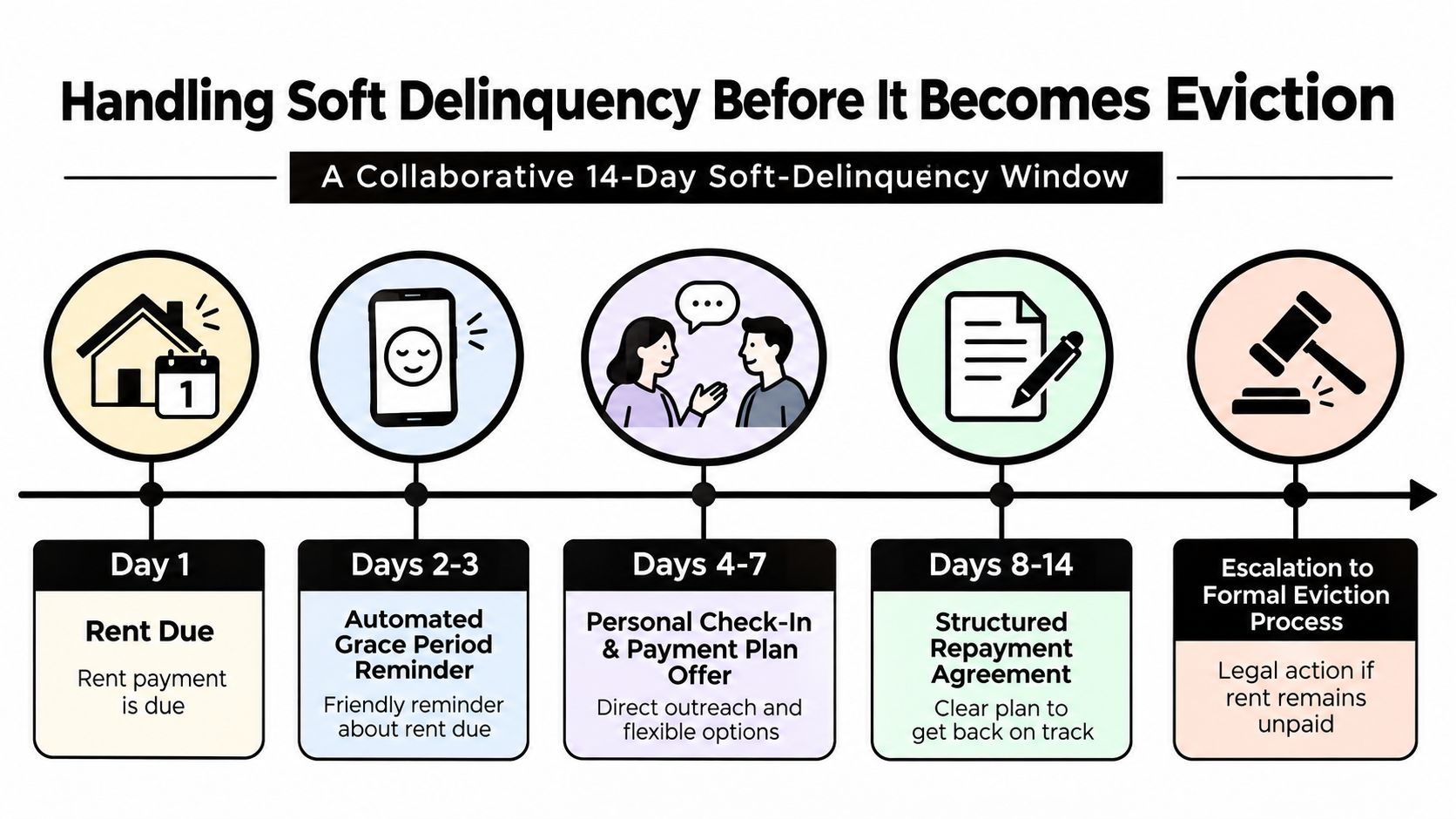
A tenant misses the due date, answers your message, and offers a clear repayment date. Handle that as a collections issue first, not an automatic eviction case. A DIY owner can preserve a workable tenancy with a documented plan. A remote investor needs the platform or manager to make that follow-up happen without repeated calls. Repeated silence or broken promises require faster escalation.
Survey data supports a collaborative opening. 78.3% of independent landlords prefer communication and payment plans over legal action, while only 0.81% start with eviction, according to the cited landlord survey and discussion of how landlords handle late rent payments. Owners who need a practical response sequence can also review how landlords handle late rent payments, then align the process with the lease and local law.
Use a defined escalation ladder
Set one written process for every tenant. It should separate a short payment delay from a pattern of nonpayment, record each contact, and give the tenant a clear way to resolve the balance.
- Day 1: Send an automated portal reminder showing the balance, due date, and payment instructions.
- Day 3: Contact the tenant directly. Ask whether the problem is payment timing, a bank failure, or financial hardship.
- Day 5: Send the formal notice required by the lease and applicable law, including any permitted late fee.
- Day 7: If the tenant can provide a credible repayment schedule, offer a written payment plan and record it in the portal.
- Days 10 to 14: If there is no payment or agreement, follow the legally required escalation process, which may include a pay-or-quit notice or filing.
The dates are an operating framework, not legal advice. Notice periods, grace periods, late-fee rules, and eviction procedures vary by jurisdiction.
A payment plan must state the total balance, installments, due dates, accepted methods, consequences of another missed payment, and that the original lease remains in effect unless formally modified. Do not rely on a verbal promise. Record every payment against the correct charge.
Automation sends reminders and preserves the ledger for promises, partial payments, notices, and reversals. The soft approach works only when records and notices are consistent. Apply the same rules across tenants, and document any legitimate exception.
Choosing the Right Setup for Your Landlord Profile
Your portfolio determines how much collection technology you need. Don't buy a full management stack for one local unit if you'll never use its accounting features. Don't run scattered properties through two unrelated payment apps because each has a convenient tenant interface.
Path one for small and local landlords
For an owner managing 1 to 10 units, I'd start with a lean setup:
- An ACH-first portal with recurring payments and optional card access.
- Automatic reminders and late-fee rules configured to match the lease.
- A connected ledger with CSV or accounting exports.
- A written soft-delinquency playbook for partial payments and payment plans.
- One communication channel that keeps payment conversations attached to the tenancy record.
This setup keeps costs and complexity controlled. You'll still handle tenant screening, maintenance coordination, notices, and exceptions yourself, but rent won't depend on text messages and memory.
Path two for remote or scaling investors
A remote investor should prioritize central reporting over the lowest transaction fee. Choose either a full-service manager or a platform with multi-user permissions, owner statements, maintenance coordination, tenant messaging, and ACH or card rails.
You're paying for time and control from a distance. A higher per-unit or percentage cost can be reasonable when it replaces chasing rent, reconciling deposits, answering tenant questions, coordinating repairs, and preparing monthly records.
| Factor | Small / Local Landlord, 1 to 10 units | Remote or Scaling Investor |
|---|---|---|
| Primary goal | Simple, repeatable collection | Central oversight and delegated operations |
| Recommended rail | ACH-first portal with card backup | ACH and card options inside a unified platform |
| Reporting need | Ledger export and payment history | Owner statements, permissions, and portfolio dashboards |
| Delinquency handling | Owner-run written escalation process | Manager-run notices, outreach, and documentation |
| Main trade-off | More manual operating work | Higher management or software cost |
Ask yourself five questions before choosing:
- How many units do you manage now, and how quickly might that change?
- Are the properties local, or spread across markets you can't visit easily?
- How many hours can you reliably give property operations each week?
- How much do you dislike chasing late rent and documenting exceptions?
- Do tenants, partners, or owners need portal access and formal statements?
If your answers point to local control and limited complexity, choose the lean portal. If they point to distance, growth, limited time, and strong reporting needs, choose full-service management or a unified platform. Avoid a hybrid stack that splits payments between two systems. A lower fee is not a saving if your books no longer have one source of truth.
For owners who want collection, tenant communication, repair coordination, renewals, and accounting handled together, Edinhart Realty and Property Management offers a full-service monthly management model with automated rent collection, tenant auto-debit, owner direct deposit, and monthly rental income statements. Owners who prefer to manage daily operations can use its placement-only service for marketing, applicant screening, and lease drafting.
If you're tired of chasing late rent or reconciling scattered payment records, visit Edinhart Realty and Property Management to discuss a collection setup matched to your property type and level of involvement. Ask about full-service management for delegated operations or placement-only support if you want to keep day-to-day control.


