

A landlord can have one tenant who wants automatic bank withdrawal, another who insists on paying by check, and a third who expects to use a card from a phone. The challenge isn't accepting money. You also need accurate records, secure handling, reliable payment timing, clear tenant communication, and a process for following up when a payment fails.
The most suitable rent collection methods depend on your portfolio size, tenant access, processing costs, security controls, and the amount of work your team can handle each month. Digital collection has become the dominant approach in major U.S. rental datasets. A long-running study covering 1.2 million renters and more than $21 billion in payments found that online payments rose from 4% in 2014 to 51% in 2025, while offline payments fell from 96% to 49% over the same period (Rentec Direct's digital rent payments report).
That shift doesn't mean every landlord should eliminate checks or cash immediately. A primary digital channel with controlled backup options usually works better than forcing every tenant into one system. The following methods compare operational fit, cost, security, reconciliation, tenant access, scalability, and California-focused compliance considerations.
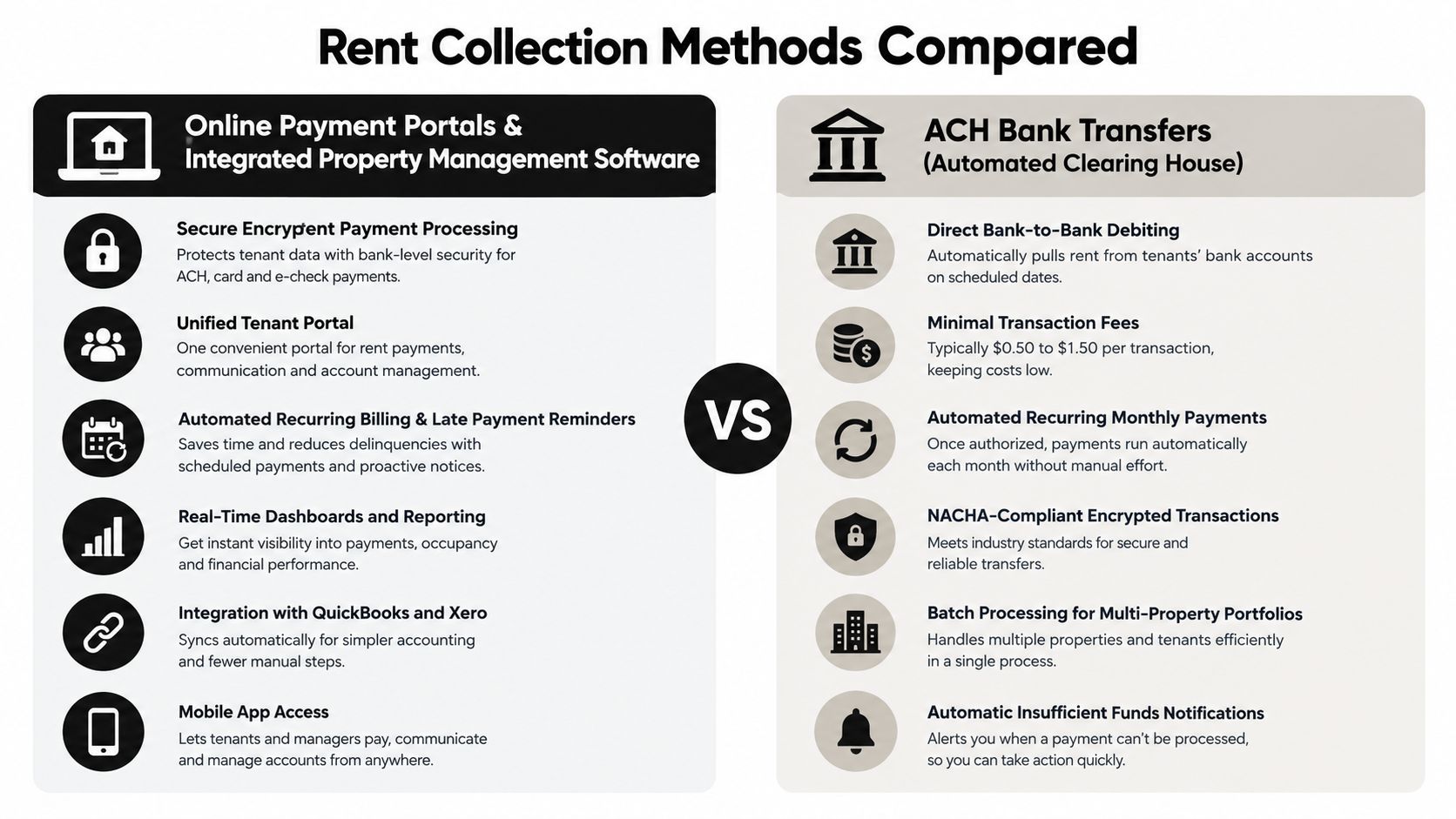
1. Online Payment Portals and Integrated Property Management Software
An online payment portal gives tenants a single place to pay rent, review balances, receive reminders, and access payment records. When the portal is part of a larger property management system, the same platform may also connect rent collection with leases, maintenance requests, accounting, owner statements, and tenant communication.
Platforms such as AppFolio, Buildium, Propertyware, Rent Manager, and Zillow Rental Manager's integrated payment tools illustrate the range of available systems. The right choice isn't the platform with the longest feature list. It's the one that matches your unit count, accounting workflow, tenant payment preferences, and California operating requirements.
Why portals scale well
A portal can reduce manual data entry because payments, receipts, reminders, and account histories live in one system. Managers can see which tenants have paid, which transactions are pending, and which accounts need attention without searching through bank statements or text messages.
Look for support for ACH, cards, e-checks, recurring billing, automated reminders, partial-payment controls, and accounting reconciliation. Confirm how the platform handles returned payments, late fees, owner reporting, security permissions, and exported records. California landlords should also review whether the software helps staff apply lease terms and notices consistently, rather than relying on informal workarounds.
Practical rule: Test the workflow with a small property group before moving the entire portfolio. A payment system that looks efficient in a demonstration can create reconciliation problems if staff aren't trained on deposits, returns, adjustments, and tenant support.
A portal is usually the strongest primary method for a growing portfolio, but it can be excessive for a single property with cooperative tenants. Use this guide to rent collection apps for landlords when comparing standalone tools with full property management software.
2. ACH Bank Transfers
ACH transfers move rent directly between a tenant's bank account and the landlord's designated account. Tenants can authorize a recurring debit, choose an agreed payment date, and avoid writing a check every month. For routine residential rent, ACH is often the best balance of cost control, automation, and predictable reconciliation.
Current industry data supports that operational role. A 2025 to 2026 industry summary reported that ACH represented 64.8% of digital rent transactions, making it the leading electronic option in that dataset (Baselane's ACH overview).
Where ACH performs best
ACH works especially well for landlords managing multiple units, institutional owners with standardized leases, and managers who want recurring collection without card-processing exposure. Each transaction can be matched to a tenant ledger, and the payment schedule can align with a tenant's payroll timing.
At lease signing, provide a clear authorization process and retain the records required by your procedures and applicable California rules. Explain the debit date, amount, handling of returned payments, cancellation rights, and what happens if rent changes after a renewal. Never treat a recurring authorization as permission to withdraw an amount that the tenant hasn't been properly notified about.
ACH still needs a failure plan. Insufficient funds, closed accounts, incorrect banking information, and canceled authorizations can interrupt collection. Build automatic notifications and a documented follow-up sequence into the process. Don't wait until month-end to discover that a scheduled debit failed.
A low-cost payment method isn't reliable unless the manager can identify failed transfers quickly and contact the tenant through a consistent process.
Managers should also monitor return patterns and reconcile deposits against tenant ledgers. Software can help, but the team still needs to review exceptions. Landlords seeking help with recurring payment administration can explore rent collection services for landlords.

3. Credit and Debit Card Payments
Cards are convenient, familiar, and useful when a tenant needs immediate payment confirmation. They can also help a landlord serve renters who don't want to connect a bank account to a property portal. That convenience comes with a tradeoff. Card payments usually carry higher processing costs than bank-based transfers and create additional exposure to disputes and chargebacks.
A practical landlord rarely needs to make cards the default for every tenant. ACH can serve as the primary recurring option, while cards remain available for one-time payments, urgent catch-up payments, or tenants whose preferred payment method is a card.
The operational tradeoff
Card acceptance can improve access and reduce friction at move-in or during a payment emergency. A tenant may have funds available on a credit card but not in the checking account used for an ACH debit. Removing the card option can create unnecessary tension, particularly when tenants have clearly communicated a preference. One 2026 industry summary reported that 81% of renters consider it important for landlords to offer their preferred payment method, and 22% would consider switching housing over payment-method restrictions (USTech Automations' rent collection software overview).
Disclose any tenant-facing processing fee before payment. In California, fee rules can be fact-specific, so landlords should confirm the current legal treatment of any surcharge or convenience charge before adding it to a lease or payment screen. A landlord might absorb card costs for selected circumstances, but that decision should be consistent, documented, and financially sustainable.
Use a processor with strong security controls, tokenization, and appropriate payment-card compliance. Limit staff access to sensitive information and don't store card details in spreadsheets, email threads, or personal devices. Reconcile card deposits separately from the tenant ledger because the processing date, settlement date, and deposited amount may differ.
Cards are a valuable access channel. They aren't automatically the most economical recurring method.

4. Check Payments With Remote Deposit Capture
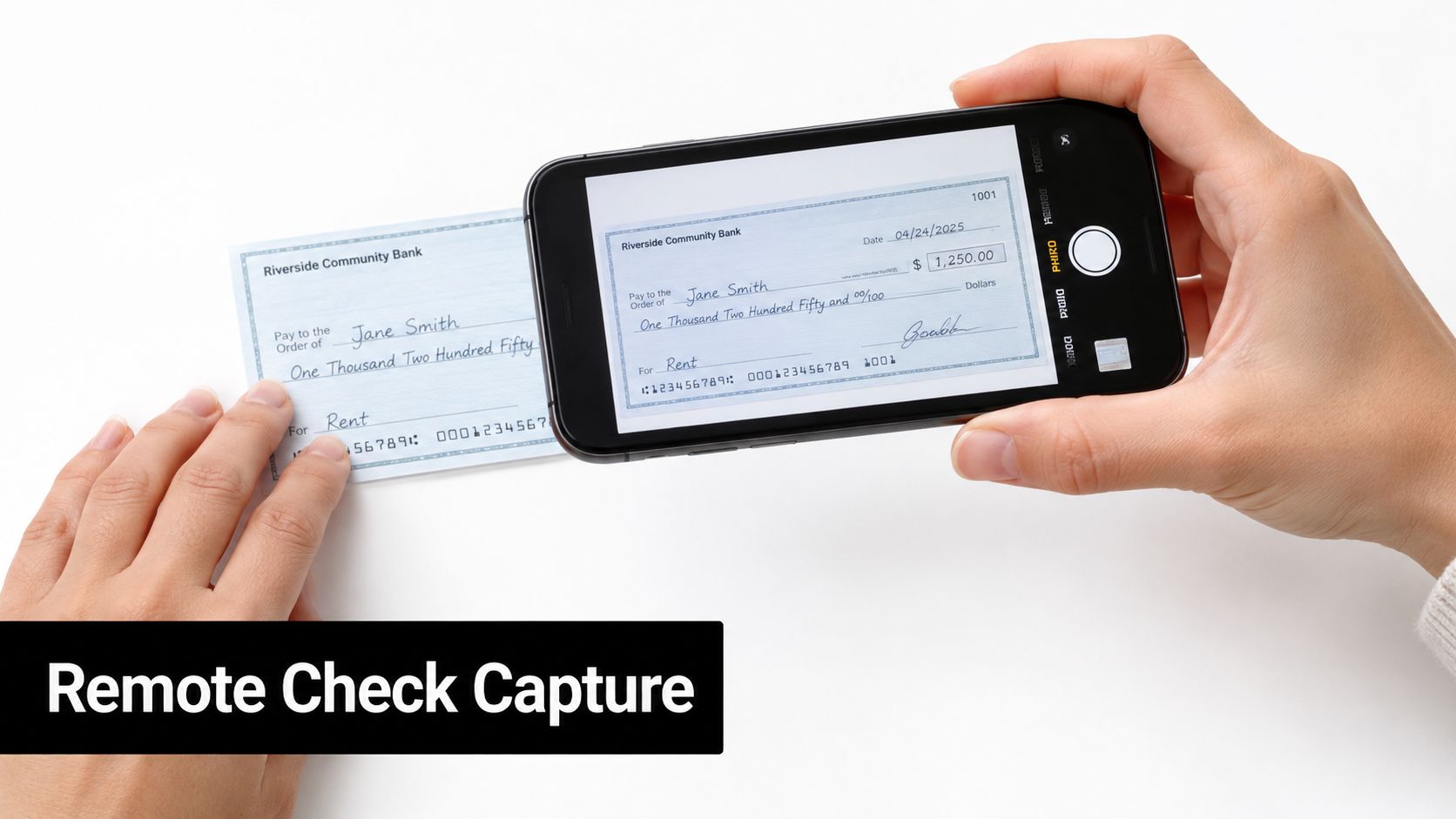
Remote deposit capture, or RDC, modernizes check collection without requiring every tenant to abandon checks. A manager or authorized staff member scans the front and back of each check through a bank app or approved device, then deposits it electronically while preserving an image and transaction trail.
This method suits landlords serving tenants who are comfortable with checks but want less manual handling. It can also help a mid-sized California management company move away from office drop-offs without creating an abrupt digital-only policy.
Where RDC helps
RDC reduces trips to a bank branch and creates a digital record of deposited checks. It doesn't eliminate the risks associated with checks. Funds can still be unavailable, the check can be returned, handwriting can be unclear, and a mailed payment can arrive after the due date.
Set a clear cutoff date for mailed checks and explain when rent is considered received under the lease and applicable law. Encourage tenants to mail early enough for delivery, but don't describe mailing a check as equivalent to a confirmed deposit unless your written policy says so.
Staff should receive training on image quality, endorsements, duplicate deposits, check storage, and destruction procedures. A blurry image or unreadable MICR line can delay processing and complicate reconciliation. Keep digital records according to your legal, accounting, insurance, and company retention policies. The plan note calls for maintaining records for 7+ years, but landlords should verify the current California requirements that apply to their records before adopting a fixed retention schedule.
A check-friendly process can still be disciplined. Familiarity for the tenant shouldn't mean uncertainty for the ledger.
RDC is a useful bridge for tenants who aren't ready for ACH or cards. It works best when paired with automated reminders, a firm receipt process, and a defined escalation path for late or returned checks. It becomes less attractive when staff must process a large volume of checks manually or when deposits can't be reconciled promptly.
5. Third-Party Collection Agencies and Services
Collection agencies are not a normal monthly payment channel. They're an escalation tool for accounts that have moved beyond ordinary reminders, payment plans, and documented landlord follow-up. A specialized agency, law-firm collection department, or property management collection service may handle delinquency communications and account recovery more consistently than an owner who is juggling repairs, leasing, and daily operations.
Use escalation carefully
A collection provider should fit the landlord's property type, communication standards, and California compliance obligations. Review its credentials, references, complaint history, written procedures, and handling of tenant disputes. California landlords should also verify the provider's status and regulatory obligations with the California Department of Financial Protection and Innovation before engagement.
Define the handoff in writing. The agreement should identify when an account is referred, which records the landlord supplies, who communicates with the tenant, how disputes are handled, and when legal counsel becomes involved. A landlord should never assume that outsourcing communication transfers responsibility for accurate records or lawful conduct.
The plan notes suggest reserving agency use for accounts 60+ days delinquent. That threshold may be appropriate for some owners, but it isn't a universal legal rule or business standard. The correct trigger depends on the lease, notices already served, payment history, balance, tenant communication, and advice from qualified California counsel.
A third party can reduce the emotional burden of repeated collection calls. It can also damage a landlord's reputation if representatives use aggressive or confusing language. Monitor the agency's work through reports, call standards, dispute logs, and clear escalation rules.
Don't send an account to collections because a tenant missed one payment. First confirm the ledger, payment status, notice requirements, accommodation issues, and any legitimate dispute. Professional collection starts with complete documentation, not just a past-due balance.
6. In-Person Cash or Check Collection
In-person collection remains relevant for small landlords, on-site managers, rural communities, and tenants with limited banking access. A tenant may pay at a designated office or collection window, hand over cash or a check, and receive a written receipt. The process is direct and familiar, but it creates substantial labor, security, and recordkeeping demands.
Cash presents the greatest handling risk because a landlord must count it, safeguard it, document it, and deposit it promptly. A check is easier to trace, but it still requires secure storage and timely deposit. Neither method scales smoothly when a manager oversees a large portfolio or multiple locations.
Make the process controlled
Set consistent collection times and publish them in the lease, welcome materials, and tenant communications. Avoid informal arrangements such as accepting cash at a private residence or asking a tenant to leave money in a mailbox. Every payment needs a receipt showing the date received, amount, property, tenant, payment type, and the person who accepted it.
Use duplicate records and reconcile the receipt book against bank deposits and tenant ledgers. For cash, consider two-person counting or a buddy system, especially when staff collect from multiple tenants at once. Deposit money as soon as practical, and limit the amount kept on site.
This method may be necessary for some tenants, but convenience for the manager shouldn't determine whether a tenant can pay. A UK housing report found 17% of recipients used in-person rent payment methods, while direct debit accounted for 52% and online payment was cited by 34%, demonstrating that offline access can persist even in a relatively digital housing environment (the UK housing payment report).
Keep an access option open when a digital-only policy would create a genuine barrier, then apply the same receipt and reconciliation standards to every tenant.
A landlord can gradually shift routine payments to ACH or a portal while retaining a controlled alternative. That approach reduces cash handling without abandoning tenants who need a different route.
7. Electronic Fund Transfer and Wire Transfers
EFT and wire transfers move funds electronically into a landlord's or property manager's account. They're useful for commercial tenants, out-of-state owners or payers, high-value properties, and irregular transactions that don't fit a recurring ACH schedule.
The distinction matters operationally. A wire is often intended for a fast, one-time transfer and may be difficult to reverse after the sender authorizes it. An EFT may describe a broader category of electronic movement, including transfers arranged through a financial institution or payment platform. The lease and payment instructions should identify the accepted method clearly.
Protect the instruction process
Provide written instructions through a secure channel. Include the legal account name, receiving institution, account details, payment reference, due date, and contact method for verification. Never rely on an emailed change request without independently confirming it using a trusted phone number or established contact.
Wire fraud frequently begins with compromised email accounts or convincing payment-instruction changes. Staff should verify new instructions and any change to existing instructions before releasing them to a tenant or sending funds internally. Store banking information with restricted access, and avoid placing complete account details in broadly shared documents.
A dedicated rental account can simplify reconciliation and help separate rental receipts from personal funds. For property managers, the account structure should also support owner reporting and the handling of funds according to the management agreement and California requirements.
Wires aren't usually the right answer for ordinary monthly residential rent. Their strength is traceability and suitability for larger or irregular payments. Their weakness is the risk of irreversible error and the extra verification required. Use recurring ACH for predictable rent, and reserve wires for situations where the payer, amount, and timing justify the control burden.
8. Rent Collection Legal and Compliance Framework
Compliance isn't a payment method in the same way ACH or checks are, but it determines whether every method can be used safely. A landlord needs a documented framework for payment instructions, late fees, notices, returned payments, receipts, records, and tenant communications before selecting software or accepting funds.
California-focused collection starts with current lease language and consistent procedures. Disclose accepted methods, payment deadlines, late-fee terms, returned-payment handling, and any permitted tenant-facing charges in clear language. Don't create a policy that conflicts with the lease or apply different requirements to similarly situated tenants.
Build an evidence trail
Record each payment attempt, successful deposit, returned transaction, notice, call, email, text, agreement, and tenant response. The plan recommends maintaining payment and collection records for 7 years, but landlords should confirm the applicable retention period with California counsel and their insurance or accounting professionals.
Use current California Association of Realtors forms where appropriate, and review documents regularly as laws and guidance change. Train staff on California landlord-tenant rules, fair housing obligations, privacy, and the restrictions that may apply to debt collection communications. The compliance documentation resource can help owners think through the records and procedures that support consistent management.
A compliant framework also protects tenants. Clear instructions reduce mistaken payments, duplicate payments, surprise fees, and confusion about what happens after a failed transfer. It protects landlords by showing that the ledger, notices, and follow-up process are based on documented facts.
The payment channel is only one part of collection. The defensible process is the ledger, the notice, the receipt, and the record of what happened next.
Before implementing a new system, have qualified California counsel review the lease language, late-fee policy, payment restrictions, notices, and recordkeeping plan. Software can automate a workflow, but it can't make an unlawful workflow compliant.
Rent Collection: 8-Point Comparison
| Method | Implementation Complexity 🔄 | Resource Requirements ⚡ | Expected Outcomes ⭐ / 📊 | Ideal Use Cases | Key Advantages 💡 |
|---|---|---|---|---|---|
| Online Payment Portals & Integrated Property Management Software | 🔄 Medium–High: vendor integration, configuration, staff training | ⚡ Subscription + processing fees; IT & training time | ⭐ High automation; 📊 improved on-time rates, real-time financial visibility | Multi-property portfolios; managers seeking end-to-end automation | 💡 Automated reconciliation; tenant self-service; scalable; accounting integration |
| ACH Bank Transfers (Automated Clearing House) | 🔄 Low–Medium: bank setup and signed authorizations required | ⚡ Low per-transaction cost; banking integration; minimal ongoing staff time | ⭐ Cost-effective recurring collections; 📊 reliable but 3–5 day processing | Recurring monthly rent across many units | 💡 Lowest-cost; automated after authorization; NACHA-compliant security |
| Credit/Debit Card Payments | 🔄 Low: easy via processors but requires PCI-DSS controls | ⚡ Higher processing fees (2–3%+); payment processor and compliance | ⭐ High tenant convenience; 📊 instant confirmation but lower net proceeds | Tenants preferring cards; short-term rentals; out‑of‑state payers | 💡 Instant receipts; wide adoption; easy implementation via Stripe/Square |
| Check Payments with Remote Deposit Capture (RDC) | 🔄 Medium: staff training for capture, mail handling workflows | ⚡ Low direct fees; staff time for image quality and deposits | ⭐ Keeps traditional payment option; 📊 digital records; moderate speed | Older demographics; rural tenants transitioning from paper checks | 💡 No processing fees when mailed; digital archiving; accommodates check-preferrers |
| Third-Party Collection Agencies and Services | 🔄 Low setup; medium complexity in contracts and protocols | ⚡ High cost (often 10–20% of collections); oversight required | ⭐ Improves recovery on chronic delinquencies; 📊 may damage relationships | Accounts 60+ days delinquent; landlords avoiding direct collections | 💡 Professional expertise; FDCPA compliance; offloads confrontations |
| In-Person Cash or Check Collection | 🔄 Low-technology but operationally complex and labor-intensive | ⚡ High staff time and security measures; minimal processing fees | ⭐ Immediate verification; 📊 labor-intensive, low scalability | Small "mom-and-pop" properties; unbanked or local tenants | 💡 Builds rapport; instant receipts; serves unbanked tenants |
| Electronic Fund Transfer (EFT) & Wire Transfers | 🔄 Medium: bank instructions, verification processes | ⚡ Significant per-transfer fees (wires $20–$50+); banking access needed | ⭐ Very secure; 📊 fast for one-off/high-value payments | Large/one-time payments; out-of-state investors and premium clients | 💡 Fast settlement; detailed audit trail; high security |
| Rent Collection Legal & Compliance Framework | 🔄 Medium–High: ongoing legal updates, policy documentation | ⚡ Legal counsel, staff training, record-keeping systems | ⭐ Reduces legal risk; 📊 creates defensible eviction/notice documentation | All portfolios, required for compliant operations | 💡 Protects from liability; standardizes procedures; ensures regulatory compliance |
Build a Collection System, Not Just a Payment Channel
The best rent collection setup usually has a clear default and carefully managed alternatives. For routine residential rent, an integrated portal paired with recurring ACH offers strong automation, tenant visibility, and reconciliation. Cards add convenience for tenants who prefer them or need a different funding source, although their processing and dispute considerations make them better as a secondary route for many portfolios.
Checks can remain useful when tenants rely on them, especially when the landlord uses remote deposit capture and firm cutoff rules. In-person cash or check collection may be necessary for tenants with limited banking access, but it demands tighter security, written receipts, prompt deposits, and regular review. Wires belong in a separate category. They're better suited to one-time, irregular, commercial, or high-value transfers than to ordinary monthly residential collection.
The market isn't fully digital despite the growth of online payments. A 2025 survey of 415 U.S. rental property owners found that 56% still accepted checks and 53% still accepted cash, while 27% used online property management platforms for rent collection (Baselane's rental market trends summary). That combination shows why a hybrid process can make practical business sense. Owners may want automation while tenants still need access to more than one channel.
A workable implementation sequence looks like this:
- Choose the primary channel: Select a portal or ACH workflow that fits your portfolio and accounting process.
- Publish clear instructions: State due dates, accepted methods, cutoff times, fees, returned-payment handling, and contact information.
- Automate routine communication: Send reminders, receipts, payment confirmations, and failed-payment notices through approved systems.
- Reconcile every transaction: Match deposits, returns, fees, and adjustments to the correct tenant ledger.
- Protect payment information: Restrict access, use secure processors, verify wire instructions, and avoid storing sensitive data in informal files.
- Review failures monthly: Look for recurring ACH returns, delayed checks, card disputes, tenant access barriers, and staff reconciliation errors.
- Escalate consistently: Use documented notices and professional procedures before referring serious delinquency to counsel or a collection provider.
Owners who don't want to build this workflow alone can consider Edinhart's Full-Service Monthly Management, which includes rent collection, tenant communication, repair coordination, move-in and move-out coordination, lease renewals, and detailed accounting statements. Edinhart's property management materials describe automated rent withdrawal through an auto-debit or EFT process, with owner rental income delivered by direct deposit. Current legal requirements, fee rules, and payment terms should be verified before implementation.
The practical objective isn't to eliminate every offline payment. It's to make the preferred method simple, make backup methods controlled, and make every transaction traceable from tenant payment to owner reporting.
Edinhart Realty and Property Management provides full-service monthly management with rent collection, automated payment options, tenant communication, repair coordination, and transparent reporting for owners in Fresno, Clovis, Friant, and greater Central California. Visit Edinhart Realty and Property Management to discuss a collection process that fits your tenants, portfolio, and California compliance needs.


