

A tenant in Fresno misses rent, promises to catch up Friday, and then stops answering calls. You're left with a partial text trail, an incomplete ledger, and the uncomfortable realization that every friendly extension changed the story you may later need to prove. The strongest rent collection letter doesn't begin when the balance becomes overwhelming. It begins as soon as the payment is late, with a tone that matches the risk and a record that matches California's process.
California landlords need to separate collection communication from a statutory notice. A courteous reminder can preserve the relationship. A formal demand can create a clear payment record. A properly served 3-day notice to pay rent or quit can start the statutory path toward an unlawful detainer, California's name for an eviction lawsuit. Those documents serve different purposes, and using the wrong one at the wrong time creates avoidable problems.
The Rent Collection Letter Most Landlords Get Wrong
A Fresno owner once told me he had been patient with a tenant for two months. The tenant had missed rent, made verbal promises, and received several informal extensions. The owner thought patience would help him recover the balance and avoid conflict.
Instead, the tenant stopped paying altogether. When the case reached court, the judge asked for the first written notice showing when the landlord demanded payment. The owner had phone calls, a few text messages, and a memory of what had been agreed. He didn't have a dated letter that established the beginning of the delinquency.
That silence became expensive. A landlord may believe a verbal grace period is temporary, but if the tenant hears repeated promises without a written deadline, the landlord may later have to explain why enforcement didn't happen earlier. A court won't accept a reconstructed timeline just because the owner remembers it clearly.
Practical rule: Every verbal arrangement that changes the payment expectation should be confirmed in writing the same day.
The first message should usually be calm and immediate. Send a short reminder when rent is late, identify the amount believed to be outstanding, and ask the tenant to contact you if a payment has already been sent or a hardship has interrupted payment. Don't accuse the tenant of bad faith, and don't threaten an eviction you aren't prepared to pursue.
California landlords often wait until the balance feels serious before writing. That approach gives the tenant time to become evasive and gives the landlord a weaker record. The first letter isn't merely a courtesy. It establishes the date, the amount, the landlord's response, and the opportunity the tenant had to resolve the problem.
The value of early communication is visible in broader housing enforcement. In Los Angeles, 290,560 eviction notices were filed from February 2023 through April 2026, and 93% involved nonpayment of rent, according to GdB Law's discussion of reminders and demands. A small, prompt reminder can preserve a path to payment before the matter becomes a formal dispute.
Three California Letter Types and When to Send Each
California landlords should use a staged process. Each document has a different job, and only one of the three is the statutory notice that can precede an unlawful detainer for unpaid rent.
Start with the friendly late-rent reminder
Send this non-legal note as soon as the due date passes and the ledger still shows no payment. For many Central California properties, that means the first few days after the due date, subject to the lease and any applicable local requirements.
Keep it short:
“Our records show that rent for [property address], due on 2026, hasn't been received. Please submit the outstanding amount or contact us today if payment has already been made or you need to discuss the account.”
This letter opens communication without turning a solvable delay into a personal confrontation. It also creates the first dated record of your response.
Follow with a formal demand
If payment and contact don't arrive, send a formal demand after a short interval, often around the fifth through seventh day after the missed due date, but check the lease and current legal requirements before relying on that timing. This isn't the same as a 3-day notice to pay rent or quit.
Itemize the balance, identify the lease provision, state how the tenant can pay, and set a firm deadline for voluntary resolution. Say that further action may follow if the account remains unpaid, but don't describe the letter as a statutory notice unless it meets every statutory requirement.
Use the 3-day notice only for the legal escalation
A California 3-day notice to pay rent or quit is governed by California Code of Civil Procedure section 1161 and must accurately state the rent due and provide the legally required opportunity to pay or vacate. It isn't a casual rewrite of your reminder. Errors in the amount, service, wording, or timing can delay an unlawful detainer case.
California law also requires attention to service rules under section 1162. Before serving this notice, verify the current statutory requirements and consider having a California landlord-tenant attorney or qualified eviction professional review it.
The mapping is simple:
- Friendly reminder: early communication and a first paper trail.
- Formal demand: clear escalation after informal contact fails.
- 3-day notice to pay rent or quit: statutory step before an unlawful detainer for qualifying nonpayment.

What Every California Rent Collection Letter Must Include
A rent collection letter should let a neutral reader answer five questions immediately: who owes the money, which property is involved, how much is due, when it was due, and what happens next. Missing details force the tenant, manager, attorney, or judge to reconstruct the account from scattered records.
Use these building blocks:
- Name every tenant on the lease.
- Identify the complete rental address.
- Break down the balance by charge.
- State the original due date.
- Set the new payment deadline.
- List accepted payment methods.
- Explain the next step if payment isn't received.
A demand letter can include lease-authorized late charges, but verify that every charge is permitted and accurately calculated. Don't casually add utilities, repair costs, legal fees, or other amounts to a statutory rent notice when they aren't legally recoverable as rent for that notice.
A comparison that exposes weak drafting
| Element Required | Compliant Phrasing | Risky Phrasing |
|---|---|---|
| Tenant identity | “To John Smith and Maria Smith, tenants under the lease.” | “To the residents.” |
| Property | “Regarding 123 Main Street, Fresno, California.” | “Regarding your rental.” |
| Balance | “The sum of $1,850.00, representing $1,650.00 rent and $200.00 late fee under paragraph 4 of the lease.” | “Your past-due balance.” |
| Due date | “Rent due on June 1 remains unpaid.” | “Rent has been late for some time.” |
| Deadline | “Please pay or contact management by June 8.” | “Pay immediately.” |
| Payment method | “Pay through the resident portal or deliver a cashier's check to the office address below.” | “Send payment as usual.” |
| Consequence | “If the account remains unresolved, management may pursue additional remedies permitted by the lease and California law.” | “You will be locked out tomorrow.” |
The exact language changes when you prepare a 3-day notice. Don't copy a friendly letter and label it statutory. A 3-day notice needs precise calculations, legally compliant service, and a deadline that follows the applicable counting rules.
California landlords also need restraint. A letter can't threaten self-help eviction, utility shutoff, lock changes, property removal, or retaliation. If you plan to issue a notice under section 1161, use the correct statutory form and confirm current requirements rather than improvising from an internet template.
Your letter protects you because it ties the ledger to a specific communication. It shows what the tenant was told, what amount the landlord demanded, and whether the landlord gave the tenant a fair chance to respond. That clarity helps resolve disputes before court and gives counsel a cleaner file if litigation becomes necessary.
How to Deliver the Letter So It Holds Up in Court
Delivery should match the document's purpose. A friendly reminder can travel by email, text, portal message, or regular mail, although I still save a copy and record when it was sent. A statutory 3-day notice requires much more care.
California Code of Civil Procedure section 1162 sets out recognized service methods for notices used in the unlawful detainer process. Personal service is generally the cleanest option when the tenant can be reached. If personal delivery isn't possible, substituted service and mailing, or posting and mailing in circumstances allowed by law, may become relevant. Don't assume that posting alone is enough for every notice or that a text message replaces statutory service.
| Method | Cost | Proof Strength | Acceptable For | Key Limitation |
|---|---|---|---|---|
| Certified mail with return receipt | Moderate | Strong mailing and receipt record | Courtesy letters and supporting documentation | Mailing can affect when a statutory notice is treated as served, and it doesn't replace all required service steps |
| Personal service | Staff time or process-server fee | Strong if properly documented | Statutory notices when delivered by an authorized server | The server must follow the required method and document the event |
| Posting on the door | Low direct cost | Weaker unless paired with required mailing and records | Statutory service only when permitted after reasonable service attempts | Posting alone may be insufficient, and the file must show compliance |
Use email and text as supplements, not as your only method for a 3-day notice to pay rent or quit. Save screenshots, delivery confirmations, and portal records, but don't confuse electronic communication with statutory service.
For a practical explanation of notice delivery and tenant communication, review how to issue a notice to a tenant in California. The procedural details matter because a perfectly written notice can still fail if the landlord can't prove compliant service.
My decision rule is straightforward:
- Day one reminder: use the tenant's established communication channel and send a written copy.
- Formal demand: send a dated letter through a trackable method, while preserving the ledger and contact log.
- 3-day notice: use an authorized method under current California law, with a server's declaration or equivalent proof.
If the tenant refuses delivery or can't be found, don't improvise. Ask a qualified professional to determine the next lawful service method, then document every attempt.
Writing for Partial Payment and Repeat Late Rent
Partial payment creates a dangerous illusion of progress. The account may receive money, but the legal and accounting position can become less clear unless the landlord documents exactly what the payment does and doesn't resolve.
Suppose rent is overdue and the tenant sends half. Deposit the payment only after checking the lease, the notice already served, and current California guidance. Then send a written acknowledgment:
“Management received $___ on 2026. This payment is applied to the account as stated in the attached ledger and does not represent full payment of the outstanding rent. The remaining balance is $___.”
Don't call the payment “accepted in full” unless that's your actual agreement. Don't casually promise that the remaining amount can wait. If a 3-day notice is already active, accepting partial payment may affect the notice or the landlord's ability to proceed, depending on the circumstances. Get legal advice before deciding whether to accept, refund, or condition the payment.
A hardship conversation deserves a different tone. Ask the tenant to propose a realistic payment date or plan, but keep the account ledger current and put every agreement in writing. A payment plan should identify the amount, due dates, consequences of another missed installment, and whether the arrangement changes the lease. Don't let compassion become an undocumented indefinite extension.
Repeat lateness needs a sharper message
One late payment may be a disruption. Repeated lateness is a management pattern, and the letter should say so without insulting the tenant.
Use this progression:
- First occurrence: “Please let us know if there's a processing issue so we can help prevent another delay.”
- Repeated occurrence: “Our records show repeated late payments. Rent remains due on the lease date, and future late payments may lead to further lease enforcement.”
- Pre-legal warning: “If rent is not paid as required, management may serve the appropriate statutory notice and pursue remedies available under California law.”
That language is firm without promising an outcome you haven't chosen. Avoid threats involving lockouts, utility interruptions, physical removal, or invented deadlines. California Civil Code section 1950.5 governs security deposits, not a shortcut for collecting unpaid rent, so don't use the deposit as an informal substitute for current rent while the tenancy continues.
For a practical workflow covering tenant communication and payment follow-up, see how to handle late rent payments. The central discipline is consistency. Apply the same written process to comparable situations, and reserve exceptions for documented agreements rather than spontaneous promises.
Building a Documentation Habit That Protects You
The letter rarely carries a case by itself. The file behind the letter does.
A judge, attorney, or auditor needs to follow the account without relying on your memory. Build one digital and physical file for each tenancy, then keep the entries in date order.
Keep five records together
- Rent ledger: Record the due date, amount charged, payment date, partial payments, reversals, and remaining balance.
- Letter archive: Save the exact version sent, the date, delivery method, and any return receipt or server declaration.
- Contact log: Note calls, texts, emails, portal messages, and in-person conversations. Record what was said without editorial comments.
- Payment evidence: Keep deposit records, transaction confirmations, returned-payment notices, and written payment agreements.
- Tenant responses: Preserve hardship requests, disputes, promises to pay, and proof of compliance with any arrangement.
A useful file names every document with the property, tenant, document type, and date. That makes it possible to see whether a friendly reminder preceded a formal demand, whether the balance changed, and whether a statutory notice used the correct account information.
Contemporaneous notes beat reconstructed memory. A note made after a call can state, “Tenant said payment would be made Friday,” while a note written weeks later may blur the exact promise. Don't embellish. Neutral records carry more credibility than angry commentary.
The best collection system makes the timeline obvious to someone who wasn't there.
Set aside ten minutes each week to reconcile the ledger, upload communications, check unresolved promises, and confirm that every sent notice has delivery evidence. That small routine prevents the familiar crisis where the landlord has dozens of messages but can't connect them to the amount allegedly owed.
If a tenant disputes the balance, stop and reconcile before escalating. A wrong ledger can undermine an otherwise valid notice, while a clean ledger lets you correct a mistake before it becomes a court exhibit.
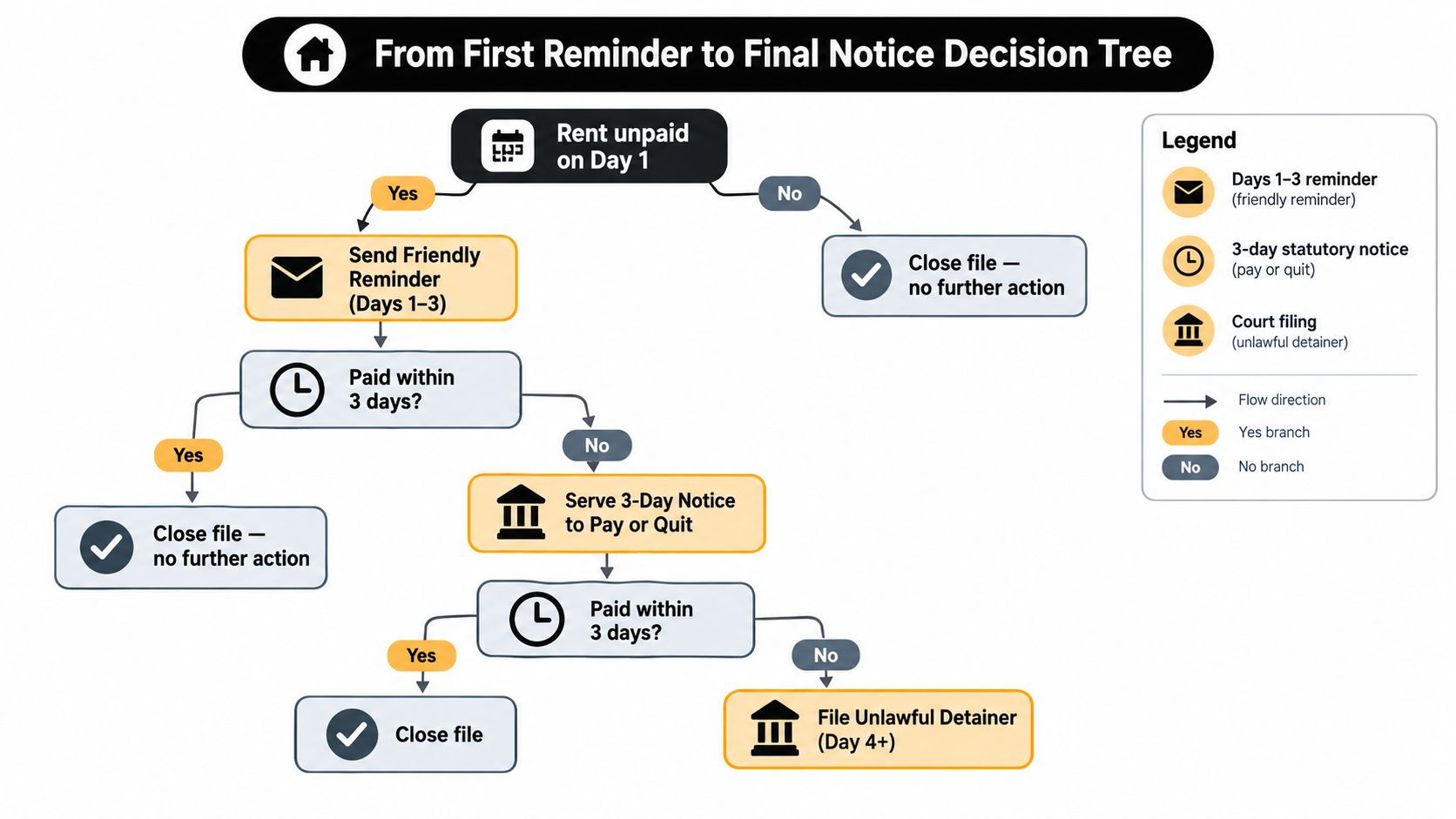
From First Reminder to Final Notice Decision Tree
A Central Valley landlord needs a process that can be followed on a busy rent day, not a complicated policy that sits in a binder. Start with the missed payment, check the ledger, and choose the communication that fits the actual risk.
A tenant with a strong payment history may deserve a personal message and a friendly written reminder. A tenant with repeated late payments may need a formal demand sooner. Those choices affect tone, but they don't eliminate the obligation to follow the lease, California notice rules, and any applicable local protections.
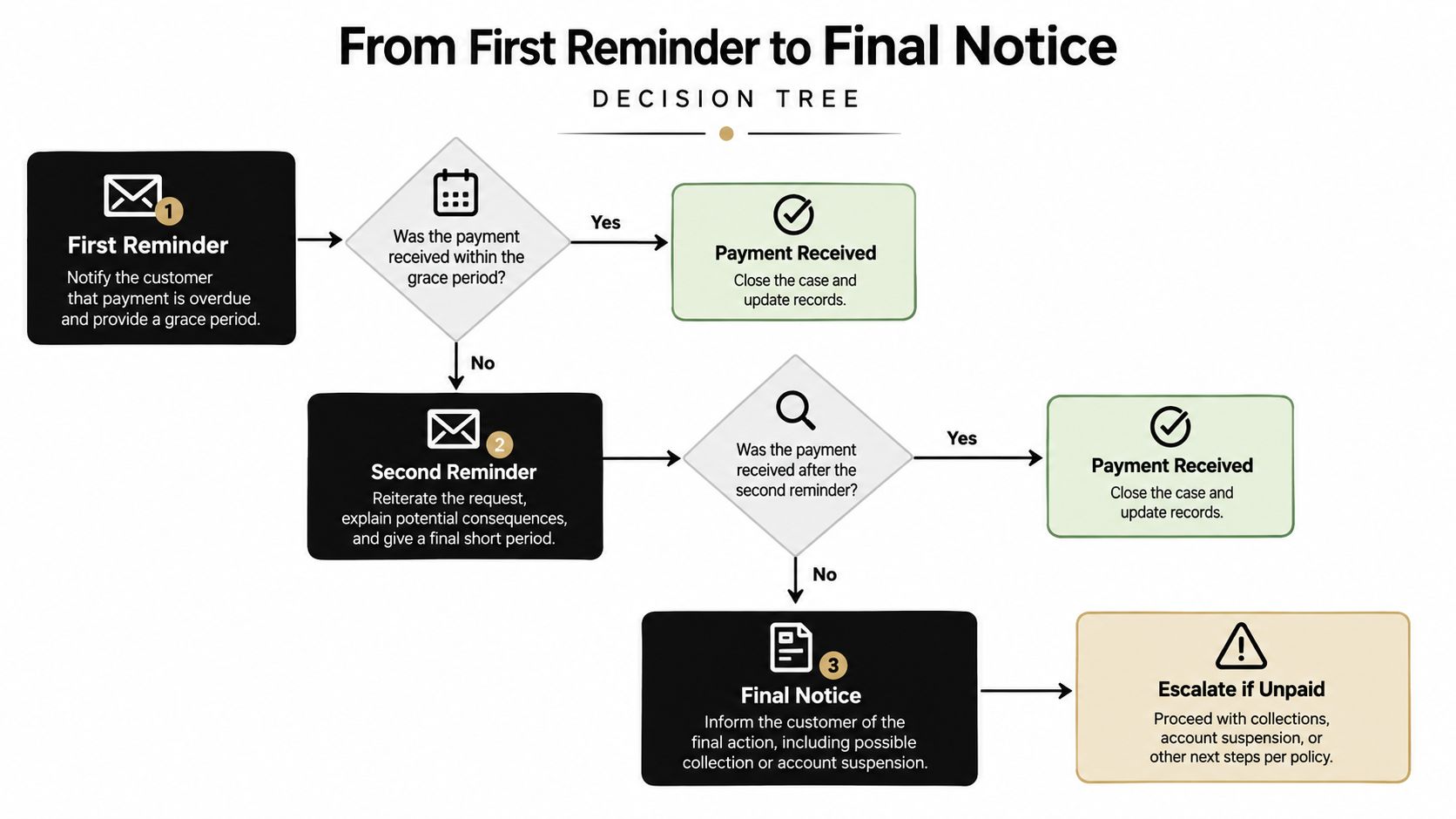
Use this decision path:
- Rent is unpaid: verify the ledger, lease due date, and whether a payment is pending.
- Send the early reminder: identify the balance and invite immediate contact.
- Payment arrives: update the ledger and confirm whether the account is paid in full.
- No payment or response: send the formal demand and preserve delivery proof.
- Nonpayment continues: review the account and serve the appropriate 3-day notice to pay rent or quit under California Code of Civil Procedure section 1161.
- Payment follows the notice: document the amount and get legal guidance before accepting partial payment or deciding whether the notice remains usable.
- The notice expires without resolution: prepare for the lawful next step, including an unlawful detainer filing when appropriate.
The timing isn't identical for every tenancy. Lease provisions, local ordinances, subsidized housing rules, just-cause requirements, and current California law can change the analysis. Owners in Fresno, Sacramento, or Los Angeles should verify local rules before treating a general timeline as a legal deadline.
Automated reminders can help with consistency, but automation doesn't decide whether a notice is legally valid. Tools such as automation tools from Truespeak can support routine payment reminders, while a property manager or attorney should handle statutory escalation and unusual payment arrangements.
For the court-facing stages, review the California tenant eviction process and confirm current requirements before filing. The objective isn't to send the harshest letter. It's to give the tenant a clear opportunity to pay while preserving a reliable record if payment never comes.
Edinhart Realty and Property Management offers full-service management with automated rent collection, tenant communication, payment follow-up, and notice handling through its resident workflow. If you manage rent collection yourself, adopt the same discipline today: reconcile the ledger, send the first written reminder promptly, and save delivery proof before the account becomes a legal problem.
If late rent is consuming your time, Edinhart Realty and Property Management can manage collection follow-up, tenant communications, documentation, and escalation for Central California rentals. Visit Edinhart Realty and Property Management to discuss full-service monthly management or placement-only support for your Fresno-area property.


