

You're probably in one of two spots right now. You've found a Fresno rental that looks promising, or you already own a property and you're trying to figure out whether it's performing well. The problem is that every conversation about investing seems to drift into terms like cap rate, cash-on-cash return, ROI, and IRR.
That jargon turns a simple question into a foggy one: Is this property making me money in a smart way, or not?
A useful real estate rate of return isn't one number pulled from a spreadsheet. It's a way of reading the whole story of a property. You want to know how much income it produces, how much cash it ties up, how financing changes the picture, and how management decisions affect what you keep. That matters even more in a market like Fresno, where investors often balance cash flow, maintenance, tenant quality, and long-term holding strategy all at once.
Why "Return" Is More Than Just a Number
Most new investors start with the same instinct. They look at the purchase price, estimate rent, subtract a few bills, and decide whether the deal feels good. That's not wrong. It's just incomplete.
A rental property behaves more like a small business than a savings account. Income comes in. Expenses go out. Financing changes the math. Timing matters. Tenant turnover matters. Repair habits matter. Even something as ordinary as how quickly a vacant home gets marketed can change your actual return.
Why one metric never tells the whole story
A property can look strong on paper and still disappoint you in real life.
For example, one house might show healthy rent relative to price, but need frequent repairs that drag down net income. Another might produce modest monthly cash flow but build wealth steadily through loan paydown and tax treatment. Both are “good” in different ways.
Practical rule: Don't ask whether a property has a good return. Ask which kind of return looks good, and whether that matches your goal.
If you want monthly income, you'll care a great deal about operating costs, rent collection, and vacancy risk. If you want long-term wealth, you may accept thinner cash flow in exchange for stronger total return over time.
The long view keeps expectations realistic
Historical context helps. From 1928 to 2023, real estate delivered an average annual rate of return of +4.2%, which supports its reputation as a stable, moderate-growth asset class rather than a fast-growth one, according to this long-run housing return analysis.
That number matters because it resets expectations. Real estate has often worked best for investors who value durability, income, and tangible ownership, not for people chasing the fastest possible appreciation.
What Fresno investors usually need to know first
Before you buy, keep, renovate, or refinance a property, you need answers to five practical questions:
- How much income does the property generate before financing?
- How much cash does it generate after financing?
- How much total profit could the property produce over time?
- How should you compare one deal against another?
- Which management choices can improve the final result?
Once those answers are clear, the numbers stop feeling abstract. They become decision tools.
The Five Essential Real Estate Return Metrics
Think of these metrics like the gauges on a dashboard. One tells you speed. Another warns you about fuel. Another tells you if the engine is overheating. You wouldn't judge a car with one gauge alone, and you shouldn't judge an investment property that way either.
The quick overview
| Metric | What It Measures | Best Used For |
|---|---|---|
| Cap Rate | Net operating income relative to property value | Comparing income performance across similar properties |
| Cash-on-Cash Return | Annual pre-tax cash flow relative to cash invested | Measuring how hard your invested cash is working |
| ROI | Overall profit relative to total cost | Evaluating the complete investment result |
| IRR | Annualized return over the holding period | Comparing long-term deals with different timelines |
| Rental Yield | Gross or net rent relative to purchase price | Fast first-pass screening |
If you like seeing business performance broken down clearly, this guide for founders to financial health gives a broader way to think about ratios and what each one reveals. Real estate works the same way. Different formulas answer different questions.
Cap rate and rental yield
Rental yield is the fast screening tool. It tells you how much rent a property brings in compared with what it costs to buy. It's simple, which makes it useful early.
Cap rate goes a step further. It uses net operating income, not just gross rent. That means you account for normal operating expenses before looking at return. Investors use cap rate when they want an apples-to-apples comparison between properties, especially when financing structures differ.
A helpful way to think about it is this: rental yield is your rough sketch, cap rate is your cleaner draft.
Cash-on-cash return and ROI
Cash-on-cash return answers a very practical question: if you put cash into this deal, how much cash comes back to you each year? This is the metric many local investors care about most because it reflects day-to-day investment performance.
ROI, or return on investment, zooms out. It includes the broader result of the investment rather than just the annual cash flow. If you improve the property, benefit from loan paydown, or sell at a profit later, ROI captures more of that bigger picture.
For investors comparing deals in Fresno neighborhoods with different rent profiles and upkeep needs, Edinhart's real estate investment property analysis resource can help frame those tradeoffs.
IRR is the time-sensitive metric
IRR, or internal rate of return, is the metric that often confuses people at first. It's not just measuring profit. It's measuring the annualized return over the life of the investment while accounting for timing.
That timing piece matters. Getting cash back sooner is better than getting the same amount much later. IRR helps capture that difference.
A property that returns money steadily over a hold period can outperform one that looks bigger on paper but pays off later and less efficiently.
If cap rate is your operating snapshot, IRR is your movie.
Calculating Returns with a Fresno Property Example
Theory gets easier once the property feels real. Let's use a simple Fresno example and walk through the numbers the way an investor would during deal review.
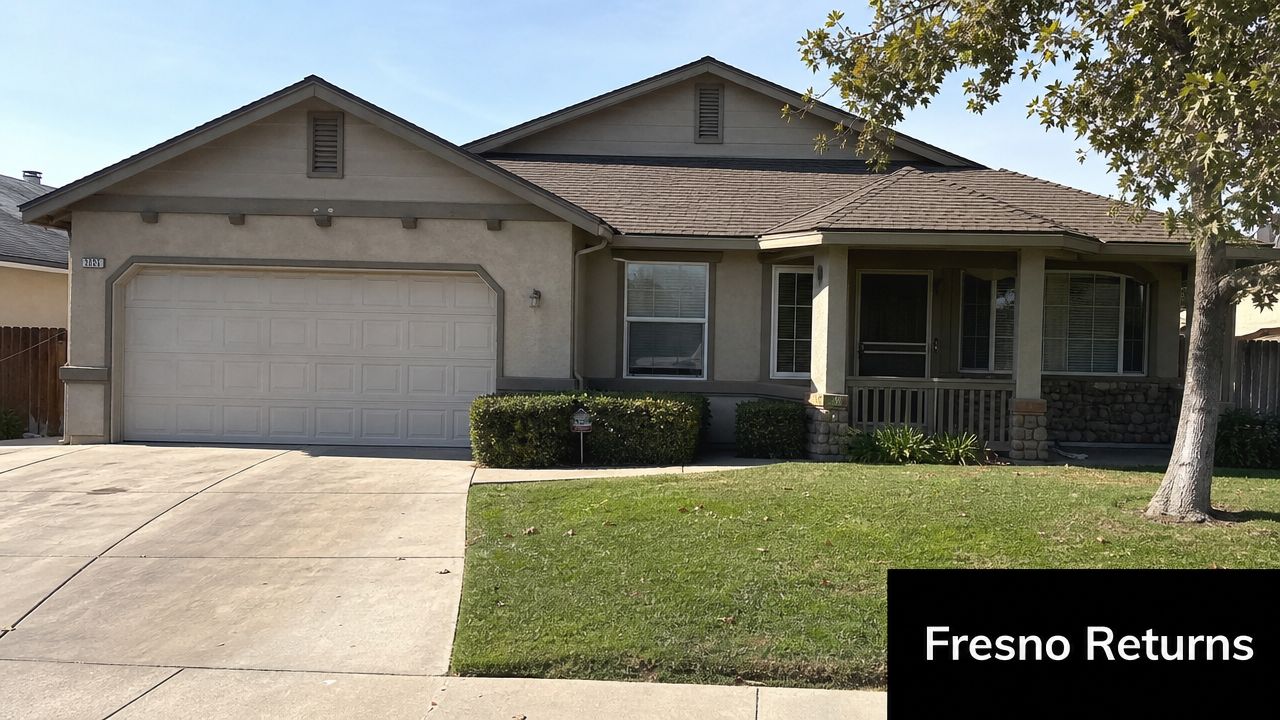
Assume you're reviewing a single-family rental in Fresno listed at $350,000. A common screening shortcut is the 1% rule, which says gross monthly rent should be at least 1% of the property's total purchase price. For a $350,000 Fresno home, that means targeting $3,500 per month, based on this explanation of the 1% rule.
That doesn't mean every good Fresno property will hit that mark. It does mean the rule gives you a quick first filter before you spend hours analyzing a deal.
Step one with rental yield
Start with gross rental yield.
Formula:
Gross Rental Yield = Annual Rent ÷ Purchase Price
Using the example:
- Monthly rent: $3,500
- Annual rent: $42,000
- Purchase price: $350,000
So the rough math is:
$42,000 ÷ $350,000
This gives you a quick sense of income relative to price before you consider expenses, vacancy, or financing.
Gross yield is useful because it's fast. But if you stop there, you'll miss the part that determines whether a property actually feels profitable to own.
Step two with net operating income
Now move to net operating income, often shortened to NOI.
Formula:
NOI = Total Rental Income − Operating Costs
Operating costs usually include items like:
- Property taxes
- Insurance
- Repairs and maintenance
- Leasing and turnover costs
- Management fees if you hire management
- Routine operating expenses tied to the property
NOI does not include mortgage payments. That's one of the most important points new investors mix up.
Key distinction: NOI tells you how the property performs as an asset. Mortgage payments tell you how your financing affects your personal cash flow.
If you want to test scenarios with your own assumptions, a rental property ROI calculator is useful because you can adjust rent, expenses, and financing instead of relying on guesswork.
Here's a short walkthrough that helps reinforce the formulas in a visual format:
Step three with cap rate and cash flow
Once you know NOI, you can calculate cap rate.
Formula:
Cap Rate = NOI ÷ Current Market Value
This helps you compare one property with another without the noise created by different loan structures. It's especially useful when you're comparing similar rentals in Fresno, Clovis, or nearby neighborhoods.
Then you can calculate cash-on-cash return.
Formula:
Cash-on-Cash Return = Annual Pre-Tax Cash Flow ÷ Total Cash Invested
Ownership becomes a personal matter. A property can have a reasonable cap rate but still produce disappointing cash-on-cash return if debt payments are high or if the property requires too much upfront cash.
Where Fresno investors often get tripped up
The confusion usually comes from mixing screening tools with decision tools.
Use this order instead:
- Start with rental yield to decide if the property deserves a closer look.
- Calculate NOI and cap rate to judge property-level performance.
- Add financing and cash invested to see what your actual return looks like.
That sequence keeps you from falling in love with gross rent while ignoring the costs that determine whether the deal works.
Uncovering Total Returns with ROI and IRR
A rental can feel underwhelming if you only look at the monthly spread between rent and expenses. That's where many investors stop too early.
Some returns don't arrive as spendable cash each month. They still matter.
ROI looks at the whole investment
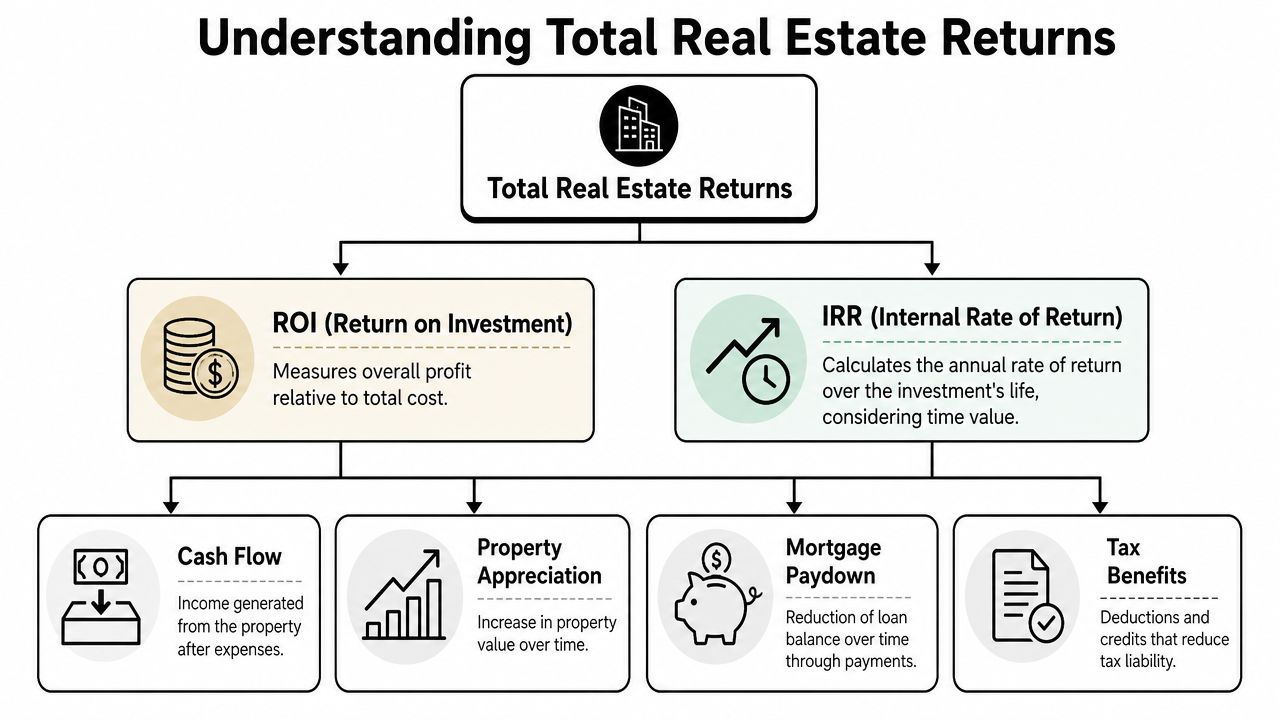
ROI asks a broader question than cash-on-cash return. It looks at total profit compared with total cost.
That broader view matters because owners benefit in several ways at once:
- Cash flow from operations
- Appreciation if the property becomes more valuable
- Mortgage paydown as the loan balance declines
- Tax benefits, including depreciation treatment where applicable
If you only look at the rent left over after bills, you'll miss part of the investment story.
Silent returns count even when you don't feel them monthly
Many investors overlook silent returns like debt paydown and depreciation. Cash-on-cash return might look low, but total return can be meaningfully higher, often reaching 6% to 7% in stable markets, once those non-cash benefits are considered, according to this discussion of the four returns in real estate.
That's a useful mental reset. A property doesn't have to shower you with monthly cash to be productive. Some of its value is building in the background.
A mortgage payment is partly an expense and partly a wealth-building transfer. The part that reduces principal doesn't vanish. It increases your equity.
Why IRR helps with longer holding periods
IRR becomes valuable when you're comparing deals over time. It accounts for when money goes out and when it comes back in. That makes it more useful for projects with multiple phases, financing changes, or a planned sale after several years.
The technical definition is straightforward even if the math looks intimidating: IRR is the rate that makes net present value equal zero over the life of the investment. In practice, most investors use software, a spreadsheet, or a calculator rather than doing it by hand.
If you're trying to estimate realistic rent before building an IRR model, a good rental property market analysis helps you avoid projecting income that the market won't support.
How management choices affect total return
Operations become investment strategy.
If a manager prices the unit well, shortens vacancy, screens carefully, coordinates repairs early, and keeps turnover under control, the effect ripples through every return measure. Better income improves NOI. Stable occupancy improves cash flow. Lower disruption can support stronger long-term ROI and a cleaner IRR profile.
That's why experienced investors don't treat property management as separate from return analysis. It's one of the inputs.
What Is a Good Real Estate Rate of Return
The honest answer is that a good real estate rate of return depends on what you want the property to do.
A retiree looking for reliable monthly income won't judge a deal the same way as a younger investor building equity over a long hold. One investor may reject a property with thin current cash flow. Another may accept it because the total return picture is stronger.
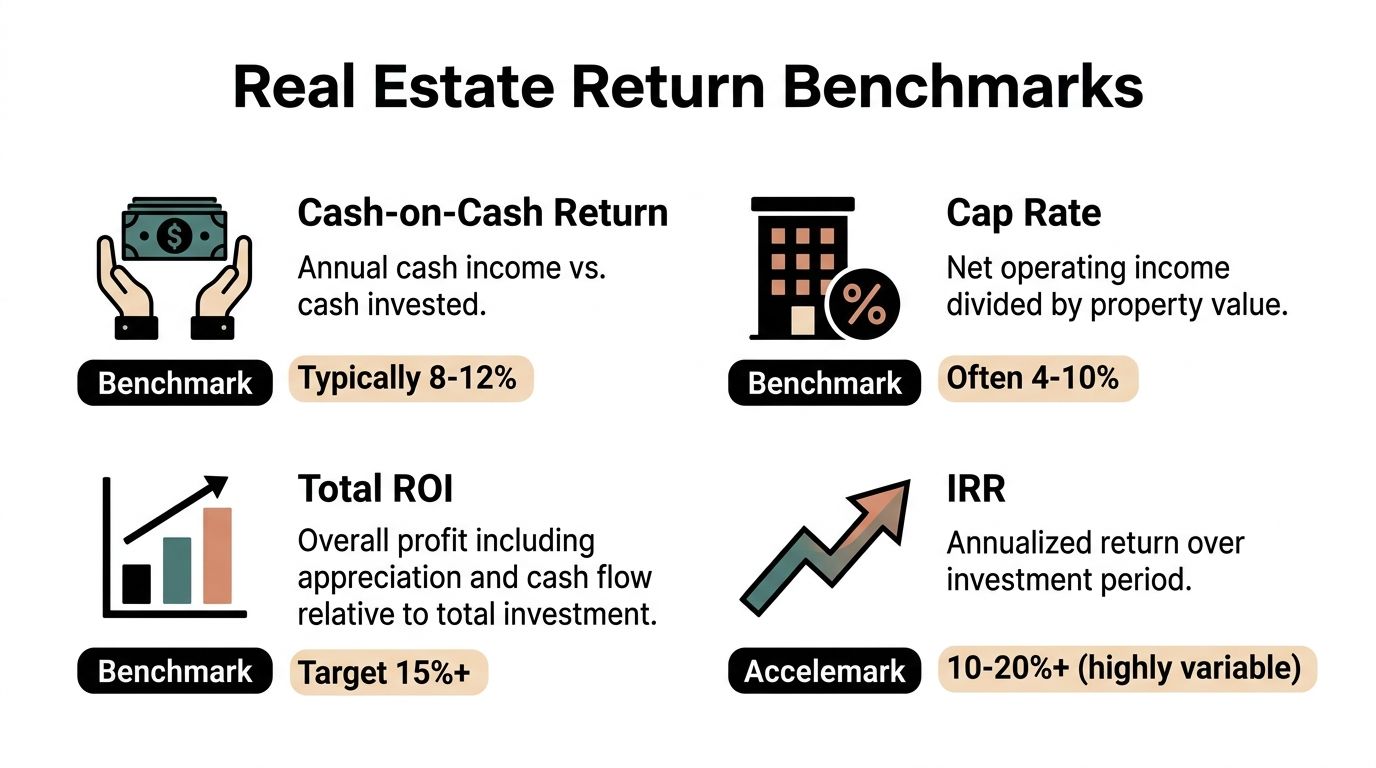
The infographic above shows common benchmark ranges investors often use in practice. Treat those as orientation tools, not guarantees. Local inventory, financing terms, property condition, and management quality can change what looks “good” very quickly.
Income matters more than many buyers assume
Long-run global data shows real estate returns average around +6% per year, with +5.5% coming from rental yield and only +0.4% from capital gains, based on this summary of global real estate returns over centuries.
That finding is important because it pushes investors toward the part of the business they can influence most directly: income. Rent collection, renewal strategy, maintenance response, vacancy control, and tenant communication all matter because rental income has historically done most of the heavy lifting.
A better way to judge your numbers
Instead of asking, “Is this cap rate good?” ask a set of narrower questions:
- Does this property meet my cash flow goal?
- Can I operate it without frequent surprises?
- Am I relying too much on appreciation to justify the deal?
- Would I still want this property if rents softened or repairs increased?
Those questions usually produce better decisions than hunting for a universal benchmark.
If the property only works under perfect conditions, the return isn't as strong as it looks.
Fresno context changes the answer
In Fresno, one investor may willingly accept a leaner initial return for a property in a neighborhood with steadier tenant demand and easier maintenance. Another may prefer a higher-yield property that requires more hands-on management.
That's why “good” is always part math, part fit. The numbers matter. So does the operational reality behind them.
Strategies to Improve Your Investment Returns
Returns don't rise by accident. Owners improve them by making better decisions around rent, expenses, leasing, renovation scope, and timing.
The biggest mistake is assuming return is fixed once you buy the property. It isn't. Your operating choices keep reshaping it.
Focus on the levers you can control
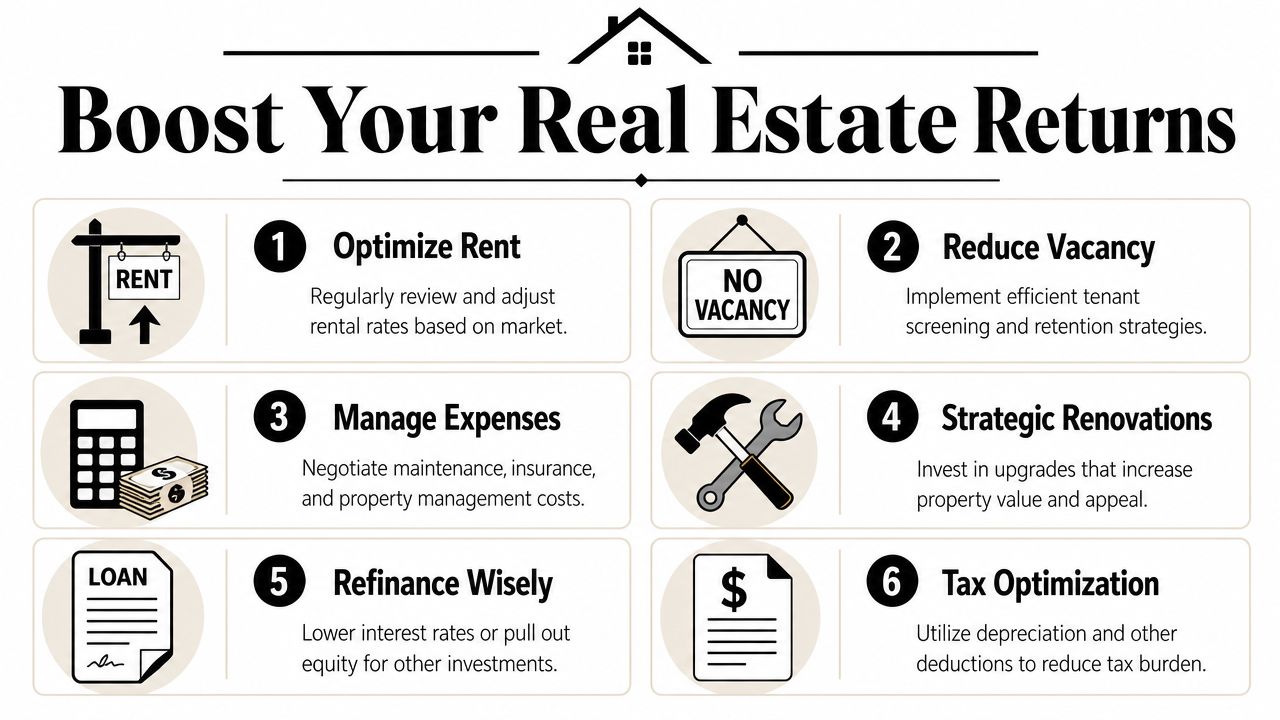
Some improvements are simple but powerful:
- Price rent carefully. If you set rent too high, vacancy can erase the gain. If you set it too low, you leave money on the table every month.
- Reduce turnover. Good screening, responsive communication, and timely renewals can protect income more effectively than constant re-leasing.
- Handle repairs early. Small maintenance issues become larger expenses when they sit too long.
- Choose renovations with rental logic. Durable flooring, clean kitchens, updated fixtures, and solid curb appeal often matter more to renters than luxury upgrades.
- Review financing when appropriate. Loan terms affect monthly cash flow and can change your cash-on-cash picture.
- Use tax planning intelligently. Tax treatment can affect the investment result even when it doesn't change rent collected.
Renovate for return, not for ego
A lot of owners overspend in the wrong places. They renovate for resale drama when they should renovate for rental durability.
A useful standard is whether the improvement helps with one of three things:
- Higher achievable rent
- Faster leasing
- Lower future maintenance
If a project doesn't support one of those outcomes, be careful.
For owners weighing specific upgrades, this guide to home renovation return on investment helps connect remodeling decisions to actual financial outcomes instead of guesswork.
Management is part of the return formula
Professional management can influence return by tightening the parts of ownership that leak money:
- Faster marketing when a property turns
- More consistent rent collection
- Better repair coordination
- Clearer owner reporting
- Stronger screening before lease signing
Edinhart Realty and Property Management is one Fresno-area option that offers full-service management and placement-only leasing, which can affect vacancy, operating consistency, and the quality of tenant placement depending on how involved an owner wants to be.
Operational discipline doesn't sound exciting. It's often where the return improves.
The Edinhart Advantage for Fresno Investors
Knowing how to calculate a real estate rate of return is one skill. Running the property in a way that protects that return is another.
For Fresno investors, the difference usually shows up in everyday execution. Accurate rental pricing helps avoid long vacancy stretches. Thorough screening helps reduce missed rent and prevent avoidable turnover. Timely repair coordination helps control costs before small issues become expensive ones. Clean accounting makes it easier to spot whether the property is improving year over year.
That's also why the strongest return isn't always attached to the flashiest property. It's often attached to the one that's marketed well, leased well, maintained consistently, and reviewed with discipline.
If you own in Fresno, Clovis, Friant, or nearby Central California communities, a management partner should help you improve the inputs behind the metrics discussed above. Better operations can support stronger NOI, steadier cash flow, and a more predictable total return profile over time.
If you want help evaluating your property's real estate rate of return or building a practical management plan around it, contact Edinhart Realty and Property Management to review your Fresno-area rental, pricing strategy, and next-step options.


